Candidasa Seismic Zone Building Codes Earthquake Insurance Bali
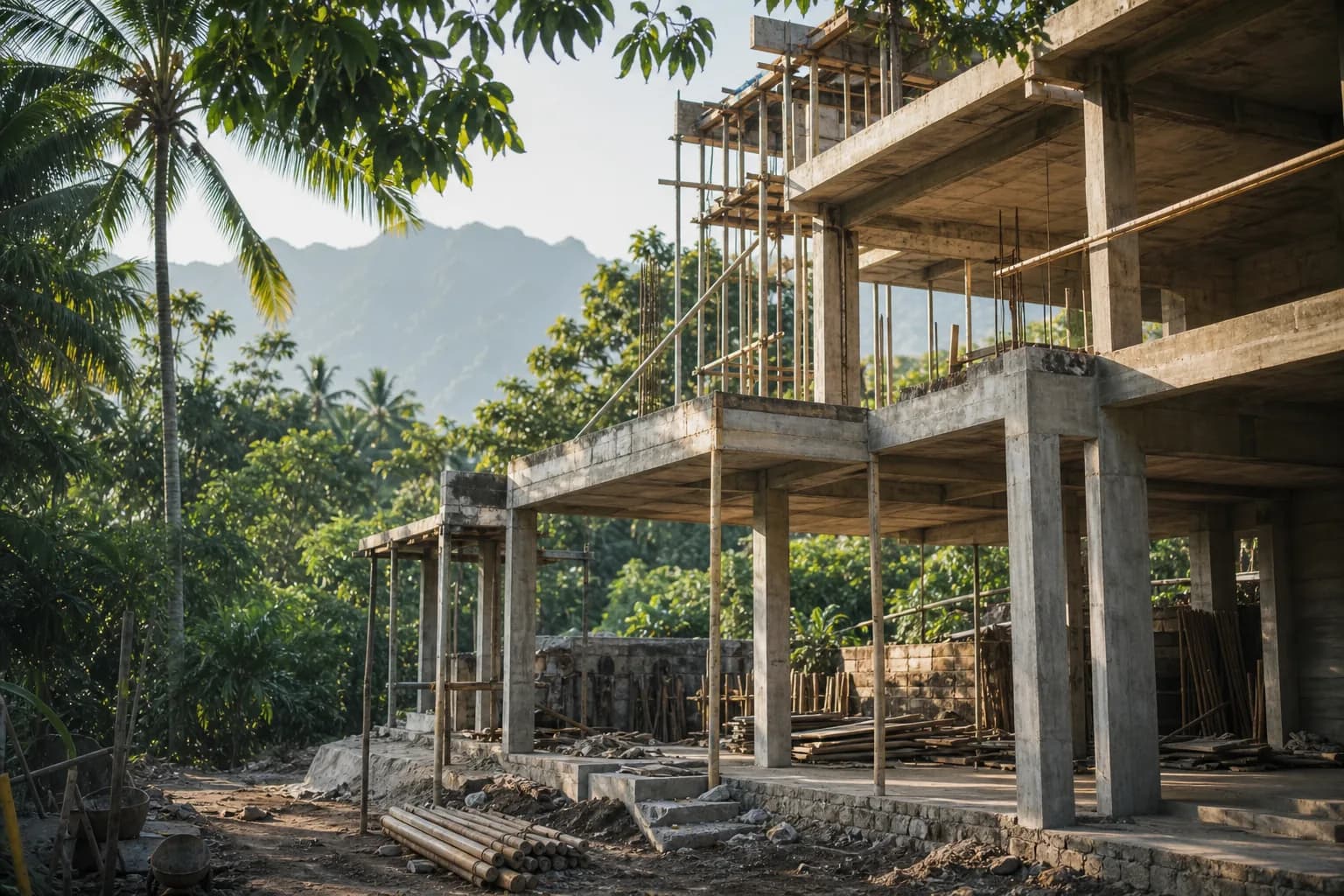
Why Candidasa’s Seismic Classification Changes Everything About Your Construction Budget and Insurance Strategy
Candidasa sits within a moderate-to-high seismic risk zone in East Bali, approximately 15 kilometers from the active volcanic arc and within documented fault line proximity. Unlike the more frequently discussed Canggu or Ubud construction markets, Candidasa’s specific seismic classification under Indonesia’s SNI 1726:2019 earthquake resistance standards triggers distinct structural engineering requirements that directly impact foundation design, material specifications, and long-term insurance availability. Foreign buyers purchasing land in this coastal corridor often discover—only after architectural plans are submitted—that their anticipated construction budget must increase by 18-27% to meet mandatory seismic reinforcement codes. Simultaneously, standard property insurance policies exclude earthquake coverage in this zone unless specific riders are purchased at premium rates that many brokers fail to disclose during land acquisition. This technical-legal gap between land purchase expectations and construction reality creates the single largest cost surprise for villa development projects in the Candidasa area, making seismic compliance and insurance strategy essential planning factors before any land consultation or design work begins.
Technical Deep Dive: Candidasa’s Seismic Zone Classification and Mandatory Structural Requirements
Indonesia’s National Standardization Agency (BSN) classifies seismic zones using peak ground acceleration (PGA) values, with Candidasa falling into Zone 4 classification under the 2019-updated SNI 1726 standard. This designation mandates specific structural design parameters that differ substantially from lower-risk areas in South Bali. The effective PGA for Candidasa ranges between 0.35-0.45g depending on precise location and soil classification, requiring engineers to design for lateral forces that can reach 45% of a structure’s dead load during seismic events.
The 2025 Bali IMB building permit updates specifically reference earthquake-resistant design protocols that apply enhanced scrutiny to projects in East Bali coastal zones. For Candidasa construction, this translates to mandatory requirements including: reinforced concrete frame systems with minimum column dimensions of 300x300mm (versus 250x250mm in lower-risk zones), continuous steel reinforcement with minimum #4 rebar at 150mm spacing in all load-bearing walls, foundation tie-beams connecting all isolated footings regardless of span distance, and shear wall placement calculated at minimum 0.8% of floor area per direction.
Soil conditions in Candidasa add complexity to these baseline requirements. The coastal strip features predominantly soft clay and loose sand formations classified as Site Class SE or SF under geotechnical standards, which amplify seismic waves and require additional foundation depth. Standard practice in this zone involves soil improvement through either stone column installation, deep pile foundations extending 8-12 meters to reach competent bearing strata, or ground improvement using cement-soil mixing techniques. Each approach carries distinct cost implications and construction timeline extensions.
The structural engineering calculations for seismic resistance in Candidasa must account for both horizontal ground motion and potential liquefaction risk in near-coastal parcels. This requires dynamic soil analysis—not just static bearing capacity tests—which adds 2-3 weeks to the pre-construction phase and costs between $2,800-$4,200 for comprehensive geotechnical investigation. Projects that skip this step face IMB permit rejection or, worse, approval based on inadequate data that leads to structural failure during moderate seismic events.
Material specifications also escalate under Candidasa’s seismic requirements. Concrete must meet minimum K-300 compressive strength (approximately 25 MPa) with strict aggregate grading and water-cement ratio controls to ensure ductility during ground motion. Steel reinforcement must be deformed bars meeting SNI 2052 standards with verified yield strength of 400 MPa minimum. Connection details between structural elements require special moment-resisting frame designs with confined concrete cores and transverse reinforcement spacing that prevents brittle failure modes.
The 2025 earthquake-resistant design guidelines published by Indonesia’s Ministry of Public Works specifically address tropical coastal construction, mandating corrosion protection measures that compound seismic requirements. In Candidasa’s salt-air environment, this means epoxy-coated rebar or increased concrete cover (50mm minimum versus 40mm standard), stainless steel connectors for critical joints, and waterproofing systems that maintain structural integrity during both seismic events and monsoon exposure. These combined requirements create a technical specification matrix that differs substantially from standard Bali villa construction protocols used in less seismically active regions.
Hidden Risks: What Foreign Buyers Miss About Seismic Compliance and Insurance Gaps
The most dangerous assumption in Candidasa construction projects is that standard Indonesian building insurance provides earthquake coverage. It does not. Baseline property insurance policies (PSAKI – Polis Standar Asuransi Kebakaran Indonesia) explicitly exclude earthquake, tsunami, and volcanic eruption damage unless specific endorsements are purchased. Many foreign buyers discover this exclusion only after construction completion when attempting to secure financing or during due diligence for eventual resale.
Earthquake insurance in Candidasa operates through a separate risk pool with premiums calculated based on construction value, structural type, and precise seismic zone classification. For a $450,000 villa in Candidasa’s Zone 4 classification, annual earthquake insurance premiums typically range from $2,700-$4,500 (0.6-1.0% of insured value), compared to $900-$1,350 for the same property in lower-risk Canggu. This 3x premium differential represents a permanent operational cost that impacts long-term ownership economics but rarely appears in initial feasibility calculations.
More problematic is coverage availability. International insurers often decline earthquake coverage for properties in Candidasa’s seismic zone unless construction documentation proves compliance with current SNI standards. This creates a documentation chain requirement: structural engineering calculations stamped by a licensed Indonesian engineer (SIPIL), IMB permit showing seismic compliance approval, construction supervision reports documenting that as-built conditions match approved plans, and material test certificates for concrete and steel. Projects that cut corners during construction—using non-certified contractors or substituting materials—find themselves uninsurable regardless of premium willingness.
The insurance-compliance gap becomes acute for leasehold properties. Many lease agreements place earthquake insurance responsibility on the leaseholder, but Indonesian insurance companies require proof of legal interest in the structure. For leasehold villas, this necessitates specific policy structures (typically “Lessee’s Interest” endorsements) that cost 15-25% more than standard coverage and require the landowner’s cooperation for claims processing. Foreign buyers who fail to address this during lease negotiation often discover they cannot obtain adequate coverage at any price.
Step-by-Step Process: Implementing Seismic Compliance and Insurance Strategy for Candidasa Projects
Phase 1: Pre-Purchase Seismic Assessment (2-3 weeks before land commitment)
Before finalizing any land purchase in Candidasa, commission a preliminary seismic risk assessment that includes: review of the parcel’s specific PGA classification using the latest hazard maps, identification of proximity to known fault lines (the Flores Thrust system runs offshore), soil classification based on available geological surveys, and preliminary foundation strategy recommendations. This assessment costs $800-$1,400 but prevents purchasing parcels with extreme foundation requirements that make construction economically unfeasible. Request this analysis during initial land consultation to understand true development costs before price negotiation.
Phase 2: Geotechnical Investigation and Soil Dynamics Testing (3-4 weeks)
Once land is secured, conduct comprehensive geotechnical investigation including Standard Penetration Tests (SPT) at minimum three locations across the site, soil classification to determine Site Class per SNI 1726, groundwater level measurement, and—critically for Candidasa—liquefaction potential analysis for parcels within 500 meters of coastline. The investigation report must be stamped by a licensed geotechnical engineer and will form the basis for foundation design. Budget $3,200-$5,500 depending on site size and number of bore holes required. This document is mandatory for IMB permit applications in seismic zones and cannot be substituted with generic soil reports.
Phase 3: Structural Engineering Design with Seismic Calculations (4-6 weeks)
Engage a structural engineer licensed in Indonesia (holding SIPIL certification) to develop seismic-compliant structural plans. This process involves: dynamic structural analysis using response spectrum methods, design of moment-resisting frames or shear wall systems meeting SNI 1726 drift limits, connection detailing for ductile behavior, and foundation design integrated with geotechnical recommendations. The engineer must produce calculation packages that demonstrate compliance with both seismic codes and tropical durability requirements. Engineering fees for Candidasa projects typically run $8,500-$14,000 for a 250-350 sqm villa, approximately 40% higher than non-seismic design work. These stamped calculations are required for IMB approval and later insurance underwriting.
Phase 4: IMB Permit Application with Seismic Documentation (6-10 weeks)
Submit building permit applications to Karangasem Regency authorities with complete seismic compliance documentation including: architectural plans, structural engineering calculations with seismic analysis, geotechnical investigation report, and environmental compliance documents. The review process in Candidasa takes longer than South Bali due to additional technical scrutiny of seismic designs. Permit costs include standard IMB fees plus technical review charges for seismic calculations, totaling approximately $3,500-$6,000 depending on construction value. Do not commence construction before receiving approved permits—insurance companies will deny claims for unpermitted structures regardless of actual code compliance.
Phase 5: Insurance Procurement Before Construction Starts
Secure both construction-phase and permanent property insurance before breaking ground. Construction All Risk (CAR) insurance for Candidasa projects should include earthquake coverage during the build phase, costing approximately 0.8-1.2% of construction value. Simultaneously, negotiate permanent property insurance with earthquake endorsement, locking in rates based on approved plans rather than waiting until completion when any construction deviations may increase premiums or trigger coverage exclusions. Work with insurance brokers experienced in seismic zone properties who can structure policies that cover both the building and—for leasehold—the leaseholder’s interest in improvements.
Phase 6: Construction Supervision and Documentation (6-12 months)
Implement rigorous construction supervision focusing on seismic-critical elements: foundation concrete placement with proper rebar positioning, column-beam connections with adequate confinement reinforcement, shear wall construction with continuous vertical steel, and material testing for concrete strength and steel properties. Maintain photographic documentation of all concealed structural elements before concrete placement—insurance underwriters may request this evidence during policy issuance. Engage the structural engineer for periodic site inspections (minimum monthly) with written reports confirming compliance with approved designs. This supervision adds $4,500-$7,500 to project costs but is essential for insurance validity and long-term structural performance.
Realistic Cost Implications: Seismic Compliance Budget for Candidasa Construction
The seismic compliance premium for Candidasa villa construction typically adds 18-27% to baseline building costs compared to identical designs in non-seismic zones. For a 300 sqm two-bedroom villa with pool, this translates to specific cost increments:
- Enhanced foundation systems: $18,000-$28,000 additional for deep pile foundations or ground improvement versus standard shallow footings
- Structural reinforcement: $12,000-$19,000 extra for increased rebar quantities, larger columns, and seismic connection details
- Engineering and compliance: $12,000-$19,500 for geotechnical investigation, seismic structural design, and construction supervision
- Higher-grade materials: $8,000-$13,000 for K-300 concrete, certified deformed rebar, and corrosion protection systems
- Extended timeline costs: $5,000-$9,000 in additional site overhead and supervision for the 6-8 week timeline extension that seismic compliance typically requires
Total seismic compliance cost increment: $55,000-$88,500 for a typical villa project, representing 19-24% of a $290,000-$370,000 base construction budget. These figures assume competent soil conditions; parcels requiring extensive ground improvement can see increments reaching 30-35%.
Insurance costs add permanent operational expenses. For a $450,000 completed villa in Candidasa, expect annual premiums of: $1,800-$2,700 for standard property insurance (fire, theft, liability) plus $2,700-$4,500 for earthquake coverage endorsement, totaling $4,500-$7,200 annually. Over a 25-year leasehold period, this represents $112,500-$180,000 in cumulative insurance costs that must be factored into ownership economics. Compare this to $75,000-$105,000 for the same property in lower-risk zones—a $37,500-$75,000 differential over the lease term.
Frequently Asked Questions: Candidasa Seismic Construction and Insurance
Does Candidasa’s seismic zone clas 3180 m²7 month(s)from 142.000 USD
Vasudeva
 2144 m²11 month(s)from 104.000 USD
Narayana
 164 m²7 month(s)from 79.000 USD
Private: Haridas Villas, Tegallalang
 4344 m²16 month(s)from 290.000 USD
Radha
164 m²7 month(s)from 79.000 USDTALA TWO

Want to calculate?
 172 m²8 month(s)from 120.000 USD
Keshava
 3104 m²11 month(s)from 99.000 USD
TALA 100
 3173 m²6 month(s)from 125.000 USD
TALA FOUR
 3127 m²9 month(s)from 177.000 USD
Mukunda
 1from 198.000 USD
Private: Haridas Villas
 3124 m²6 month(s)from 123.000 USD
TALA 8
Start With Real Numbers, Not Guesses
Before buying land or finalizing a design, check the realistic build cost range for your project in Bali.
Our team reviews your inputs and gives a grounded estimate.
Available lands
 750 m²15 min$ 187038Bali, Kerobokan
 5028 m²10 min$ 361000Bali, Ubud
 2800 m²15 min$ 310345Bali, Tabanan
 1000 m²10 min$ 384852Bali, Canggu
 2130 m²10 min$ 495776Bali, Pecatu
 1720 m²2 min$ 241478Bali, Tabanan
 1600 m²32 min$ 266010Bali, Tabanan
 1000 m²8 min$ 134544Bali, Bukit
 3900 m²10 min$ 432266Bali, Tabanan
 700 m²7 min$ 400000Bali, Canggu
 800 m²5 min$ 295567Bali, Seseh
 1410 m²15 min$ 390702Bali, Tabanan
 550 m²15 min$ 164594Bali, Mengwi
 3254 m²5 min$ 631800Bali, All
 2000 m²15 min$ 110837Bali, Karangasem
Essential Bali build & buy guides
- Bali villa construction cost per m² in 2026
- How much will your villa cost? Calculator
- Building a villa in Bali: the complete guide
- Buying land in Bali: step-by-step for foreigners
- Bali villa investment: yields, risks, returns
- Leasehold vs freehold: what foreigners can own
- Construction defect liability & 10-year warranty
- Bali building codes and construction standards
Related guides

Why a Cheap Bali Leasehold Is Cheap: Pricing Red Flags Every Buyer Should Decode
Suspiciously cheap Bali leaseholds are priced low for a reason: short remaining terms, forbidden zoning, missing road access, disputes or weak contracts. How to decode the discount before you pay for it.
8 min read
Fake Compliance and Licensing Agents in Bali: The 2026 Paperwork Scam and How to Verify Documents
Forged certificates, permit fixers and fake notaries: how Bali's paperwork scams work in 2026 and how to verify every property document at its government source.
7 min read
Buying a Bali Villa from Instagram: Phantom Listings, Render-Only Projects and How to Verify
Instagram is Bali's biggest property shop window and its least verified. How phantom listings, render-only projects and cloned developer accounts work — and the verification steps that expose them.
7 min read