Bukit Peninsula Soil Subsidence Testing Insurance Costs Bali
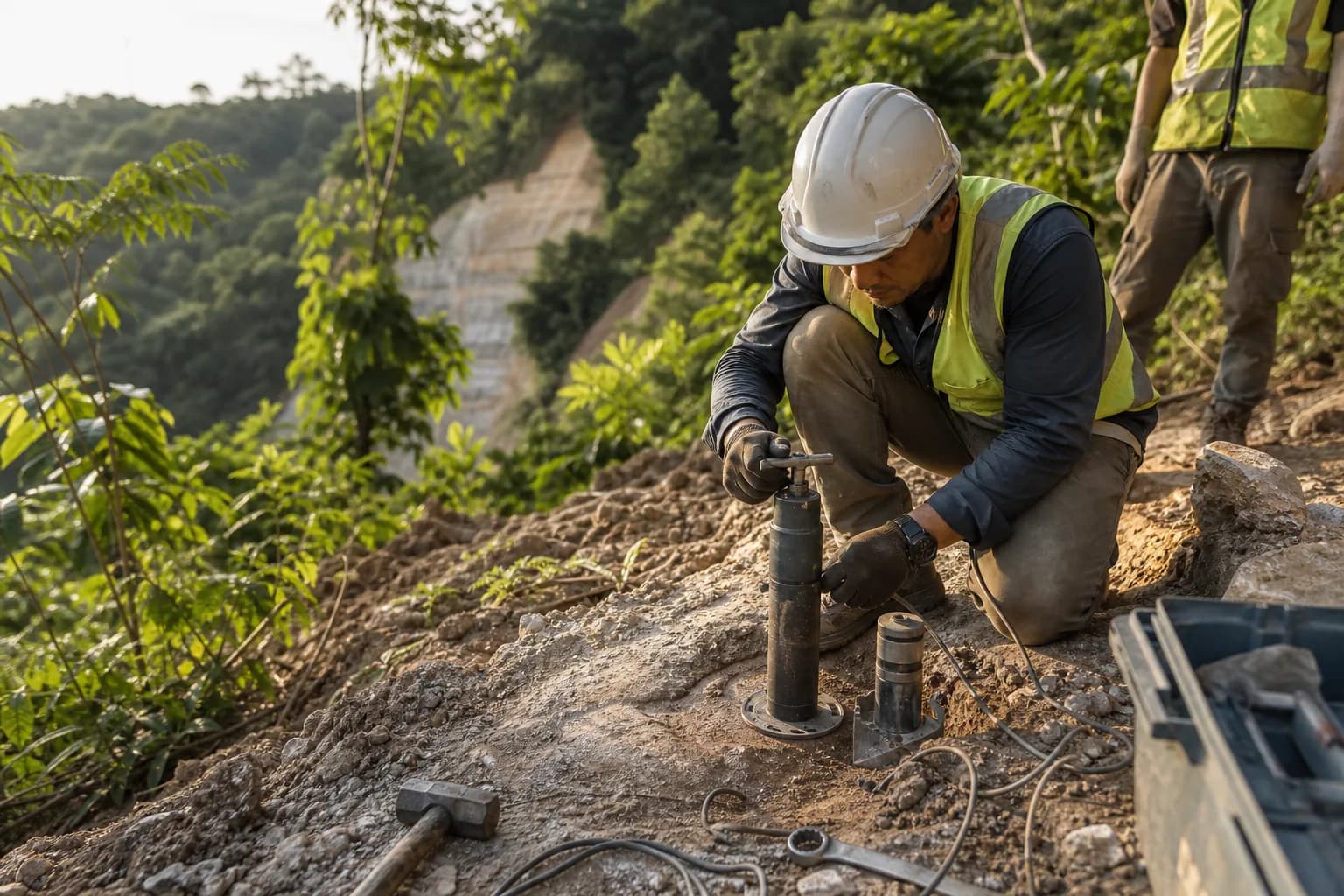
Why Bukit Peninsula Limestone Foundations Require Specialized Subsidence Testing Before Construction
The Bukit Peninsula’s distinctive geological profile—characterized by porous limestone bedrock, underground cavities, and seasonal water table fluctuations—creates subsidence risks that standard soil testing protocols often fail to detect. Property buyers investing IDR 3-8 billion in villa construction face a critical question: how do you quantify subsidence risk before breaking ground, and what insurance mechanisms protect against catastrophic foundation failure on limestone terrain? Unlike Bali’s volcanic soil regions in Canggu or Ubud, Bukit’s karst topography demands geotechnical investigations that map underground voids, measure load-bearing capacity at multiple depths, and model long-term settlement patterns under tropical rainfall cycles.
Geotechnical Engineering Requirements for Bukit Peninsula Limestone Substrates
Bukit Peninsula’s geological formation consists primarily of Miocene-era coral limestone with porosity rates reaching 30-45%, creating subsurface conditions fundamentally different from Bali’s volcanic ash soils. This karst landscape features solution cavities, fracture networks, and unpredictable bedrock depth variations—sometimes shifting from 2 meters to 15 meters within a single 500-square-meter plot. Standard building permits Bali processes require soil testing, but generic SPT (Standard Penetration Test) reports often miss the critical subsidence indicators specific to limestone foundations.
Comprehensive subsidence risk assessment for Bukit construction sites requires a three-phase geotechnical investigation protocol. Phase one involves desktop geological surveys analyzing historical subsidence incidents within 500-meter radius, reviewing regional karst mapping data, and identifying known cavity zones from previous construction projects. Uluwatu, Pecatu, and Ungasan areas show documented subsidence events where villas experienced 8-15cm differential settlement within 18 months of completion—structural damage that standard construction insurance policies explicitly exclude without proper pre-construction testing documentation.
Phase two deploys rotary core drilling to minimum 15-meter depth at 4-6 locations per standard villa plot, extracting intact limestone samples for laboratory analysis. Unlike percussion drilling methods that pulverize rock samples, rotary coring preserves cavity evidence and fracture patterns. Laboratory testing measures unconfined compressive strength (target: minimum 5 MPa for residential foundations), porosity percentages, and water absorption rates under simulated monsoon saturation. Bukit limestone typically shows compressive strength ranging 3-12 MPa—the lower range requiring engineered foundation solutions like micro-piling or ground improvement grouting.
Phase three conducts geophysical surveys using Ground Penetrating Radar (GPR) or Electrical Resistivity Tomography (ERT) to map subsurface anomalies between borehole locations. These non-invasive methods detect hidden cavities, water-filled voids, and weak zones that drilling might miss. A 2024 case study from a Pecatu villa project revealed a 4-meter cavity located 7 meters below proposed pool excavation—discovered only through GPR survey after initial soil boring showed “acceptable” results. The cavity required 18 cubic meters of controlled grout injection, adding IDR 145 million to foundation costs but preventing potential catastrophic pool deck collapse.
Engineering analysis must model differential settlement scenarios under combined dead loads (structure weight) and live loads (occupancy, furniture, water features). Bukit’s limestone exhibits time-dependent consolidation behavior different from volcanic soils—settlement often accelerates during second and third rainy seasons as groundwater dissolves calcium carbonate bonds. Geotechnical reports should specify maximum allowable differential settlement (typically 1:500 slope for residential structures) and recommend foundation systems that accommodate or prevent predicted movement patterns.
For tropical construction engineering on limestone, foundation solutions range from conventional spread footings on competent bedrock (requiring cavity-free verification) to deep foundation systems. Micro-piles driven to 12-18 meter depths through weak limestone into competent strata provide reliable load transfer but add IDR 850-1,200 per linear centimeter to foundation costs. Ground improvement techniques like compaction grouting or void filling with controlled low-strength material (CLSM) address specific cavity zones, with costs varying IDR 2.8-4.5 million per cubic meter depending on void volume and access constraints.
Insurance Coverage Gaps and Liability Exposure in Limestone Construction Zones
Standard Construction All Risk (CAR) insurance policies available in Bali typically exclude subsidence-related damage unless specific geological endorsements are purchased and pre-construction testing documentation is provided. The critical liability gap emerges between construction phase coverage and long-term structural warranty periods. Most CAR policies terminate at practical completion, while subsidence symptoms often manifest 12-36 months post-construction as seasonal groundwater cycles stress foundation systems.
Buyers commissioning Bali villa construction on Bukit Peninsula face three distinct insurance cost categories. First, construction phase CAR insurance with geological hazard endorsements typically costs 0.8-1.4% of total construction value for projects with comprehensive geotechnical reports demonstrating acceptable subsidence risk. A IDR 5 billion villa project would incur IDR 40-70 million in enhanced CAR premiums. Policies without geological endorsements cost 0.4-0.6% but explicitly exclude subsidence, cavity collapse, and differential settlement claims—creating false economy that exposes buyers to uninsured foundation repair costs potentially exceeding IDR 500 million.
Second, professional indemnity insurance for geotechnical consultants and structural engineers provides recourse if subsidence occurs due to inadequate investigation or design errors. Reputable firms carry PI coverage with minimum IDR 10 billion limits, but policy effectiveness depends on documented testing protocols and clear engineering recommendations. Buyers should verify consultant insurance certificates and confirm coverage extends to latent defect periods of 5-10 years beyond construction completion.
Third, long-term structural defect insurance—uncommon in Indonesian construction but increasingly requested by international buyers—covers major structural failures including subsidence-induced damage for 10-year periods post-completion. Annual premiums range IDR 15-28 million for typical villa projects, but underwriters require comprehensive geotechnical documentation, engineered foundation systems, and independent inspection protocols during construction. This insurance category remains underdeveloped in Bali’s market, with only 2-3 international underwriters offering products through specialized brokers.
Critical Oversights in Bukit Peninsula Pre-Construction Due Diligence
The most dangerous assumption buyers make is treating all Bukit locations as geologically equivalent. Subsidence risk varies dramatically across micro-zones—a plot in Bingin’s clifftop area faces entirely different conditions than inland Pecatu locations 2 kilometers away. Buyers often accept generic soil reports that test only 3-meter depths or rely on neighboring property data without site-specific investigation. Limestone cavity patterns show no surface indicators; adjacent plots can have drastically different subsurface conditions.
Many developers commission minimal soil testing to satisfy permit requirements but fail to conduct subsidence-specific analysis. Standard SPT reports measure soil density and bearing capacity but don’t map cavities, assess dissolution risk, or model long-term settlement. A compliant soil report for permit purposes may cost IDR 8-12 million, while comprehensive subsidence risk assessment requires IDR 45-85 million investment—a cost differential that tempts shortcuts with catastrophic long-term consequences.
Insurance procurement timing creates another critical gap. Buyers often address insurance after construction commences, discovering that geological endorsements require pre-construction testing documentation. Retroactive coverage for subsidence risk is either unavailable or prohibitively expensive, leaving projects exposed throughout construction phases when excavation and loading trigger subsidence events.
The liability chain in Indonesian construction law places ultimate responsibility on property owners, not contractors, for foundation adequacy unless explicit contractual warranties specify subsidence protection. Standard construction contracts reference soil reports as “owner-provided information,” limiting contractor liability for foundation failures caused by unforeseen geological conditions. Without proper testing and insurance, buyers absorb 100% of subsidence remediation costs.
Implementing Comprehensive Subsidence Risk Management Protocol
Effective subsidence risk management for Bukit Peninsula construction begins during land purchase Bali due diligence, not after acquisition. Step one involves engaging licensed geotechnical consultants (minimum HAKI certification for Indonesian firms, or international firms with Indonesian project experience) to conduct preliminary geological desktop studies before finalizing land transactions. This 2-3 week assessment costs IDR 15-25 million but identifies red-flag conditions that may warrant price renegotiation or purchase cancellation.
Step two commences immediately after land acquisition with comprehensive site investigation including minimum 4 rotary core boreholes to 15-meter depth, laboratory testing of extracted samples, and geophysical surveys covering 100% of proposed building footprint plus 5-meter perimeter buffer. Investigation scope should explicitly include subsidence risk assessment, cavity mapping, and long-term settlement modeling. This phase requires 4-6 weeks and costs IDR 65-95 million for typical 500-800 square meter villa plots, with pricing increasing for larger sites or complex topography.
Step three translates geotechnical findings into engineered foundation design with specific subsidence mitigation measures. Structural engineers must design foundation systems that either eliminate subsidence risk (deep foundations bypassing weak zones) or accommodate predicted settlement within acceptable limits (flexible foundation systems with articulated connections). Design documentation should specify construction tolerances, inspection protocols, and performance criteria that become contractual requirements for builders.
Step four involves insurance procurement before construction commencement. Buyers should engage insurance brokers specializing in construction risks (not general property insurance agents) to structure CAR policies with geological hazard endorsements, professional indemnity verification for consultants, and long-term structural defect coverage if available. Insurance applications require submission of complete geotechnical reports and engineered foundation drawings—documentation that must be prepared before policy binding.
Step five implements construction phase monitoring with independent geotechnical observation during critical foundation activities. Observers verify actual subsurface conditions match investigation predictions, confirm cavity treatment procedures, and document foundation construction compliance with engineered specifications. This monitoring costs IDR 8-15 million monthly but provides essential documentation for insurance claims and future liability protection. Many subsidence insurance claims fail due to inadequate construction documentation proving proper implementation of engineered solutions.
Step six establishes post-construction monitoring for 24-36 months using survey benchmarks to measure actual settlement patterns. Quarterly elevation surveys of foundation reference points cost IDR 4-6 million per survey but provide early warning of excessive settlement before structural damage occurs. This data also supports insurance claims and validates foundation system performance for future property transactions.
Realistic Cost Structures and Timeline Requirements
Comprehensive subsidence risk management for Bukit Peninsula villa construction adds IDR 180-320 million to total project costs for typical 300-500 square meter villas, representing 3.6-6.4% of IDR 5 billion total construction budgets. This investment breaks down into geotechnical investigation (IDR 65-95 million), enhanced foundation systems (IDR 75-160 million depending on conditions), insurance premiums (IDR 25-45 million), and monitoring services (IDR 15-20 million).
Timeline implications add 8-12 weeks to pre-construction phases. Geotechnical investigation requires 4-6 weeks from mobilization to final report delivery, with laboratory testing representing the critical path. Foundation engineering design adds 2-3 weeks, and insurance procurement requires 1-2 weeks after documentation submission. Projects attempting to compress these timelines through parallel processing or abbreviated testing protocols consistently encounter problems during construction when actual conditions don’t match assumptions.
Foundation cost variations depend heavily on subsurface conditions discovered during investigation. Best-case scenarios with competent limestone at shallow depth (2-4 meters) and no significant cavities allow conventional spread footing foundations at standard costs. Moderate-risk sites requiring selective cavity grouting add IDR 45-85 million. High-risk locations necessitating micro-pile foundations increase costs by IDR 120-180 million for typical villa footprints. These ranges assume 300-400 square meter building footprints with standard two-story configurations.
Insurance premium calculations use construction value as base, with geological endorsement surcharges adding 0.4-0.8 percentage points to standard CAR rates. A IDR 5 billion project with comprehensive geotechnical documentation might pay IDR 40 million for CAR with subsidence coverage versus IDR 25 million for basic CAR excluding geological risks—a IDR 15 million premium that protects against potential IDR 500+ million uninsured loss exposure.
Frequently Asked Questions: Bukit Subsidence Testing and Insurance
How does Bukit Penin 172 m²8 month(s)from 120.000 USD
Keshava
 1from 198.000 USD
Private: Haridas Villas
 4344 m²16 month(s)from 290.000 USD
Radha

Want to calculate?
 3180 m²7 month(s)from 142.000 USD
Vasudeva
 2144 m²11 month(s)from 104.000 USD
Narayana
 164 m²7 month(s)from 79.000 USD
TALA TWO
164 m²7 month(s)from 79.000 USDPrivate: Haridas Villas, Tegallalang
 3173 m²6 month(s)from 125.000 USD
TALA FOUR
 3124 m²6 month(s)from 123.000 USD
TALA 8
 3127 m²9 month(s)from 177.000 USD
Mukunda
 3104 m²11 month(s)from 99.000 USD
TALA 100
Start With Real Numbers, Not Guesses
Before buying land or finalizing a design, check the realistic build cost range for your project in Bali.
Our team reviews your inputs and gives a grounded estimate.
Available lands
 800 m²10 min$ 307882Bali, Tibubeneng
 300 m²55 min$ 32475Bali, Tegelalang
 1000 m²10 min$ 384852Bali, Canggu
 700 m²20 min$ 90517Bali, Cepaka
 585 m²8 min$ 165702Bali, Mengwi
 1600 m²32 min$ 266010Bali, Tabanan
 2000 m²10 min$ 243842Bali, Mengwi
 1533 m²5 min$ 165666Bali, Cepaka
 260 m²5 min$ 51872Bali, Kedungu
 2800 m²2 min$ 713793Bali, Kedungu
 911 m²15 min$ 248217Bali, Pererenan
 250 m²15 min$ 40025Bali, Munggu
 3100 m²20 min$ 272968Bali, Tabanan
 2000 m²15 min$ 523000Bali, Canggu
 3000 m²15 min$ 738916Bali, Cepaka
Essential Bali build & buy guides
- Bali villa construction cost per m² in 2026
- How much will your villa cost? Calculator
- Building a villa in Bali: the complete guide
- Buying land in Bali: step-by-step for foreigners
- Bali villa investment: yields, risks, returns
- Leasehold vs freehold: what foreigners can own
- Construction defect liability & 10-year warranty
- Bali building codes and construction standards
Related guides

Why a Cheap Bali Leasehold Is Cheap: Pricing Red Flags Every Buyer Should Decode
Suspiciously cheap Bali leaseholds are priced low for a reason: short remaining terms, forbidden zoning, missing road access, disputes or weak contracts. How to decode the discount before you pay for it.
8 min read
Fake Compliance and Licensing Agents in Bali: The 2026 Paperwork Scam and How to Verify Documents
Forged certificates, permit fixers and fake notaries: how Bali's paperwork scams work in 2026 and how to verify every property document at its government source.
7 min read
Buying a Bali Villa from Instagram: Phantom Listings, Render-Only Projects and How to Verify
Instagram is Bali's biggest property shop window and its least verified. How phantom listings, render-only projects and cloned developer accounts work — and the verification steps that expose them.
7 min read