Bali Construction Insurance Claims Defect Liability Guide
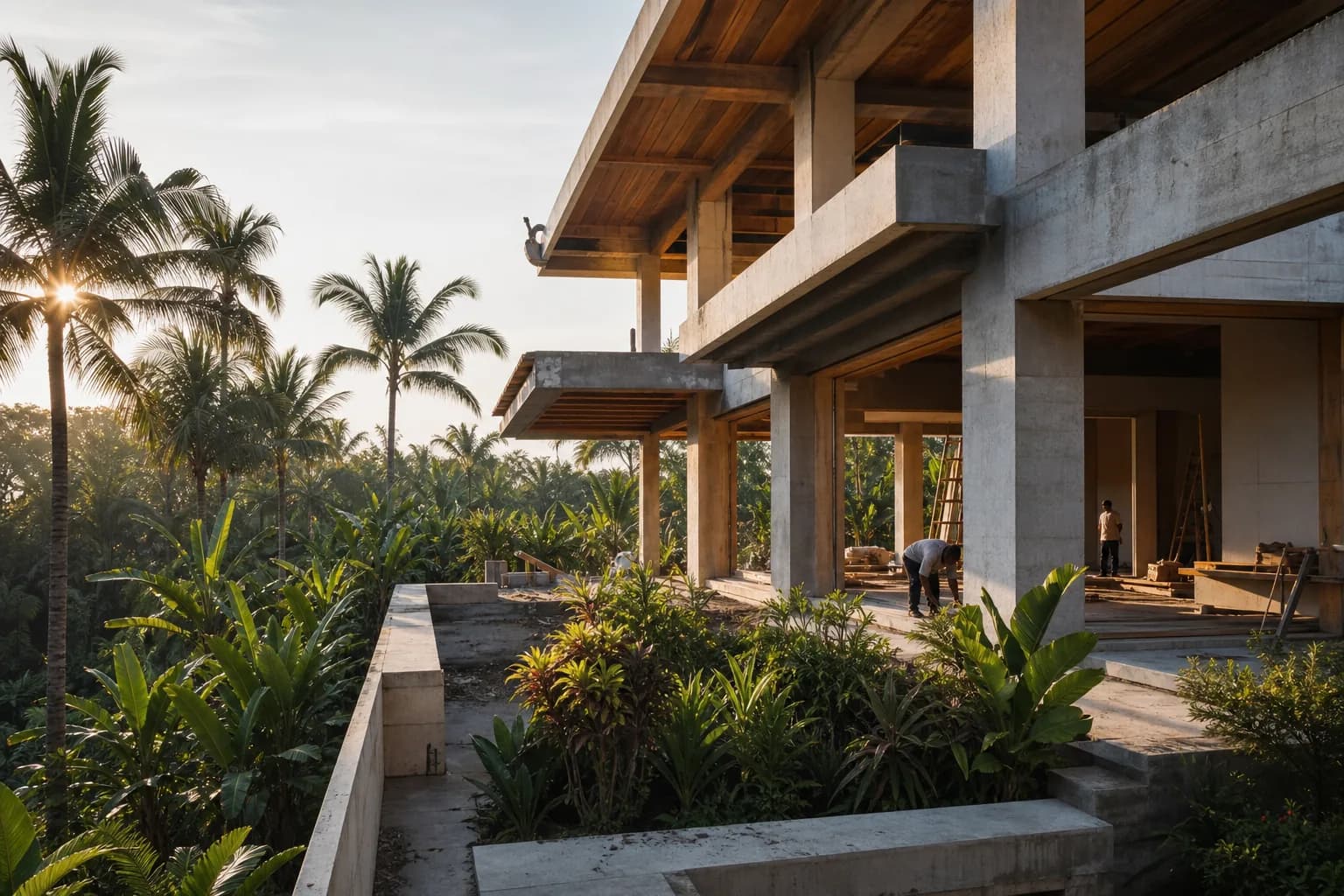
{
“article”: {
“title”: “Bali Construction Insurance Claims: Defect Liability Period Guide”,
“content”: “
The Critical Gap Between Villa Completion and Long-Term Structural Integrity
\n\n
When your newly completed Bali villa develops roof leaks during the first monsoon season or wall cracks appear six months after handover, understanding the defect liability period becomes your primary financial protection mechanism. In Bali’s construction landscape, the defect liability period—typically ranging from 6 to 24 months depending on project complexity—represents the contractual window during which contractors remain legally obligated to rectify construction defects at no additional cost. However, most foreign property owners discover too late that Indonesian construction contracts often lack clear defect classification systems, dispute resolution protocols, and insurance claim procedures that align with international standards, leaving them financially exposed when structural issues emerge after the initial euphoria of project completion fades.
\n\n
Technical Framework: How Defect Liability Periods Function in Indonesian Construction Law
\n\n
The defect liability period in Bali construction projects operates within a complex intersection of Indonesian Civil Code provisions, construction contract law, and industry-standard practices that differ substantially from Western construction frameworks. Under Indonesian law, contractors bear responsibility for latent defects—structural issues not immediately visible during handover inspections—for periods extending well beyond project completion, but the enforceability depends entirely on contract documentation quality and defect classification precision.
\n\n
Standard Defect Liability Timeframes in Bali Construction
\n\n
Bali construction projects typically implement defect liability periods structured across three distinct categories. Cosmetic defects—paint imperfections, minor tile chips, door alignment issues—generally carry 6-month liability periods from practical completion. Functional defects affecting building systems like plumbing leaks, electrical faults, or window seal failures typically extend to 12-month periods. Structural defects involving foundation integrity, load-bearing elements, or waterproofing systems command 24-month liability periods, though some engineering-driven contractors extend structural warranties to 36 months for critical elements.
\n\n
The challenge emerges in defect classification disputes. When wall cracks appear eight months post-completion, contractors may argue they represent cosmetic issues outside the 6-month window, while owners claim they indicate structural movement requiring 24-month coverage. Without precise contractual definitions—including crack width measurements, location specifications, and progression monitoring protocols—these disputes frequently escalate to costly arbitration proceedings.
\n\n
Insurance Integration with Defect Liability Obligations
\n\n
Construction insurance in Bali operates through two primary mechanisms during the defect liability period: Contractor’s All Risk (CAR) insurance and Professional Indemnity insurance. CAR policies typically terminate at practical completion, leaving a critical coverage gap during the defect liability period unless specifically extended through maintenance period endorsements. This extension—rarely included in standard Bali construction contracts—provides continued coverage for rectification work the contractor performs during defect liability periods.
\n\n
Professional Indemnity insurance covers design-related defects that manifest during construction or the defect liability period, but Indonesian insurance markets offer limited PI coverage for architectural and engineering consultants compared to international standards. When structural defects emerge from design errors rather than construction workmanship—foundation inadequacy for soil conditions, inadequate waterproofing specifications, or undersized structural elements—owners often discover their contractor lacks insurance coverage for design liability, particularly when contractors provide design-build services without separate professional consultants.
\n\n
Retention Money as Financial Security Mechanism
\n\n
Indonesian construction contracts typically withhold 5-10% of the total contract value as retention money—released only after the defect liability period expires and all identified defects receive satisfactory rectification. This retention serves as the primary financial security ensuring contractor responsiveness during the defect liability period. However, retention money proves inadequate when defect rectification costs exceed the retained amount, particularly for major waterproofing failures or structural remediation requiring specialized engineering interventions.
\n\n
The retention release process requires formal defect inspections, documented rectification completion, and owner sign-off—procedures often poorly defined in Bali construction contracts. Without clear inspection protocols, contractors may claim defect-free completion while owners identify multiple outstanding issues, creating payment disputes that delay retention release and strain contractor-owner relationships. Professionally managed projects implement structured defect inspection schedules at 3, 6, and 12-month intervals with photographic documentation and agreed rectification timelines.
\n\n
Hidden Risks: What Standard Contracts Don’t Protect Against
\n\n
The most significant risk in Bali construction defect liability involves contractor insolvency or disappearance during the defect liability period. Unlike jurisdictions requiring contractor licensing bonds or mandatory insurance, Indonesian construction law imposes minimal financial security requirements beyond retention money. When contractors cease operations—whether through business failure, ownership disputes, or simple abandonment—owners lose practical recourse regardless of contractual defect liability obligations. The retention money provides limited compensation, and pursuing legal claims against dissolved entities proves futile.
\n\n
Foreign owners frequently overlook subcontractor liability limitations embedded in construction contracts. When defects originate from subcontractor work—specialized waterproofing, structural steel fabrication, or MEP installations—primary contractors often claim limited liability, arguing they bear responsibility only for subcontractor selection and supervision, not subcontractor performance. Without contractual provisions establishing primary contractor liability for all subcontractor defects, owners face the burden of identifying responsible subcontractors and pursuing separate claims, often impossible when subcontractors operate informally without registered business entities.
\n\n
Environmental condition exclusions represent another critical gap in defect liability coverage. Contractors routinely exclude liability for defects resulting from \”abnormal weather conditions,\” \”ground movement,\” or \”environmental factors beyond reasonable prediction.\” In Bali’s tropical climate with intense monsoon seasons, high humidity, and seismic activity, these exclusions potentially encompass most common defect scenarios—roof leaks during heavy rainfall, foundation settlement in expansive soils, or corrosion in coastal environments. Without specific contractual definitions of \”abnormal\” conditions with reference to historical weather data and geological surveys, these exclusions provide contractors broad defenses against defect liability claims.
\n\n
The defect notification timeframe creates substantial owner risk. Construction contracts typically require owners to notify contractors of defects within 7-14 days of discovery, with failure to provide timely notice potentially voiding defect liability obligations. For owners residing overseas or visiting properties infrequently, defects may remain undetected for months, exceeding notification deadlines. Even when property managers identify issues, communication delays or misunderstanding of contractual notification requirements can inadvertently forfeit defect liability rights.
\n\n
Step-by-Step Process: Managing Defect Liability Claims Effectively
\n\n
Step 1: Pre-Completion Defect Liability Documentation (Weeks Before Handover)
\n\n
Before accepting practical completion, conduct comprehensive defect liability clause review with Indonesian legal counsel specializing in construction law. Verify the contract specifies: defect liability period duration for each defect category, retention money percentage and release conditions, defect notification procedures with specific timeframes, contractor insurance requirements including maintenance period coverage, dispute resolution mechanisms with arbitration venue and governing law, and subcontractor liability provisions. Simultaneously, engage independent building inspectors to conduct pre-handover inspections, creating baseline documentation of the property’s condition at practical completion. This baseline proves essential for distinguishing pre-existing conditions from defects emerging during the liability period.
\n\n
Step 2: Establish Systematic Defect Monitoring Protocol (First 30 Days Post-Handover)
\n\n
Implement structured property inspection schedules aligned with Bali’s seasonal weather patterns. Conduct initial comprehensive inspections immediately after the first significant rainfall event to identify waterproofing defects, then establish monthly inspection routines focusing on high-risk areas: roof penetrations and flashing details, external wall joints and expansion gaps, bathroom and wet area waterproofing, foundation perimeter for settlement indicators, and structural elements for cracking or deflection. Document all inspections photographically with date stamps and maintain inspection logs. For owners unable to conduct personal inspections, engage qualified property management services with construction defect identification expertise, ensuring management agreements include specific defect monitoring and notification obligations.
\n\n
Step 3: Formal Defect Notification and Claim Initiation (Upon Defect Discovery)
\n\n
Upon identifying potential defects, immediately provide written notification to the contractor via registered mail and email, strictly adhering to contractual notification timeframes. The notification should include: detailed defect descriptions with specific locations, photographic evidence with date stamps and scale references, preliminary assessment of defect severity and classification (cosmetic, functional, or structural), reference to relevant contract clauses and warranty provisions, and formal request for contractor inspection within specified timeframe (typically 7-14 days). Avoid informal communication or verbal notifications that lack documentation. Simultaneously notify your insurance broker if the project carries owner’s insurance that might provide coverage pending contractor rectification.
\n\n
Step 4: Joint Defect Assessment and Rectification Agreement (Within 30 Days of Notification)
\n\n
Coordinate joint site inspections with the contractor, ideally including the project’s original architect or engineer to provide technical assessment. Document the inspection process, contractor acknowledgments, and any disputed items. Negotiate formal rectification agreements specifying: agreed defect scope and classification, detailed rectification methodology and materials, completion timeline with milestone dates, access arrangements and owner obligations, and interim protective measures if immediate rectification isn’t feasible. For disputed defects where contractors deny liability, engage independent structural engineers or building surveyors to provide technical reports supporting your claim. These reports prove essential if disputes escalate to arbitration or litigation.
\n\n
Step 5: Rectification Monitoring and Retention Release Management (Throughout Defect Liability Period)
\n\n
Monitor all rectification work to ensure compliance with agreed methodologies and quality standards. Conduct post-rectification inspections to verify defect resolution, documenting outcomes photographically. Maintain comprehensive defect registers tracking: initial defect identification dates, notification dates, contractor response timelines, rectification completion dates, and verification outcomes. As the defect liability period approaches expiration, conduct final comprehensive inspections at least 30 days before the period ends, providing contractors adequate time to address any newly identified issues. Only authorize retention money release after: all identified defects receive satisfactory rectification, final inspection confirms defect-free status, and you receive updated warranty documentation for rectified elements. Consider engaging quantity surveyors to assess whether retention amounts adequately cover any remaining minor defects, potentially negotiating partial retention holdbacks for incomplete items.
\n\n
Realistic Cost Ranges: Defect Rectification and Insurance Claim Expenses
\n\n
Understanding the financial implications of defect liability claims helps owners budget appropriately and assess whether pursuing claims justifies the associated costs. Independent building inspection fees for comprehensive defect assessments typically range from IDR 15,000,000 to IDR 35,000,000 (approximately $950-$2,200 USD) for standard villa projects, with costs increasing for larger or more complex properties. These inspections prove essential for documenting defects and supporting claims when contractors dispute liability.
\n\n
Structural engineering reports for significant defect assessment—foundation issues, structural cracking, or load-bearing element concerns—cost IDR 25,000,000 to IDR 75,000,000 ($1,600-$4,700 USD) depending on investigation scope, including soil testing, structural calculations, or non-destructive testing requirements. While substantial, these reports provide the technical evidence necessary for high-value defect claims and potential legal proceedings.
\n\n
Legal costs for defect liability disputes vary dramatically based on dispute resolution mechanisms. Negotiated settlements through legal counsel typically incur IDR 30,000,000 to IDR 60,000,000 ($1,900-$3,800 USD) in legal fees. Formal arbitration proceedings cost IDR 100,000,000 to IDR 300,000,000 ($6,300-$19,000 USD) including arbitrator fees, legal representation, and expert witness costs. Litigation through Indonesian courts, while theoretically less expensive, often extends 2-4 years with unpredictable outcomes and total costs potentially exceeding arbitration expenses when accounting for extended legal representation.
\n\n
Actual defect rectification costs when contractors refuse liability and owners must engage alternative contractors typically run 150-200% of original work costs due to mobilization inefficiencies, existing structure protection requirements, and premium pricing for remedial work. Common defect rectification ranges include: roof waterproofing repairs at IDR 500,000-IDR 1,200,000 per square meter, structural crack repair and reinforcement at IDR 2,500,000-IDR 8,000,000 per location depending on severity, complete bathroom waterproofing replacement at IDR 15,000,000-IDR 35,000,000 per bathroom, and foundation underpinning or stabilization at IDR 50,000,000-IDR 200,000,000 depending on scope. These costs underscore the importance of contractor selection and robust defect liability provisions in initial construction contracts. Explore detailed cost estimation services for comprehensive project budgeting including contingency allowances for potential defect rectification.
\n\n
Frequently Asked Questions: Bali Construction Defect Liability
\n\n
What happens if my contractor refuses to acknowledge defects during the liability period?
\n\n
When contractors dispute defect liability, your recourse depends entirely on contract documentation quality and available evidence. First, engage independent building inspectors or structural engineers to provide technical reports substantiating your defect claims—these reports carry significant weight in dispute resolution. Second, review your contract’s dispute resolution provisions; most professional construction contracts specify arbitration through BANI (Indonesian National Arbitration Board) or similar bodies. Initiate formal dispute resolution procedures as specified in your contract, providing all documentation including defect notifications, photographic evidence, and technical reports. Third, consider the financial calculus: if defect rectification costs are less than dispute resolution expenses (legal fees, arbitration costs, expert witnesses), direct engagement of alternative contractors may prove more economical despite losing the principle of contractor liability. Finally, if your contractor provided bank guarantees or performance bonds (uncommon in Bali residential construction but standard in commercial projects), you may claim against these instruments. Prevention remains more effective than cure—selecting contractors with established reputations, verified completed project portfolios, and robust financial standing significantly reduces dispute likelihood.
\n\n
Can I extend the defect liability period beyond the standard 12-24 months?
\n\n
Yes, defect liability periods are contractually negotiable, and sophisticated owners often negotiate extended periods for critical building elements. Standard approaches include tiered liability periods: 6 months for cosmetic defects, 12 months for functional systems, 24 months for waterproofing, and 36-60 months for structural elements. Contractors typically resist extended liability periods due to increased risk exposure and insurance implications, but you can negotiate extensions by: offering higher contract values to compensate for extended risk, requiring specific extended warranty insurance products that transfer risk from contractors to insurers, or accepting reduced retention money percentages in exchange for longer liability periods with maintained retention amounts. For critical elements like foundation systems, structural frames, or comprehensive waterproofing, consider negotiating separate extended warranties with higher retention holdbacks specific to those elements. Document all extended liability periods explicitly in contract schedules with clear definitions of covered defects and exclusions. Some international contractors operating in Bali offer standard extended warranties as competitive differentiators, though these contractors typically command premium pricing reflecting their enhanced liability exposure.
\n\n
How do I verify my contractor has adequate insurance coverage for defect liability?
\n\n
Contractor insurance verification requires proactive due diligence before contract execution, not after defects emerge. Request copies of current insurance certificates for Contractor’s All Risk (CAR) insurance and Professional Indemnity (PI) insurance if the contractor provides design services. Verify the CAR policy includes maintenance period extensions

Want to calculate?
 3180 m²7 month(s)from 142.000 USD
Vasudeva
 3173 m²6 month(s)from 125.000 USD
TALA FOUR
 164 m²7 month(s)from 79.000 USD
TALA TWO
 3104 m²11 month(s)from 99.000 USD
TALA 100
 1from 198.000 USD
Private: Haridas Villas
 3127 m²9 month(s)from 177.000 USD
Mukunda
164 m²7 month(s)from 79.000 USDPrivate: Haridas Villas, Tegallalang
 2144 m²11 month(s)from 104.000 USD
Narayana
 172 m²8 month(s)from 120.000 USD
Keshava
 3124 m²6 month(s)from 123.000 USD
TALA 8
 4344 m²16 month(s)from 290.000 USD
Radha
Start With Real Numbers, Not Guesses
Before buying land or finalizing a design, check the realistic build cost range for your project in Bali.
Our team reviews your inputs and gives a grounded estimate.
Available lands
 2680 m²10 min$ 1732759Bali, Pererenan
 800 m²5 min$ 295567Bali, Seseh
 1000 m²8 min$ 134544Bali, Bukit
 660 m²10 min$ 175567Bali, Mengwi
 2130 m²10 min$ 495776Bali, Pecatu
 1375 m²10 min$ 447044Bali, Canggu
 550 m²5 min$ 217629Bali, Tabanan
 3100 m²20 min$ 272968Bali, Tabanan
 1000 m²10 min$ 280788Bali, Pecatu
 7500 m²5 min$ 206281Bali, Kedungu
 2000 m²5 min$ 1440887Bali, Pecatu
 250 m²15 min$ 40025Bali, Munggu
 204 m²5 min$ 40899Bali, Kedungu
 2800 m²15 min$ 310345Bali, Tabanan
 10000 m²19 min$ 232759Bali, Buleleng
Essential Bali build & buy guides
- Bali villa construction cost per m² in 2026
- How much will your villa cost? Calculator
- Building a villa in Bali: the complete guide
- Buying land in Bali: step-by-step for foreigners
- Bali villa investment: yields, risks, returns
- Leasehold vs freehold: what foreigners can own
- Construction defect liability & 10-year warranty
- Bali building codes and construction standards
Related guides

Why a Cheap Bali Leasehold Is Cheap: Pricing Red Flags Every Buyer Should Decode
Suspiciously cheap Bali leaseholds are priced low for a reason: short remaining terms, forbidden zoning, missing road access, disputes or weak contracts. How to decode the discount before you pay for it.
8 min read
Fake Compliance and Licensing Agents in Bali: The 2026 Paperwork Scam and How to Verify Documents
Forged certificates, permit fixers and fake notaries: how Bali's paperwork scams work in 2026 and how to verify every property document at its government source.
7 min read
Buying a Bali Villa from Instagram: Phantom Listings, Render-Only Projects and How to Verify
Instagram is Bali's biggest property shop window and its least verified. How phantom listings, render-only projects and cloned developer accounts work — and the verification steps that expose them.
7 min read