Bali Construction Escrow: Protect Against Contractor Default
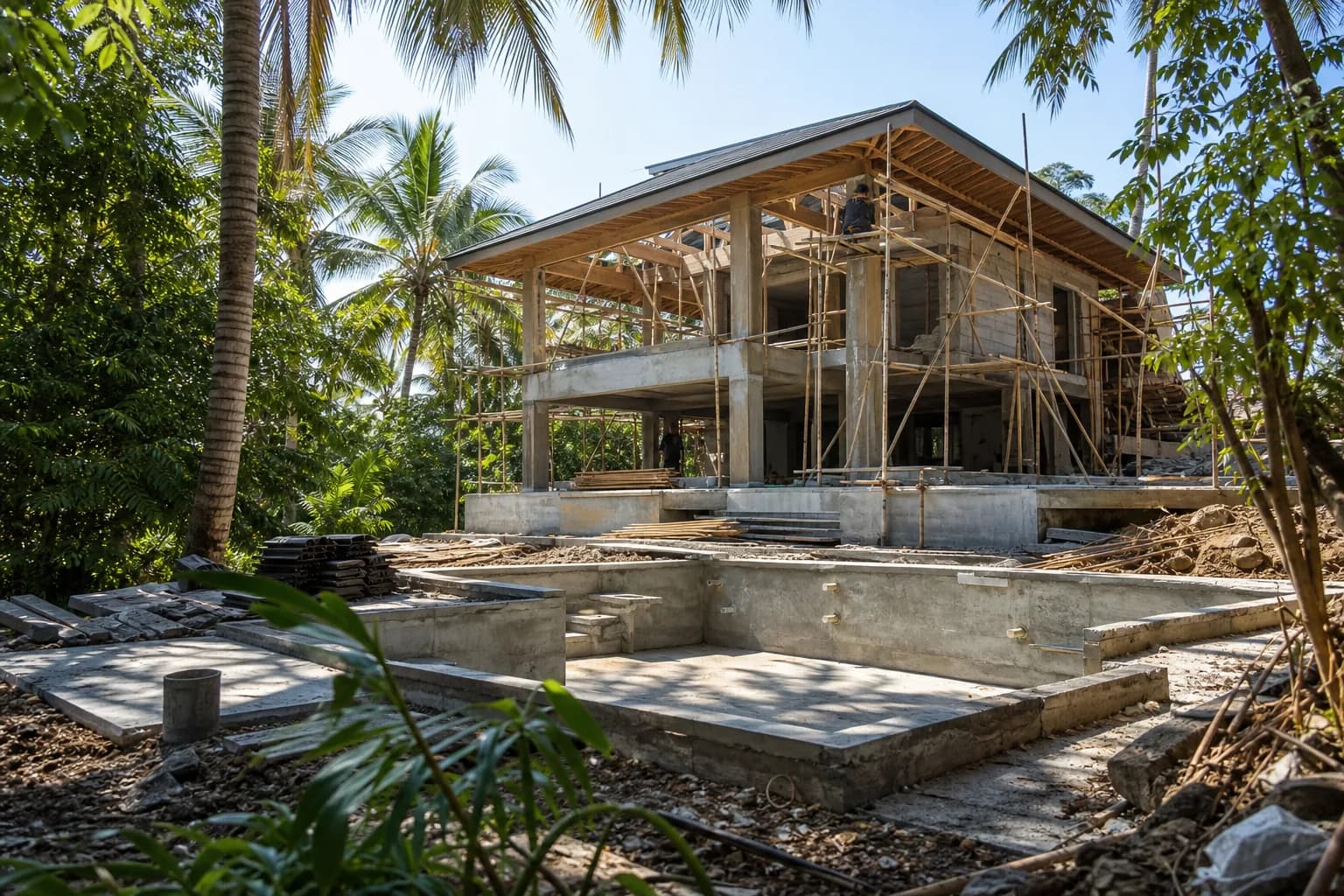
The Critical Vulnerability: Why Standard Payment Terms Leave Bali Construction Buyers Exposed
A Singapore-based investor transferred $180,000 to a Bali contractor for villa construction—30% upfront, 40% at foundation completion, 30% at handover. Four months in, the contractor disappeared after completing only 60% of the foundation work, leaving exposed rebar, incomplete drainage systems, and no legal recourse for fund recovery. This scenario repeats across Bali’s construction landscape because standard payment structures lack the protective mechanisms that escrow systems provide. Without independent fund custody, milestone verification protocols, and default protection clauses, buyers face catastrophic financial exposure when contractors fail to perform, abandon projects mid-construction, or misallocate funds intended for materials and subcontractors. The fundamental problem isn’t contractor dishonesty alone—it’s the structural absence of payment safeguards that would prevent fund release until objective completion criteria are independently verified and documented.
Engineering the Financial Architecture: How Construction Escrow Systems Actually Function
Construction escrow for Bali projects operates as a tripartite financial control mechanism involving the buyer (fund provider), contractor (service provider), and independent escrow agent (neutral custodian). The technical architecture differs fundamentally from direct payment structures by inserting verification layers between fund availability and fund release.
Escrow Account Structure and Legal Framework
Proper construction escrow in Indonesia requires establishment of a dedicated account under Indonesian banking regulations, typically structured as a “rekening bersama” (joint account) with specific withdrawal conditions. The account must be domiciled with a licensed Indonesian bank, as foreign escrow services lack legal enforceability under Indonesian contract law. The escrow agreement—drafted as a separate legal instrument from the construction contract—defines three critical parameters: milestone definitions with measurable completion criteria, inspection protocols including who conducts verification and within what timeframe, and dispute resolution mechanisms when parties disagree on milestone achievement.
The legal foundation rests on Indonesian Civil Code Articles 1338 (contract freedom) and 1792-1819 (construction agreements), combined with specific escrow provisions that establish the agent’s fiduciary duty to both parties. Unlike Western jurisdictions where escrow agents assume liability for improper releases, Indonesian escrow structures typically limit agent liability to gross negligence or willful misconduct, placing greater emphasis on precise milestone documentation.
Milestone-Based Release Mechanisms
Effective escrow structures divide construction into 6-8 technical milestones rather than arbitrary percentage completions. For tropical villa construction in Bali, the optimal milestone structure includes: site preparation and foundation excavation (8-12% of contract value), foundation completion including waterproofing and drainage systems (15-18%), structural frame and roof structure completion (20-25%), roof covering and building envelope weatherproofing (12-15%), rough mechanical/electrical/plumbing installation (10-12%), interior finishes and fixed installations (15-18%), final fixtures and landscape integration (8-10%), and final inspection with defect rectification period (5-8% held for 60-90 days post-completion).
Each milestone requires objective verification criteria. Foundation completion, for example, shouldn’t release funds based on contractor declaration but rather on independent structural engineer confirmation that: concrete strength testing meets specified 25-30 MPa requirements, waterproofing membrane installation passes flood testing protocols, drainage systems demonstrate proper gradient and flow capacity, and rebar placement and concrete coverage comply with tropical corrosion protection standards (minimum 50mm coverage for coastal locations).
Independent Verification Protocols
The escrow system’s integrity depends entirely on verification independence. Teville’s approach to milestone verification involves third-party structural engineers conducting on-site inspections against detailed technical specifications, photographic documentation with timestamp verification, materials testing for critical components (concrete strength, steel grade, waterproofing integrity), and written certification that work meets both contract specifications and Indonesian building code requirements (SNI standards).
Verification timing is critical—inspections must occur within 5-7 business days of contractor milestone completion notice, with escrow release occurring only after written verification approval. This timing prevents contractor cash flow disruption while maintaining buyer protection. The verification cost (typically 1.5-2.5% of total contract value) should be explicitly allocated in the escrow agreement, usually split between parties or included in the contractor’s pricing.
Default Protection Mechanisms
Escrow agreements must contain explicit default definitions and remediation procedures. Technical default occurs when contractors fail to achieve milestones within agreed timeframes (typically with 14-day cure periods), when work quality fails verification inspection requiring remediation, or when contractors fail to maintain required insurance coverage or subcontractor payments. Financial default triggers include contractor insolvency proceedings, failure to pay subcontractors creating lien risks, or diversion of escrow funds to non-project purposes.
Upon default declaration, the escrow agreement should provide for: immediate suspension of further fund releases, buyer right to engage alternative contractors to complete work using remaining escrow funds, contractor obligation to provide as-built documentation and site access, and dispute resolution through Indonesian arbitration (BANI) rather than litigation, which can extend 18-36 months.
The Hidden Vulnerabilities: What Escrow Agreements Fail to Address
Most Bali construction escrow arrangements contain critical gaps that become apparent only during disputes. The primary vulnerability involves milestone definition ambiguity—agreements stating “foundation complete” without specifying whether this includes waterproofing, drainage systems, utility rough-ins, or merely concrete pouring. This ambiguity creates verification disputes that delay fund release and project progress.
A second critical gap involves subcontractor payment verification. Even with escrow protection, buyers remain exposed to subcontractor liens if the primary contractor receives escrow funds but fails to pay material suppliers or specialty trades. Indonesian law allows unpaid subcontractors to place claims against the property itself, creating title complications. Effective escrow structures require contractors to provide subcontractor lien waivers before each milestone payment release, documenting that all parties involved in the previous construction phase have been compensated.
Currency fluctuation risk represents another overlooked exposure. Construction contracts denominated in USD but with escrow accounts in Indonesian Rupiah create exchange rate risk that can erode project budgets by 8-15% during typical 12-18 month construction periods. Sophisticated escrow structures address this through currency hedging provisions or USD-denominated accounts (available through certain Indonesian banks for foreign investment projects), though these add 0.5-1.2% in banking fees.
The verification independence illusion poses perhaps the greatest risk. Many escrow agreements specify “independent” inspectors who are actually recommended by or have ongoing relationships with the contractor. True independence requires buyers to directly engage and compensate verification engineers, with their scope of work defined in the escrow agreement itself. This structural separation prevents the conflict of interest that undermines most escrow protections.
Finally, most escrow agreements fail to address the completion definition problem—when exactly is construction “complete” triggering final payment release? Without explicit punch-list procedures, defect rectification timeframes, and performance testing requirements (especially for pools, drainage, and electrical systems in tropical environments), contractors can claim completion while significant deficiencies remain unresolved.
Implementation Protocol: Structuring Enforceable Escrow Protection
Step 1: Escrow Agent Selection and Account Establishment
Begin by identifying qualified escrow agents—typically Indonesian banks with dedicated escrow services (Bank Mandiri, BCA, CIMB Niaga) or specialized legal firms offering escrow administration. Evaluate agents based on: experience with construction escrow specifically (not just property transactions), willingness to accept detailed milestone verification requirements, fee structure transparency (typically 0.5-1.5% of total contract value), and dispute resolution track record. Establish the escrow account before signing the construction contract, ensuring the account agreement explicitly references and incorporates the construction contract’s milestone schedule. The account should require dual authorization for any withdrawal—escrow agent confirmation that verification has occurred plus buyer approval of the verification report.
Step 2: Milestone Definition and Verification Criteria Documentation
Work with your structural engineer to develop detailed milestone definitions that include: specific work scope for each phase, measurable completion criteria (concrete strength test results, waterproofing flood test duration, electrical system load testing), required documentation (as-built drawings, materials certifications, subcontractor lien waivers), and photographic evidence requirements. For a typical 300 sqm villa, this documentation package should span 15-25 pages of technical specifications. Each milestone should have a defined payment percentage and a maximum timeframe for completion (with weather delay provisions for Bali’s monsoon season). Attach this milestone schedule as Exhibit A to both the construction contract and escrow agreement, ensuring consistency across all documents.
Step 3: Independent Verification Engineer Engagement
Separately engage a structural engineer or quantity surveyor to conduct milestone verifications, with their scope of work explicitly defined to match the escrow agreement’s verification requirements. This engagement should be independent of the contractor—you contract directly with the engineer, compensate them separately, and their professional liability insurance covers verification errors. The verification protocol should require site inspections within 5 business days of contractor completion notice, written reports within 3 business days of inspection, and explicit approval or rejection statements with deficiency lists when work fails to meet specifications. Budget 1.5-2.5% of construction value for verification services across the full project duration.
Step 4: Escrow Agreement Drafting and Default Provisions
Engage an Indonesian construction lawyer to draft the escrow agreement (separate from the construction contract) incorporating: the detailed milestone schedule with verification requirements, explicit default definitions including timeframe triggers, remediation procedures when defaults occur (cure periods, alternative contractor engagement rights, fund reallocation authority), dispute resolution through BANI arbitration with expedited procedures, and subcontractor lien waiver requirements before each payment release. The agreement should specify that verification engineer rejection of milestone completion prevents fund release until deficiencies are corrected and re-inspection occurs. Include provisions for escrow account interest (typically credited to buyer) and final account closure procedures including final lien waiver collection.
Step 5: Funding Schedule and Initial Deposit Protection
Structure the initial deposit (typically 10-15% for mobilization and materials procurement) with additional protection mechanisms since this payment occurs before substantial work completion. Options include: requiring the contractor to provide a bank guarantee for 100% of the initial deposit (returnable upon first milestone completion), splitting the initial deposit into two tranches—50% at contract signing and 50% at site mobilization verification, or requiring detailed materials procurement documentation (supplier invoices, delivery confirmations) before initial deposit release. For projects exceeding $300,000, bank guarantee protection for the initial deposit is standard practice and should be non-negotiable.
Step 6: Ongoing Monitoring and Documentation
Establish a documentation protocol throughout construction: weekly progress photo documentation with timestamps, monthly quantity surveyor reports comparing actual progress to schedule, subcontractor payment verification before each escrow release, and materials testing documentation for critical components. This documentation serves two purposes—it provides evidence for milestone verification and creates a defensible record if disputes arise. Store all documentation in cloud-based systems with access provided to buyer, contractor, verification engineer, and escrow agent, ensuring transparency and preventing documentation disputes.
Financial Reality: Escrow Costs and Protection Value
Implementing comprehensive escrow protection for Bali villa construction adds 2.5-4.5% to total project costs, but this investment directly mitigates the 15-30% loss risk from contractor default. For a $400,000 villa construction project, expect these escrow-related costs: escrow account establishment and administration fees of $2,000-4,000 (0.5-1% of contract value), independent verification engineer services of $6,000-10,000 (1.5-2.5% of contract value), legal fees for escrow agreement drafting of $2,500-4,000, and bank guarantee for initial deposit protection of $1,200-2,000 (typically 3-5% annual fee on guaranteed amount, prorated for 2-3 month period until first milestone).
The timeline implications are equally important. Proper escrow structure adds 2-3 weeks to project initiation (for account setup, agreement drafting, and verification engineer engagement) and 5-7 days to each milestone payment cycle (for inspection scheduling, verification reporting, and fund
 3104 m²11 month(s)from 99.000 USD
TALA 100
 164 m²7 month(s)from 79.000 USD
TALA TWO
 2144 m²11 month(s)from 104.000 USD
Narayana
 3173 m²6 month(s)from 125.000 USD
TALA FOUR
 1from 198.000 USD
Private: Haridas Villas
 3127 m²9 month(s)from 177.000 USD
Mukunda

Want to calculate?
 3180 m²7 month(s)from 142.000 USD
Vasudeva
 172 m²8 month(s)from 120.000 USD
Keshava
 3124 m²6 month(s)from 123.000 USD
TALA 8
164 m²7 month(s)from 79.000 USDPrivate: Haridas Villas, Tegallalang
 4344 m²16 month(s)from 290.000 USD
Radha
Start With Real Numbers, Not Guesses
Before buying land or finalizing a design, check the realistic build cost range for your project in Bali.
Our team reviews your inputs and gives a grounded estimate.
Available lands
 2400 m²7 min$ 496552Bali, Canggu
 204 m²5 min$ 40899Bali, Kedungu
 1000 m²10 min$ 184729Bali, Kutuh South Bali
 911 m²15 min$ 248217Bali, Pererenan
 2800 m²15 min$ 310345Bali, Tabanan
 3100 m²20 min$ 272968Bali, Tabanan
 6000 m²10 min$ 1330049Bali, Kutuh South Bali
 2680 m²10 min$ 1732759Bali, Pererenan
 700 m²8 min$ 165517Bali, Umalas
 600 m²12 min$ 101970Bali, Mengwi
 515 m²7 min$ 570813Bali, Canggu
 1300 m²10 min$ 312192Bali, Kutuh South Bali
 200 m²5 min$ 59113Bali, Bukit
 29000 m²6 min$ 3857143Bali, Tabanan
 2230 m²15 min$ 410573Bali, Padonan
Essential Bali build & buy guides
- Bali villa construction cost per m² in 2026
- How much will your villa cost? Calculator
- Building a villa in Bali: the complete guide
- Buying land in Bali: step-by-step for foreigners
- Bali villa investment: yields, risks, returns
- Leasehold vs freehold: what foreigners can own
- Construction defect liability & 10-year warranty
- Bali building codes and construction standards
Related guides

Why a Cheap Bali Leasehold Is Cheap: Pricing Red Flags Every Buyer Should Decode
Suspiciously cheap Bali leaseholds are priced low for a reason: short remaining terms, forbidden zoning, missing road access, disputes or weak contracts. How to decode the discount before you pay for it.
8 min read
Fake Compliance and Licensing Agents in Bali: The 2026 Paperwork Scam and How to Verify Documents
Forged certificates, permit fixers and fake notaries: how Bali's paperwork scams work in 2026 and how to verify every property document at its government source.
7 min read
Buying a Bali Villa from Instagram: Phantom Listings, Render-Only Projects and How to Verify
Instagram is Bali's biggest property shop window and its least verified. How phantom listings, render-only projects and cloned developer accounts work — and the verification steps that expose them.
7 min read