Bali Builder Bankruptcy: Protect Your Construction Deposit
{
“article”: {
“title”: “Bali Builder Bankruptcy: Protecting Your Construction Deposit”,
“meta_description”: “Discover how to protect your construction deposit from builder bankruptcy in Bali. Technical due diligence, escrow structures, and legal safeguards for villa construction projects.”,
“content”: “
The Hidden Threat to Your Bali Villa Construction Investment
\n\n
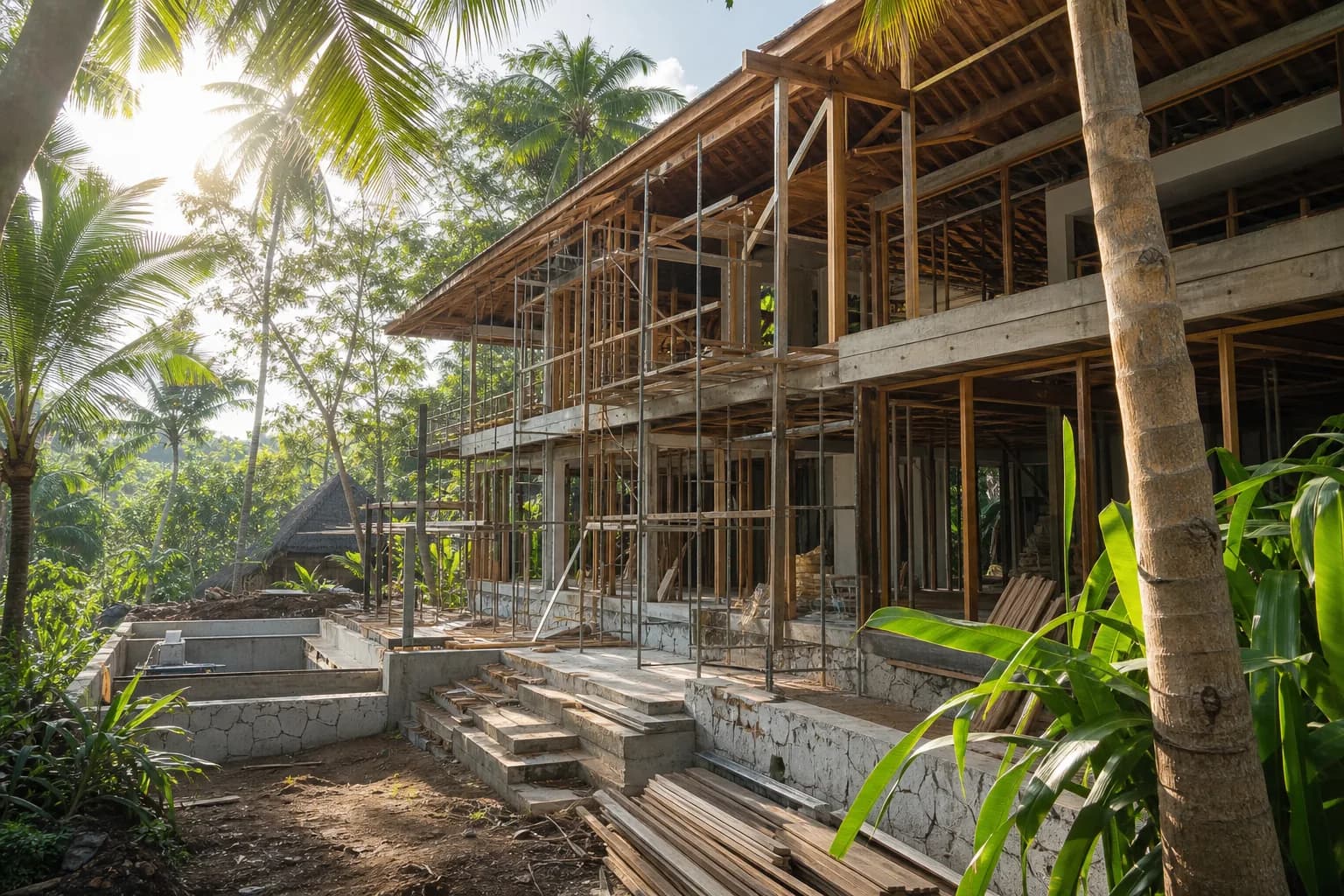
Imagine transferring $150,000 USD as a construction deposit to your Bali builder, only to discover three months later that the company has ceased operations, the site remains untouched, and your funds have vanished into a web of unpaid subcontractor debts. Builder bankruptcy represents one of the most catastrophic financial risks in Bali’s construction sector—yet it remains largely invisible until it’s too late. Unlike Western markets with robust contractor licensing, bonding requirements, and consumer protection frameworks, Bali’s construction industry operates with minimal regulatory oversight, making deposit protection a matter of proactive legal structuring rather than statutory safeguards.
\n\n
Understanding Builder Bankruptcy Risk in Bali’s Construction Market
\n\n
Builder bankruptcy in Bali rarely follows formal insolvency proceedings. Instead, it manifests as sudden operational cessation, where construction companies simply stop responding to communications, abandon active projects, and dissolve their corporate entities without legal liquidation. This informal collapse pattern creates unique challenges for deposit recovery.
\n\n
The Structural Vulnerabilities of Bali Construction Companies
\n\n
Most Bali construction firms operate as PT (Perseroan Terbatas) companies with minimal capitalization requirements—often just IDR 50 million (approximately $3,200 USD) in registered capital. This low barrier to entry means builders can establish seemingly legitimate companies without substantial financial backing. The typical operational model involves:
\n\n
- \n
- Project-to-project cash flow dependency: Builders use deposits from new clients to complete existing projects, creating a Ponzi-like financial structure that collapses when new project acquisition slows
- Subcontractor payment delays: Material suppliers and labor contractors often work on 30-90 day payment terms, allowing builders to appear solvent while accumulating hidden liabilities
- Minimal asset ownership: Construction equipment is typically rented, office spaces leased month-to-month, and no real property held in the company name—leaving virtually no recoverable assets upon collapse
- Director liability shields: Indonesian corporate law provides strong separation between company debts and director personal assets, making personal liability claims extremely difficult
\n
\n
\n
\n
\n\n
Warning Signs of Financial Distress
\n\n
Technical due diligence should identify these red flags before deposit transfer:
\n\n
Aggressive payment terms: Builders requesting 50-70% upfront deposits (industry standard is 30-40% for mobilization) often signal cash flow problems. At Teville’s construction process, payment schedules align with verified completion milestones, not arbitrary percentages.
\n\n
Incomplete portfolio documentation: Inability to provide verifiable completion certificates, client references with contact details, or site visit access to current projects indicates potential project abandonment history.
\n\n
Subcontractor complaints: Direct conversations with material suppliers (cement distributors, steel fabricators) can reveal payment delays that don’t appear in company financial statements.
\n\n
Permit processing delays: Builders who cannot demonstrate active IMB (building permit) processing within 45 days of deposit may be stalling due to inability to pay permit fees or outstanding violations on other projects.
\n\n
Legal Framework Limitations
\n\n
Indonesia’s construction law (UU No. 2/2017) establishes contractor classification systems (grades 1-7) but does not mandate performance bonds or deposit insurance for residential projects under certain thresholds. The Consumer Protection Law (UU No. 8/1999) provides theoretical recourse, but practical enforcement requires:
\n\n
- \n
- Documented evidence of contractual breach (often difficult when builders claim force majeure or design changes)
- Active company registration (collapsed builders typically let SIUP and TDP licenses lapse)
- Recoverable assets within Indonesian jurisdiction (directors often transfer personal assets to family members pre-collapse)
\n
\n
\n
\n\n
Civil litigation for deposit recovery averages 18-36 months in Bali’s court system, with legal costs consuming 15-25% of claimed amounts. Success rates for full recovery sit below 30% when the defendant company has ceased operations.
\n\n
Hidden Risks That Amplify Deposit Loss
\n\n
The Nominee Director Problem
\n\n
Many foreign-facing construction companies use Indonesian nominee directors who hold no actual decision-making authority. When bankruptcy occurs, these nominees claim ignorance of financial decisions, and the beneficial foreign owners (who cannot legally own construction companies) remain beyond legal reach. This structure creates a liability vacuum where no party can be held accountable.
\n\n
Commingled Fund Structures
\n\n
Without project-specific escrow accounts, your deposit enters the builder’s general operating account alongside funds from multiple other clients. When financial distress hits, the company uses available cash to pay the most urgent creditors (often subcontractors threatening work stoppages on other sites), leaving later-stage deposit holders with nothing. Indonesian banking law does not provide deposit holders with priority creditor status over operational creditors.
\n\n
The Permit Trap
\n\n
Some builders collect deposits before securing IMB approval, claiming they’ll \”process permits during design phase.\” If the builder collapses before permit issuance, you face a double loss: the deposit disappears, and you cannot legally continue construction with a new builder because no valid permit exists in your name. Permit transfer between builders requires full re-application, adding 4-6 months and $8,000-$15,000 in additional costs.
\n\n
Material Supplier Liens
\n\n
Under Indonesian law, unpaid material suppliers can place liens on the construction site itself, not just the builder’s assets. If your builder ordered materials on credit and failed to pay, suppliers may legally prevent construction continuation until debts are settled—even though you already paid the builder for those materials. This creates secondary financial liability beyond the lost deposit.
\n\n
Step-by-Step Deposit Protection Framework
\n\n
Phase 1: Pre-Engagement Due Diligence (Weeks 1-2)
\n\n
Step 1: Request the builder’s complete corporate documentation: PT establishment deed (Akta Pendirian), latest tax clearance certificate (SKT), and construction business license (SIUJK). Verify these documents through Indonesia’s Online Single Submission system (OSS) to confirm active status. Companies operating with expired licenses often signal financial inability to pay renewal fees.
\n\n
Step 2: Conduct site visits to minimum three current active projects at different completion stages (foundation, structure, finishing). Speak directly with on-site project managers and subcontractors about payment timeliness. Request contact details for two completed projects from the past 12 months and verify client satisfaction independently.
\n\n
Step 3: Engage a local attorney to search for any existing legal disputes involving the builder at Denpasar District Court. Construction disputes become public record, and patterns of client litigation indicate systemic issues. This search costs approximately IDR 3-5 million ($190-$320 USD) and takes 5-7 business days.
\n\n
Phase 2: Contract Structuring (Weeks 3-4)
\n\n
Step 4: Establish a project-specific escrow account at a reputable Indonesian bank (BCA, Mandiri, or BNI) with dual-signature requirements: your signature plus the builder’s signature for any withdrawal. The escrow agreement should specify that funds release only upon verified completion of defined milestones, confirmed by an independent quantity surveyor.
\n\n
Step 5: Structure the payment schedule with maximum 35% initial deposit (covering mobilization, permits, and design), followed by milestone-based releases: 15% at foundation completion, 20% at structural frame completion, 15% at roof completion, 10% at MEP rough-in, and final 5% at practical completion. This structure ensures the builder maintains financial incentive throughout the project.
\n\n
Step 6: Include contractual provisions requiring the builder to provide: (a) payment receipts from all major material suppliers within 7 days of each milestone payment, (b) lien waiver documents from subcontractors, and (c) monthly financial statements showing project-specific cost tracking. These transparency requirements make it impossible for builders to hide financial distress.
\n\n
Phase 3: Construction Monitoring (Months 1-8)
\n\n
Step 7: Hire an independent project supervisor (not affiliated with the builder) to verify milestone completion before authorizing escrow releases. This supervisor should be a licensed engineer (Ir. or ST. designation) with professional indemnity insurance. Supervision costs typically run 3-5% of construction value but provide essential verification. Teville’s portfolio demonstrates the quality standards that independent verification should confirm.
\n\n
Step 8: Maintain direct relationships with key subcontractors (steel fabricator, concrete supplier, electrical contractor) and verify they’re receiving timely payment. Request copies of paid invoices monthly. If payment delays exceed 15 days, suspend further escrow releases until the builder demonstrates financial stability.
\n\n
Step 9: Monitor the builder’s other active projects through periodic site visits. If you observe work stoppages or subcontractor complaints on other sites, immediately halt your project payments and consult legal counsel about protective measures, including potential contract termination with deposit recovery provisions.
\n\n
Realistic Cost Ranges for Deposit Protection
\n\n
Legal and Financial Infrastructure Costs
\n\n
Implementing comprehensive deposit protection involves upfront costs that many buyers overlook when comparing builder quotes:
\n\n
Escrow account establishment: IDR 5-8 million ($320-$510 USD) for legal documentation plus monthly maintenance fees of IDR 200,000-500,000 ($13-$32 USD). Banks typically require minimum balances of IDR 50 million ($3,200 USD) in the escrow account.
\n\n
Independent legal review: Comprehensive contract review by a construction-specialized attorney costs IDR 15-25 million ($950-$1,600 USD). This includes due diligence searches, contract drafting, and escrow agreement preparation. Budget an additional IDR 8-12 million ($510-$765 USD) for ongoing legal consultation during construction.
\n\n
Quantity surveyor verification: Independent milestone verification by a licensed QS costs IDR 3-5 million ($190-$320 USD) per inspection. With 6-8 major milestones, total verification costs reach IDR 18-40 million ($1,150-$2,550 USD) for a typical villa project.
\n\n
Performance bond alternatives: Since traditional performance bonds are rare in Bali’s residential construction market, some buyers negotiate personal guarantees from builder directors, backed by notarized asset pledges (property or vehicles). Notarization and legal documentation costs IDR 10-15 million ($640-$950 USD), though enforcement remains challenging.
\n\n
Recovery Cost Realities
\n\n
If builder bankruptcy occurs despite precautions, recovery attempts involve substantial additional costs:
\n\n
Civil litigation: Attorney fees for deposit recovery lawsuits start at IDR 50 million ($3,200 USD) for case preparation, plus IDR 15-25 million ($950-$1,600 USD) per court appearance. Total litigation costs for a case reaching judgment average IDR 150-250 million ($9,500-$16,000 USD) over 18-30 months.
\n\n
Asset investigation: Private investigators who trace builder assets and director holdings charge IDR 20-35 million ($1,275-$2,230 USD) for comprehensive searches, with no guarantee of finding recoverable assets.
\n\n
These figures underscore why prevention through proper structuring costs far less than attempted recovery. For context, Teville’s cost estimation process includes transparent breakdowns that allow clients to verify fund allocation throughout construction.
\n\n
Frequently Asked Questions
\n\n
Can I purchase insurance to protect my construction deposit in Bali?
\n\n
Standard construction insurance policies in Indonesia cover physical damage to the project (fire, natural disasters, theft) but do not cover builder bankruptcy or deposit loss. Some international insurers offer \”advance payment bonds\” or \”contractor default insurance,\” but these products are rarely available for residential projects in Bali and, when available, cost 3-8% of the insured deposit amount with extensive exclusions. The most practical protection remains contractual structuring with escrow accounts and milestone-based payments rather than insurance products. Builders with strong financial positions, like those maintaining documented project portfolios, present inherently lower risk than insurance can address.
\n\n
What happens to my land if the builder goes bankrupt mid-construction?
\n\n
Your land ownership remains unaffected by builder bankruptcy since the land title (either freehold SHM for Indonesian citizens or leasehold Hak Pakai for foreigners) stays in your name throughout construction. However, you face several complications: (1) incomplete structures may violate building codes, requiring expensive remediation before a new builder can continue, (2) unpaid material suppliers may place liens on the property, preventing further construction until debts are settled, (3) the partially completed structure may not match approved IMB plans, requiring permit amendments costing $5,000-$12,000, and (4) new builders typically charge 15-25% premiums to complete another builder’s work due to unknown quality issues and liability concerns. If construction hasn’t begun, you can engage a new builder with minimal complications, but mid-construction bankruptcies create 4-8 month delays and 20-35% cost overruns.
\n\n
How can I verify a builder’s financial stability before signing a contract?
\n\n
Request three years of audited financial statements (Laporan Keuangan) and tax returns (SPT Tahunan). Healthy builders show consistent revenue growth, positive operating cash flow, and current ratios above 1.5 (current assets divided by current liabilities). Be suspicious of builders who refuse financial disclosure or provide only single-year statements. Additionally, check the builder’s bank references by requesting a solvency letter (surat keterangan bank) from their primary banking institution—banks will confirm account standing without disclosing specific balances. Visit the builder’s office and warehouse facilities; established companies maintain permanent locations with owned equipment, while financially unstable builders operate from temporary offices with rented equipment. Finally, verify the builder’s project pipeline by requesting a list of all active projects with client contact information, then independently confirm these projects are actually under construction and payments are current.
\n\n
Should I pay the builder directly or use a third-party payment processor?
\n\n
Never pay builders through personal accounts or cash transactions. Establish a project-specific escrow account at a major Indonesian bank with dual-signature requirements (your approval plus builder’s request) for all withdrawals. The escrow agreement should specify that funds release only upon independent verification of completed milestones by a licensed quantity surveyor or engineer. This structure costs approximately $320-$510 USD to establish plus $13-$32 monthly maintenance, but it provides essential protection by ensuring the builder cannot access funds without demonstrating progress. Some buyers use their attorney’s client trust account as an alternative, though this requires absolute confidence in the attorney’s integrity and proper trust accounting practices. Avoid builders who resist escrow arrangements or demand direct payment to company accounts, as this resistance often signals cash flow problems or intention to commingle funds across multiple projects.
\n\n
What legal recourse do I have if my builder declares bankruptcy after taking my deposit?
\n\n
Indonesian law provides several theoretical remedies, though practical recovery remains challenging. First, file a civil lawsuit (gugatan perdata) for breach of contract and deposit return at Denpasar District Court, which costs IDR 2-5 million ($125-$320 USD) in court fees plus attorney fees of IDR 50-150 million ($3,200-$9,500 USD). Judgments typically take 18-36 months, and winning a judgment doesn’t guarantee recovery if the company has no assets. Second, if you can prove criminal fraud (the builder never intended to perform construction), file a police report under Article 378 of the Indonesian Criminal Code, though police rarely pursue construction disputes as criminal matters unless evidence of systematic fraud exists. Third, if the builder is a PT company, you may attempt to pierce the corporate veil and pursue director personal liability, but this requires proving directors acted in bad faith or personally benefited from the fraud—extremely difficult to establish. The most effective approach combines immediate contract termination (using termination clauses you included during contract negotiation), asset freezing through preliminary injunction (sita jaminan), and negotiated settlement where you accept partial recovery in exchange for releasing legal claims.
\n\n
How does Bali’s 2026 construction moratorium affect builder bankruptcy risk?
\n\n
The February 2026 moratorium restricting new permits for hotels, restaurants, and commercial facilities on agricultural land has created financial pressure on builders who specialized in commercial projects, potentially increasing bankruptcy risk in that segment. However, the moratorium exempts residential villas on properly zoned land, and existing valid permits remain enforceable. Builders with diversified portfolios including residential projects face less moratorium impact than those focused exclusively on commercial hospitality construction. The moratorium may actually reduce bankruptcy risk for residential-focused builders by decreasing competition and stabilizing pricing, as commercial-focused builders exit the market. When evaluating builders, ask what percentage of their revenue comes from commercial versus residential projects—those deriving over 60% from commercial hospitality construction m
 164 m²7 month(s)from 79.000 USD
Private: Haridas Villas, Tegallalang
 3124 m²6 month(s)from 123.000 USD
TALA 8
 3173 m²6 month(s)from 125.000 USD
TALA FOUR
 3127 m²9 month(s)from 177.000 USD
Mukunda
 2144 m²11 month(s)from 104.000 USD
Narayana
 3180 m²7 month(s)from 142.000 USD
Vasudeva

Want to calculate?
 4344 m²16 month(s)from 290.000 USD
Radha
 1from 198.000 USD
Private: Haridas Villas
 3104 m²11 month(s)from 99.000 USD
TALA 100
164 m²7 month(s)from 79.000 USDTALA TWO
 172 m²8 month(s)from 120.000 USD
Keshava
Start With Real Numbers, Not Guesses
Before buying land or finalizing a design, check the realistic build cost range for your project in Bali.
Our team reviews your inputs and gives a grounded estimate.
Available lands
 1000 m²5 min$ 350431Bali, Drupadi
 800 m²10 min$ 307882Bali, Tibubeneng
 300 m²55 min$ 32475Bali, Tegelalang
 500 m²15 min$ 124692Bali, Kaba Kaba
 1200 m²2 min$ 155172Bali, Klungkung
 7000 m²36 min$ 284483Bali, Gianyar
 2800 m²15 min$ 310345Bali, Tabanan
 1362 m²15 min$ 335468Bali, Tumbak
 1700 m²10 min$ 392549Bali, Nusadua
 1410 m²15 min$ 390702Bali, Tabanan
 660 m²10 min$ 175567Bali, Mengwi
 1000 m²10 min$ 230911Bali, Kerobokan
 200 m²11 min$ 89286Bali, Tabanan
 550 m²15 min$ 164594Bali, Mengwi
 2000 m²5 min$ 738916Bali, Ungasan
Essential Bali build & buy guides
- Bali villa construction cost per m² in 2026
- How much will your villa cost? Calculator
- Building a villa in Bali: the complete guide
- Buying land in Bali: step-by-step for foreigners
- Bali villa investment: yields, risks, returns
- Leasehold vs freehold: what foreigners can own
- Construction defect liability & 10-year warranty
- Bali building codes and construction standards
Related guides

Why a Cheap Bali Leasehold Is Cheap: Pricing Red Flags Every Buyer Should Decode
Suspiciously cheap Bali leaseholds are priced low for a reason: short remaining terms, forbidden zoning, missing road access, disputes or weak contracts. How to decode the discount before you pay for it.
8 min read
Fake Compliance and Licensing Agents in Bali: The 2026 Paperwork Scam and How to Verify Documents
Forged certificates, permit fixers and fake notaries: how Bali's paperwork scams work in 2026 and how to verify every property document at its government source.
7 min read
Buying a Bali Villa from Instagram: Phantom Listings, Render-Only Projects and How to Verify
Instagram is Bali's biggest property shop window and its least verified. How phantom listings, render-only projects and cloned developer accounts work — and the verification steps that expose them.
7 min read