Concrete Countertop Sealing in Bali: Food-Safe Products
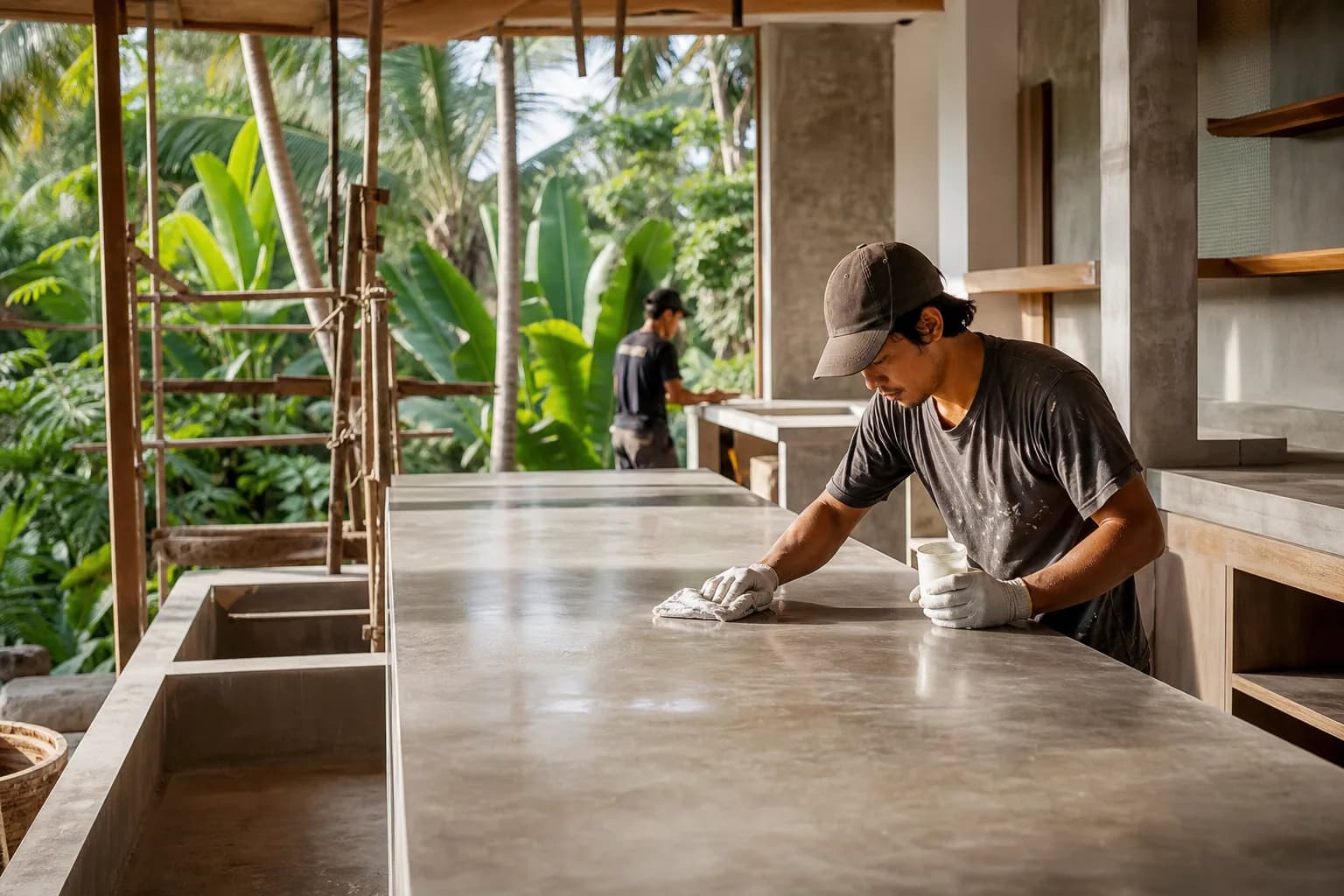
# Concrete Countertop Sealing: Food-Safe Products for Bali Kitchens
The Critical Challenge of Sealing Concrete Countertops in Bali’s Tropical Climate
Concrete countertops have become increasingly popular in Bali villa construction and renovation projects, offering a modern aesthetic that complements both contemporary and traditional Balinese design. However, unsealed or improperly sealed concrete surfaces in kitchen environments pose serious risks: moisture penetration from Bali’s 80%+ humidity levels, staining from acidic tropical fruits and cooking oils, bacterial growth in porous surfaces, and rapid deterioration from daily food preparation activities. The question facing homeowners and villa developers isn’t whether to seal concrete countertops, but rather which food-safe sealing products can withstand Bali’s unique combination of high humidity, intense UV exposure, and constant kitchen use while maintaining non-toxic surface contact with food.
Understanding Food-Safe Concrete Sealer Technology for Tropical Kitchen Applications
Food-safe concrete countertop sealers represent a specialized category within interior finishing Bali projects, designed specifically to create impermeable barriers without leaching harmful chemicals into food contact areas. As of 2026, the leading products—H-Seal, XS-327, Cheng Food-Safe Sealer, Ovation, and Cheng 4L—all utilize water-based polymer technology that cures to form a protective film meeting FDA and NSF standards for indirect food contact surfaces.
The fundamental difference between standard concrete sealers and food-safe variants lies in their chemical composition. Traditional solvent-based sealers contain volatile organic compounds (VOCs) and petroleum derivatives that can migrate to food surfaces, making them unsuitable for kitchen countertops. Water-based food-safe sealers, by contrast, employ acrylic or polyurethane polymers suspended in water carriers that evaporate during curing, leaving only inert, non-toxic protective layers.
In Bali’s tropical environment, concrete countertop sealing faces unique challenges that don’t exist in temperate climates. The island’s consistent 26-32°C temperatures combined with 70-90% relative humidity create conditions where moisture vapor transmission becomes critical. Concrete naturally breathes, releasing moisture vapor from within its matrix. If a sealer doesn’t accommodate this vapor transmission while still blocking liquid water penetration, delamination and bubbling occur within months—a common failure we observe in renovation Bali projects where inappropriate products were initially specified.
H-Seal concrete countertop sealer offers penetrating protection that works by filling the concrete’s capillary structure rather than forming a surface film. This approach allows vapor transmission while blocking liquid penetration, making it particularly suitable for Bali’s climate. The product cures to a natural matte finish that doesn’t alter the concrete’s appearance, ideal for projects seeking authentic material expression.
XS-327 provides semi-gloss and matte finish options with enhanced UV stability—crucial for kitchen areas receiving direct tropical sunlight through large villa windows common in Bali villa construction. Its formulation includes UV inhibitors that prevent the yellowing and degradation that plague many sealers under intense equatorial sun exposure.
Cheng Food-Safe Sealer and the newer Cheng 4L represent evolution in sealer technology, offering scratch-resistant properties essential for high-use kitchen surfaces. These products cure harder than earlier generations, providing better resistance to knife marks, pot sliding, and the abrasive cleaning that tropical kitchens require. The 4-liter packaging of Cheng 4L makes it economical for larger villa projects or multiple countertop installations.
Ovation concrete countertop sealer distinguishes itself through rapid cure times—fully functional within 72 hours compared to 7-14 days for some competitors. For renovation projects where kitchen downtime must be minimized, this accelerated schedule proves invaluable. Its water-based formulation remains workable in Bali’s heat without flash-drying, a problem that affects some products in tropical applications.
The sealing process creates multiple protective mechanisms simultaneously. First, the sealer fills microscopic pores in the concrete surface, eliminating pathways for liquid penetration. Second, it forms a continuous film across the surface that resists staining from oils, acids, and pigmented liquids common in food preparation. Third, it creates a cleanable surface that prevents bacterial colonization in the concrete’s naturally porous structure—a critical consideration for food safety in tropical climates where bacterial growth accelerates.
Material Specifications and Performance Standards for Bali Kitchen Environments
Selecting appropriate sealing products for concrete countertops in Bali requires understanding both international food safety standards and local environmental performance requirements. All food-safe sealers should meet FDA CFR 175.300 regulations for resinous and polymeric coatings intended for indirect food contact, and ideally carry NSF/ANSI Standard 51 certification for food equipment materials.
For Bali applications, additional performance criteria become essential. Water vapor permeability ratings should fall between 0.5-2.0 perms to allow concrete breathing while blocking liquid water. UV resistance must withstand 4,000+ hours of QUV-A exposure without significant color change or gloss reduction—equivalent to approximately 3-4 years of Bali’s intense equatorial sunlight. Chemical resistance testing should demonstrate no staining or etching from common kitchen acids including lime juice (pH 2.0), tamarind (pH 2.8), and tomato (pH 4.2), all staples in Balinese and international cuisine.
Scratch resistance measured by pencil hardness should achieve minimum 2H rating, with premium products reaching 3H-4H. This ensures the sealed surface withstands daily knife use, pot movement, and cleaning without visible wear patterns. Adhesion strength to concrete substrates should exceed 200 psi in pull-off testing to prevent delamination under thermal cycling common in tropical kitchens.
Material coverage rates vary by product and concrete porosity, but typically range from 200-400 square feet per liter for initial coats and 400-600 square feet per liter for subsequent coats. Bali’s porous volcanic aggregate concrete often requires 15-20% more sealer than projects using denser limestone aggregates, a factor that must be incorporated into furniture installation and finishing budgets.
Cure schedules represent another critical specification. While products may be dry-to-touch within hours, full chemical cure requiring 7-30 days determines when countertops can withstand full kitchen use. Temperature and humidity directly affect cure rates—Bali’s warm temperatures accelerate curing, but high humidity can extend it. Professional interior finishing Bali contractors account for these variables when scheduling project completion and handover.
Professional Application Process for Concrete Countertop Sealing in Tropical Conditions
Proper sealing of concrete countertops requires meticulous surface preparation and controlled application conditions—factors that become more challenging in Bali’s climate but remain absolutely critical for long-term performance. The process Teville employs for villa projects follows a systematic approach refined through hundreds of kitchen installations across the island.
Surface Preparation Phase: Begin with concrete that has cured minimum 28 days, allowing complete hydration and strength development. The surface must be ground smooth using progressively finer diamond pads—typically 50, 100, 200, and 400 grit sequences—to achieve uniform porosity and remove any laitance or weak surface material. This grinding process is performed wet to control dust and prevent heat buildup that can cause micro-cracking in tropical conditions.
After grinding, thoroughly clean the surface using pH-neutral cleaners to remove all grinding residue, oils, and contaminants. Rinse multiple times with clean water and allow complete drying—typically 24-48 hours in Bali’s humidity. Use moisture meters to verify the concrete surface has reached below 4% moisture content before sealer application; applying sealer to damp concrete causes whitening, poor adhesion, and premature failure.
Environmental Control: Schedule sealing work during Bali’s dry season (April-October) when possible, and specifically during morning hours when humidity is lowest and temperatures haven’t peaked. Ideal application conditions are 20-28°C with relative humidity below 70%. Use dehumidifiers in enclosed kitchen spaces if necessary to achieve proper conditions. Avoid application when rain is forecast within 24 hours, as moisture can interfere with curing.
First Coat Application: Pour sealer into paint trays and apply using high-density foam rollers or microfiber applicators, working in 2-3 square meter sections. Apply thin, even coats rather than heavy applications—excess sealer pools in low spots and creates uneven gloss patterns. Maintain wet edges to prevent lap marks. For penetrating sealers like H-Seal, flood the surface and allow 5-10 minutes penetration time before removing excess with clean, lint-free cloths.
Inter-Coat Procedures: Allow first coats to dry according to manufacturer specifications—typically 2-4 hours in Bali’s warm temperatures. Lightly sand between coats using 320-400 grit sandpaper to remove any raised grain or surface imperfections, then clean thoroughly with tack cloths. This inter-coat sanding ensures mechanical bonding between layers and eliminates surface defects that become magnified with subsequent coats.
Final Coat Application: Apply 2-4 total coats depending on product and desired protection level. High-use kitchen areas benefit from additional coats on primary work zones. Final coats should be applied even thinner than initial coats to avoid buildup and ensure smooth, uniform finish. For products offering gloss options, final coat selection determines ultimate appearance—matte finishes better hide minor imperfections and wear patterns over time.
Curing and Protection: After final coat application, protect surfaces from any contact for minimum 24 hours. Install temporary barriers to prevent accidental touching or debris contact. Maintain good ventilation to facilitate curing but avoid direct fan airflow that can cause uneven drying. Full cure requiring 7-30 days means limiting kitchen use to light activities initially, gradually increasing to full use as cure progresses. Provide clients with detailed care instructions including 30-day restrictions on harsh cleaners and cutting directly on surfaces.
Quality Verification: After complete curing, perform water bead testing by placing water droplets on various surface areas. Properly sealed concrete should cause water to bead and not penetrate. Check for uniform appearance, smooth texture, and absence of bubbles, whitening, or delamination. Document the installation with photos and provide clients with product information, batch numbers, and maintenance guidelines for future reference.
Cost Analysis and Project Timeline for Bali Kitchen Countertop Sealing
Understanding the investment required for professional concrete countertop sealing helps villa owners and developers budget appropriately for interior finishing Bali projects. Material costs for food-safe sealers range from $45-85 per liter depending on product selection and import logistics to Bali. A typical 4-meter kitchen countertop with 60cm depth (2.4 square meters) requires approximately 0.5-0.8 liters total for 3-4 coat applications, translating to $25-70 in sealer material costs per countertop.
Professional labor for surface preparation, sealing application, and quality control typically costs $180-320 per countertop installation, reflecting the skilled craftsmanship required for proper execution. This includes grinding, cleaning, multiple coat applications with inter-coat sanding, and post-installation verification. Total project costs for sealing a standard villa kitchen with 6-8 square meters of concrete countertop surface range from $650-1,200 including materials, labor, and project management.
Additional costs may include surface repairs if existing concrete shows cracks or damage ($120-280 per repair area), custom color tinting for sealers ($45-90 per project), and expedited scheduling during peak construction seasons ($80-150 premium). For renovation Bali projects requiring kitchen operation during work, temporary cooking facilities add $150-300 to project costs.
Timeline considerations begin with concrete curing—new countertops require 28+ days before sealing can commence. The sealing process itself spans 5-7 days including surface preparation (1-2 days), sealer application with drying time between coats (2-3 days), and initial cure period before light use (2 days). Full cure requiring 14-30 days means complete project timelines from concrete pour to unrestricted kitchen use extend 6-8 weeks.
For villa projects coordinating multiple trades, sealing typically occurs after plumbing and electrical rough-in but before cabinet installation and appliance placement. This sequencing protects sealed surfaces from construction damage while ensuring proper integration with other furniture installation elements. Teville’s construction process coordinates these dependencies to optimize schedules and minimize delays.
Frequently Asked Questions About Concrete Countertop Sealing in Bali
How long do food-safe concrete sealers last in Bali’s tropical climate?
Professional-grade food-safe sealers properly applied to concrete countertops typically provide 3-5 years of effective protection in Bali’s climate before requiring reapplication. High-use areas like primary food preparation zones may show wear after 2-3 years, while lower-use sections can extend beyond 5 years. Longevity depends on maintenance practices, cleaning product selection, and use intensity. Regular resealing maintains optimal protection and appearance, with subsequent applications requiring less material and time than initial sealing since surface preparation is simplified.
Can I seal concrete countertops myself or should I hire professionals?
While DIY sealing is technically possible, professional application ensures proper sur
 164 m²7 month(s)from 79.000 USD
Private: Haridas Villas, Tegallalang
164 m²7 month(s)from 79.000 USDTALA TWO
 172 m²8 month(s)from 120.000 USD
Keshava
 3104 m²11 month(s)from 99.000 USD
TALA 100

Want to calculate?
 3173 m²6 month(s)from 125.000 USD
TALA FOUR
 3180 m²7 month(s)from 142.000 USD
Vasudeva
 2144 m²11 month(s)from 104.000 USD
Narayana
 3127 m²9 month(s)from 177.000 USD
Mukunda
 1from 198.000 USD
Private: Haridas Villas
 3124 m²6 month(s)from 123.000 USD
TALA 8
 4344 m²16 month(s)from 290.000 USD
Radha
Start With Real Numbers, Not Guesses
Before finalizing your finishing works plan, check realistic cost ranges for your Bali villa project.
Available lands
 2000 m²5 min$ 738916Bali, Ungasan
 1000 m²5 min$ 350431Bali, Drupadi
 400 m²15 min$ 67192Bali, Tabanan
 18900 m²2 min$ 6912931Bali, Pecatu
 928 m²15 min$ 910123Bali, Pererenan
 10000 m²19 min$ 232759Bali, Buleleng
 1430 m²5 min$ 209862Bali, Klungkung
 3000 m²15 min$ 1246921Bali, Tabanan
 889 m²15 min$ 145612Bali, Cepaka
 2800 m²2 min$ 713793Bali, Kedungu
 2200 m²3 min$ 183842Bali, Berawa
 600 m²10 min$ 206897Bali, Canggu
 2850 m²15 min$ 315887Bali, Tabanan
 660 m²10 min$ 175567Bali, Mengwi
 2130 m²10 min$ 495776Bali, Pecatu
Essential Bali build & buy guides
- Bali villa construction cost per m² in 2026
- How much will your villa cost? Calculator
- Building a villa in Bali: the complete guide
- Buying land in Bali: step-by-step for foreigners
- Bali villa investment: yields, risks, returns
- Leasehold vs freehold: what foreigners can own
- Construction defect liability & 10-year warranty
- Bali building codes and construction standards
Related guides
Sanur and Nusa Dua vs Canggu: Stability Plays vs Hype
Canggu gets the headlines; Sanur and Nusa Dua quietly deliver steadier returns to a different kind of buyer. An honest 2026 comparison of the stability markets against the hype market — prices, demand drivers, oversupply risk, and who should buy where.
7 min read
Ubud and the Wellness Market: Buying or Building for Retreats
Ubud is Bali's wellness capital, and retreat-focused property behaves differently from beach villas: longer stays, group bookings, lower volatility. Here is what the market rewards, what zoning allows, and what it costs to buy or build a retreat property in 2026.
8 min read
Buying and Building on the Bukit: Uluwatu, Bingin and Balangan from a Buyer's Seat
A buyer's-seat 2026 guide to the Bukit peninsula — Uluwatu, Bingin and Balangan land prices, the water problem nobody budgets, cliff setbacks after the 2025 Bingin demolitions, and how to build there properly.
7 min read