Villa Ownership Operation in Bali: Complete Guide
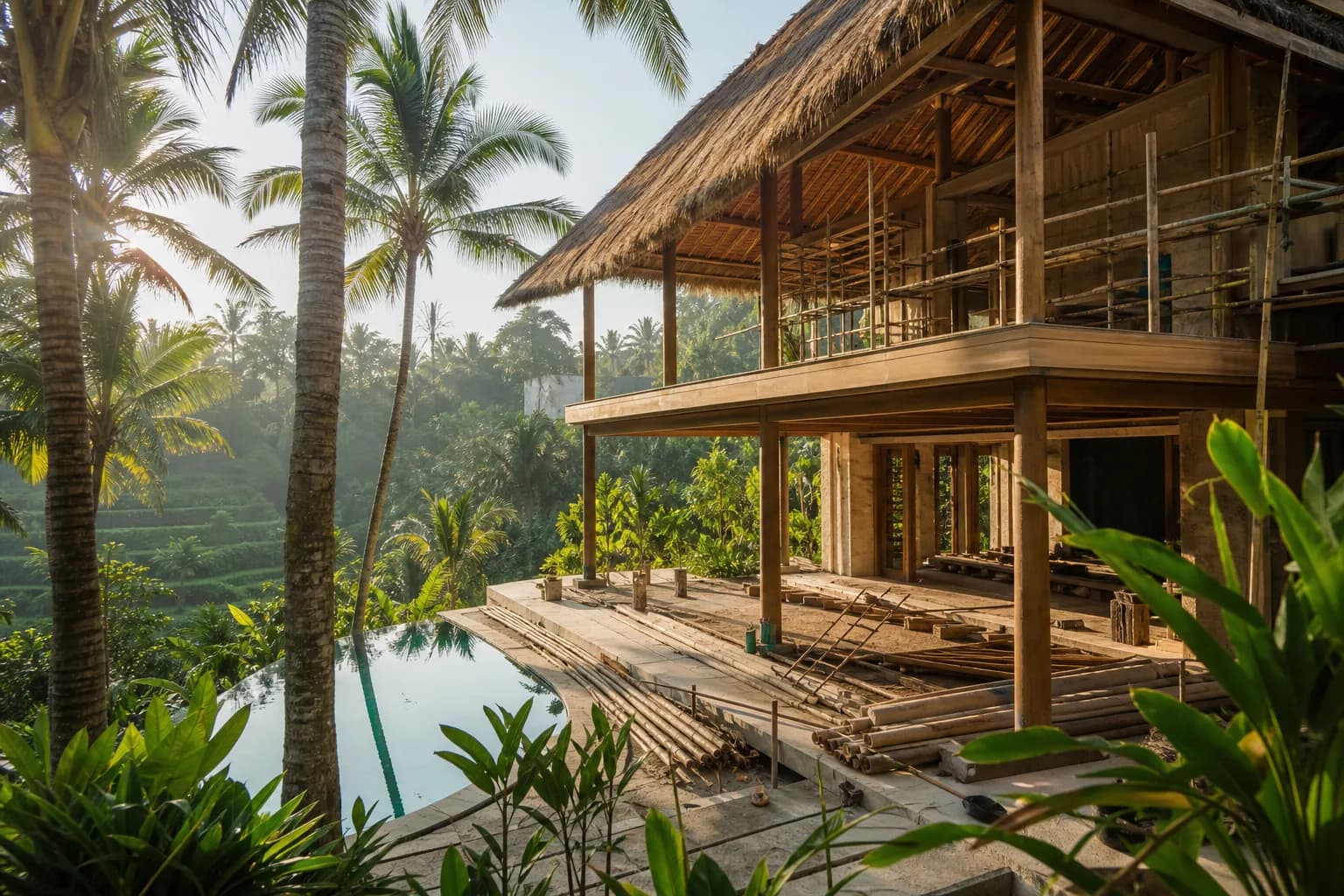
# The Complete Guide to Villa Ownership and Operation in Bali: Construction, Legal Compliance, and Long-Term Management
Understanding the Reality of Villa Ownership in Bali
Villa ownership in Bali represents a complex intersection of tropical construction engineering, Indonesian property law, and operational management that extends far beyond the initial build phase. For foreign investors and local developers alike, the journey from land acquisition to profitable villa operation involves navigating strict regulatory frameworks, understanding material science in high-humidity environments, and implementing sustainable maintenance protocols that protect long-term asset value.
The Bali villa market has matured significantly over the past decade, with construction costs in 2026 typically ranging between $1,000 and $1,800 per square meter for investment-grade properties. However, these figures represent only the baseline construction expenditure. The true cost of villa ownership encompasses legal compliance procedures, ongoing operational expenses, and the engineering considerations specific to tropical coastal environments that can add 30-40% to initial budget projections.
This comprehensive guide examines villa ownership from a construction and operational perspective, focusing on the technical realities that determine whether a villa project succeeds or becomes a financial liability. We’ll explore the regulatory landscape, material specifications, construction methodologies, and the operational frameworks necessary for sustainable villa management in Bali’s unique environment.
The Core Challenges of Villa Ownership in Bali
Villa ownership in Bali presents distinct challenges that differ fundamentally from property ownership in temperate climates or more developed regulatory environments. Understanding these challenges before committing to construction is essential for realistic project planning and budget allocation.
Regulatory Complexity and Foreign Ownership Restrictions
Indonesia’s property ownership laws create a layered regulatory environment that directly impacts construction planning and operational structure. Foreign nationals cannot own freehold land (Hak Milik) in Indonesia, limiting ownership options to leasehold arrangements (typically 25-30 years with extension options), nominee structures (legally questionable and risky), or Indonesian PT PMA company ownership (requiring minimum investment thresholds and operational compliance).
Each ownership structure carries different implications for construction permits, tax obligations, and operational licensing. A villa operated commercially requires different permits than a private residence, and the distinction affects everything from utility connections to staff employment regulations. The PBG (Persetujuan Bangunan Gedung) building permit and SLF (Sertifikat Laik Fungsi) occupancy certificate represent mandatory compliance checkpoints that cannot be circumvented without risking demolition orders or operational shutdowns.
Tropical Environmental Degradation
Bali’s tropical climate—characterized by 70-90% humidity, salt-laden coastal air, intense UV exposure, and seasonal monsoon rainfall exceeding 2,000mm annually—creates an aggressive environment for building materials. Standard construction materials and techniques used in temperate climates fail rapidly in these conditions, leading to structural degradation, mold proliferation, and accelerated corrosion that can compromise a villa’s integrity within 3-5 years if improper materials are specified.
The engineering challenge extends beyond material selection to encompass drainage design, ventilation strategies, and foundation systems that account for expansive clay soils and seasonal water table fluctuations. Villas constructed without proper tropical engineering consideration often experience foundation settlement, chronic moisture intrusion, and electrical system failures that require expensive remediation.
Operational Sustainability and Market Saturation
The operational phase of villa ownership presents ongoing challenges that many investors underestimate during the construction planning phase. Bali’s villa rental market has become increasingly saturated, with occupancy rates in secondary locations often falling below 40% annually. This reality makes operational efficiency and cost control critical for financial viability.
Maintenance costs in tropical environments typically run 8-12% of property value annually—significantly higher than the 1-2% common in temperate climates. Pool systems, air conditioning units, and exterior finishes require constant attention, while staff costs for cleaning, gardening, and security represent fixed expenses regardless of occupancy rates. Villas that fail to budget adequately for these operational realities often deteriorate rapidly, entering a cycle of deferred maintenance that destroys asset value.
Technical Construction Standards for Bali Villas
Investment-grade villa construction in Bali requires adherence to specific technical standards that address the unique environmental challenges of tropical coastal construction. These standards represent the minimum specifications necessary for long-term structural integrity and operational viability.
Foundation and Structural Systems
Bali’s geology varies significantly by region, with volcanic soils in the central highlands, limestone formations in the southern peninsula, and alluvial deposits in coastal areas. Each soil type requires different foundation approaches. Standard practice involves geotechnical investigation before design, with soil bearing capacity testing determining whether shallow strip footings, reinforced raft foundations, or deep pile systems are required.
For coastal locations within 2 kilometers of the ocean, marine-grade concrete specifications are essential. This typically means concrete with minimum 30 MPa compressive strength, maximum 0.4 water-cement ratio, and the addition of corrosion inhibitors. Reinforcing steel must be epoxy-coated or stainless steel (316 grade minimum) with concrete cover increased to 50-75mm to prevent chloride-induced corrosion. These specifications add approximately 15-20% to structural costs but are non-negotiable for long-term durability.
Structural frames should utilize reinforced concrete rather than steel framing in coastal areas, as steel corrosion remains problematic even with protective coatings. Concrete columns and beams should be designed with seismic considerations, as Bali sits in an active seismic zone requiring ductile detailing and proper reinforcement lap lengths per Indonesian building codes (SNI standards).
Envelope and Weatherproofing Systems
The building envelope represents the primary defense against tropical environmental degradation. Roof systems must handle intense UV exposure, thermal cycling, and heavy rainfall events. Clay tile roofing remains popular but requires proper underlayment—specifically, synthetic waterproof membranes rather than traditional felt paper, which degrades rapidly in tropical conditions.
Roof pitch should be minimum 30 degrees to ensure rapid water shedding, with generous overhangs (minimum 800mm) protecting walls from direct rainfall. Gutters and downspouts must be sized for tropical rainfall intensity—typically 150mm/hour design storms—with overflow provisions preventing water backup that can damage fascias and infiltrate wall systems.
Wall systems require careful vapor management. Unlike temperate climates where vapor barriers prevent interior moisture from reaching cold exterior surfaces, tropical construction requires vapor-permeable wall assemblies that allow moisture to escape while preventing liquid water intrusion. This typically means rendered masonry walls with breathable exterior finishes rather than sealed systems that trap moisture and promote mold growth.
Window and door systems represent critical vulnerability points. Aluminum frames should be marine-grade alloy (6063-T5 minimum) with powder-coated finishes rather than anodizing, which degrades in salt air. Hardware must be stainless steel (304 grade minimum), and glazing should be laminated safety glass with UV-filtering low-E coatings to reduce solar heat gain and protect interior finishes from UV degradation.
Mechanical and Electrical Systems
Electrical systems in tropical environments face unique challenges from humidity, salt air, and frequent power fluctuations common in Bali’s electrical grid. All electrical panels, junction boxes, and fixtures should be rated IP65 minimum for moisture protection. Wiring should be run in conduit rather than direct-buried in walls, facilitating future maintenance and preventing moisture-related failures.
Grounding systems are critical in tropical environments with frequent lightning activity. A comprehensive grounding grid with multiple earth electrodes and surge protection on main panels protects sensitive electronics and prevents dangerous voltage potentials. Many Bali villas experience chronic electrical problems due to inadequate grounding—a specification often cut during value engineering but essential for safe operation.
Air conditioning systems require careful sizing and specification. Undersized systems run continuously without achieving comfort conditions, while oversized systems short-cycle, failing to dehumidify effectively. Proper sizing requires heat load calculations accounting for Bali’s solar intensity, with systems typically requiring 30-40% greater capacity than equivalent temperate climate applications. Inverter-type systems with variable speed compressors provide better humidity control and energy efficiency than fixed-speed units.
Plumbing systems should utilize CPVC or PEX piping rather than PVC, which becomes brittle under UV exposure. All exterior piping must be protected from direct sunlight. Hot water systems should be solar thermal where possible, reducing operational costs while providing reliable performance. Drainage systems require proper venting and trap seals to prevent sewer gas intrusion—a common problem in poorly designed villas.
The Legal and Regulatory Framework
Successful villa ownership in Bali requires navigating a complex regulatory framework that governs land use, construction permits, operational licensing, and ongoing compliance obligations. Understanding this framework before committing to construction prevents costly delays and legal complications.
Land Acquisition and Ownership Structures
The foundation of villa ownership begins with proper land acquisition and legal structure. Foreign investors typically utilize one of three approaches: leasehold agreements (Hak Sewa), Indonesian PT PMA company ownership, or nominee arrangements. Each carries distinct legal implications and risk profiles.
Leasehold agreements provide the most straightforward approach for foreign villa owners, offering 25-30 year terms with extension options. Properly structured leasehold agreements should be notarized, registered with the local land office (BPN), and include clear terms regarding construction rights, extension mechanisms, and dispute resolution. The leasehold should be registered against the land title itself, providing protection against subsequent claims. Costs for leasehold registration typically run 2-3% of land value, plus notary fees.
PT PMA company ownership provides stronger legal standing but requires minimum investment thresholds (currently $2.5 million for property investment companies), annual compliance obligations including audited financial statements, and operational requirements that may include employing Indonesian staff. This structure suits larger villa developments or investors planning multiple properties but adds ongoing administrative costs of $5,000-10,000 annually for proper compliance.
Nominee arrangements, where Indonesian citizens hold title on behalf of foreign investors, remain legally questionable despite widespread use. Indonesian law explicitly prohibits such arrangements, and courts have ruled against foreign investors in disputes with nominees. While many villas operate under nominee structures, this approach carries substantial risk and cannot be recommended from a legal compliance perspective.
Construction Permits and Approvals
Construction in Bali requires multiple permits and approvals, with the PBG (building permit) representing the primary authorization. Obtaining a PBG requires submission of detailed construction drawings prepared by licensed Indonesian architects and engineers, structural calculations, site plans showing setbacks and coverage ratios, and proof of land rights.
The PBG application process typically requires 2-4 months for approval, though timelines vary by regency and project complexity. Costs include official fees (calculated based on construction value, typically 0.5-1% of project cost) plus professional fees for document preparation. Attempting construction without a valid PBG risks stop-work orders, fines, or demolition—enforcement has increased significantly in recent years as local governments crack down on illegal construction.
Upon completion, buildings require an SLF (occupancy certificate) confirming the structure was built according to approved plans and meets safety standards. The SLF process involves inspections by local building officials and typically requires 1-2 months. Operating a villa commercially without a valid SLF violates regulations and can result in operational shutdowns.
Additional permits may be required depending on location and intended use. Villas in tourist zones require tourism business licenses (TDUP), while villas operating as homestays or hotels require hospitality licenses. Environmental permits (UKL-UPL or AMDAL) may be required for larger developments or environmentally sensitive locations. Each permit carries specific requirements and renewal obligations that must be maintained throughout the villa’s operational life.
Zoning and Development Restrictions
Bali’s spatial planning regulations (RTRW) designate specific zones for different land uses, with restrictions on building height, coverage ratios, and setbacks varying by zone. Tourist zones typically allow commercial villa operations, while residential zones may restrict short-term rentals. Understanding zoning classifications before land acquisition prevents discovering that intended uses are prohibited after purchase.
Coastal setback regulations prohibit construction within 100 meters of the high tide line in most areas, with some regions extending this to 200 meters. These regulations are increasingly enforced, with several high-profile demolitions of illegal coastal structures in recent years. Villas in coastal areas must verify compliance with setback regulations and obtain proper permits—grandfather clauses for existing structures are limited and unreliable.
Cultural and religious restrictions also affect development. Land near temples (within the “aura” or sacred radius) may face construction restrictions, and certain areas are designated as culturally protected zones with additional requirements. Proper due diligence includes consulting with local banjar (village councils) and obtaining community approval, which, while not legally required, prevents future conflicts that can disrupt operations.
Step-by-Step Villa Development Process
Developing a villa in Bali follows a structured process that, when properly executed, minimizes risks and ensures regulatory compliance. This process typically spans 12-18 months from land acquisition to operational readiness.
Phase 1: Due Diligence and Land Acquisition (Months 1-3)
The development process begins with comprehensive due diligence on potential land parcels. This includes title verification at the local land office (BPN), confirming the seller’s legal ownership and identifying any encumbrances, liens, or disputes. Engage a reputable notary (PPAT) to conduct title searches and verify documentation authenticity—title fraud remains a risk in Bali’s property market.
Physical site assessment should include topographic survey, geotechnical investigation (minimum 3 boreholes for typical villa sites), utility availability verification, and access confirmation. Many attractive land parcels lack proper legal access or adequate utility infrastructure, creating expensive problems during construction. Budget $2,000-5,000 for comprehensive due diligence on typical villa sites.
Zoning verification confirms the intended use is permitted and identifies applicable restrictions. Obtain written confirmation from local planning offices (DPMPTSP) regarding zoning classification, building parameters, and permit requirements. This documentation protects against future disputes and provides clarity for design development.
Once due diligence is satisfactory, proceed with land acquisition through proper legal channels. Use a qualified notary for transaction documentation, ensure all taxes are paid (typically 5% BPHTB land transfer tax plus 2.5% income tax on seller), and register the transaction or leasehold agreement with the land office. Proper registration provides legal protection and is essential for subsequent permit applications.
Phase 2: Design Development and Permit Applications (Months 3-6)
With land secured, engage qualified design professionals—specifically, Indonesian-licensed architects and engineers required for permit applications. The design process should begin with a comprehensive brief outlining functional requirements, budget parameters, and operational intentions. Clear communication of expectations at this stage prevents expensive redesigns later.
Design development should proceed through schematic design, design development, and construction documentation phases. Each phase requires owner review and approval before proceeding. Budget adequate time for this process—rushed design leads to construction problems and cost overruns. Typical design fees run 5-8% of construction value for comprehensive services including permit documentation.
Concurrent with design development, begin permit applications. The PBG application requires complete construction drawings, structural calculations, site plans, and supporting documentation. Submit applications early in the design process, as approval timelines are unpredictable and delays are common. Engage a permit expediter (often provided by your architect) familiar with local procedures to navigate bureaucratic requirements efficiently.
During this phase, finalize construction budgets based on detailed quantity takeoffs from construction drawings. Obtain quotes from multiple contractors, comparing not just price but qualifications, experience with similar projects, and financial stability. The lowest bid is rarely the best value—contractor selection should prioritize competence and reliability over minimal cost. Review contractor proposals carefully, ensuring they include all scope items and clarifying any ambiguities before contract execution.
Phase 3: Construction Execution (Months 6-14)
Construction begins only after obtaining a valid PBG and executing a comprehensive construction contract. The contract should clearly define scope, schedule, payment terms, quality standards, and dispute resolution mechanisms. Use a standard form contract (such as FIDIC adapted for Indonesian law) rather than contractor-provided agreements that typically favor the contractor.
Implement proper construction oversight through regular site inspections by qualified professionals. Many villa owners attempt to manage construction themselves or rely solely on contractor representations—this approach consistently leads to quality problems and cost overruns. Engage an independent construction supervisor or project manager to verify work quality, monitor progress, and approve payment applications. This oversight typically costs 3-5% of construction value but prevents problems costing multiples of this amount.
Construction should proceed through foundation, structural frame, envelope, and finishing phases. Critical quality control points include foundation concrete placement (verify proper reinforcement and concrete quality), structural frame construction (confirm reinforcement placement and concrete strength), waterproofing installations (test before covering), and mechanical/electrical rough-ins (verify before closing walls).
Maintain detailed documentation throughout construction, including progress photos, material certifications, test reports, and as-built drawings noting any deviations from design documents. This documentation proves invaluable for future maintenance and renovations, and is required for SLF applications.
Payment should follow a structured schedule tied to verified completion milestones rather than time-based payments. Typical payment structures include 10% deposit, 30% upon foundation completion, 30% upon frame and roof completion, 20% upon substantial completion, and 10% retention released after final completion and defect rectification. Never advance payments beyond completed work value—this protects against contractor default.
Phase 4: Commissioning and Operational Setup (Months 14-18)
As construction nears completion, begin commissioning mechanical and electrical systems. This includes testing all equipment, verifying proper operation, and training operational staff on maintenance requirements. Many system failures in new villas result from improper commissioning rather than equipment defects.
Apply for the SLF certificate, which requires final inspections by local building officials. Address any deficiencies identified during inspections promptly—SLF issuance is mandatory for legal operation. Simultaneously, apply for operational licenses required for your intended use (tourism licenses, business permits, etc.).
Establish operational systems including staff hiring and training, maintenance protocols, booking systems (if operating as rental villa), and financial management procedures. Many villa owners underestimate the complexity of operational setup, leading to chaotic early operations that damage reputation and financial performance. Consider engaging experienced villa management companies, particularly for the first year of operation, to establish proper systems and procedures. Management fees typically run 20-30% of rental revenue but provide professional operations that maximize occupancy and protect asset value.
Conduct a comprehensive defect inspection before final contractor payment, documenting all incomplete or defective work requiring correction. Retain sufficient funds to ensure contractor motivation to complete punch list items—releasing final payment before defect correction typically results in abandoned items requiring expensive remediation.
Financial Realities: Costs and Ongoing Expenses
Understanding the complete financial picture of villa ownership requires examining not just construction costs but the full lifecycle expenses that determine long-term viability. Many villa projects fail financially because owners underestimate ongoing operational costs and maintenance requirements.
Construction Cost Breakdown
As noted, investment-grade villa construction in Bali typically costs $1,000-1,800 per square meter for finished properties. This range reflects different quality levels, location factors, and design complexity. A typical 200-square-meter villa therefore costs $200,000-360,000 for construction alone.
This baseline construction cost includes structure, envelope, finishes, mechanical and electrical systems, and basic landscaping. It assumes standard quality materials and finishes appropriate for rental villas—not luxury specifications or custom features. Breaking down this cost further: structure and envelope typically represent 40-45% of total cost, finishes 25-30%, mechanical and electrical systems 15-20%, and site work and landscaping 10-15%.
Additional costs beyond base construction include: land acquisition (varies widely by location, from $100-500+ per square meter), design fees (5-8% of construction cost), permits and legal fees (3-5% of construction cost), furniture and equipment (10-15% of construction cost for rental-ready villa), and contingency (minimum 10% for unforeseen conditions and changes). Total project cost therefore typically runs 150-180% of base construction cost.
For a 200
 172 m²8 month(s)from 120.000 USD
Keshava

Want to calculate?
 3104 m²11 month(s)from 99.000 USD
TALA 100
 164 m²7 month(s)from 79.000 USD
TALA TWO
164 m²7 month(s)from 79.000 USDPrivate: Haridas Villas, Tegallalang
 3173 m²6 month(s)from 125.000 USD
TALA FOUR
 3124 m²6 month(s)from 123.000 USD
TALA 8
 1from 198.000 USD
Private: Haridas Villas
 3127 m²9 month(s)from 177.000 USD
Mukunda
 3180 m²7 month(s)from 142.000 USD
Vasudeva
 4344 m²16 month(s)from 290.000 USD
Radha
 2144 m²11 month(s)from 104.000 USD
Narayana
Start With Real Numbers, Not Guesses
Before buying land or finalizing a design, check the realistic build cost range for your project in Bali.
Our team reviews your inputs and gives a grounded estimate.
Available lands
 2700 m²30 min$ 314224Bali, Sidemen
 2800 m²2 min$ 713793Bali, Kedungu
 550 m²5 min$ 217629Bali, Tabanan
 29000 m²6 min$ 3857143Bali, Tabanan
 515 m²7 min$ 570813Bali, Canggu
 1000 m²10 min$ 303571Bali, Tabanan
 500 m²15 min$ 124692Bali, Kaba Kaba
 2400 m²7 min$ 496552Bali, Canggu
 1300 m²10 min$ 312192Bali, Kutuh South Bali
 800 m²5 min$ 295567Bali, Seseh
 2000 m²10 min$ 243842Bali, Mengwi
 8313 m²15 min$ 716670Bali, Buduk
 889 m²15 min$ 145612Bali, Cepaka
 550 m²15 min$ 164594Bali, Mengwi
 1375 m²10 min$ 447044Bali, Canggu
Essential Bali build & buy guides
- Bali villa construction cost per m² in 2026
- How much will your villa cost? Calculator
- Building a villa in Bali: the complete guide
- Buying land in Bali: step-by-step for foreigners
- Bali villa investment: yields, risks, returns
- Leasehold vs freehold: what foreigners can own
- Construction defect liability & 10-year warranty
- Bali building codes and construction standards
Related guides
Selling a Bali Villa: Leasehold Resale, Exit Strategy and What Makes Villas Sellable
How the Bali leasehold resale market works in 2026: what you legally sell, how remaining lease term sets price, the notary transfer process, and the entry-day decisions that make a villa sellable later.
7 min read
Airbnb in Bali Under the 2026 Permit Rules: Delisting Enforcement and What Hosts Must Have in Place
Indonesia now requires every Bali Airbnb listing to sit on a verified registered business, with platform delisting for non-compliant hosts from 2026. What the rules require, how enforcement works, and the compliant path for foreign owners.
7 min read
Bali Villa Management Companies: Fee Structures, Contract Clauses, and How to Stay in Control
Villa management in Bali typically costs 15–25% of gross rental income — but OTA commissions, maintenance reserves and add-ons push the real erosion past 40%. How fee models work, which contract clauses protect you, and how to choose and control a manager.
8 min read