Pecatu Cliff Villa Cantilever Foundations: Engineering Costs Bali
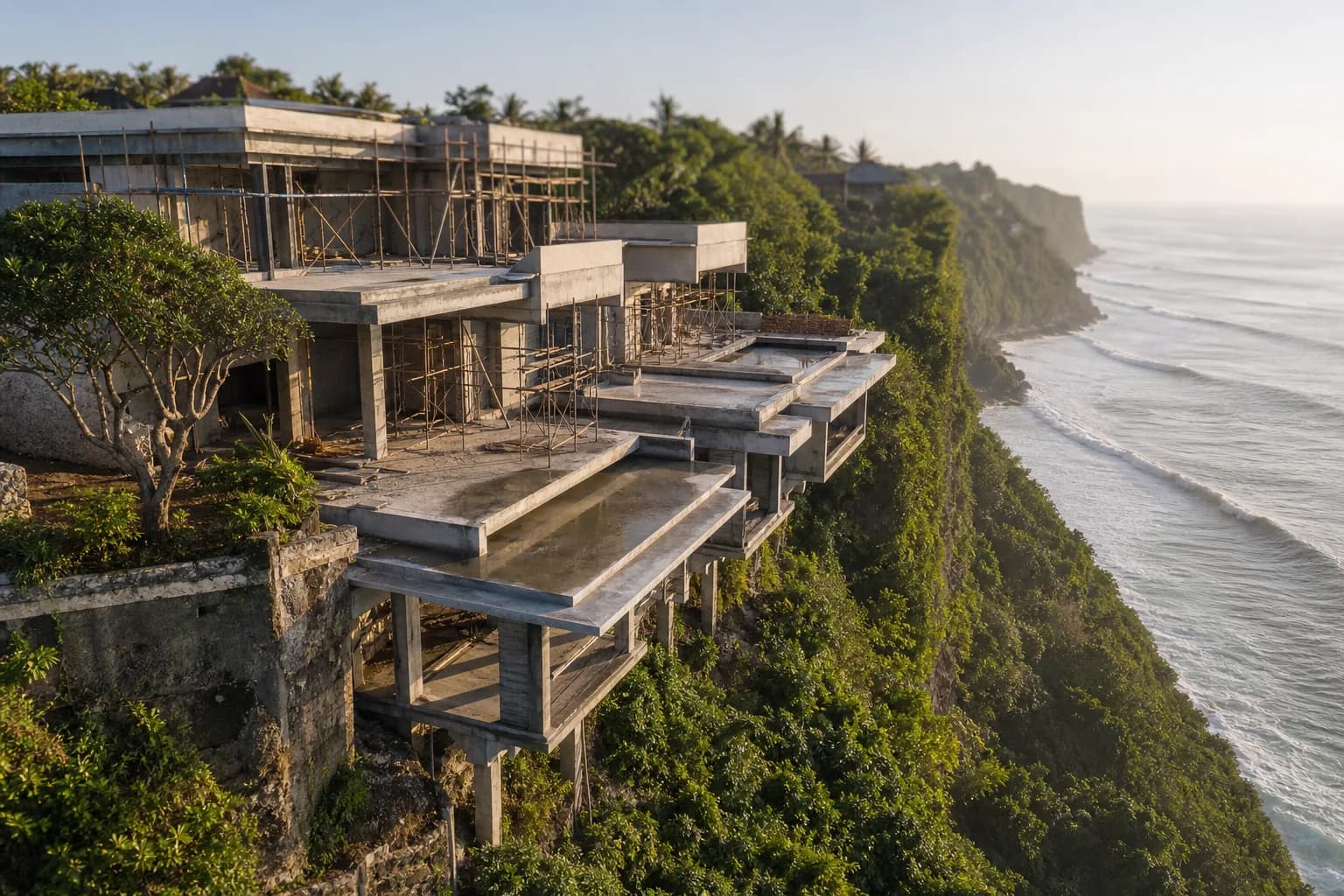
The Structural Challenge of Building on Pecatu’s Dramatic Cliff Edges
Pecatu’s limestone cliffs offer some of Bali’s most spectacular ocean views, but building a villa foundation on these dramatic edges requires specialized cantilever engineering that dramatically increases construction complexity and cost. Unlike standard villa construction on flat terrain, cliff-edge projects in Pecatu demand advanced structural calculations, specialized foundation systems, and geological assessments to prevent catastrophic failure. The question facing prospective villa owners isn’t whether cantilever engineering is expensive—it’s whether the site can safely support the loads at all, and what the true engineering cost premium will be for a structurally sound, legally compliant cliff-edge villa foundation.
Engineering Fundamentals: How Cantilever Foundations Work on Pecatu Limestone
Cantilever villa foundations in Pecatu represent one of the most technically demanding construction challenges in Bali villa development. The engineering principle involves extending structural elements beyond their natural support point, creating dramatic overhangs that appear to float above the cliff face. This isn’t architectural showmanship—it’s complex structural engineering that requires precise load distribution, advanced materials, and geological certainty.
Geological Considerations Specific to Pecatu Limestone
Pecatu’s cliff formations consist primarily of coral limestone (batu karang), which presents unique engineering challenges. Unlike the volcanic bedrock found in Ubud or the stable alluvial soils of Canggu, Pecatu limestone is porous, stratified, and subject to erosion from salt spray and wave action. Before any cantilever foundation design begins, geological surveys must determine:
- Load-bearing capacity of the specific limestone strata at various depths
- Fracture patterns and existing fissures that could propagate under load
- Erosion rates at the cliff face and subsurface water movement
- Seismic response characteristics of the limestone formation
- Setback requirements from the cliff edge based on geological stability
Professional geological surveys for cliff-edge sites in Pecatu typically cost IDR 45-75 million ($2,800-$4,700), but this investment is non-negotiable. Without accurate subsurface data, no reputable structural engineer will certify a cantilever foundation design.
Cantilever Foundation Design Systems
Three primary foundation systems are used for Pecatu cliff-edge villas, each with distinct engineering requirements and cost implications:
1. Deep Pile Foundation with Cantilever Beams: This system drives reinforced concrete piles 8-15 meters into stable limestone strata, well back from the cliff edge. Grade beams and cantilever beams extend from these piles toward the cliff, supporting the villa structure. The cantilever portion typically extends 3-6 meters beyond the last pile line. This system requires extensive steel reinforcement (often 180-220 kg/m³ compared to 120-150 kg/m³ for standard foundations) and high-grade concrete (K-350 or K-400 minimum).
2. Reinforced Concrete Mat Foundation with Tension Anchors: For sites where bedrock is relatively shallow (3-5 meters), a thick reinforced concrete mat (60-100cm thick) can be anchored into the limestone using post-tensioned cables or rock anchors. This system distributes loads across a larger area and uses the mass of the foundation itself as a counterweight to cantilever forces. Rock anchors must penetrate 4-8 meters into competent limestone and are typically spaced 2-3 meters apart along the cliff-facing edge.
3. Hybrid Pile-and-Anchor System: Combining elements of both approaches, this system uses shorter piles (5-8 meters) supplemented by tension anchors at strategic points. It’s often specified when geological surveys reveal variable limestone quality or when the villa design requires multiple cantilever points at different elevations.
Structural Load Calculations and Safety Factors
Cantilever foundations must resist several simultaneous forces: vertical dead loads (the villa’s weight), live loads (occupants, furniture, water in pools), wind loads (particularly significant at exposed cliff locations), and seismic loads. Indonesian building code (SNI 1726:2019 for seismic design, SNI 2847:2019 for concrete structures) requires minimum safety factors, but responsible engineers apply additional factors for cliff-edge construction.
For a typical 300m² cliff-edge villa with a 4-meter cantilever section, structural calculations must account for moment forces that can exceed 800 kN-m at the cantilever support point. This requires primary reinforcement bars of 25-32mm diameter, spaced at 150-200mm centers, with secondary reinforcement creating a dense steel cage. The engineering drawings alone for such a foundation system typically run 40-60 pages of detailed specifications.
Regulatory Compliance and IMB Requirements
Obtaining an IMB (Izin Mendirikan Bangunan – building permit) for a Pecatu cliff-edge villa requires additional documentation beyond standard villa construction. The Badung Regency building authority requires:
- Certified geological survey report from a licensed geotechnical engineer
- Structural calculations stamped by an Indonesian-licensed civil engineer (SIPIL)
- Environmental impact assessment for coastal zone construction
- Proof of compliance with coastal setback regulations (typically 100 meters from high tide line, though enforcement varies)
- Neighbor consent documentation if cantilever extends toward adjacent property boundaries
The IMB process for cliff-edge villas typically takes 4-7 months, compared to 2-4 months for standard villa construction, due to the additional technical review requirements.
Hidden Risks: What Villa Buyers Overlook in Cliff-Edge Construction
The Progressive Erosion Factor
Many buyers focus on initial structural integrity but fail to consider long-term cliff erosion. Pecatu’s limestone cliffs recede at rates of 2-8cm annually depending on exposure to wave action and prevailing winds. A foundation designed with a 5-meter setback from the cliff edge today may be at the edge in 15-20 years. Conservative engineering practice designs for 50-year erosion projections, but not all contractors include this in their calculations. This oversight can render a villa structurally compromised or unsellable within two decades.
Underestimating Corrosion in Marine Environments
The salt-laden air at Pecatu cliff locations accelerates steel reinforcement corrosion at rates 3-5 times faster than inland locations. Standard concrete cover (the distance between steel reinforcement and the concrete surface) of 40-50mm is insufficient. Cliff-edge foundations require 75-100mm cover, epoxy-coated reinforcement bars, and concrete admixtures that reduce permeability. Builders who skip these specifications save 15-20% on foundation costs initially but create structures that will show distress within 8-12 years instead of the expected 40-50 year lifespan.
The Infinity Pool Miscalculation
Infinity pools at cliff edges are visually stunning but represent a significant additional structural challenge. A 4m x 10m infinity pool holds approximately 120,000 liters of water, adding 120 tonnes of live load to the cantilever structure. This load is dynamic—it shifts with wind, creates wave action, and concentrates at the infinity edge. Many villa designs add pools as an afterthought without recalculating foundation requirements, leading to structural inadequacy. Proper engineering requires the pool to be integrated into the initial foundation design, typically adding 25-35% to the cantilever foundation cost.
Inadequate Drainage Engineering
Water infiltration is the primary cause of limestone foundation failure in Pecatu. Without proper drainage systems, rainwater and pool backwash can infiltrate the limestone, creating subsurface voids and reducing bearing capacity. Comprehensive drainage design includes perimeter drains, subsurface drainage layers, waterproof membranes, and positive drainage away from the cliff edge. This system typically adds IDR 85-150 million ($5,300-$9,400) to foundation costs but is frequently value-engineered out by cost-cutting contractors.
Step-by-Step Process: Engineering a Cliff-Edge Villa Foundation in Pecatu
Phase 1: Site Assessment and Feasibility (4-8 weeks)
Before purchasing land or finalizing villa designs, commission a preliminary geological assessment. This involves test borings at 3-5 locations across the proposed building footprint, extending to at least 15 meters depth or until competent bedrock is reached. The geotechnical report will specify allowable bearing pressures, recommend foundation types, and identify any geological conditions that make the site unsuitable for cantilever construction. Cost: IDR 45-75 million ($2,800-$4,700).
Simultaneously, verify the land’s legal status and coastal zone compliance. Pecatu cliff lands often have complex title situations, and some areas fall within protected coastal zones where construction is restricted or prohibited. Teville’s verified land consultation service can help navigate these legal complexities before significant engineering costs are incurred.
Phase 2: Conceptual Design and Load Analysis (3-5 weeks)
Work with an architect and structural engineer simultaneously to develop a villa concept that responds to the site’s geological constraints. The structural engineer performs preliminary load calculations to determine if the desired cantilever distances are feasible given the limestone bearing capacity. This phase often involves design iterations—reducing cantilever spans, relocating heavy elements like pools, or adjusting floor plans to optimize load distribution.
Key deliverable: A conceptual design with preliminary structural feasibility confirmed. This prevents the common mistake of falling in love with an architectural design that’s structurally impossible or prohibitively expensive to build on the specific site.
Phase 3: Detailed Engineering and Permit Documentation (8-12 weeks)
The structural engineer develops complete foundation drawings, including pile layouts, reinforcement schedules, concrete specifications, and construction sequencing. These drawings must comply with Indonesian building codes (SNI standards) and be stamped by an Indonesian-licensed civil engineer. Simultaneously, prepare the IMB application package, including the geological report, structural calculations, architectural drawings, and environmental compliance documentation.
Engineering fees for cliff-edge villa foundations typically range from 4-6% of the total foundation construction cost, compared to 2-3% for standard foundations, reflecting the additional complexity and liability.
Phase 4: Foundation Construction (10-16 weeks)
Cliff-edge foundation construction requires specialized equipment and experienced crews. The sequence typically involves: site preparation and temporary shoring, pile drilling or excavation (often requiring rock drilling equipment), steel reinforcement installation (with particular attention to lap lengths and cover requirements), formwork construction (more complex for cantilever sections), concrete placement (often requiring pumps due to site access constraints), and curing (extended curing periods for high-grade concrete in marine environments).
Quality control is critical. Third-party testing of concrete strength, reinforcement placement verification, and pile integrity testing should be mandatory. Teville’s construction process includes these quality checkpoints as standard practice for cliff-edge projects.
Phase 5: Monitoring and Maintenance Planning (Ongoing)
After construction, establish a monitoring protocol for the foundation. This includes annual visual inspections of the cliff face for erosion or cracking, periodic surveys to detect any settlement or movement, and concrete condition assessments every 3-5 years. This proactive approach identifies issues early when remediation is still feasible and cost-effective.
Realistic Cost Analysis: Pecatu Cliff-Edge Foundation Premiums
Cantilever foundation engineering for Pecatu cliff-edge villas commands significant cost premiums over standard villa foundations. Based on 2026 construction data, here are realistic cost ranges:
Standard Villa Foundation (flat terrain): IDR 2.8-4.2 million per m² ($176-$264 per m²)
Cliff-Edge Cantilever Foundation: IDR 6.5-11.5 million per m² ($409-$724 per m²)
This represents a 130-175% cost premium, driven by:
- Geological surveys and geotechnical engineering: IDR 45-75 million ($2,800-$4,700)
- Enhanced structural engineering fees: 4-6% of foundation cost vs. 2-3% standard
- Increased steel reinforcement: 180-220 kg/m³ vs. 120-150 kg/m³ standard
- Higher concrete grades: K-350/K-400 vs. K-250/K-300 standard
- Specialized equipment and labor: 35-50% premium for cliff-edge work
- Extended construction timeline: 10-16 weeks vs. 6-8 weeks standard
- Additional drainage and waterproofing systems: IDR 85-150 million ($5,300-$9,400)
For a 300m² villa with 40% of the footprint (120m²) on cantilever foundation, expect total foundation costs of IDR 1.2-1.8 billion ($75,500-$113,300), compared to IDR 550-750 million ($34,600-$47,200) for the same villa on flat terrain.
Timeline considerations: Cliff-edge villa projects require 6-9 months from land acquisition to foundation completion, compared to 3-5 months for standard villas. This extended timeline has carrying cost implications for land leases and construction financing.
Frequently Asked Questions: Pecatu Cliff-Edge Villa Foundations
Can existing cliff-edge villas in Pecatu be used as reference for foundation design?
No—each cliff-edge site has unique geological conditions that require site-specific engineering. Pecatu’s limestone varies significantly in quality, stratification, and bearing capacity even within a single development area. What works 100 meters away may be inadequate or over-engineered for your specific site. Additionally, many older cliff-edge villas in Pecatu were built before curr
 1from 198.000 USD
Private: Haridas Villas
 172 m²8 month(s)from 120.000 USD
Keshava
 3124 m²6 month(s)from 123.000 USD
TALA 8
 164 m²7 month(s)from 79.000 USD
Private: Haridas Villas, Tegallalang
 3127 m²9 month(s)from 177.000 USD
Mukunda

Want to calculate?
 3104 m²11 month(s)from 99.000 USD
TALA 100
 4344 m²16 month(s)from 290.000 USD
Radha
 2144 m²11 month(s)from 104.000 USD
Narayana
 3173 m²6 month(s)from 125.000 USD
TALA FOUR
164 m²7 month(s)from 79.000 USDTALA TWO
 3180 m²7 month(s)from 142.000 USD
Vasudeva
Start With Real Numbers, Not Guesses
Before buying land or finalizing a design, check the realistic build cost range for your project in Bali.
Our team reviews your inputs and gives a grounded estimate.
Available lands
 2500 m²5 min$ 609606Bali, Kedungu
 1000 m²5 min$ 350431Bali, Drupadi
 889 m²15 min$ 145612Bali, Cepaka
 7250 m²56 min$ 235714Bali, Tabanan
 3100 m²15 min$ 257697Bali, Tegallalang
 1000 m²10 min$ 230911Bali, Kerobokan
 7500 m²5 min$ 206281Bali, Kedungu
 1362 m²15 min$ 335468Bali, Tumbak
 13000 m²1 min$ 920567Bali, Pekutatan
 911 m²15 min$ 248217Bali, Pererenan
 1100 m²8 min$ 280419Bali, Ungasan
 680 m²15 min$ 110751Bali, Pererenan
 420 m²15 min$ 41897Bali, Tabanan
 660 m²10 min$ 175567Bali, Mengwi
 250 m²15 min$ 40025Bali, Munggu
Essential Bali build & buy guides
- Bali villa construction cost per m² in 2026
- How much will your villa cost? Calculator
- Building a villa in Bali: the complete guide
- Buying land in Bali: step-by-step for foreigners
- Bali villa investment: yields, risks, returns
- Leasehold vs freehold: what foreigners can own
- Construction defect liability & 10-year warranty
- Bali building codes and construction standards
Related guides
Selling a Bali Villa: Leasehold Resale, Exit Strategy and What Makes Villas Sellable
How the Bali leasehold resale market works in 2026: what you legally sell, how remaining lease term sets price, the notary transfer process, and the entry-day decisions that make a villa sellable later.
7 min read
Airbnb in Bali Under the 2026 Permit Rules: Delisting Enforcement and What Hosts Must Have in Place
Indonesia now requires every Bali Airbnb listing to sit on a verified registered business, with platform delisting for non-compliant hosts from 2026. What the rules require, how enforcement works, and the compliant path for foreign owners.
7 min read
Bali Villa Management Companies: Fee Structures, Contract Clauses, and How to Stay in Control
Villa management in Bali typically costs 15–25% of gross rental income — but OTA commissions, maintenance reserves and add-ons push the real erosion past 40%. How fee models work, which contract clauses protect you, and how to choose and control a manager.
8 min read