Bedugul Highland Frost Heave Prevention Drainage Costs Bali
Why Bedugul Highland Foundation Engineering Demands Specialized Frost Heave Prevention and Drainage Systems
Bedugul’s highland terrain at 1,200-1,500 meters elevation presents a unique construction challenge rarely discussed in Bali villa development: foundation frost heave risk combined with extreme rainfall drainage requirements. While Bali’s tropical climate doesn’t produce traditional ground freezing, Bedugul’s microclimate creates temperature fluctuations between 10-28°C with soil moisture cycles that mimic frost heave mechanics—expansive clay soils absorbing water, expanding, then contracting during dry periods. This cyclical movement, combined with annual rainfall exceeding 3,000mm, creates foundation stress patterns that standard Bali coastal construction methods cannot address. Villa owners purchasing highland land without engineering-grade foundation systems face cracked structural walls, differential settlement, and drainage failure within 18-36 months of completion.
Technical Engineering Requirements for Bedugul Highland Foundation Systems
Bedugul’s volcanic soil composition—predominantly andosol and latosol clay mixtures—exhibits plasticity indices between 25-40%, classifying as highly expansive under the Unified Soil Classification System. When moisture content increases during monsoon periods (November-March), these soils can expand 8-12% volumetrically, generating uplift pressures exceeding 150 kPa on shallow foundations. The engineering solution requires three integrated systems that coastal Bali construction rarely implements.
Deep Foundation Penetration Below Active Soil Zone
Standard Bali villa foundations terminate at 0.8-1.2 meters depth, adequate for stable coastal sand-clay mixtures. Bedugul highland sites require foundation penetration to 2.5-3.5 meters, reaching below the active moisture fluctuation zone where seasonal expansion-contraction cycles occur. This typically necessitates reinforced concrete pile foundations (25cm diameter, grade K-300 concrete) spaced at 1.5-2.0 meter intervals, tied with grade beams rather than simple strip footings. Geotechnical investigation through Standard Penetration Test (SPT) borings at 3-5 locations across the site determines exact bearing stratum depth—a step frequently omitted in speculative highland developments.
Capillary Break Layers and Moisture Barriers
Preventing moisture migration from expansive subsoil into the foundation system requires engineered capillary break layers—typically 20-30cm compacted aggregate (crushed stone 20-40mm diameter) beneath all foundation elements, wrapped in geotextile fabric (minimum 200 g/m² non-woven polypropylene). This layer interrupts capillary rise that would otherwise transport groundwater upward during wet seasons. Additionally, horizontal moisture barriers (polyethylene sheeting minimum 0.5mm thickness or bituminous membrane) must be installed at the foundation-to-superstructure interface, preventing moisture wicking into structural walls. These specifications exceed standard Indonesian construction codes (SNI 03-2847-2019) which assume non-expansive soil conditions.
Perimeter Drainage and Surface Water Management
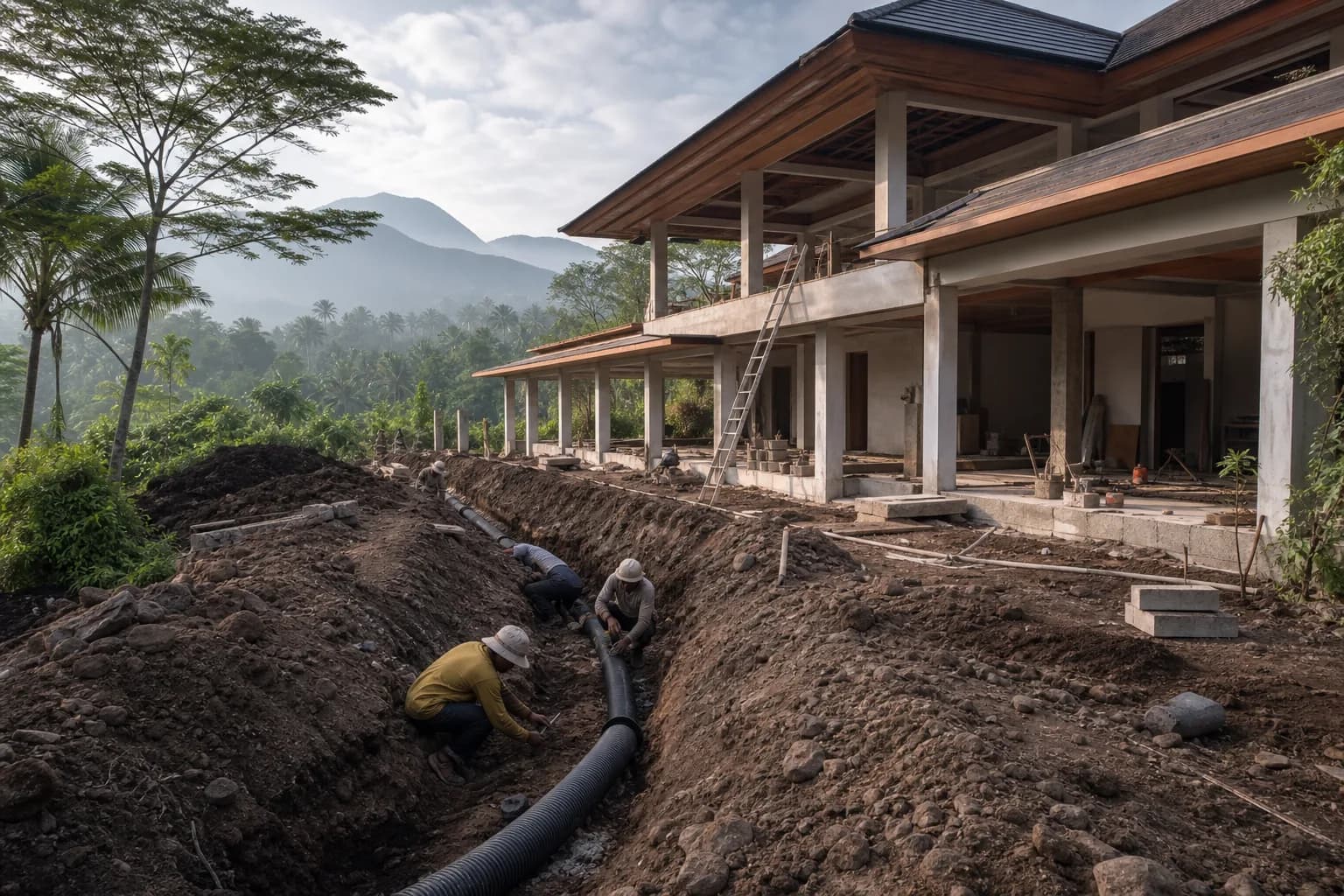
Bedugul’s 3,000-3,500mm annual rainfall—triple the Seminyak coastal average—requires comprehensive drainage engineering. Perimeter foundation drains (100-150mm perforated PVC pipe in 30cm gravel-filled trenches) must be installed at footing depth around the entire building envelope, sloped minimum 1% grade to discharge points. Surface drainage systems including French drains, swales, and retention basins prevent water accumulation within 5 meters of foundations. Critical detail: discharge systems must account for soil percolation rates of 5-15mm/hour in Bedugul clay soils versus 25-50mm/hour in coastal sandy soils, requiring larger retention volumes or mechanical pumping to municipal drainage where gravity discharge is insufficient.
Structural Reinforcement for Differential Movement
Even with proper foundation depth and drainage, residual soil movement requires structural accommodation. Reinforced concrete ring beams at foundation level (minimum 20x30cm section, 4D16 longitudinal bars, D10 stirrups @150mm spacing) create a rigid frame that distributes localized soil pressures. Wall reinforcement—typically 12mm diameter vertical bars at 400mm centers in concrete columns, tied with horizontal ring beams at 3-meter vertical intervals—prevents crack propagation from minor differential settlement. This reinforcement density exceeds standard single-story villa construction by 40-60% in steel tonnage.
Hidden Risks Villa Buyers Miss in Highland Foundation Specifications
The primary risk in Bedugul highland villa construction is specification substitution during execution. Developers and contractors familiar only with coastal construction methods routinely propose “standard Bali villa foundations” without disclosing their inadequacy for expansive highland soils. Three critical oversights occur repeatedly:
Omitted Geotechnical Investigation
Approximately 70% of highland villa projects proceed without proper soil testing, relying instead on visual assessment or neighboring project assumptions. Bedugul soil conditions vary dramatically within 50-meter distances due to historical volcanic ash deposition patterns and erosion. A site appearing stable may contain clay lenses at 1.5-2.0 meter depth with expansion potential 3-4 times higher than surface soils. Without SPT boring data and laboratory plasticity testing, foundation design becomes speculative guesswork.
Inadequate Drainage Capacity Calculation
Standard drainage pipe sizing uses coastal rainfall intensity (50-80mm/hour peak). Bedugul experiences storm events exceeding 120mm/hour, overwhelming undersized drainage systems. The result: water accumulation at foundations during critical monsoon periods, precisely when soil expansion risk peaks. Proper design requires hydrological analysis using Bedugul-specific rainfall data (available from BMKG Baturiti station) and soil infiltration testing, not generic Bali assumptions.
Construction Sequencing Errors
Highland foundation work requires dry-season scheduling (April-October) when soil moisture content stabilizes. Contractors pouring foundations during monsoon months embed high moisture content into the system, guaranteeing future expansion-contraction cycles. Additionally, inadequate concrete curing in Bedugul’s cooler temperatures (often 12-15°C overnight) reduces 28-day compressive strength by 15-25% compared to coastal pours, compromising structural capacity against soil pressure loads.
Step-by-Step Process for Engineering-Grade Highland Foundation Systems
Phase 1: Site Investigation and Geotechnical Analysis (3-4 Weeks)
Commission geotechnical investigation through certified soil mechanics laboratory. Minimum scope includes three SPT borings to 5-meter depth across the building footprint, laboratory testing for plasticity index, grain size distribution, and permeability. Request specific analysis for expansive soil potential using swell pressure testing. Budget 25-35 million IDR for comprehensive investigation on typical 500-1,000m² villa sites. This data determines foundation type (shallow reinforced vs. pile system) and drainage requirements.
Phase 2: Foundation Engineering Design (2-3 Weeks)
Engage structural engineer with highland construction experience to develop foundation drawings based on geotechnical data. Design must specify: pile depth and spacing if required, reinforcement schedules, capillary break layer specifications, moisture barrier details, and perimeter drainage layout. Verify design compliance with SNI 03-2847-2019 concrete code and SNI 03-1726-2019 seismic provisions (Bedugul falls in seismic zone 3). Engineering fees typically range 15-25 million IDR for single-villa foundations.
Phase 3: Material Procurement and Quality Verification (1-2 Weeks)
Source materials meeting specification grades: K-300 ready-mix concrete from certified batching plants (verify test certificates), steel reinforcement with mill certificates confirming grade BjTS 40 (400 MPa yield strength), geotextile fabric with manufacturer specifications, and perforated drainage pipe rated for soil burial. Highland logistics add 15-20% to material costs versus coastal delivery due to transport distance and road conditions. Reject contractor proposals to substitute lower-grade materials “because it’s standard in Bali.”
Phase 4: Foundation Construction with Quality Control (4-6 Weeks)
Schedule foundation work during dry season months. Implement mandatory quality checkpoints: excavation depth verification before concrete pour, reinforcement placement inspection (photograph bar spacing and lap lengths), concrete slump testing on delivery (12±2cm for K-300 mix), and proper curing procedures (wet burlap covering for minimum 7 days in Bedugul’s cooler climate). Install perimeter drainage before backfilling, with inspection of pipe slope using laser level. Document all stages photographically for future reference.
Phase 5: Drainage System Integration and Testing (1-2 Weeks)
Complete surface drainage elements including swales, retention basins, and discharge connections. Conduct water testing by flooding areas adjacent to foundations and verifying drainage flow rates and discharge capacity. Confirm no ponding occurs within 5-meter perimeter of building footprint during simulated heavy rainfall (50 liters/minute application for 30 minutes). Address any low spots or inadequate slopes before proceeding to superstructure construction.
Realistic Cost Ranges for Bedugul Highland Foundation Systems
Foundation costs for Bedugul highland villas significantly exceed coastal construction due to engineering requirements and material quantities. For a typical 200m² single-story villa, expect the following ranges based on 2026 Bali construction economics:
Geotechnical Investigation: 25-35 million IDR for three SPT borings with laboratory analysis, site-specific recommendations, and engineer’s report. Add 8-12 million IDR for expansive soil swell testing if preliminary results indicate high plasticity clays.
Foundation Structural System: 180-280 million IDR for engineered pile foundation with grade beams, including excavation, reinforcement, concrete, and formwork. This represents 850,000-1,400,000 IDR per square meter of building footprint—approximately 60-80% higher than standard coastal strip footing foundations (500,000-700,000 IDR/m²). Shallow reinforced foundations on favorable soil conditions may reduce costs to 120-180 million IDR total.
Drainage Infrastructure: 45-75 million IDR for comprehensive perimeter drainage system including perforated pipe, gravel bedding, geotextile wrapping, surface swales, and retention basin. Complex sites with poor natural drainage requiring pumped discharge systems add 30-50 million IDR for sump installation and piping to municipal drainage points.
Moisture Barriers and Capillary Breaks: 15-25 million IDR for aggregate capillary break layers, geotextile fabric, and horizontal moisture barriers at foundation-to-wall interfaces across typical villa footprint.
Total Foundation Package: 265-415 million IDR ($16,500-$26,000 USD at 16,000 IDR exchange rate) for complete engineering-grade highland foundation system. This represents 18-25% of total villa construction budget for 200m² building, compared to 12-15% for coastal sites.
Timeline from geotechnical investigation through completed foundation ready for superstructure: 10-15 weeks, weather-dependent. Monsoon delays can extend schedules by 4-8 weeks if work must pause during heavy rainfall periods.
Frequently Asked Questions: Bedugul Highland Foundation Engineering
Can I use the same foundation design as coastal Bali villas for my Bedugul highland property?
No—coastal foundation designs fail in Bedugul’s expansive clay soils and high-rainfall environment. Coastal villas typically use shallow strip footings at 0.8-1.2m depth, adequate for stable sandy-clay coastal soils with 1,500mm annual rainfall. Bedugul’s expansive volcanic clays require foundations penetrating 2.5-3.5m to reach stable bearing strata below the moisture fluctuation zone, plus engineered drainage handling 3,000mm+ annual rainfall. Using coastal specifications in highland conditions results in foundation movement, structural cracking, and drainage failure within 18-36 months. Site-specific geotechnical investigation determines appropriate foundation type—never assume coastal methods transfer to highland elevations.
What soil testing is actually necessary before designing a Bedugul villa foundation?
Minimum requirement: three Standard Penetration Test (SPT) borings distributed across the building footprint, penetrating to 5-meter depth or 3 meters below planned foundation depth, whichever is greater. Laboratory testing must include Atterberg limits (plasticity index), grain size distribution, natural moisture content, and permeability. If plasticity index exceeds 20%, request swell pressure testing to quantify expansion potential. Testing costs 25-35 million IDR but prevents foundation failures costing 200-500 million IDR to remediate. Bedugul soil conditions vary dramatically within small distances due to volcanic deposition patterns—neighboring site data cannot substitute for property-specific investigation. Certified geotechnical laboratories in Bali include those affiliated with Udayana University and independent consultancies serving infrastructure projects.
How much does frost heave prevention add to foundation costs compared to standard construction?
Bedugul doesn’t experience true frost heave (ground freezing), but expansive clay behavior creates similar foundation stress. Prevention measures—deep foundations below active soil zone, capillary break layers, moisture barriers, and comprehensive drainage—add 60-80% to foundation costs versus standard coastal construction. For 200m² villa: standard coastal foundation costs 120-150 million IDR; Bedugul engineering-grade system costs 265-415 million IDR. The increment (145-265 million IDR) purchases long-term structural stability. Omitting these measures doesn’t save money—it defers costs to post-construction remediation averaging 300-600 million IDR when foundation movement damages superstructure. View highland foundation engineering as essential infrastructure, not optional upgrade.
What drainage capacity should Bedugul villa foundations include 1from 198.000 USD
Private: Haridas Villas
 3180 m²7 month(s)from 142.000 USD
Vasudeva
 164 m²7 month(s)from 79.000 USD
TALA TWO
164 m²7 month(s)from 79.000 USDPrivate: Haridas Villas, Tegallalang
 2144 m²11 month(s)from 104.000 USD
Narayana

Want to calculate?
 3104 m²11 month(s)from 99.000 USD
TALA 100
 3124 m²6 month(s)from 123.000 USD
TALA 8
 3127 m²9 month(s)from 177.000 USD
Mukunda
 3173 m²6 month(s)from 125.000 USD
TALA FOUR
 172 m²8 month(s)from 120.000 USD
Keshava
 4344 m²16 month(s)from 290.000 USD
Radha
Start With Real Numbers, Not Guesses
Before buying land or finalizing a design, check the realistic build cost range for your project in Bali.
Our team reviews your inputs and gives a grounded estimate.
Available lands
 5028 m²10 min$ 361000Bali, Ubud
 4270 m²10 min$ 394397Bali, Ubud
 6000 m²30 min$ 55419Bali, Tabanan
 700 m²8 min$ 165517Bali, Umalas
 1000 m²10 min$ 184729Bali, Kutuh South Bali
 3000 m²15 min$ 738916Bali, Cepaka
 700 m²20 min$ 90517Bali, Cepaka
 5815 m²5 min$ 815740Bali, Tabanan
 1660 m²10 min$ 343448Bali, Kerobokan
 7900 m²25 min$ 413485Bali, Tabanan
 2200 m²3 min$ 183842Bali, Berawa
 3800 m²15 min$ 100616Bali, Pererenan
 700 m²15 min$ 162500Bali, Tabanan
 1000 m²5 min$ 350431Bali, Drupadi
 1100 m²8 min$ 280419Bali, Ungasan
Essential Bali build & buy guides
- Bali villa construction cost per m² in 2026
- How much will your villa cost? Calculator
- Building a villa in Bali: the complete guide
- Buying land in Bali: step-by-step for foreigners
- Bali villa investment: yields, risks, returns
- Leasehold vs freehold: what foreigners can own
- Construction defect liability & 10-year warranty
- Bali building codes and construction standards
Related guides
Selling a Bali Villa: Leasehold Resale, Exit Strategy and What Makes Villas Sellable
How the Bali leasehold resale market works in 2026: what you legally sell, how remaining lease term sets price, the notary transfer process, and the entry-day decisions that make a villa sellable later.
7 min read
Airbnb in Bali Under the 2026 Permit Rules: Delisting Enforcement and What Hosts Must Have in Place
Indonesia now requires every Bali Airbnb listing to sit on a verified registered business, with platform delisting for non-compliant hosts from 2026. What the rules require, how enforcement works, and the compliant path for foreign owners.
7 min read
Bali Villa Management Companies: Fee Structures, Contract Clauses, and How to Stay in Control
Villa management in Bali typically costs 15–25% of gross rental income — but OTA commissions, maintenance reserves and add-ons push the real erosion past 40%. How fee models work, which contract clauses protect you, and how to choose and control a manager.
8 min read