Uluwatu Cliff Setback Violations: Liability Retrofit Costs Bali
{
“article”: {
“title”: “Uluwatu Cliff-Edge Setback Violations: Liability & Retrofit Costs Bali”,
“content”: “
The Cliff-Edge Compliance Crisis in Uluwatu
\n\n
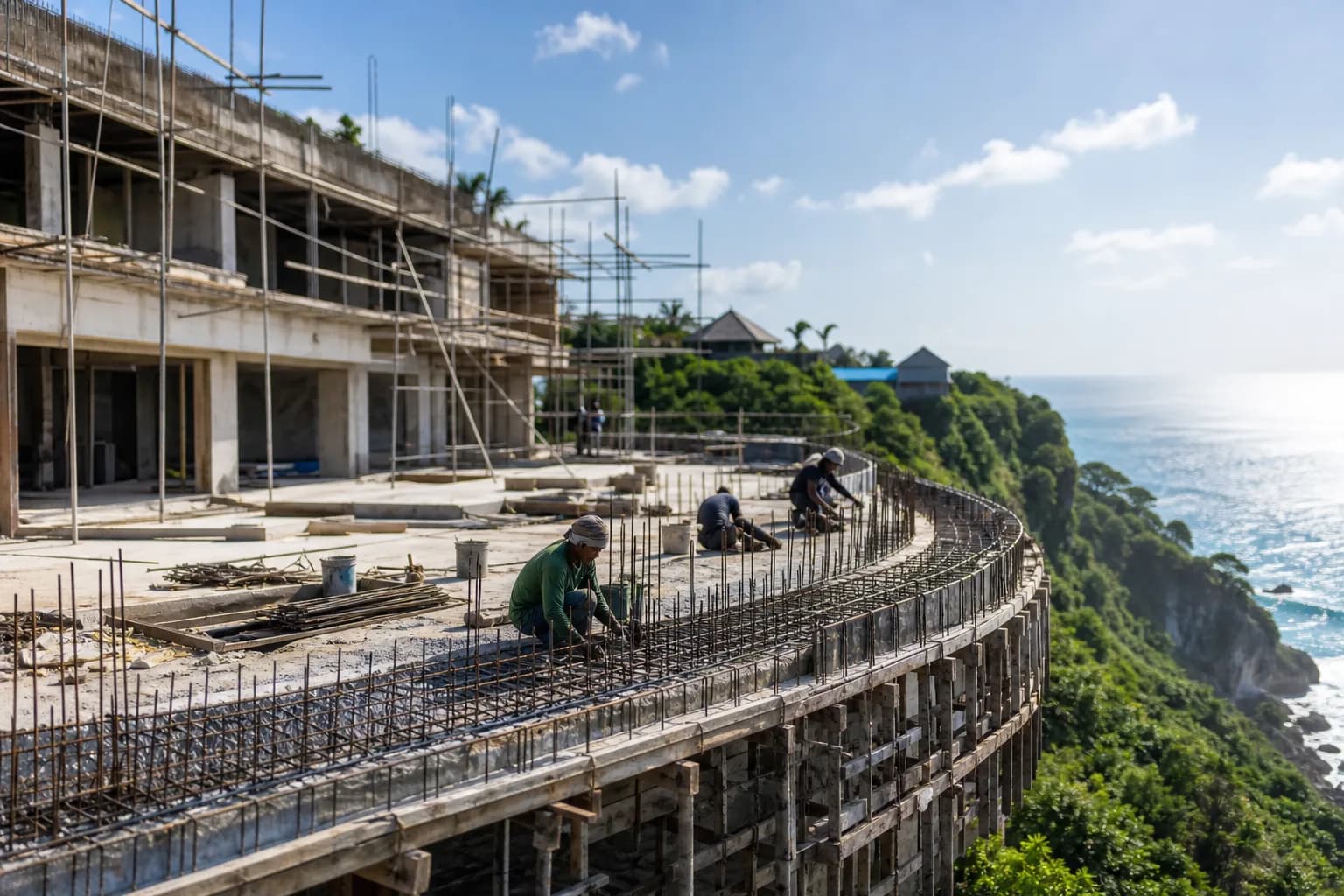
Uluwatu’s dramatic cliff-edge properties represent some of Bali’s most spectacular real estate, but a growing number of villa owners are discovering that their dream properties violate strict coastal setback regulations. Recent enforcement actions have resulted in demolition orders for structures built within the mandated 100-meter cliff-edge buffer zone, with property owners facing liability costs between $180,000 and $220,000 for full demolition and site restoration. Unlike coastal beach setbacks, cliff-edge violations in Uluwatu involve additional geological stability concerns, making retrofit solutions significantly more complex and expensive than standard compliance corrections.
\n\n
Technical Framework: Cliff-Edge Setback Regulations in Uluwatu
\n\n
Uluwatu’s cliff-edge setback regulations are governed by multiple overlapping frameworks that create a complex compliance landscape. The primary regulation establishes a 100-meter setback from the cliff edge, measured from the point of highest erosion risk or structural instability. This differs fundamentally from beach setbacks, which measure from the high-tide line.
\n\n
The technical definition of \”cliff edge\” is critical: it’s not simply the visible edge but rather the geologically determined zone of potential instability. Limestone cliff formations in Uluwatu are subject to progressive erosion, underground water flow, and seismic activity. Engineering assessments must account for a 50-year erosion projection, which can extend the effective setback zone by an additional 15-25 meters depending on cliff composition and wave exposure.
\n\n
Three regulatory layers govern these properties:
\n\n
- \n
- Provincial Coastal Zone Management: Establishes the baseline 100-meter setback from cliff edges exceeding 10 meters in height
- Badung Regency Spatial Planning: Adds specific restrictions for Uluwatu’s protected scenic corridor, including height limitations and density controls
- Environmental Impact Assessment Requirements: Mandates geological stability studies for any construction within 150 meters of cliff edges
\n
\n
\n
\n\n
The liability structure for violations is particularly severe. Property owners bear full responsibility regardless of when the structure was built or whether previous permits were issued. Recent court cases have established that improperly issued permits do not shield owners from demolition orders. The legal principle of \”public safety supersedes private property rights\” has been consistently applied in cliff-edge violation cases.
\n\n
Structural engineering considerations add another layer of complexity. Cliff-edge properties must demonstrate that foundations do not compromise cliff stability through:
\n\n
- \n
- Deep pile foundations that penetrate water-bearing strata
- Excavation that removes lateral support from cliff faces
- Drainage systems that alter natural water flow patterns
- Weight loading that exceeds the bearing capacity of eroded limestone
\n
\n
\n
\n
\n\n
Retrofit engineering for existing violations must address both regulatory compliance and geological stability. This typically requires comprehensive geotechnical investigation including ground-penetrating radar, core sampling to 20-meter depths, and hydrological flow analysis. The engineering assessment alone costs $15,000-$25,000 before any remediation work begins.
\n\n
Current enforcement protocols involve annual aerial drone surveys combined with ground inspections. Properties identified with potential violations receive formal notice requiring owner-funded geological assessments within 90 days. Failure to comply results in immediate construction prohibition orders and potential criminal liability for property owners and their construction contractors.
\n\n
Hidden Risks: What Property Buyers Miss in Cliff-Edge Transactions
\n\n
The most dangerous assumption buyers make is that existing structures with IMB permits are automatically compliant. In Uluwatu’s cliff-edge zones, permits issued before 2019 often did not require the geological stability assessments now mandated. Properties with valid permits can still face demolition orders if subsequent geological surveys reveal stability risks or setback violations based on updated erosion projections.
\n\n
Title insurance and standard due diligence rarely catch these issues. Most property lawyers check permit documentation but don’t commission independent geological surveys or verify that setback measurements account for erosion projections. The $3,000-$5,000 cost of pre-purchase geological assessment seems expensive until compared to the $180,000+ demolition liability.
\n\n
Another critical gap: many properties have compliant main structures but violating auxiliary buildings. Infinity pools, viewing decks, and guest pavilions built within the setback zone trigger the same demolition liability as main villas. Partial demolition orders are common, where owners must remove specific structures while maintaining others—a process that often damages remaining buildings and requires extensive reconstruction.
\n\n
Leasehold properties present amplified risk. Lease agreements typically make the leaseholder responsible for regulatory compliance and demolition costs, but many leases don’t specify liability for violations that existed before the lease term. Foreign leaseholders have faced situations where they’re liable for demolishing structures they didn’t build, with no recourse against the Indonesian landowner who originally violated setback rules.
\n\n
Step-by-Step Compliance Verification and Retrofit Process
\n\n
For existing properties or land purchases in Uluwatu’s cliff-edge zones, a systematic verification process is essential:
\n\n
Phase 1: Preliminary Assessment (2-3 weeks)
\n\n
Commission a licensed surveyor to establish exact distances from the cliff edge to all structures, using the geological definition rather than visual edge. This requires topographical survey equipment and costs $2,500-$4,000. Simultaneously, obtain all existing permits and compare approved site plans against actual construction. Discrepancies between permitted and built structures are common and indicate potential violations.
\n\n
Phase 2: Geological Investigation (4-6 weeks)
\n\n
Engage a certified geotechnical engineer to conduct subsurface investigation including:
\n\n
- \n
- Minimum six bore holes to 20-meter depth
- Ground-penetrating radar survey of cliff structure
- Water table and flow pattern analysis
- 50-year erosion projection modeling
- Seismic stability assessment for existing foundations
\n
\n
\n
\n
\n
\n\n
This investigation costs $15,000-$25,000 but provides the technical basis for any retrofit strategy or compliance defense.
\n\n
Phase 3: Regulatory Consultation (3-4 weeks)
\n\n
Before designing retrofit solutions, obtain formal written guidance from Badung Regency spatial planning office and provincial coastal management authority. Submit the geological report and request specific guidance on compliance pathways. This step is critical because retrofit solutions that seem logical may not satisfy regulatory requirements.
\n\n
Phase 4: Retrofit Engineering Design (6-8 weeks)
\n\n
If partial compliance is possible, structural engineers must design solutions that may include:
\n\n
- \n
- Selective demolition of violating structures while preserving compliant portions
- Foundation reinforcement to eliminate cliff stability impacts
- Drainage system redesign to prevent erosion acceleration
- Structural modifications to reduce weight loading on cliff-edge zones
\n
\n
\n
\n
\n\n
Engineering design for complex retrofits costs $12,000-$20,000. In many cases, the engineering analysis concludes that full demolition is more cost-effective than partial retrofit.
\n\n
Phase 5: Permit Application and Execution (4-6 months)
\n\n
Retrofit work requires new building permits with enhanced documentation requirements. The application must include the geological report, structural engineering plans, environmental impact mitigation measures, and often a legal opinion on liability resolution. Permit processing for retrofit projects takes longer than new construction due to additional regulatory scrutiny.
\n\n
Realistic Cost Ranges for Violation Remediation
\n\n
Demolition costs for cliff-edge violations vary significantly based on structure size and access constraints:
\n\n
- \n
- Small pavilion or pool deck (50-100 sqm): $25,000-$45,000 including demolition, debris removal, and site restoration
- Guest villa or medium structure (150-250 sqm): $65,000-$95,000 with foundation removal and erosion control measures
- Main villa with multiple buildings (300-500 sqm): $180,000-$220,000 including complete site remediation
- Large estate with infrastructure (500+ sqm): $250,000-$400,000 with utility disconnection and landscape restoration
\n
\n
\n
\n
\n\n
Partial retrofit costs when demolition can be avoided:
\n\n
- \n
- Foundation reinforcement and drainage redesign: $45,000-$75,000 for typical villa
- Structural modification to reduce cliff loading: $35,000-$60,000 depending on complexity
- Selective demolition with reconstruction: $80,000-$140,000 for partial compliance solutions
\n
\n
\n
\n\n
Timeline considerations are equally important. From violation notice to required compliance typically ranges from 6-12 months. Demolition execution takes 2-4 months for large structures. Retrofit projects require 8-14 months from engineering assessment through completion. During this period, properties may be subject to occupancy restrictions or complete prohibition orders.
\n\n
Frequently Asked Questions: Uluwatu Cliff-Edge Violations
\n\n
Can I purchase insurance to cover cliff-edge setback violation liability?
\n\n
Standard property insurance in Indonesia explicitly excludes coverage for regulatory violations and government-ordered demolitions. Some international insurers offer specialized \”regulatory compliance\” policies, but these typically require pre-purchase geological certification and cost 3-5% of property value annually. More importantly, these policies often cover only the demolition cost, not the loss of property value or reconstruction expenses. The most effective protection is pre-purchase verification rather than post-purchase insurance.
\n\n
If I buy a property with existing violations, can I claim the seller is liable?
\n\n
Indonesian property law follows \”caveat emptor\” (buyer beware) principles. Unless the sales agreement specifically warrants compliance with cliff-edge setbacks and includes indemnification clauses, buyers assume all regulatory liability upon transfer. Even with warranty clauses, enforcement against sellers—particularly foreign sellers who leave Indonesia—is extremely difficult. Due diligence is the buyer’s responsibility, and courts consistently rule that permit documentation alone does not constitute adequate verification of cliff-edge compliance.
\n\n
Are there grandfather clauses for structures built before current regulations?
\n\n
No meaningful grandfather protection exists for cliff-edge violations in Uluwatu. While some coastal regulations include limited grandfather provisions for structures built before 2010, these do not apply when geological stability is compromised or when structures pose public safety risks. Recent enforcement actions have demolished structures built in the 1990s and early 2000s. The legal principle is that public safety and environmental protection supersede property rights regardless of construction date.
\n\n
Can I obtain a variance or exception for a violating structure?
\n\n
Variance applications for cliff-edge setbacks are theoretically possible but rarely approved. The application requires demonstrating that the structure poses no geological stability risk and serves significant public interest. In practice, variances are only granted for public infrastructure or structures with exceptional cultural significance. Private residential villas do not qualify. The variance application process costs $8,000-$15,000 in legal and engineering fees with approval rates below 5% for residential properties.
\n\n
What happens to leasehold agreements if the structure is demolished?
\n\n
Demolition orders typically do not void leasehold agreements unless the lease specifically includes compliance warranties. Leaseholders remain obligated to pay rent on land that no longer has usable structures. Well-drafted leases include force majeure clauses that address government demolition orders, but many leases lack these provisions. Leaseholders facing demolition should immediately seek legal counsel to negotiate lease termination or rent reduction, but landowners are not automatically obligated to provide relief. This represents one of the highest-risk scenarios in Bali property transactions.
\n\n
Expert Summary: Engineering-First Approach to Cliff-Edge Properties
\n\n
Uluwatu cliff-edge properties require fundamentally different due diligence than standard Bali real estate transactions. The combination of geological instability, strict setback enforcement, and substantial demolition liability creates risk levels that standard legal review cannot adequately address. Property buyers must commission independent geological assessments before purchase, regardless of existing permits or seller representations. For existing property owners discovering violations, immediate engineering consultation is essential—delay increases both liability exposure and remediation costs. The $20,000-$30,000 investment in proper geological and structural assessment is insignificant compared to the $180,000-$220,000 demolition liability or the complete loss of property value that violation orders create.
\n\n
At Teville, our construction approach for cliff-edge properties begins with comprehensive geological investigation before any design work. We maintain relationships with certified geotechnical engineers who specialize in Bali’s limestone cliff formations and understand the specific regulatory requirements for Uluwatu’s protected zones. Our construction process integrates setback compliance verification at m

Want to calculate?
 3127 m²9 month(s)from 177.000 USD
Mukunda
 3124 m²6 month(s)from 123.000 USD
TALA 8
 3104 m²11 month(s)from 99.000 USD
TALA 100
 172 m²8 month(s)from 120.000 USD
Keshava
 164 m²7 month(s)from 79.000 USD
Private: Haridas Villas, Tegallalang
 3180 m²7 month(s)from 142.000 USD
Vasudeva
164 m²7 month(s)from 79.000 USDTALA TWO
 1from 198.000 USD
Private: Haridas Villas
 2144 m²11 month(s)from 104.000 USD
Narayana
 3173 m²6 month(s)from 125.000 USD
TALA FOUR
 4344 m²16 month(s)from 290.000 USD
Radha
Start With Real Numbers, Not Guesses
Before buying land or finalizing a design, check the realistic build cost range for your project in Bali.
Our team reviews your inputs and gives a grounded estimate.
Available lands
 6000 m²10 min$ 1330049Bali, Kutuh South Bali
 2680 m²10 min$ 1732759Bali, Pererenan
 1350 m²5 min$ 283467Bali, Pecatu
 770 m²5 min$ 163578Bali, Kedungu
 750 m²15 min$ 187038Bali, Kerobokan
 1430 m²5 min$ 209862Bali, Klungkung
 1533 m²5 min$ 165666Bali, Cepaka
 1660 m²10 min$ 343448Bali, Kerobokan
 500 m²2 min$ 175862Bali, Cemagi
 585 m²8 min$ 165702Bali, Mengwi
 680 m²15 min$ 110751Bali, Pererenan
 610 m²10 min$ 165271Bali, Seminyak
 2000 m²10 min$ 243842Bali, Mengwi
 2130 m²10 min$ 495776Bali, Pecatu
 2400 m²7 min$ 496552Bali, Canggu
Essential Bali build & buy guides
- Bali villa construction cost per m² in 2026
- How much will your villa cost? Calculator
- Building a villa in Bali: the complete guide
- Buying land in Bali: step-by-step for foreigners
- Bali villa investment: yields, risks, returns
- Leasehold vs freehold: what foreigners can own
- Construction defect liability & 10-year warranty
- Bali building codes and construction standards
Related guides

Why a Cheap Bali Leasehold Is Cheap: Pricing Red Flags Every Buyer Should Decode
Suspiciously cheap Bali leaseholds are priced low for a reason: short remaining terms, forbidden zoning, missing road access, disputes or weak contracts. How to decode the discount before you pay for it.
8 min read
Fake Compliance and Licensing Agents in Bali: The 2026 Paperwork Scam and How to Verify Documents
Forged certificates, permit fixers and fake notaries: how Bali's paperwork scams work in 2026 and how to verify every property document at its government source.
7 min read
Buying a Bali Villa from Instagram: Phantom Listings, Render-Only Projects and How to Verify
Instagram is Bali's biggest property shop window and its least verified. How phantom listings, render-only projects and cloned developer accounts work — and the verification steps that expose them.
7 min read