Teak vs Aluminum Window Frames in Bali: Retrofit Costs
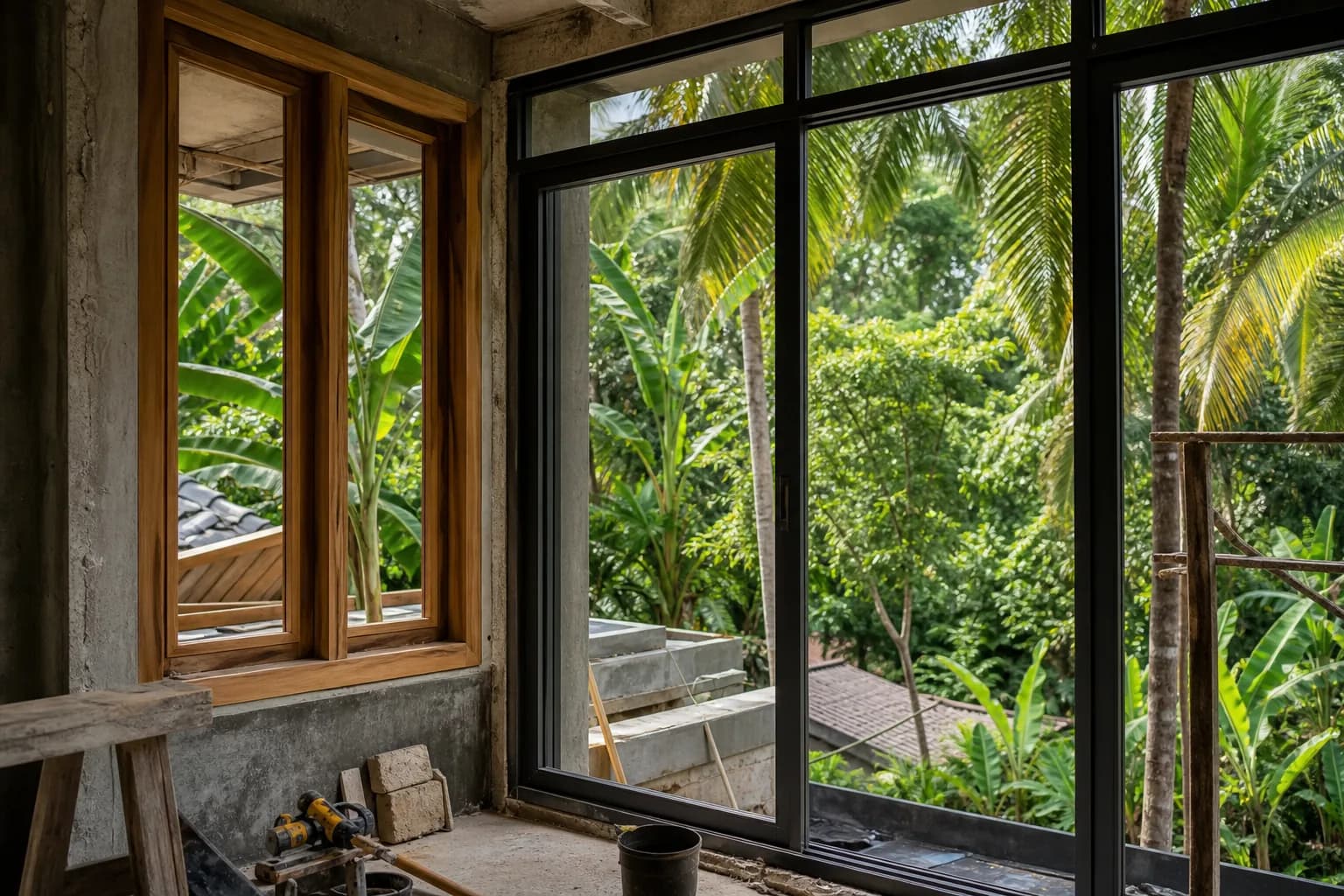
Teak vs Aluminum Window Frame Retrofits: Bali Renovation Costs
When renovating existing villas in Bali, window frame replacement represents one of the most critical finishing decisions affecting both aesthetic appeal and long-term durability. Property owners frequently face the dilemma: should they invest in traditional teak frames that complement Bali’s architectural heritage, or opt for modern aluminum systems that promise lower maintenance? The choice becomes particularly complex when retrofitting existing openings, where installation precision, tropical climate performance, and cost implications intersect. Understanding the technical requirements, material behaviors in Bali’s humid environment, and realistic budget expectations is essential for making informed renovation decisions that won’t compromise structural integrity or finishing quality.
Technical Deep Dive: Retrofit Installation Complexities
Window frame retrofits in Bali villa construction demand significantly different technical approaches depending on material selection. Unlike new construction where openings are designed around frame specifications, retrofit projects must adapt new frames to existing structural conditions—often revealing hidden challenges that impact both installation methodology and final costs.
Teak Frame Retrofit Specifications
Teak window frame installation in existing openings requires meticulous attention to moisture content and dimensional stability. Indonesian teak must be kiln-dried to 12-14% moisture content before fabrication to prevent post-installation warping in Bali’s 70-85% humidity environment. The retrofit process begins with precise measurement of existing openings, accounting for wall irregularities that commonly exist in older Bali properties. Teak frames typically require 15-20mm installation tolerance around the perimeter for proper shimming and sealing.
The joinery method critically affects longevity. Traditional mortise-and-tenon joints with marine-grade adhesives provide superior structural integrity compared to simple butt joints with mechanical fasteners. Corner reinforcement using stainless steel brackets (grade 316 minimum) prevents joint separation under thermal expansion cycles. Each frame component should be pre-treated with penetrating teak oil or marine varnish before installation, as post-installation finishing in tight spaces compromises coating coverage.
Mounting methodology differs substantially from aluminum systems. Teak frames attach to masonry or concrete using stainless steel anchor bolts at 300-400mm intervals, with neoprene or EPDM gaskets preventing direct wood-to-masonry contact that accelerates moisture absorption. The installation gap requires polyurethane sealant with minimum 25% movement capability to accommodate teak’s natural expansion-contraction cycles, which can reach 3-5mm across frame width in Bali’s seasonal humidity variations.
Aluminum Frame Retrofit Engineering
Aluminum window retrofits in Bali villa construction utilize fundamentally different installation principles. Modern aluminum systems employ thermal-break technology—polyamide strips separating interior and exterior aluminum sections—essential for preventing condensation in air-conditioned spaces. Retrofit frames typically use either pocket replacement (inserting new frames within existing frames) or full-frame replacement methods, with the latter providing superior performance but requiring more extensive wall finishing work.
Structural attachment relies on adjustable mounting brackets that compensate for out-of-plumb conditions common in older Bali properties. Aluminum’s minimal thermal expansion (approximately 0.0024mm per degree Celsius) simplifies installation tolerances compared to teak, requiring only 5-8mm perimeter gaps. However, galvanic corrosion prevention becomes critical—aluminum frames must never contact dissimilar metals without isolation barriers, and all fasteners must be stainless steel grade 316 or aluminum alloy compatible.
The glazing integration differs significantly between materials. Aluminum frames accommodate modern double-glazed units with superior thermal performance, while teak frames traditionally use single glazing with wooden beading. Retrofit aluminum systems often include integrated drainage channels and weep holes positioned at 600mm intervals along sill sections, preventing water accumulation that causes premature failure in tropical environments. Proper installation requires silicone structural glazing with minimum 6mm bite depth and continuous weatherproofing gaskets meeting EPDM or silicone specifications.
Materials & Standards for Bali Climate Performance
Material selection for window frame retrofits must address Bali’s specific environmental stressors: sustained high humidity, salt-laden coastal air in many villa locations, intense UV exposure, and seasonal monsoon conditions. Both teak and aluminum offer distinct performance characteristics when properly specified.
Teak Material Specifications
Premium Indonesian teak (Tectona grandis) contains natural oils providing inherent resistance to moisture, insects, and fungal decay. For window frame applications, select heartwood-only stock with tight grain patterns indicating slow growth and higher density. Acceptable teak should demonstrate Janka hardness ratings above 1,000 lbf and natural oil content exceeding 1.5% by weight. Avoid sapwood sections that lack protective oils and deteriorate rapidly in tropical conditions.
Frame components require minimum dimensions: stiles and rails at 70mm width × 45mm depth for standard residential windows, increasing to 90mm × 60mm for openings exceeding 1.5m². Hardware integration demands marine-grade stainless steel hinges, locks, and fasteners—brass and standard steel corrode within 18-24 months in Bali’s coastal zones. Finishing systems should employ UV-resistant marine varnishes or penetrating oil systems requiring reapplication every 12-18 months to maintain weather protection.
Aluminum System Standards
Aluminum window frames for Bali applications must meet specific alloy and coating requirements. Specify 6063-T5 or 6061-T6 aluminum alloys providing optimal strength-to-weight ratios and corrosion resistance. Powder-coating thickness should meet AAMA 2604 standards minimum (typically 60-80 microns), with polyester or fluoropolymer formulations offering superior UV stability. For coastal properties within 5km of ocean exposure, consider anodized finishes (Class I, 25+ microns) providing enhanced salt-air resistance.
Thermal-break components require polyamide strips minimum 24mm width for effective condensation control in air-conditioned spaces. Glazing specifications should include low-E coatings and argon gas fills for double-glazed units, reducing solar heat gain by 30-40% compared to single glazing. Weatherstripping must employ EPDM or silicone materials rather than PVC, which degrades rapidly under UV exposure and tropical heat. All drainage components and weep hole covers should be UV-stabilized polypropylene or aluminum to prevent brittle failure.
Step-by-Step Retrofit Installation Process
Phase 1: Assessment and Preparation (Days 1-2)
Begin with comprehensive measurement of existing window openings, documenting width, height, and diagonal dimensions at multiple points to identify out-of-square conditions. Photograph existing frame conditions, wall finishes, and surrounding areas to establish baseline documentation. Remove interior and exterior trim carefully if preservation is desired, labeling components for potential reinstallation. Assess wall structure around openings for hidden damage, particularly checking for water infiltration evidence, concrete spalling, or masonry deterioration requiring repair before new frame installation.
For teak retrofits, verify that custom fabrication drawings match actual opening dimensions within 5mm tolerance. Confirm teak moisture content using pin-type meters—readings above 16% require additional drying time. For aluminum systems, verify frame specifications match ordered units, checking thermal-break presence, powder-coating quality, and hardware completeness. Prepare installation area by protecting flooring and adjacent finishes with drop cloths and masking materials.
Phase 2: Existing Frame Removal (Days 2-3)
Remove existing window frames using methods that minimize wall damage. For wooden frames, cut through fasteners using oscillating multi-tools rather than prying, which cracks surrounding plaster or concrete. Aluminum frame removal requires grinding or cutting fasteners, as extraction often proves impossible without frame destruction. Remove all old sealant, gasket materials, and shim remnants from opening perimeters using scrapers and wire brushes.
Inspect revealed wall conditions thoroughly. Repair any concrete damage using polymer-modified repair mortars, and address water-damaged masonry with appropriate remediation. Clean opening perimeters completely, removing dust, loose material, and organic growth. Apply primer coatings to porous masonry surfaces to improve sealant adhesion. This preparation phase critically affects long-term installation performance—rushed preparation causes 60-70% of premature retrofit failures in Bali villa construction.
Phase 3: New Frame Installation (Days 3-5)
For teak frames, apply initial weatherproofing membrane to opening perimeter, lapping corners and extending 50mm beyond frame footprint. Position frame in opening using temporary bracing, checking plumb and level conditions with precision levels (2mm tolerance maximum). Install shims at mounting points, using rot-resistant hardwood or PVC shim materials. Drill pilot holes through frame and into wall structure, then secure using stainless steel anchor bolts with washers distributing load across teak grain. Verify frame operation before final fastening—adjustments become difficult after sealant application.
Aluminum frame installation follows similar sequencing but employs adjustable mounting brackets allowing fine-tuning after initial positioning. Set frame depth to achieve proper interior and exterior reveal dimensions, typically positioning frames at wall centerline for balanced appearance. Secure brackets at specified intervals, then inject low-expansion polyurethane foam into perimeter gaps, filling to 60-70% capacity to allow expansion without frame distortion. Excess foam removal after curing prevents interference with trim installation.
Phase 4: Sealing and Finishing (Days 5-7)
Apply exterior weatherproofing using polyurethane or silicone sealants appropriate for material type. Teak frames require sealants with minimum 25% movement capability, while aluminum systems perform adequately with 15-20% movement ratings. Tool sealant joints to concave profiles, ensuring complete adhesion to both frame and wall surfaces without voids or gaps. Install weep hole covers and drainage components per manufacturer specifications.
Complete interior finishing by installing trim, casing, or plaster returns matching existing wall conditions. For teak frames, apply final finishing coats after installation dust settles—typically 48 hours post-installation. Aluminum frames require only cleaning and protective film removal. Install window hardware, adjust operating mechanisms, and verify smooth operation through full range of motion. Conduct water testing using gentle spray patterns to verify weatherproofing integrity before final client handover.
Costs & Timeline: 2026 Bali Renovation Budget
Window frame retrofit costs in Bali vary substantially based on material selection, opening sizes, and project complexity. For teak window frames, expect material and fabrication costs ranging from $1,150 to $3,000 per square meter for quality Indonesian teak with proper joinery. Standard residential window sizes (1.2m × 1.5m) typically cost $2,070 to $5,400 per unit including fabrication. Installation labor adds $150 to $300 per window depending on access conditions and wall repair requirements. Complete teak retrofit projects including removal, preparation, installation, and finishing average $2,500 to $6,200 per window opening.
Aluminum window frame retrofits present more predictable pricing. Quality aluminum frames with thermal breaks and powder-coating cost $200 to $1,500 per unit for standard sizes, with premium systems featuring enhanced weatherproofing and double-glazing reaching $1,800 to $2,500 per window. Installation labor ranges from $70 to $150 per window for straightforward replacements, increasing to $200 to $350 for complex retrofits requiring significant wall modification. Total aluminum retrofit costs typically range from $400 to $2,200 per window opening, representing 40-60% savings compared to teak alternatives.
Project timelines differ between materials. Teak retrofits require 3-4 weeks for custom fabrication after final measurements, plus 5-7 days installation time per window. Aluminum systems with standard sizing ship within 7-10 days, with installation completing in 3-5 days per window. Multi-window projects benefit from economies of scale, reducing per-unit installation time by 20-30%. Weather conditions significantly impact scheduling—plan retrofit work during Bali’s dry season (April-October) to avoid monsoon-related delays and ensure proper sealant curing.
Frequently Asked Questions: Window Frame Retrofits in Bali
How long do teak versus aluminum window frames last in Bali’s tropical climate?
Properly installed and maintained teak window frames typically last 25-35 years in Bali’s climate, with some well-maintained examples exceeding 50 years. The natural oils in Indonesian teak provide inherent rot and insect resistance, though frames require regular maintenance including oil or varnish reapplication every 12-18 months. Aluminum frames with quality powder-coating or anodizing last 30-40 years with minimal maintenance, though coastal properties may experience accelerated corrosion requiring refinishing after 15-20 years. The key longevity factor for both materials is proper installation with adequate weatherproofing—poor installation reduces lifespan by 40-60% regardless of material quality.
Can I retrofit modern double-glazed windows into existing teak frames?
Retrofitting double-glazed units into existing teak frames is technically possible but rarely cost-effective. Traditional teak frames lack the depth and structural design to properly support double-glazed units, which weigh 2-3 times more than single glazing and require 20-28mm glazing pockets. Modification requires extensive fram
 3104 m²11 month(s)from 99.000 USD
TALA 100
 3173 m²6 month(s)from 125.000 USD
TALA FOUR
 164 m²7 month(s)from 79.000 USD
Private: Haridas Villas, Tegallalang
 3124 m²6 month(s)from 123.000 USD
TALA 8
 3127 m²9 month(s)from 177.000 USD
Mukunda
 4344 m²16 month(s)from 290.000 USD
Radha
 2144 m²11 month(s)from 104.000 USD
Narayana
 1from 198.000 USD
Private: Haridas Villas
 172 m²8 month(s)from 120.000 USD
Keshava
 3180 m²7 month(s)from 142.000 USD
Vasudeva

Want to calculate?
164 m²7 month(s)from 79.000 USDTALA TWO
Start With Real Numbers, Not Guesses
Before finalizing your finishing works plan, check realistic cost ranges for your Bali villa project.
Available lands
 3700 m²15 min$ 738177Bali, Tabanan
 2000 m²15 min$ 261700Bali, Babakan
 800 m²5 min$ 295567Bali, Seseh
 7900 m²25 min$ 413485Bali, Tabanan
 1375 m²10 min$ 447044Bali, Canggu
 700 m²15 min$ 90517Bali, Central Bali
 3100 m²15 min$ 257697Bali, Tegallalang
 220 m²2 min$ 66565Bali, Cemagi
 660 m²10 min$ 175567Bali, Mengwi
 1700 m²10 min$ 392549Bali, Nusadua
 770 m²5 min$ 163578Bali, Kedungu
 600 m²10 min$ 206897Bali, Canggu
 1000 m²5 min$ 350431Bali, Drupadi
 2700 m²30 min$ 314224Bali, Sidemen
 2800 m²15 min$ 310345Bali, Tabanan
Essential Bali build & buy guides
- Bali villa construction cost per m² in 2026
- How much will your villa cost? Calculator
- Building a villa in Bali: the complete guide
- Buying land in Bali: step-by-step for foreigners
- Bali villa investment: yields, risks, returns
- Leasehold vs freehold: what foreigners can own
- Construction defect liability & 10-year warranty
- Bali building codes and construction standards
Related guides

Why a Cheap Bali Leasehold Is Cheap: Pricing Red Flags Every Buyer Should Decode
Suspiciously cheap Bali leaseholds are priced low for a reason: short remaining terms, forbidden zoning, missing road access, disputes or weak contracts. How to decode the discount before you pay for it.
8 min read
Fake Compliance and Licensing Agents in Bali: The 2026 Paperwork Scam and How to Verify Documents
Forged certificates, permit fixers and fake notaries: how Bali's paperwork scams work in 2026 and how to verify every property document at its government source.
7 min read
Buying a Bali Villa from Instagram: Phantom Listings, Render-Only Projects and How to Verify
Instagram is Bali's biggest property shop window and its least verified. How phantom listings, render-only projects and cloned developer accounts work — and the verification steps that expose them.
7 min read