Porcelain vs Stone Countertops in Bali: Installation Risks
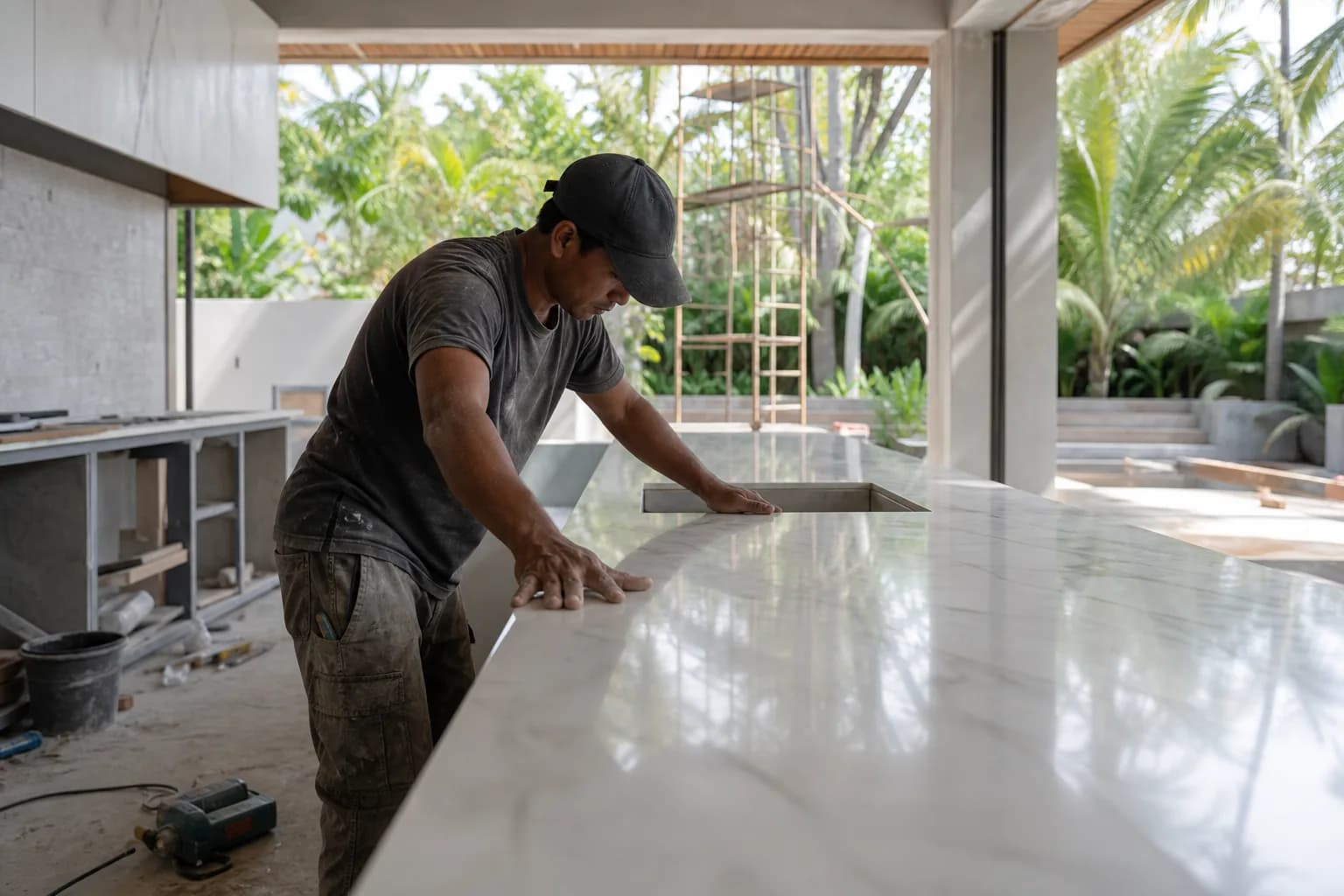
Why Countertop Material Choice Determines Kitchen Longevity in Bali’s Tropical Climate
Choosing between porcelain and natural stone countertops for your Bali kitchen renovation isn’t merely an aesthetic decision—it’s a critical structural choice that directly impacts installation complexity, long-term durability, and maintenance requirements in Indonesia’s humid tropical environment. The wrong material selection or improper installation technique can lead to cracking, staining, delamination, and costly replacements within 18-24 months. Understanding the specific installation risks associated with each material type, particularly in Bali’s unique climate conditions with 70-85% humidity levels and temperature fluctuations, is essential for villa construction and renovation projects that prioritize lasting quality.
Technical Installation Challenges: Porcelain vs Natural Stone in Tropical Environments
The fundamental difference between porcelain and natural stone countertop installation lies in material composition, substrate preparation requirements, and vulnerability to Bali’s environmental stressors. These distinctions create distinct risk profiles that experienced finishing contractors must navigate during interior finishing Bali projects.
Porcelain Slab Installation Complexities
Porcelain countertops, manufactured through high-temperature sintering of refined clay and minerals, present unique handling challenges despite their superior technical properties. Large-format porcelain slabs (typically 3200mm x 1600mm x 12mm) require specialized transportation, cutting, and installation techniques that many local Bali contractors lack experience with. The material’s extreme hardness (Mohs 7-8) demands diamond-tipped cutting tools and water-cooled fabrication equipment to prevent thermal shock cracking during edge profiling and cutout creation.
The primary installation risk with porcelain involves its brittleness under point-load stress. While porcelain resists surface scratching and heat exceptionally well, the thin slab format (typically 12mm compared to 20-30mm natural stone) makes it vulnerable to cracking if the substrate isn’t perfectly flat and fully supported. Any voids or inconsistencies in the adhesive layer create stress concentration points that can propagate cracks under normal kitchen use. This requires meticulous substrate preparation with self-leveling compounds and full-coverage adhesive application using notched trowels with appropriate ridge height (10-12mm for large-format slabs).
In Bali villa construction projects, we’ve observed that porcelain installation failures typically occur at three critical points: unsupported overhangs exceeding 300mm without steel reinforcement brackets, inadequate adhesive coverage (less than 95% contact), and improper seam alignment where thermal expansion wasn’t accommodated. The tropical temperature differential between air-conditioned interiors (24°C) and outdoor ambient temperatures (32-35°C) creates expansion-contraction cycles that stress improperly installed joints.
Natural Stone Installation Variables and Moisture Risks
Natural stone countertops—including granite, marble, quartzite, and soapstone—present entirely different installation risk factors rooted in their geological formation and inherent porosity. Each stone type exhibits unique characteristics: granite’s crystalline structure provides excellent strength but variable absorption rates (0.4-4% depending on density), marble’s calcium carbonate composition makes it susceptible to acid etching from citrus and cleaning products, and soapstone’s talc content creates a softer, more scratch-prone but stain-resistant surface.
The critical installation risk for natural stone in Bali’s climate centers on moisture management. Stone slabs arrive with 0.2-0.8% moisture content from quarrying and fabrication, but Bali’s 75-85% ambient humidity causes continuous moisture absorption through the stone’s porous structure. Without proper sealing protocols applied before, during, and after installation, this moisture creates multiple failure modes: efflorescence (white salt deposits migrating to the surface), substrate adhesive failure from moisture vapor transmission, and biological growth (mold, mildew) within the stone matrix.
During furniture installation and kitchen renovation Bali projects, natural stone requires 48-72 hours of climate acclimatization before installation to equilibrate moisture content with the installation environment. The substrate must incorporate vapor barriers and the adhesive system must be moisture-tolerant (typically modified thin-set mortars or epoxy-based systems rather than cement-based adhesives). Failure to implement these moisture control measures results in delamination, typically manifesting 6-18 months post-installation when seasonal humidity peaks during Bali’s wet season (November-March).
Structural Support Requirements and Load Distribution
Both materials demand proper structural support, but with different engineering considerations. Natural stone’s greater thickness (20-30mm) and density (2.6-2.8 g/cm³ for granite) creates substantial dead loads—a typical 3-meter kitchen counter weighs 180-240kg. Cabinet structures must be reinforced with additional cross-bracing, and wall-mounted sections require steel bracket systems anchored into structural elements, not just masonry infill.
Porcelain’s lighter weight (approximately 40% less than equivalent stone) reduces structural demands but increases vulnerability to deflection. Any cabinet flex or settlement translates directly into slab stress. This makes porcelain particularly risky in Bali villa construction where foundation settlement can occur during the first 12-24 months as tropical soils consolidate under building loads.
Material Standards and Quality Verification for Bali Installations
Ensuring countertop material quality before installation is critical for risk mitigation, yet Bali’s import-dependent supply chain creates verification challenges that don’t exist in markets with direct manufacturer access.
Porcelain Slab Certification and Grading
Quality porcelain slabs should meet ISO 13006 standards with water absorption rates below 0.5% (Group BIa classification). Reputable manufacturers provide technical datasheets specifying breaking strength (minimum 35 N/mm² for 12mm slabs), frost resistance, and chemical resistance ratings. For Bali projects, verify that imported porcelain includes proper documentation—counterfeit or substandard slabs from uncertified manufacturers represent 15-20% of the local market according to industry estimates.
Inspect slabs for manufacturing defects before fabrication: surface crazing (micro-cracks in the glaze layer), warping beyond 2mm over 3-meter length, and color consistency between slabs from the same production lot. These defects become permanent installation flaws that no amount of skilled craftsmanship can remedy.
Natural Stone Selection and Geological Assessment
Natural stone quality varies dramatically based on quarry location, extraction method, and geological characteristics. For interior finishing Bali applications, prioritize dense, low-porosity stones: granite with absorption rates below 0.4%, honed or leathered finishes that hide etching better than polished surfaces for marble, and quartzite over marble for high-use kitchen areas.
Request petrographic analysis reports for high-value installations, documenting mineral composition, porosity, and structural integrity. Examine slabs under raking light to identify natural fissures, resin-filled repairs, and color variation that might create aesthetic issues post-installation. Natural stone’s inherent variation is desirable, but structural weaknesses along fissure lines create fracture risks during cutting and installation.
Adhesive and Sealant System Specifications
The adhesive system represents the critical interface between countertop and substrate, yet it’s frequently underspecified in renovation Bali projects. Porcelain requires high-performance modified thin-set mortars with polymer additives providing flexibility and superior bond strength (minimum 1.5 N/mm² tensile adhesion). Natural stone demands moisture-tolerant systems—epoxy-based adhesives for high-moisture areas or polymer-modified mortars with hydrophobic additives.
Sealant selection for natural stone is equally critical: penetrating sealers (silane/siloxane-based) for granite and quartzite, and specialized marble sealers that don’t alter surface appearance while providing acid-etch resistance. In Bali’s climate, specify sealers with 3-5 year durability ratings rather than annual resealing products.
Professional Installation Process: Step-by-Step Risk Mitigation
Phase 1: Substrate Preparation and Moisture Testing (Days 1-2)
Proper countertop installation begins with comprehensive substrate assessment—the foundation that determines long-term performance. For cabinet-mounted installations, verify cabinet levelness within 2mm over 3-meter spans using precision levels. Shim and adjust cabinet positioning before proceeding, as countertop materials cannot compensate for unlevel substrates without creating stress concentrations.
Conduct moisture testing on concrete or masonry substrates using calcium chloride tests or electronic moisture meters. Substrate moisture content must be below 4% for adhesive application. In Bali villa construction, this often requires additional drying time or application of moisture-mitigating primers, particularly in recently completed buildings where concrete hasn’t fully cured.
Apply substrate reinforcement where required: cement backer board over wood substrates, steel reinforcement brackets for overhangs exceeding 250mm, and vapor barriers on moisture-prone surfaces. This preparation phase, though time-consuming, prevents 70% of installation failures we’ve documented in furniture installation projects across Bali.
Phase 2: Template Creation and Fabrication Verification (Days 3-4)
Create precise templates using 6mm MDF or specialized templating systems, capturing exact dimensions, cutout locations (sink, cooktop), and edge profiles. Template accuracy within ±2mm is essential—errors compound during fabrication and become unfixable installation problems. For natural stone with directional veining, mark grain direction and aesthetic preferences directly on templates.
During fabrication verification at the workshop, inspect cut edges for chip-out (particularly critical for porcelain), seam placement optimization, and cutout precision. Quality fabricators use CNC machinery with water-cooled diamond tooling, producing clean edges requiring minimal hand-finishing. Reject slabs with edge chips exceeding 3mm depth or visible stress cracks radiating from cutouts.
Phase 3: Dry-Fit and Adhesive Application (Day 5)
Perform complete dry-fit installation before adhesive application, verifying fit, seam alignment (maximum 0.5mm offset), and overhang dimensions. This critical step identifies issues while correction remains possible. Check that all cutouts align with plumbing and electrical fixtures—repositioning after adhesive application risks slab breakage.
Apply adhesive using appropriate trowel notch size (10-12mm square-notch for large-format porcelain, 6-8mm for natural stone) in sections small enough to prevent skinning (typically 15-20 minute working time in Bali’s heat). Achieve minimum 95% adhesive coverage by back-buttering slabs and using proper troweling technique with consistent ridge direction. Insufficient coverage creates voids that become failure points under load.
Phase 4: Setting, Seaming, and Curing (Days 5-7)
Position slabs carefully using suction cup lifters for large-format porcelain (minimum 4-point lift for 3-meter slabs) to prevent flexing during placement. For natural stone, verify that heavy sections have adequate personnel—granite slabs require 3-4 installers for safe handling. Press slabs firmly into adhesive bed, checking for full contact and level alignment.
Execute seams using color-matched epoxy or polyester resins, creating invisible joints through proper surface preparation, resin mixing, and curing. Quality seams require edge polishing to 400-grit minimum, solvent cleaning, and precise resin application with minimal excess. Allow 24-hour cure time before stressing seam areas.
Maintain installation area temperature (20-30°C) and humidity control during curing. In Bali’s climate, this may require temporary air conditioning or dehumidification to prevent moisture interference with adhesive curing chemistry. Restrict access for 48-72 hours minimum—premature loading causes micro-movements that compromise bond integrity.
Phase 5: Sealing and Final Protection (Days 8-9)
For natural stone, apply penetrating sealer after adhesive fully cures (minimum 72 hours). Use lint-free applicators, applying thin, even coats and removing excess within manufacturer-specified dwell time (typically 5-15 minutes). Multiple thin coats outperform single heavy applications. Allow 24-hour cure between coats and 72-hour full cure before kitchen use.
Install final edge treatments, backsplash connections, and sink/cooktop fixtures. Apply neutral-cure silicone sealants at all penetrations and perimeter joints, tooling to smooth profiles that shed water away from vulnerable edges. Protect completed installation with corrugated cardboard or protective film during remaining construction activities.
Cost Analysis and Project Timeline for Bali Kitchen Countertop Installation
Material and Installation Cost Factors
Porcelain countertop costs in Bali range from IDR 2,500,000-4,500,000 per square meter including materials, fabrication, and professional installation. Premium imported porcelain with book-matched veining or specialized finishes reaches IDR 6,000,000-8,000,000 per square meter. These prices reflect import duties, specialized handling requirements, and limited local fabrication expertise.
Natural stone costs vary by type and origin: domestic granite (IDR 1,800,000-3,200,000/m²), imported granite (IDR 3,500,000-5,500,000/m²), marble (IDR 4,000,000-8,000,000/m²), and exotic stones like quartzite or soapstone (IDR 6,000,000-12,000,000/m²). Installation adds IDR 800,000-1,500,000 per square meter depending on complexity, edge profiles, and cutout requirements.
Additional cost factors include substrate preparation (IDR 200,000-500,000/m²), specialized adhesive systems (IDR 150,000-300,000/m²), sealing treatments for natural stone (IDR 100,000-200
 2144 m²11 month(s)from 104.000 USD
Narayana
 3104 m²11 month(s)from 99.000 USD
TALA 100

Want to calculate?
 3173 m²6 month(s)from 125.000 USD
TALA FOUR
 164 m²7 month(s)from 79.000 USD
Private: Haridas Villas, Tegallalang
 1from 198.000 USD
Private: Haridas Villas
 172 m²8 month(s)from 120.000 USD
Keshava
 3124 m²6 month(s)from 123.000 USD
TALA 8
 3180 m²7 month(s)from 142.000 USD
Vasudeva
164 m²7 month(s)from 79.000 USDTALA TWO
 3127 m²9 month(s)from 177.000 USD
Mukunda
 4344 m²16 month(s)from 290.000 USD
Radha
Start With Real Numbers, Not Guesses
Before finalizing your finishing works plan, check realistic cost ranges for your Bali villa project.
Available lands
 7000 m²36 min$ 284483Bali, Gianyar
 1000 m²10 min$ 230911Bali, Kerobokan
 700 m²7 min$ 400000Bali, Canggu
 18900 m²2 min$ 6912931Bali, Pecatu
 2400 m²7 min$ 496552Bali, Canggu
 2000 m²5 min$ 738916Bali, Ungasan
 600 m²12 min$ 101970Bali, Mengwi
 2130 m²10 min$ 495776Bali, Pecatu
 660 m²10 min$ 175567Bali, Mengwi
 700 m²15 min$ 90517Bali, Central Bali
 1000 m²10 min$ 184729Bali, Kutuh South Bali
 7500 m²5 min$ 206281Bali, Kedungu
 220 m²2 min$ 66565Bali, Cemagi
 1350 m²5 min$ 283467Bali, Pecatu
 1100 m²8 min$ 280419Bali, Ungasan
Essential Bali build & buy guides
- Bali villa construction cost per m² in 2026
- How much will your villa cost? Calculator
- Building a villa in Bali: the complete guide
- Buying land in Bali: step-by-step for foreigners
- Bali villa investment: yields, risks, returns
- Leasehold vs freehold: what foreigners can own
- Construction defect liability & 10-year warranty
- Bali building codes and construction standards
Related guides

Why a Cheap Bali Leasehold Is Cheap: Pricing Red Flags Every Buyer Should Decode
Suspiciously cheap Bali leaseholds are priced low for a reason: short remaining terms, forbidden zoning, missing road access, disputes or weak contracts. How to decode the discount before you pay for it.
8 min read
Fake Compliance and Licensing Agents in Bali: The 2026 Paperwork Scam and How to Verify Documents
Forged certificates, permit fixers and fake notaries: how Bali's paperwork scams work in 2026 and how to verify every property document at its government source.
7 min read
Buying a Bali Villa from Instagram: Phantom Listings, Render-Only Projects and How to Verify
Instagram is Bali's biggest property shop window and its least verified. How phantom listings, render-only projects and cloned developer accounts work — and the verification steps that expose them.
7 min read