Pererenan Flood Zone Insurance: Wet Season Construction Liability
Pererenan Flood Zone Insurance: Wet Season Construction Liability Bali
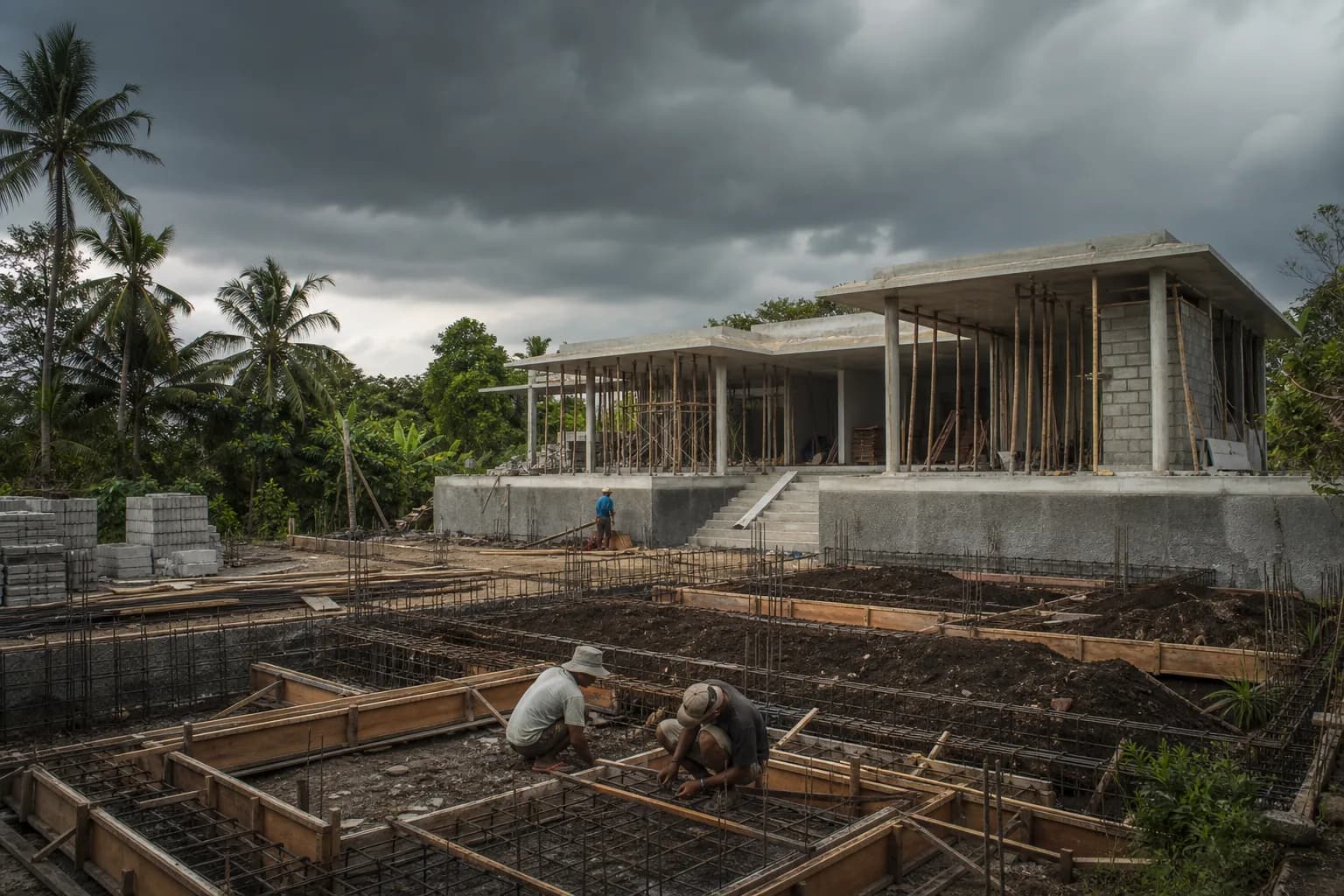
Pererenan’s rapid development has transformed rice paddies into villa estates, but the 2024-2025 wet seasons exposed a critical vulnerability: inadequate drainage infrastructure combined with lowered water tables creating localized flooding that halts construction mid-project. When your foundation excavation fills with water during monsoon downpours, who bears the liability—your contractor, the insurance provider, or you? The answer depends entirely on how construction contracts address wet season risks and whether your policy explicitly covers flood-related work stoppages in designated zones. Most foreign buyers discover too late that standard construction insurance excludes “seasonal flooding” or limits coverage to “sudden and unforeseen” water events, leaving partially completed structures exposed to water damage, timeline delays, and contractor disputes during Bali’s November-March wet season.
Engineering Reality: Pererenan’s Flood Vulnerability During Active Construction
Pererenan sits 2-8 meters above sea level with a shallow water table (1.5-3 meters depth) and clay-heavy soil composition that creates poor natural drainage. The area’s transformation from agricultural land to residential development removed traditional irrigation channels without replacing them with adequate stormwater management systems. During peak wet season (December-February), localized flooding occurs when 100-200mm rainfall events overwhelm undersized drainage, particularly in lower-elevation pockets near Jalan Pererenan and areas south of Pantai Pererenan.
For active construction sites, this creates specific engineering challenges. Foundation excavations become collection points for groundwater and surface runoff. A typical 10×15-meter villa foundation excavated to 1.2 meters depth can accumulate 180 cubic meters of water during a single heavy rainfall event. Dewatering pumps running continuously increase operational costs by USD $40-80 daily while delaying concrete pours that require dry conditions. More critically, water intrusion during foundation curing (first 7-14 days) compromises concrete strength, potentially reducing compressive capacity by 15-30%.
Construction liability insurance in Indonesia operates under different principles than Western markets. Policies typically fall under “Contractors All Risk” (CAR) or “Erection All Risk” (EAR) frameworks, which cover physical damage to works under construction. However, standard CAR policies contain specific exclusions for “gradually operating causes” including seasonal flooding, rising groundwater, and inadequate site drainage. The critical distinction: sudden flood events from unprecedented rainfall may be covered, but recurring wet season water accumulation is classified as foreseeable and excluded.
Indonesian insurance law (Law No. 40/2014) requires clear disclosure of flood risk zones, but Pererenan lacks official government flood mapping. The Indonesian Disaster Management Agency (BNPB) classifies coastal Canggu-Pererenan as “medium flood risk,” but this designation doesn’t trigger mandatory insurance requirements or construction restrictions. This regulatory gap means builders can proceed without flood-specific coverage, transferring risk to property owners through contract clauses.
The liability chain becomes complex during wet season delays. If foundation work scheduled for December faces three weeks of water-related stoppages, contractors may invoke force majeure clauses to extend timelines without penalty. However, if the delay results from inadequate site preparation (insufficient drainage installation, poor excavation timing), liability may fall on the contractor. Insurance adjusters examine site preparation documentation, weather records, and engineering reports to determine if flooding was “reasonably foreseeable”—a subjective assessment that often favors insurers.
Pererenan’s specific risk profile requires enhanced coverage beyond standard CAR policies. Flood endorsements typically add 0.8-1.5% to total construction insurance premiums but provide critical protection for water-related delays and damage. These endorsements should explicitly cover: groundwater intrusion during excavation, surface water damage to partially completed structures, costs of dewatering operations exceeding 14 consecutive days, and timeline extensions due to wet season conditions. Without these specific provisions, owners face out-of-pocket costs averaging USD $8,000-15,000 for flood-related construction delays on typical villa projects.
Hidden Risks Foreign Buyers Miss in Pererenan Wet Season Construction
The most dangerous assumption is that “construction insurance” automatically covers all weather-related risks. Foreign buyers accustomed to comprehensive builder’s risk policies in their home countries don’t realize Indonesian CAR policies operate on narrow coverage principles with extensive exclusions. Reading the policy schedule isn’t enough—the critical details hide in endorsement clauses and exclusion lists written in Indonesian legal terminology.
Many buyers schedule construction start dates for September-October to “beat the wet season,” not understanding that foundation and structural work extending into November-March faces inevitable water management challenges. Contractors may agree to aggressive timelines during dry season negotiations, then invoke weather delays once rains begin. Without contractual penalties for wet season delays or requirements for continuous dewatering, projects can stall for weeks while owners continue paying land lease installments and construction financing interest.
The “acts of God” clause in Indonesian construction contracts is interpreted more broadly than in Western jurisdictions. Contractors successfully argue that seasonal flooding—even in known flood-prone areas—constitutes force majeure, releasing them from timeline obligations. Owners who don’t negotiate specific wet season performance requirements or weather-related delay caps find themselves with no recourse when 8-month projects stretch to 14 months.
Another overlooked risk: partial structure damage during construction pauses. A villa with completed foundation and ground floor columns but no roof becomes a water collection system during heavy rains. Standing water in floor slabs, water infiltration into rebar connections, and moisture absorption in concrete block walls create long-term structural issues. Standard insurance covers “sudden damage” but excludes deterioration from extended water exposure during construction delays—a distinction that costs owners USD $5,000-12,000 in remediation work.
Step-by-Step Process: Securing Proper Wet Season Construction Coverage in Pererenan
Phase 1: Pre-Construction Risk Assessment (Weeks 1-2)
Before finalizing land purchase or construction contracts, commission a site-specific flood risk assessment from a qualified Indonesian engineering firm. This assessment should include: historical water table measurements during wet season, soil permeability testing, elevation survey relative to surrounding drainage, and analysis of existing stormwater infrastructure capacity. Cost: USD $800-1,500. This documentation becomes critical for insurance underwriting and establishes baseline conditions for liability determination.
Request flood history from neighboring property owners and local banjar (community association). Pererenan residents can identify specific streets and elevation zones that experience recurring wet season flooding. This informal intelligence often reveals risks not captured in official assessments.
Phase 2: Insurance Specification and Procurement (Weeks 3-4)
Engage an Indonesian insurance broker experienced in construction coverage—not a general property insurance agent. Specify requirements for Pererenan wet season risks: flood endorsement covering groundwater and surface water intrusion, extended dewatering cost coverage (minimum 30 days), wet season delay coverage (minimum 45 days), and partial structure water damage during construction pauses. Obtain quotes from minimum three providers: local Indonesian insurers (PT Asuransi Sinar Mas, PT Asuransi Ramayana), international insurers with Indonesian operations (Allianz Indonesia, AXA Indonesia), and Lloyd’s of London syndicates through local brokers.
Compare policies on exclusion clauses, not just premium costs. A policy costing 2.1% of construction value with comprehensive wet season coverage provides better protection than a 1.4% policy with broad weather-related exclusions.
Phase 3: Contract Integration (Weeks 4-5)
Integrate insurance requirements directly into construction contracts. Specify that contractor must maintain continuous dewatering during wet season if groundwater exceeds 30cm depth in excavations, install temporary drainage systems before foundation excavation, and protect partially completed structures with waterproof covering during construction pauses exceeding 7 days. Establish weather delay caps: contractor absorbs first 15 days of wet season delays, insurance covers days 16-45, and timeline extends beyond 45 days without additional owner cost but with penalty reductions.
Require contractor to provide evidence of their own liability insurance covering water damage to works under construction. Many small Bali contractors operate without proper insurance, transferring all risk to owners.
Phase 4: Wet Season Monitoring and Documentation (During Construction)
Implement weekly site inspections during November-March wet season, documenting water management measures, dewatering operations, and any water intrusion events with photographs and written reports. This documentation proves essential for insurance claims and liability disputes. Require contractor to maintain daily weather logs and water table measurements during foundation and structural work phases.
If flooding occurs, notify insurance provider within 48 hours even if damage appears minor. Delayed notification provides grounds for claim denial under Indonesian insurance regulations.
Realistic Cost Ranges for Pererenan Wet Season Construction Protection
Standard CAR construction insurance in Bali: 1.2-1.8% of total construction value for projects under USD $400,000. For a typical USD $250,000 villa construction, base premium: USD $3,000-4,500.
Flood endorsement for Pererenan location: additional 0.8-1.5% of construction value. Additional premium: USD $2,000-3,750. Total insured construction coverage with flood protection: USD $5,000-8,250 for USD $250,000 project.
Dewatering costs during wet season construction: USD $40-80 daily for continuous pumping operations. For 60-day wet season exposure during foundation phase: USD $2,400-4,800. Enhanced policies covering extended dewatering reduce owner exposure by 60-80%.
Wet season delay costs (indirect): USD $150-300 daily including land lease payments, construction financing interest, temporary accommodation, and project management fees. A 30-day weather delay costs USD $4,500-9,000 in carrying costs beyond direct construction expenses.
Site preparation for flood mitigation: USD $3,500-7,000 including perimeter drainage installation, sump pump systems, temporary bunding around excavations, and elevated material storage. These upfront investments reduce wet season delay probability by 40-60% based on Pererenan project data.
Remediation costs for water-damaged partial structures: USD $5,000-12,000 including concrete testing, rebar corrosion treatment, moisture remediation in walls, and structural repairs. Proper insurance coverage eliminates this owner expense.
Timeline impact: Pererenan projects starting construction in September-October without wet season planning experience average 35-50 day delays. Projects with comprehensive flood mitigation and insurance: 10-18 day delays. The difference represents USD $3,750-9,600 in reduced carrying costs.
Frequently Asked Questions: Pererenan Flood Zone Construction Insurance
Does standard villa construction insurance in Bali cover wet season flooding in Pererenan?
No. Standard Contractors All Risk (CAR) policies explicitly exclude “gradually operating causes” including seasonal flooding, rising groundwater, and inadequate drainage. These policies may cover sudden, unprecedented flood events but not recurring wet season water accumulation in known flood-prone areas. Pererenan requires specific flood endorsements that add 0.8-1.5% to insurance premiums but provide essential coverage for groundwater intrusion, surface water damage, dewatering costs, and wet season delays. Review policy exclusion clauses carefully—the terms “seasonal flooding,” “groundwater,” and “inadequate site drainage” indicate gaps in coverage that leave owners financially exposed during November-March construction.
Who is liable when wet season flooding delays my Pererenan villa construction—the contractor or insurance company?
Liability depends on contract terms, insurance coverage, and whether flooding was “reasonably foreseeable.” If your construction contract contains force majeure clauses covering weather events, contractors can extend timelines without penalty for wet season delays. However, if delays result from inadequate site preparation (failure to install drainage, poor excavation timing), contractor liability may apply. Insurance covers delays only if your policy includes specific wet season delay endorsements—standard policies don’t cover timeline extensions. The solution: negotiate contracts with weather delay caps (contractor absorbs first 15 days), require wet season preparation measures, and secure insurance with explicit delay coverage. Without these protections, owners bear financial burden of extended timelines including ongoing land lease payments and financing costs averaging USD $150-300 daily.
Should I avoid starting construction in Pererenan during September-October if the project extends into wet season?
Not necessarily, but you need specific wet season planning. September-October starts allow completion of foundation and ground floor structural work during dry conditions, reducing water intrusion risks during critical concrete curing phases. The key is ensuring your contractor implements wet season preparation: perimeter drainage installation before November, temporary sump pump systems, waterproof covering for partially completed structures, and accelerated scheduling to complete water-sensitive work before December. Projects starting in September with proper planning complete foundation and structural work by early No
 3127 m²9 month(s)from 177.000 USD
Mukunda
 2144 m²11 month(s)from 104.000 USD
Narayana
 3124 m²6 month(s)from 123.000 USD
TALA 8
 164 m²7 month(s)from 79.000 USD
Private: Haridas Villas, Tegallalang
164 m²7 month(s)from 79.000 USDTALA TWO
 3104 m²11 month(s)from 99.000 USD
TALA 100
 172 m²8 month(s)from 120.000 USD
Keshava
 3180 m²7 month(s)from 142.000 USD
Vasudeva
 4344 m²16 month(s)from 290.000 USD
Radha

Want to calculate?
 1from 198.000 USD
Private: Haridas Villas
 3173 m²6 month(s)from 125.000 USD
TALA FOUR
Start With Real Numbers, Not Guesses
Before buying land or finalizing a design, check the realistic build cost range for your project in Bali.
Our team reviews your inputs and gives a grounded estimate.
Available lands
 422 m²15 min$ 93547Bali, Kerobokan
 3900 m²10 min$ 432266Bali, Tabanan
 1000 m²10 min$ 230911Bali, Kerobokan
 5815 m²5 min$ 815740Bali, Tabanan
 3254 m²5 min$ 631800Bali, All
 680 m²15 min$ 110751Bali, Pererenan
 500 m²2 min$ 175862Bali, Cemagi
 3100 m²20 min$ 272968Bali, Tabanan
 550 m²15 min$ 164594Bali, Mengwi
 700 m²7 min$ 400000Bali, Canggu
 1700 m²10 min$ 632257Bali, Kuta
 1375 m²10 min$ 447044Bali, Canggu
 7250 m²56 min$ 235714Bali, Tabanan
 2000 m²15 min$ 110837Bali, Karangasem
 1000 m²10 min$ 184729Bali, Kutuh South Bali
Essential Bali build & buy guides
- Bali villa construction cost per m² in 2026
- How much will your villa cost? Calculator
- Building a villa in Bali: the complete guide
- Buying land in Bali: step-by-step for foreigners
- Bali villa investment: yields, risks, returns
- Leasehold vs freehold: what foreigners can own
- Construction defect liability & 10-year warranty
- Bali building codes and construction standards
Related guides

Why a Cheap Bali Leasehold Is Cheap: Pricing Red Flags Every Buyer Should Decode
Suspiciously cheap Bali leaseholds are priced low for a reason: short remaining terms, forbidden zoning, missing road access, disputes or weak contracts. How to decode the discount before you pay for it.
8 min read
Fake Compliance and Licensing Agents in Bali: The 2026 Paperwork Scam and How to Verify Documents
Forged certificates, permit fixers and fake notaries: how Bali's paperwork scams work in 2026 and how to verify every property document at its government source.
7 min read
Buying a Bali Villa from Instagram: Phantom Listings, Render-Only Projects and How to Verify
Instagram is Bali's biggest property shop window and its least verified. How phantom listings, render-only projects and cloned developer accounts work — and the verification steps that expose them.
7 min read