Nusa Dua Foreign Ownership Nominee Agreements: Legal Risk Audit B
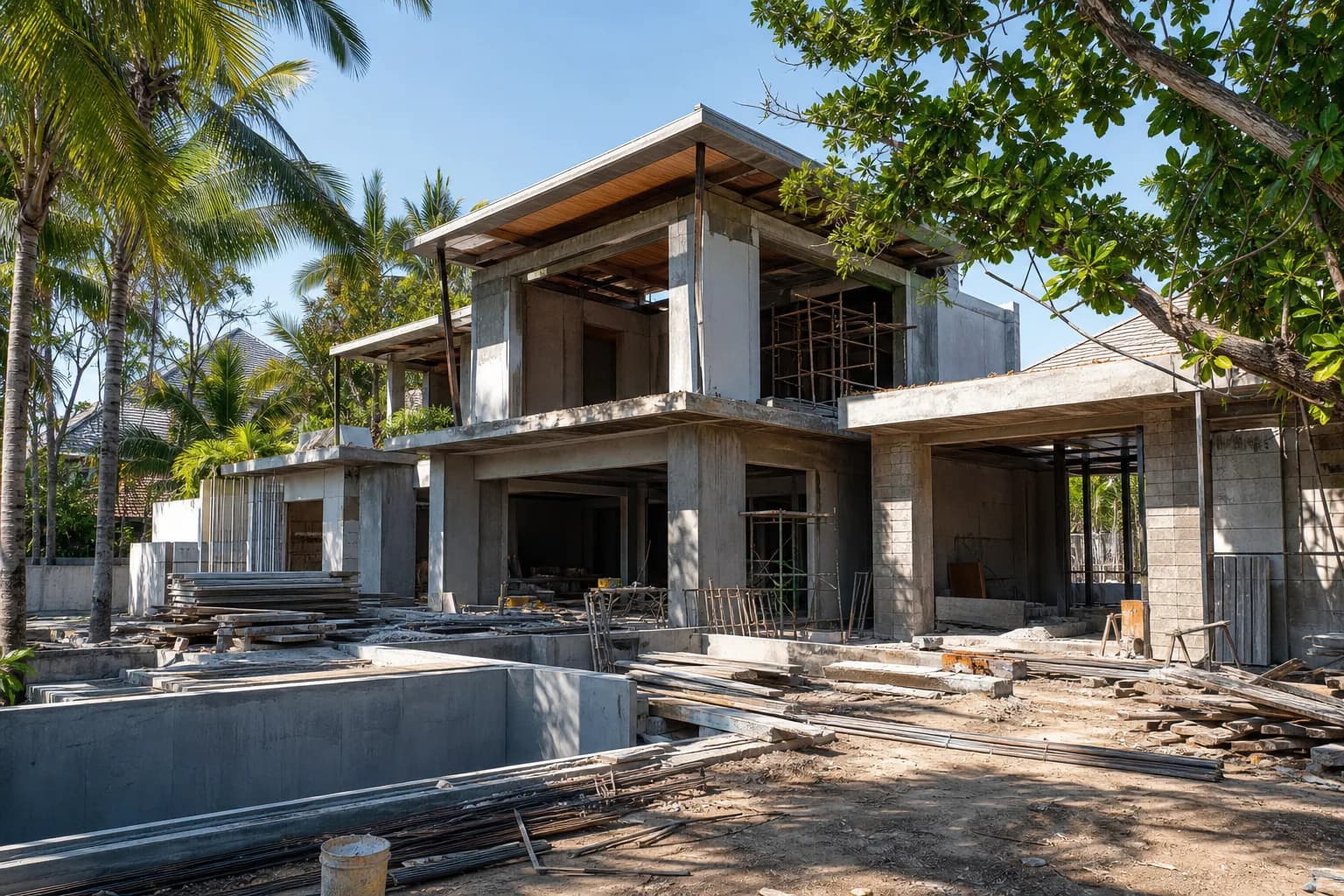
The Hidden Legal Trap: Why Nusa Dua Nominee Agreements Threaten Your Construction Investment
You’ve found the perfect hillside plot in Nusa Dua with ocean views, negotiated what seems like a fair price, and a local “consultant” suggests using a nominee structure to bypass foreign ownership restrictions. The land certificate looks legitimate, the nominee signs documents promising you control, and construction begins. Two years later, during your villa’s final inspection phase, the nominee claims full ownership, changes property locks, and Indonesian courts side with them—your $400,000 construction investment vanishes overnight with zero legal recourse. This isn’t a hypothetical scenario; it’s the documented reality of nominee agreement failures across Bali’s premium districts, where the intersection of illegal ownership structures and construction projects creates compounded legal and financial exposure that most foreign buyers discover only after structural foundations are poured.
The Legal Architecture of Nominee Agreement Risk in Nusa Dua Construction Projects
Nominee agreements in Indonesia operate in direct violation of Article 26(2) of the Basic Agrarian Law (UUPA No. 5/1960) and the 2006 Agrarian Law amendments, which explicitly prohibit foreigners from holding freehold (Hak Milik) land titles through proxy arrangements. From a construction engineering perspective, this creates a unique risk profile: you’re building permanent structures on land where your legal claim is not merely weak—it’s criminally unenforceable.
The technical legal structure typically involves three documents: a nominee agreement (perjanjian pinjam nama), a power of attorney, and a loan agreement claiming the Indonesian nominee “borrowed” funds from you. Indonesian courts have consistently ruled these arrangements as attempts to circumvent constitutional land ownership restrictions, rendering all three documents void under Article 1335 of the Indonesian Civil Code, which invalidates contracts with illegal causes.
For construction projects specifically, this creates cascading engineering and legal complications. When you commission villa construction in Nusa Dua, building permits (IMB) are issued in the land certificate holder’s name—the nominee. Construction contracts, utility connections, and structural warranties all reference this legal owner. If the nominee relationship deteriorates during the 8-14 month construction timeline typical for a 300-400 sqm villa, you face three simultaneous crises: incomplete construction with no legal authority to direct contractors, building permits you cannot enforce, and structural investments you cannot protect.
The Nusa Dua context intensifies these risks due to premium land values. Plots in Nusa Dua’s gated communities range from $350-$800 per square meter, meaning a modest 500 sqm plot represents $175,000-$400,000 in land value alone. When combined with construction costs of $1,200-$1,800 per square meter for quality tropical villa construction, total project values easily exceed $600,000-$1.2 million. At these investment levels, the financial incentive for nominee betrayal becomes substantial, particularly when nominees realize the completed villa’s market value.
From a construction risk management perspective, nominee structures also complicate contractor relationships. Reputable construction firms like Teville require clear legal authority before commencing work, as construction liens and payment disputes must be resolved through the legal property owner. When that owner is a nominee with conflicting interests, contractors face uncertainty about payment authority, change order approvals, and final acceptance procedures. This often forces foreign buyers toward less established contractors willing to work in legal gray areas—compounding both legal and construction quality risks.
The Indonesian government’s 2015-2016 regulatory reforms attempted to address foreign property access through expanded leasehold rights (Hak Pakai) allowing 80-year terms for foreigners, renewable once for 80 additional years. These legal structures provide genuine property rights enforceable in Indonesian courts, unlike nominee arrangements. However, many foreign buyers still pursue nominee structures due to misconceptions about control, inheritance flexibility, or advice from unqualified consultants who profit from facilitating illegal arrangements.
The engineering implications extend to long-term building maintenance and structural modifications. Tropical construction in Bali’s coastal climate requires ongoing maintenance—roof membrane inspections every 3-5 years, structural timber treatments, pool equipment replacement, and foundation monitoring in areas with high water tables. All maintenance contracts, warranty claims, and structural modification permits require the legal owner’s authorization. Under nominee structures, you’re dependent on the nominee’s cooperation for basic building preservation, creating long-term structural risk alongside legal vulnerability.
Critical Blind Spots: What Construction Buyers Miss in Nominee Due Diligence
The most dangerous assumption foreign buyers make is believing nominee agreements can be “done correctly” with proper documentation. Indonesian legal precedent is unambiguous: no amount of notarization, witness signatures, or contractual language makes an illegal arrangement legal. The Supreme Court’s 2014 ruling in case No. 3210 K/Pdt/2013 explicitly stated that nominee agreements violate public order and are void ab initio—invalid from inception, regardless of documentation quality.
Buyers also underestimate the timeline vulnerability. Villa construction in Nusa Dua typically spans 10-16 months from permit acquisition to final inspection. During this extended period, nominee relationships face multiple stress points: construction cost overruns requiring additional funds, disputes over design changes, delays in material delivery, and the nominee’s growing awareness of the property’s increasing value as construction progresses. Each stress point creates opportunity for nominee leverage or betrayal.
Another critical oversight involves family law complications. Indonesian nominees often face pressure from spouses, children, or extended family who view the property as family asset. Under Indonesian marriage law, property acquired during marriage becomes joint marital property (harta bersama), meaning the nominee’s spouse may claim ownership rights regardless of nominee agreements. If the nominee divorces or dies during your construction project, you’re suddenly negotiating with family members who never agreed to the nominee arrangement and have legal standing the foreign buyer lacks.
The construction permit dimension creates additional hidden risk. Building permits in Nusa Dua require environmental impact assessments (AMDAL or UKL-UPL), coastal setback compliance, and height restrictions specific to the tourism zone. These permits are issued to the legal landowner and are non-transferable. If you later attempt to legitimize ownership through proper leasehold conversion, all existing permits may require reissuance, potentially under updated regulations that could prohibit your as-built structure’s current configuration.
Risk Audit Protocol: Systematic Assessment for Existing and Planned Nominee Structures
If you’re currently in a nominee arrangement with construction planned or underway in Nusa Dua, immediate legal risk assessment is critical. Begin with title verification through the local Land Office (BPN – Badan Pertanahan Nasional) to confirm the nominee holds legitimate Hak Milik title without encumbrances, liens, or ownership disputes. Request a complete title history showing all previous transfers—multiple rapid ownership changes often indicate land speculation or problematic title chains.
Second, commission an independent legal review from a qualified Indonesian property lawyer (not the lawyer who structured the nominee arrangement) to assess conversion feasibility to legal leasehold. This review should analyze whether the specific plot qualifies for Hak Pakai conversion under current regulations, estimate conversion costs and timeline, and identify any regulatory barriers specific to Nusa Dua’s zoning designation. Conversion typically costs $3,000-$8,000 in legal fees plus government processing fees of 1-2% of assessed land value, but is only possible with nominee cooperation.
Third, conduct a construction contract audit. Review all existing agreements with contractors, architects, and engineers to identify who holds legal authority for contract execution, payment authorization, and change orders. If construction hasn’t begun, structure contracts to include escrow payment mechanisms and completion guarantees that don’t rely solely on nominee authorization. Reputable firms offering transparent construction processes can structure payment milestones tied to verified completion stages rather than nominee approval.
Fourth, implement a documented exit strategy before construction begins. This includes written nominee cooperation agreements for leasehold conversion at project completion, escrow arrangements for conversion costs, and timeline commitments. While these documents don’t make the underlying nominee structure legal, they create evidence of intent and financial arrangements that may provide limited leverage in dispute resolution, though they remain unenforceable in Indonesian courts.
Fifth, assess alternative legal structures immediately. For Nusa Dua properties, this means evaluating whether leasehold acquisition from the current nominee is feasible, exploring Indonesian PT PMA (foreign investment company) structures if you’re willing to maintain active business operations, or considering whether the project should be abandoned before additional construction investment. The sunk cost fallacy is particularly dangerous here—many buyers continue construction in compromised nominee arrangements because they’ve already invested in land and design, ultimately losing far more when the structure fails.
For those not yet committed to nominee structures, the risk audit should occur during land selection. When reviewing verified land options, prioritize plots already held under leasehold title or those where sellers are willing to structure direct leasehold transfers. This eliminates nominee risk entirely while providing enforceable property rights for your construction investment. The leasehold premium—typically 15-25% higher initial cost than nominee arrangements—is negligible compared to total loss risk.
Financial Exposure Analysis: Quantifying Nominee Risk in Construction Projects
The financial risk profile of nominee-based construction in Nusa Dua involves multiple loss scenarios with different probability weights. Total property loss—where the nominee claims full ownership and you lose both land and construction investment—represents the maximum exposure. For a typical 400 sqm villa on 500 sqm land, this totals $175,000-$400,000 in land value plus $480,000-$720,000 in construction costs, equating to $655,000-$1,120,000 total exposure.
Partial loss scenarios involve nominee cooperation breakdown during construction, forcing project abandonment with incomplete structures. If this occurs at 60% construction completion, you’ve invested approximately $288,000-$432,000 in construction costs plus full land costs, totaling $463,000-$832,000 in unrecoverable investment. The incomplete structure has minimal salvage value, as Indonesian law prohibits selling buildings separately from land, and the nominee controls both.
Legal defense costs for disputed nominee arrangements typically range from $15,000-$45,000 for initial litigation through district court, with appeals to high court and supreme court adding $20,000-$60,000 more. These costs are incurred regardless of outcome, and Indonesian legal precedent strongly favors nominees in ownership disputes, making successful legal recovery statistically unlikely even with substantial legal investment.
Conversion costs to legitimate leasehold structures—when nominees cooperate—include legal fees of $3,000-$8,000, notary fees of $1,500-$3,000, BPN processing fees of 1-2% of assessed land value ($1,750-$8,000 for typical Nusa Dua plots), and often “cooperation payments” to nominees ranging from $10,000-$50,000 depending on property value and nominee leverage. Total conversion costs typically reach $16,250-$69,000, representing a substantial penalty for initially choosing illegal structures.
Timeline costs also factor significantly. Legal disputes over nominee arrangements typically require 18-36 months for resolution through Indonesian courts, during which construction halts, materials deteriorate in tropical climate, and partially completed structures suffer weather damage. Restarting construction after legal resolution adds 15-25% to original construction costs due to remediation needs, contractor remobilization, and material price escalation.
Frequently Asked Questions: Nusa Dua Nominee Agreement Legal Risk
Can nominee agreements be made legally enforceable through specific contract language or notarization?
No. Indonesian courts have consistently ruled that nominee agreements violate Article 26(2) of the Basic Agrarian Law and are void regardless of documentation quality, notarization, or witness signatures. The Supreme Court’s position is that contracts with illegal purposes (circumventing foreign ownership restrictions) are unenforceable under Article 1335 of the Civil Code. No contractual structure can legitimize an arrangement designed to violate constitutional land ownership restrictions. From a construction perspective, this means any building contracts, permits, or warranties tied to nominee-held land carry inherent unenforceability risk that no legal drafting can eliminate.
What happens to my villa construction if the nominee dies during the building process?
The property becomes part of the nominee’s estate and passes to legal heirs under Indonesian inheritance law, regardless of nominee agreements. Heirs are not bound by agreements they didn’t sign, and frequently claim full ownership of both land and partially completed structures. Construction typically halts immediately as you lose legal authority to direct contractors or access the site. Your investment in materials, completed work, and design becomes part of the estate with no legal mechanism for recovery. This risk is particularly acute in Nusa Dua where construction timelines of 10-16 months create extended exposure periods
 4344 m²16 month(s)from 290.000 USD
Radha
 164 m²7 month(s)from 79.000 USD
Private: Haridas Villas, Tegallalang
 172 m²8 month(s)from 120.000 USD
Keshava
 1from 198.000 USD
Private: Haridas Villas
164 m²7 month(s)from 79.000 USDTALA TWO
 3180 m²7 month(s)from 142.000 USD
Vasudeva
 3104 m²11 month(s)from 99.000 USD
TALA 100
 3127 m²9 month(s)from 177.000 USD
Mukunda
 3173 m²6 month(s)from 125.000 USD
TALA FOUR
 2144 m²11 month(s)from 104.000 USD
Narayana
 3124 m²6 month(s)from 123.000 USD
TALA 8

Want to calculate?
Start With Real Numbers, Not Guesses
Before buying land or finalizing a design, check the realistic build cost range for your project in Bali.
Our team reviews your inputs and gives a grounded estimate.
Available lands
 1410 m²15 min$ 390702Bali, Tabanan
 260 m²5 min$ 51872Bali, Kedungu
 10000 m²19 min$ 232759Bali, Buleleng
 500 m²2 min$ 175862Bali, Cemagi
 6000 m²30 min$ 55419Bali, Tabanan
 2000 m²5 min$ 738916Bali, Ungasan
 928 m²15 min$ 910123Bali, Pererenan
 1000 m²10 min$ 230911Bali, Kerobokan
 200 m²11 min$ 89286Bali, Tabanan
 3100 m²15 min$ 257697Bali, Tegallalang
 2130 m²10 min$ 495776Bali, Pecatu
 220 m²2 min$ 66565Bali, Cemagi
 750 m²15 min$ 187038Bali, Kerobokan
 1950 m²7 min$ 150092Bali, Tabanan
 1300 m²10 min$ 312192Bali, Kutuh South Bali
Essential Bali build & buy guides
- Bali villa construction cost per m² in 2026
- How much will your villa cost? Calculator
- Building a villa in Bali: the complete guide
- Buying land in Bali: step-by-step for foreigners
- Bali villa investment: yields, risks, returns
- Leasehold vs freehold: what foreigners can own
- Construction defect liability & 10-year warranty
- Bali building codes and construction standards
Related guides

Why a Cheap Bali Leasehold Is Cheap: Pricing Red Flags Every Buyer Should Decode
Suspiciously cheap Bali leaseholds are priced low for a reason: short remaining terms, forbidden zoning, missing road access, disputes or weak contracts. How to decode the discount before you pay for it.
8 min read
Fake Compliance and Licensing Agents in Bali: The 2026 Paperwork Scam and How to Verify Documents
Forged certificates, permit fixers and fake notaries: how Bali's paperwork scams work in 2026 and how to verify every property document at its government source.
7 min read
Buying a Bali Villa from Instagram: Phantom Listings, Render-Only Projects and How to Verify
Instagram is Bali's biggest property shop window and its least verified. How phantom listings, render-only projects and cloned developer accounts work — and the verification steps that expose them.
7 min read