Notary Deed Verification: Detecting Forged Land Certificates Bali
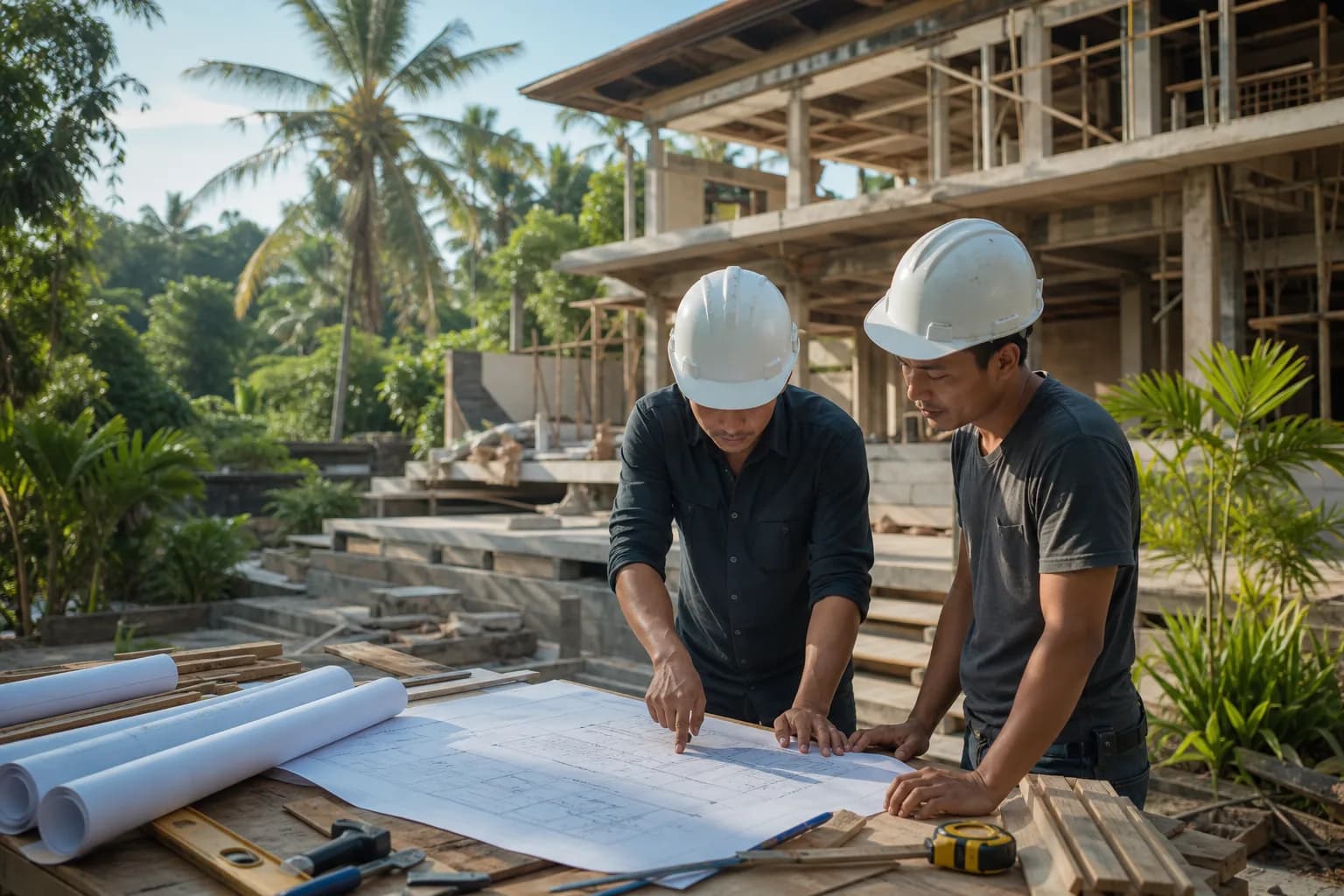
The Critical Flaw in Bali Land Transactions: When Notary Deeds Hide Forged Certificates
A foreign investor recently approached our engineering team after discovering their “verified” land certificate was fraudulent—three months into foundation excavation. The notary deed appeared legitimate, stamped and registered, yet the underlying land certificate had been expertly forged. This scenario represents one of the most dangerous construction risks in Bali: proceeding with villa construction on land you don’t legally own. Unlike structural engineering failures that reveal themselves during construction, forged land certificates can remain undetected until government authorities halt your project, leaving you with a half-built structure on disputed land and no legal recourse for recovery.
Technical Architecture of Notary Deed Verification Systems in Bali
Understanding notary deed verification requires examining the multi-layered authentication system that Indonesian land law mandates. The notary deed (Akta Jual Beli) serves as the primary legal instrument transferring land ownership, but its validity depends entirely on the authenticity of the underlying land certificate it references. This creates a critical vulnerability point that sophisticated forgery operations exploit.
The Indonesian land registration system operates through the National Land Agency (BPN/ATR), which issues certificates in three primary categories: Hak Milik (freehold for Indonesian citizens), Hak Guna Bangunan (building rights, typically 30 years), and Hak Pakai (right to use). Each certificate contains specific security features including watermarked paper, embossed seals, unique registration numbers, and digital verification codes in newer certificates issued post-2018. However, the transition period between paper-based and electronic certificates has created opportunities for forgery, particularly in rural Bali areas where land records may not be fully digitized.
From a construction engineering perspective, this legal foundation directly impacts project feasibility. We’ve encountered cases where forged certificates showed incorrect land boundaries, resulting in foundation designs that encroached on neighboring properties. One project in Canggu required complete redesign when proper verification revealed the actual plot was 180 square meters smaller than the forged certificate indicated—a 22% reduction that fundamentally altered the villa’s structural layout and eliminated the planned infinity pool.
The technical verification process involves cross-referencing multiple data points: the certificate number against BPN’s central database, the physical certificate’s security features against known authentic samples, the land measurements against official cadastral maps, and the ownership history against village records (buku desa). Modern electronic certificates include QR codes linking to BPN’s verification portal, but certificates issued before 2018 require manual verification at the local land office, creating a time-intensive process that many buyers skip.
Notaries in Indonesia hold legal responsibility for deed authenticity under Law No. 2 of 2014 concerning Notary Positions. However, their verification obligations have technical limitations. A notary must verify that the seller possesses the physical certificate and matches the identity documents, but they’re not required to conduct forensic analysis of the certificate’s paper composition or holographic elements. This creates a gap where high-quality forgeries can pass initial notary review, only to be detected later during construction permit applications when government engineers conduct their own land verification.
The construction implications extend beyond ownership disputes. Building permits in Bali require submission of the original land certificate for verification by the DPMPTSP (Investment and One-Stop Integrated Service Office). If forgery is detected at this stage—often 2-3 months into the permit process—the entire application is rejected, and the case is referred to law enforcement. We’ve documented cases where this discovery occurred after site preparation work had already begun, resulting in immediate stop-work orders and potential criminal liability for the construction company if they proceeded despite knowing about the fraudulent documentation.
Hidden Vulnerabilities That Bypass Standard Due Diligence
The most dangerous forgeries don’t target the notary deed itself—they target the underlying land certificate that the notary references. We’ve identified three sophisticated forgery methods that regularly evade standard verification:
Certificate cloning involves creating duplicate certificates for legitimately registered land, often targeting properties with absentee owners. The forger obtains the authentic certificate number and details, then produces a physical forgery that passes visual inspection. When the notary verifies the certificate number against BPN records, it returns as valid because the land is genuinely registered—just not to the person presenting the forged certificate. This only surfaces when both the legitimate owner and the fraud victim attempt to transact simultaneously, or when construction begins and neighbors alert the actual owner.
Historical record manipulation exploits gaps in Bali’s land registration history, particularly for land that transitioned from customary (adat) ownership to formal certificates in the 1980s-1990s. Forgers create certificates with authentic-looking registration numbers that fall within known ranges for that era, betting that incomplete digitization of historical records will prevent immediate detection. These forgeries often survive initial notary verification but fail when construction engineers request detailed ownership history for structural insurance purposes.
Boundary coordinate fraud presents authentic certificates for genuinely owned land, but with altered GPS coordinates or boundary descriptions. The certificate number verifies correctly, the owner is legitimate, but the physical land being sold doesn’t match the certificate’s legal description. This particularly affects villa construction projects in areas with irregular plot shapes, where buyers assume the physical boundaries match the certificate without conducting independent surveying.
Engineering-Grade Verification Protocol for Land Certificate Authentication
Our construction engineering approach to land verification applies the same systematic rigor we use for structural calculations. This protocol has prevented 14 forged certificate transactions from reaching our project pipeline over the past three years:
Phase 1: Physical Certificate Forensics (Week 1)
Obtain the original certificate—never accept copies for initial verification. Examine security features under proper lighting: authentic certificates printed after 2015 contain microtext along borders visible only under magnification, color-shifting ink on the BPN seal that changes from green to blue at different angles, and watermarked paper with embedded fibers visible when backlit. Document the certificate with high-resolution photography including close-ups of all seals and stamps. Compare paper texture and weight against known authentic samples—forgeries often use standard security paper that feels subtly different from BPN’s proprietary stock.
Phase 2: Multi-Source Database Cross-Reference (Week 1-2)
Verify the certificate number through three independent channels: BPN’s online verification portal (for post-2018 certificates), in-person verification at the local land office with the physical certificate, and cross-reference against village land records (buku desa) maintained by the kelurahan office. Discrepancies between these sources indicate potential forgery. Request a formal land status letter (Surat Keterangan Pendaftaran Tanah) directly from BPN—this official document confirms current ownership and reveals any encumbrances, disputes, or irregularities not visible on the certificate itself.
Phase 3: Cadastral Survey Verification (Week 2-3)
Commission an independent licensed surveyor to measure the physical plot and compare against the certificate’s boundary coordinates. This reveals boundary coordinate fraud and identifies encroachments. The surveyor should provide a stamped site plan (gambar ukur) that overlays the certificate’s legal boundaries with actual physical measurements. For land purchase in Bali intended for construction, this survey data feeds directly into foundation engineering calculations, making it a dual-purpose investment.
Phase 4: Ownership History Chain Analysis (Week 3-4)
Request complete ownership transfer history from BPN, documenting every transaction since original certificate issuance. Authentic certificates show clear transfer chains with consistent notary deed references. Gaps in the chain, especially recent transfers with unusually short ownership periods, suggest potential fraud. Interview the previous owner directly when possible—legitimate sellers can provide context about their acquisition and use of the land. Forgers typically avoid this step, claiming the previous owner is unavailable or deceased.
Phase 5: Neighborhood and Customary Verification (Week 4)
Conduct interviews with adjacent landowners and the local banjar (customary community organization). Long-term residents can confirm ownership history and identify discrepancies. Request verification from the village head (kepala desa) regarding any customary claims or disputes affecting the land. This step is particularly critical in Bali where customary law (adat) can create obligations not reflected in formal certificates, such as temple access rights or ceremonial use requirements that impact construction feasibility.
Cost and Timeline Realities for Comprehensive Verification
Professional-grade land certificate verification for a typical villa construction plot (300-500 square meters) requires 4-6 weeks and costs between IDR 15-25 million (approximately $950-1,600 USD). This breaks down as: licensed surveyor fees (IDR 5-8 million), notary verification services (IDR 3-5 million), legal consultant for document analysis (IDR 4-7 million), and BPN administrative fees for official letters and history reports (IDR 3-5 million).
These costs represent 0.3-0.5% of typical villa construction costs in Bali, yet prevent losses that average IDR 800 million when forged certificates are discovered mid-construction. The timeline cannot be compressed without sacrificing verification quality—BPN database queries require 5-7 business days for official responses, cadastral surveys need 7-10 days including site visits and report preparation, and ownership history research involves manual archive review that takes 10-14 days for properties with multiple previous owners.
For buyers attempting to expedite the process, understand that “express” verification services claiming 1-2 week completion typically skip the cadastral survey and ownership chain analysis—precisely the steps that detect sophisticated forgeries. We’ve documented cases where buyers paid for expedited verification, received clean reports, then discovered forgery during our construction engineering due diligence, requiring the entire verification process to be repeated properly.
Frequently Asked Questions: Notary Deed Verification and Forged Certificates
Can a notary be held liable if they authenticate a deed based on a forged land certificate?
Yes, under Indonesian law, notaries face civil, criminal, and administrative liability for deeds involving forged documents. However, liability depends on whether the notary exercised proper due diligence. If the forgery was sophisticated enough to pass standard verification procedures (checking certificate number against BPN database, verifying seller identity), the notary may avoid criminal charges but still face administrative sanctions from the Notary Supervisory Council. For construction projects, this means you cannot rely solely on the notary’s verification—independent engineering-grade verification is essential before committing to villa construction.
What happens to a construction project if land certificate forgery is discovered after building permits are issued?
Building permits are immediately revoked, and construction must cease. The permit-issuing authority (DPMPTSP) will issue a stop-work order, and continued construction constitutes a criminal offense. The structure built on fraudulently obtained land becomes legally problematic—you cannot claim ownership of improvements made to land you don’t legally possess. In cases we’ve documented, buyers lost both their land purchase payment and the value of construction completed before discovery, with no practical legal recourse against sellers who had disappeared. This represents total project loss, typically IDR 2-5 billion for partially completed villas.
Are electronic land certificates issued after 2018 immune to forgery?
Electronic certificates significantly reduce forgery risk but aren’t completely immune. The QR code verification system prevents physical certificate forgery, but doesn’t protect against identity fraud where someone impersonates the legitimate owner, or database manipulation in cases of internal corruption. Additionally, many Bali properties still operate on pre-2018 paper certificates that haven’t been converted to electronic format. For construction engineering purposes, we treat even electronic certificates as requiring full verification protocol, particularly the cadastral survey and ownership chain analysis that confirm the physical land matches the digital record.
How can I verify that the person selling the land is actually the certificate holder?
Demand original identity documents (KTP for Indonesian citizens, passport and KITAS/KITAP for foreigners) and compare the name, photo, and ID number against the land certificate. Request the seller to appear in person at the land office (BPN) to authorize a verification letter—legitimate owners will comply, forgers will create excuses. For Indonesian sellers, cross-reference their identity against the Family Card (Kartu Keluarga) and request a recent domicile letter from their village office. Commission a background check through a licensed investigator for high-value transactions. We’ve prevented fraud by requiring sellers to provide notarized authoriz
 3180 m²7 month(s)from 142.000 USD
Vasudeva
 164 m²7 month(s)from 79.000 USD
Private: Haridas Villas, Tegallalang
 3173 m²6 month(s)from 125.000 USD
TALA FOUR
 4344 m²16 month(s)from 290.000 USD
Radha
 3127 m²9 month(s)from 177.000 USD
Mukunda
 172 m²8 month(s)from 120.000 USD
Keshava
 1from 198.000 USD
Private: Haridas Villas
 3104 m²11 month(s)from 99.000 USD
TALA 100
 3124 m²6 month(s)from 123.000 USD
TALA 8
164 m²7 month(s)from 79.000 USDTALA TWO

Want to calculate?
 2144 m²11 month(s)from 104.000 USD
Narayana
Start With Real Numbers, Not Guesses
Before buying land or finalizing a design, check the realistic build cost range for your project in Bali.
Our team reviews your inputs and gives a grounded estimate.
Available lands
 585 m²8 min$ 165702Bali, Mengwi
 1350 m²5 min$ 283467Bali, Pecatu
 515 m²7 min$ 570813Bali, Canggu
 400 m²15 min$ 67192Bali, Tabanan
 1533 m²5 min$ 165666Bali, Cepaka
 2400 m²7 min$ 496552Bali, Canggu
 700 m²15 min$ 90517Bali, Central Bali
 1700 m²10 min$ 632257Bali, Kuta
 7900 m²25 min$ 413485Bali, Tabanan
 220 m²2 min$ 66565Bali, Cemagi
 600 m²12 min$ 101970Bali, Mengwi
 800 m²8 min$ 113300Bali, Ungasan
 204 m²5 min$ 40899Bali, Kedungu
 3300 m²15 min$ 449889Bali, Tabanan
 700 m²15 min$ 162500Bali, Tabanan
Essential Bali build & buy guides
- Bali villa construction cost per m² in 2026
- How much will your villa cost? Calculator
- Building a villa in Bali: the complete guide
- Buying land in Bali: step-by-step for foreigners
- Bali villa investment: yields, risks, returns
- Leasehold vs freehold: what foreigners can own
- Construction defect liability & 10-year warranty
- Bali building codes and construction standards
Related guides

Why a Cheap Bali Leasehold Is Cheap: Pricing Red Flags Every Buyer Should Decode
Suspiciously cheap Bali leaseholds are priced low for a reason: short remaining terms, forbidden zoning, missing road access, disputes or weak contracts. How to decode the discount before you pay for it.
8 min read
Fake Compliance and Licensing Agents in Bali: The 2026 Paperwork Scam and How to Verify Documents
Forged certificates, permit fixers and fake notaries: how Bali's paperwork scams work in 2026 and how to verify every property document at its government source.
7 min read
Buying a Bali Villa from Instagram: Phantom Listings, Render-Only Projects and How to Verify
Instagram is Bali's biggest property shop window and its least verified. How phantom listings, render-only projects and cloned developer accounts work — and the verification steps that expose them.
7 min read