Fiber Optic vs Copper Cabling: Villa Internet in Bali
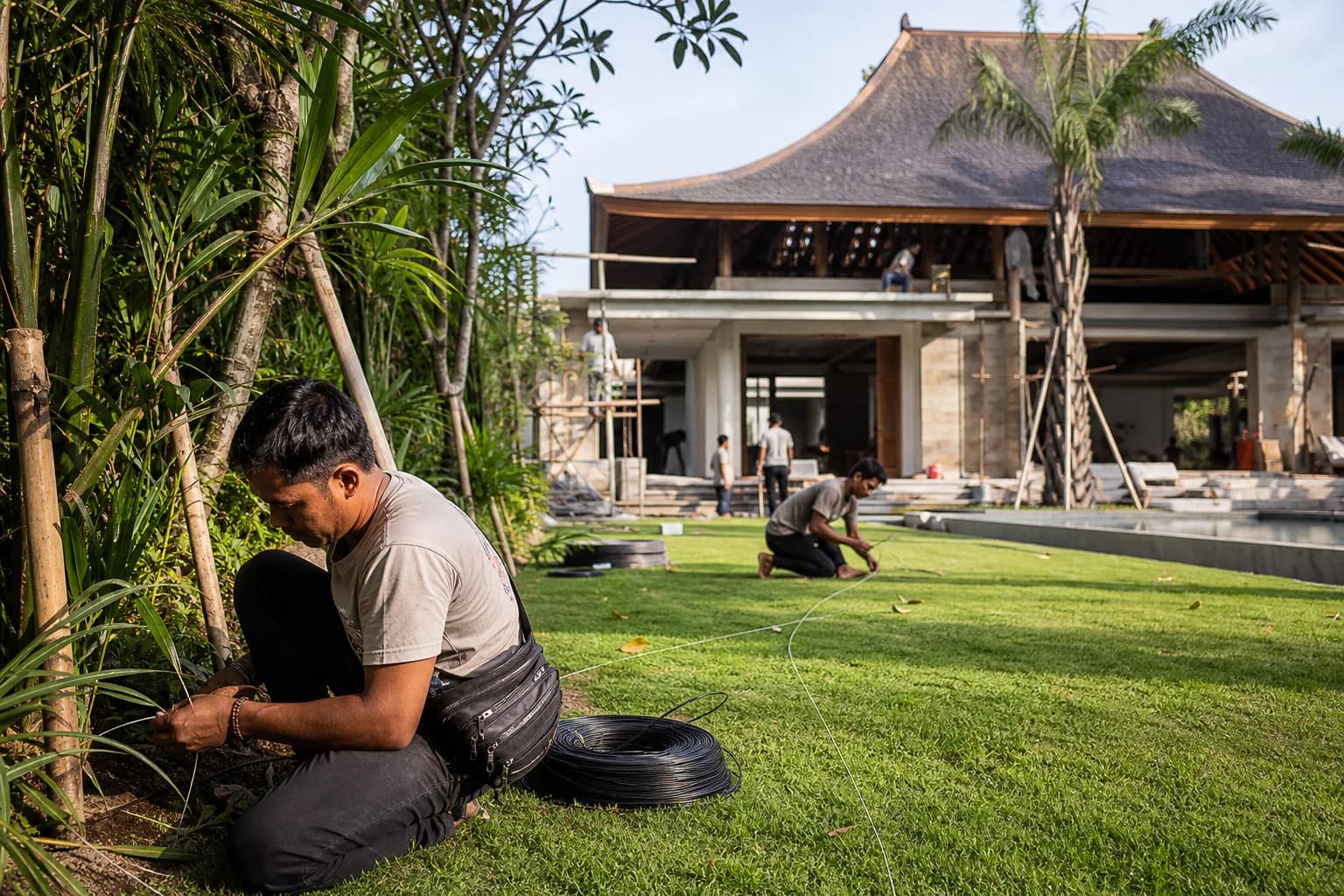
# Fiber Optic vs Copper Cabling: Villa Internet Infrastructure Bali
The Critical Infrastructure Decision That Determines Your Villa’s Long-Term Connectivity
When planning villa construction or renovation in Bali, the choice between fiber optic and copper cabling for internet infrastructure represents a fundamental decision that affects property functionality for decades. Many villa owners discover too late that copper-based systems installed during construction cannot support modern bandwidth demands, requiring expensive retrofitting through finished walls and ceilings. In Bali’s tropical climate, where humidity exceeds 80% year-round and salt air accelerates corrosion in coastal areas, the technical specifications of your cabling system directly impact reliability, maintenance costs, and guest satisfaction. This infrastructure choice must be made during the rough-in phase, before finishing works seal access points permanently.
Technical Infrastructure Comparison: Installation and Performance Specifications
The fundamental difference between fiber optic and copper cabling extends far beyond simple speed metrics. Fiber optic cables transmit data as light pulses through glass or plastic strands, while copper cables use electrical signals through metal conductors. This distinction creates profound implications for villa installation in Bali’s challenging environment.
Bandwidth Capacity and Future-Proofing
Fiber optic infrastructure supports multi-terabit-per-second transmission speeds, with modern single-mode fiber capable of handling bandwidth demands that won’t materialize for decades. Standard Cat6 copper cabling maxes out around 10 Gbps over short distances, while Cat6a can theoretically reach similar speeds but only across 100-meter maximum runs. For villa properties with multiple buildings, guest houses, or facilities spread across large compounds—common in Bali villa construction—this distance limitation becomes critical. Fiber maintains signal integrity across kilometers without repeaters, enabling centralized network equipment in secure locations while serving distant pavilions, pools, and entertainment areas.
Environmental Resistance in Tropical Conditions
Bali’s climate presents specific challenges that dramatically favor fiber optic installation. Copper cabling conducts electricity, making it susceptible to electromagnetic interference from nearby power lines, electrical panels, and equipment—all standard elements in villa utilities infrastructure. More critically, copper corrodes when exposed to moisture and salt air. Even within conduit systems, condensation forms during Bali’s rainy season (November through March), when humidity approaches saturation. Coastal villas face accelerated degradation, with copper connections showing oxidation within 5-7 years despite proper installation.
Fiber optic cables contain no metal conductors in the signal path, rendering them completely immune to electromagnetic interference and corrosion. The dielectric nature of fiber means lightning strikes and electrical surges—common during Bali’s dramatic thunderstorms—cannot travel through the cabling to damage network equipment or create fire hazards. This electrical isolation also eliminates ground loop problems that plague copper networks in villas with multiple electrical panels and grounding points.
Physical Durability and Installation Considerations
Modern fiber optic cables demonstrate superior tensile strength compared to copper alternatives. While copper Cat6 cable typically withstands 110 Newtons of pulling force during installation, armored fiber optic cable handles 300+ Newtons, reducing installation damage risk when pulling through long conduit runs in villa construction. The smaller diameter of fiber bundles—often 40% thinner than equivalent copper—simplifies routing through tight spaces in finished ceilings and walls during renovation projects.
However, fiber requires more careful handling at termination points. The glass core can crack if bent beyond minimum radius specifications (typically 10x cable diameter for single-mode fiber). Professional installation becomes non-negotiable, as improper termination creates signal loss that’s difficult to diagnose after finishing works are complete. Copper terminations, while more forgiving during installation, create connection points where corrosion initiates in humid environments.
Heat Generation and Power Requirements
Copper cabling generates heat during data transmission, particularly at higher speeds. In Bali’s ambient temperatures (28-32°C), this heat accumulation in bundled cables within ceiling spaces can accelerate insulation degradation. Fiber generates no heat during transmission, maintaining stable performance regardless of ambient temperature. Additionally, fiber networks can implement passive optical networks (PON) that require no powered equipment between the main distribution point and end users, reducing electrical infrastructure requirements and eliminating heat-generating switches in remote locations.
Materials Standards and Specification Requirements
Proper material selection for villa internet infrastructure in Bali requires understanding international standards and tropical-specific requirements that ensure long-term performance.
Fiber Optic Cable Specifications
Single-mode fiber (SMF) represents the optimal choice for villa installations, supporting transmission distances up to 40 kilometers and bandwidth capabilities that exceed any foreseeable residential requirement. The 9-micron core diameter requires laser-based transmission equipment but provides maximum future-proofing. Multi-mode fiber (MMF), with its 50 or 62.5-micron core, costs less and uses cheaper LED-based equipment but limits distances to 550 meters for 10 Gbps speeds—still adequate for most villa compounds.
For Bali installations, specify armored fiber optic cable with PE (polyethylene) outer jacket rated for direct burial and UV resistance. The armor layer—typically corrugated steel or aramid yarn—protects against rodent damage, a significant concern in tropical environments. Loose-tube construction, where fibers sit in gel-filled tubes within the cable, provides superior moisture protection compared to tight-buffered designs.
Copper Cable Specifications
If copper cabling is selected for specific applications, Cat6a represents the minimum acceptable standard for new villa construction in 2026, supporting 10 Gbps over 100 meters. Specify shielded twisted pair (STP) rather than unshielded (UTP) to minimize electromagnetic interference from villa electrical systems. The cable jacket must meet UV and moisture resistance standards, with outdoor-rated CMX or direct-burial CMX specifications for any exterior runs.
All copper terminations should use gold-plated connectors to resist corrosion, and connection points must be housed in weatherproof enclosures with IP65 or higher ratings. Even interior connections benefit from conformal coating on termination points in high-humidity areas.
Conduit and Protection Systems
Both fiber and copper installations require proper conduit systems during villa construction. Schedule 40 PVC conduit provides adequate protection for most applications, with 25mm minimum diameter for single cable runs and 40mm for multiple cables. Underground conduit runs should include pull boxes every 30 meters and at direction changes exceeding 90 degrees total. Conduit must slope toward drainage points to prevent water accumulation, with weep holes at low points.
Step-by-Step Installation Process for Villa Fiber Infrastructure
Phase 1: Design and Rough-In Planning (Week 1-2)
Infrastructure planning begins during architectural design, before foundation work commences. Map all network termination points: bedrooms, living areas, offices, outdoor entertainment spaces, security camera locations, and equipment rooms. Identify the main distribution frame (MDF) location—typically a climate-controlled room with backup power access. Calculate distances between MDF and all endpoints to determine cable specifications and equipment requirements.
Design conduit pathways that avoid crossing high-voltage electrical runs and maintain minimum 300mm separation where parallel runs are unavoidable. Plan for 30% spare capacity in all conduit runs to accommodate future additions without requiring new pathways through finished spaces. Submit infrastructure plans for permit approval alongside electrical and plumbing systems.
Phase 2: Conduit Installation During Structural Phase (Week 3-6)
Install conduit systems during foundation and framing work, before any finishing works begin. Underground conduit runs should sit in 150mm sand bedding, positioned at 600mm minimum depth to prevent damage from landscaping activities. Mark conduit locations with warning tape 300mm above pipes. Stub conduit ends up through floor slabs at planned termination points, extending 200mm above finished floor level for later trimming.
Within walls and ceilings, secure conduit every 900mm using appropriate clips. Maintain smooth bends using long-radius elbows rather than sharp 90-degree fittings—fiber optic cable cannot tolerate tight bends. Install pull strings in all conduit runs immediately, as pulling string through completed conduit proves difficult. Cap all conduit ends to prevent concrete, debris, or insects from entering during construction.
Phase 3: Cable Pulling and Installation (Week 10-12)
Cable installation occurs after rough electrical and plumbing work completes but before insulation and drywall installation. This timing provides access to conduit entry points while protecting cables from construction damage. Use proper cable pulling lubricant rated for fiber optic applications—never use soap or petroleum-based products that can damage cable jackets.
Maintain minimum bend radius throughout pulling operations: 10x cable diameter during pulling, 5x cable diameter for permanent installations. Use pulling grips that distribute force across the cable jacket rather than pulling on connectors or exposed fiber. Monitor pulling tension using a dynamometer, stopping if force exceeds cable specifications. For long runs exceeding 50 meters, use intermediate pull boxes and pull from the middle toward both ends rather than pulling the entire length in one operation.
Leave 3-meter service loops at all termination points and 5-meter loops at the MDF. These loops provide slack for future modifications and equipment relocations without requiring new cable runs. Coil excess cable carefully, maintaining minimum bend radius, and secure with velcro straps—never use zip ties that can create pressure points on fiber.
Phase 4: Termination and Testing (Week 13-14)
Fiber termination requires specialized equipment and training. Fusion splicing creates permanent connections with minimal signal loss (typically 0.1dB per splice), while mechanical splicing and pre-terminated connectors offer faster installation with slightly higher loss (0.3-0.5dB). For villa installations, pre-terminated fiber assemblies with factory-installed connectors provide optimal reliability, though they require accurate length measurement during planning.
Test all fiber runs using an optical time-domain reflectometer (OTDR) to verify continuity, measure total loss, and identify any damage or poor connections. Document test results with distance measurements and loss budgets for future troubleshooting. Test copper installations using cable certification testers that verify performance to Cat6a specifications, including crosstalk, return loss, and propagation delay.
Phase 5: Equipment Installation and Integration (Week 15)
Install network equipment after finishing works complete and climate control systems operate. Mount fiber optic patch panels in the MDF using 19-inch rack systems with proper cable management. Install media converters, switches, and routers according to network design specifications. Implement proper grounding for all equipment, with fiber maintaining electrical isolation between buildings to prevent ground loop issues.
Configure network equipment and test end-to-end connectivity to all termination points. Document network topology, IP addressing schemes, and equipment configurations for future maintenance and troubleshooting.
Cost Analysis and Project Timeline
Material Cost Comparison
Fiber optic cable costs approximately $2.50-4.00 per meter for armored single-mode cable suitable for Bali installations, compared to $1.50-2.50 per meter for Cat6a copper cable. However, fiber requires fewer intermediate components—no powered switches needed for distances under 40km—reducing overall system costs. A typical 300-square-meter villa with 20 network drops requires approximately 500 meters of cable, creating a material cost difference of $500-750 between fiber and copper.
Termination costs favor copper for small installations, with fiber terminations running $50-100 per endpoint compared to $15-30 for copper. However, fiber’s longer lifespan (30-50 years versus 5-10 years for copper in tropical environments) and lower maintenance requirements offset higher initial costs within the first decade of operation.
Installation Labor and Timeline
Professional fiber installation requires specialized skills, increasing labor costs by approximately 30-40% compared to copper installation. A complete villa fiber infrastructure installation typically requires 2-3 weeks from cable pulling through testing and commissioning, compared to 1-2 weeks for copper. However, this represents a small fraction of total villa construction timeline, and the work occurs during the rough-in phase when multiple trades operate simultaneously.
Budget $3,000-6,000 for complete fiber infrastructure in a standard villa, including materials, labor, testing, and equipment. Copper systems cost $2,000-4,000 for equivalent coverage. The cost difference narrows significantly when factoring in the superior performance, reliability, and longevity of fiber systems in Bali’s challenging environment.
Frequently Asked Questions
Can fiber optic cabling be added during villa renovation without major demolition?
Fiber’s small diameter and flexibility make it easier to retrofit than copper in many scenarios. If existing conduit systems have spare capacity, fiber can often be pulle
 3173 m²6 month(s)from 125.000 USD
TALA FOUR
 3127 m²9 month(s)from 177.000 USD
Mukunda
 164 m²7 month(s)from 79.000 USD
TALA TWO
 3124 m²6 month(s)from 123.000 USD
TALA 8
 3104 m²11 month(s)from 99.000 USD
TALA 100
 1from 198.000 USD
Private: Haridas Villas
 2144 m²11 month(s)from 104.000 USD
Narayana

Want to calculate?
 172 m²8 month(s)from 120.000 USD
Keshava
164 m²7 month(s)from 79.000 USDPrivate: Haridas Villas, Tegallalang
 3180 m²7 month(s)from 142.000 USD
Vasudeva
 4344 m²16 month(s)from 290.000 USD
Radha
Start With Real Numbers, Not Guesses
Before finalizing your finishing works plan, check realistic cost ranges for your Bali villa project.
Available lands
 1410 m²15 min$ 390702Bali, Tabanan
 3100 m²15 min$ 257697Bali, Tegallalang
 800 m²5 min$ 295567Bali, Seseh
 3900 m²10 min$ 432266Bali, Tabanan
 1000 m²10 min$ 303571Bali, Tabanan
 700 m²8 min$ 165517Bali, Umalas
 500 m²2 min$ 175862Bali, Cemagi
 1362 m²15 min$ 335468Bali, Tumbak
 6000 m²10 min$ 1330049Bali, Kutuh South Bali
 2200 m²15 min$ 508005Bali, Canggu
 1000 m²10 min$ 230911Bali, Kerobokan
 4270 m²10 min$ 394397Bali, Ubud
 515 m²7 min$ 570813Bali, Canggu
 610 m²10 min$ 165271Bali, Seminyak
 1000 m²10 min$ 123154Bali, Jimbaran
Essential Bali build & buy guides
- Bali villa construction cost per m² in 2026
- How much will your villa cost? Calculator
- Building a villa in Bali: the complete guide
- Buying land in Bali: step-by-step for foreigners
- Bali villa investment: yields, risks, returns
- Leasehold vs freehold: what foreigners can own
- Construction defect liability & 10-year warranty
- Bali building codes and construction standards
Related guides

Why a Cheap Bali Leasehold Is Cheap: Pricing Red Flags Every Buyer Should Decode
Suspiciously cheap Bali leaseholds are priced low for a reason: short remaining terms, forbidden zoning, missing road access, disputes or weak contracts. How to decode the discount before you pay for it.
8 min read
Fake Compliance and Licensing Agents in Bali: The 2026 Paperwork Scam and How to Verify Documents
Forged certificates, permit fixers and fake notaries: how Bali's paperwork scams work in 2026 and how to verify every property document at its government source.
7 min read
Buying a Bali Villa from Instagram: Phantom Listings, Render-Only Projects and How to Verify
Instagram is Bali's biggest property shop window and its least verified. How phantom listings, render-only projects and cloned developer accounts work — and the verification steps that expose them.
7 min read