Construction Risks in Bali: Safety Hazards Mitigation Strategie
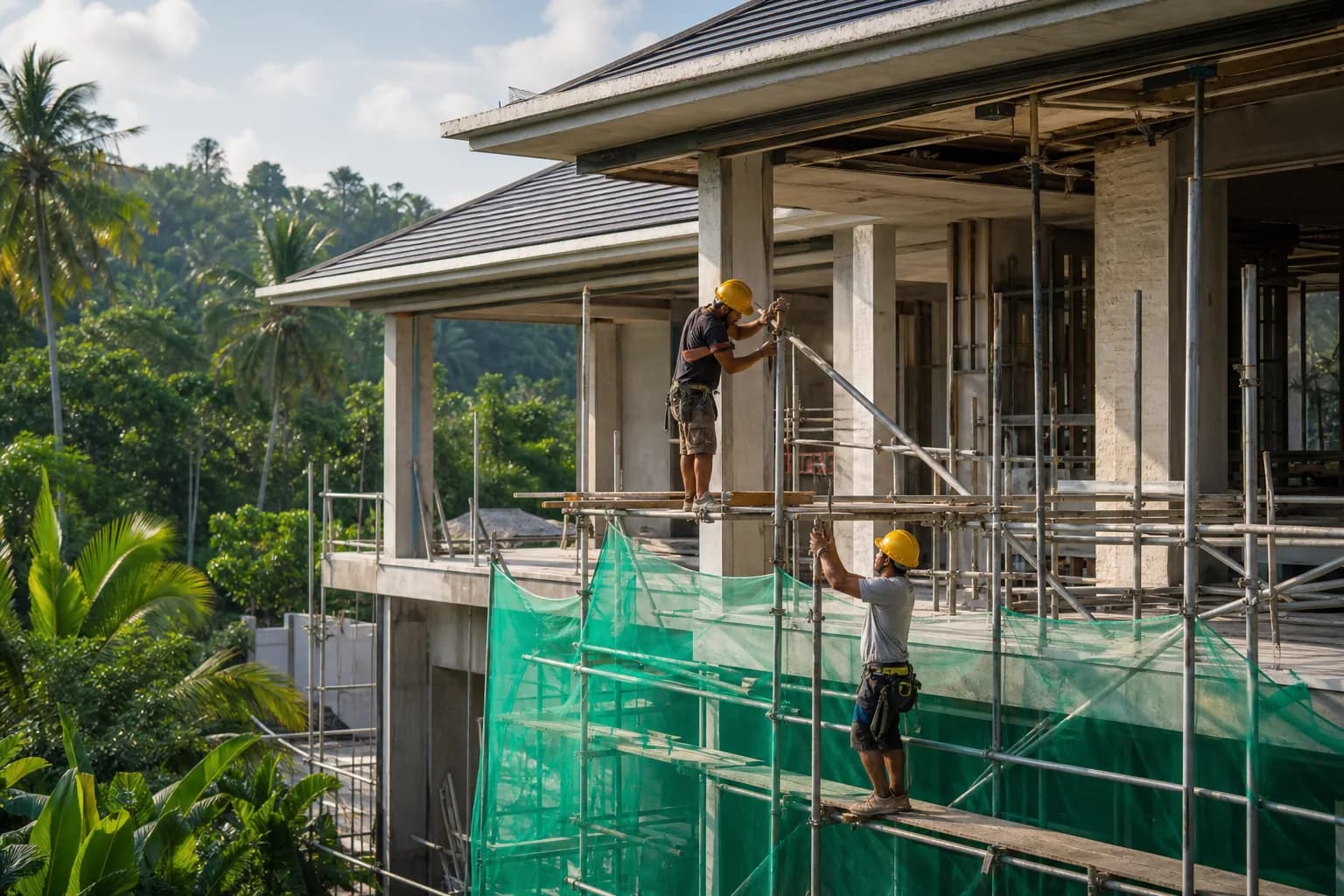
Why Do So Many Bali Villa Construction Projects Fail—And How Do You Avoid Becoming Another Statistic?
A foreign buyer signs a land lease, transfers 60% upfront to a contractor, and returns six months later to find an abandoned foundation, incorrect setbacks violating zoning rules, and a builder who’s stopped answering calls. This scenario repeats across Bali dozens of times each year—not because of bad luck, but because construction risk management was never part of the planning process. The question isn’t whether risks exist in Bali construction; it’s whether you’ve systematically identified and mitigated each one before breaking ground.
The Engineering and Legal Reality: Construction Risks in Bali Are Structural, Not Superficial
Construction risks in Bali operate across four distinct technical domains: land legal status and zoning compliance, contractor capability and financial stability, engineering design suitability for tropical conditions, and regulatory approval processes. Each domain contains failure points that can halt projects, trigger legal disputes, or result in structurally compromised buildings.
Land and zoning risks begin before purchase. Bali’s 2025 construction restrictions on rice field land (sawah) and certain agricultural zones mean land that was legally buildable in 2023 may now be prohibited. ITR (Izin Tata Ruang) zoning certificates must be verified directly with local planning offices—not assumed from seller claims. Leasehold agreements require notarized contracts with clear extension terms, because Indonesian law doesn’t automatically grant lease renewals. A 25-year lease without documented extension rights becomes a demolition timeline, not a property asset.
Contractor financial risk is the most common project killer. Bali operates without mandatory contractor licensing for villa-scale projects, meaning anyone can claim construction expertise. Contractors who request 50-70% upfront payments before foundation completion create cash flow risk—if they’re managing multiple projects simultaneously and one client defaults, your funds may subsidize another project. This isn’t theoretical: construction abandonment cases in Bali typically involve contractors who over-leveraged across 4-6 concurrent projects.
Engineering design risks are climate-specific. Bali’s tropical environment—consistent 80%+ humidity, intense UV exposure, seasonal monsoon rainfall exceeding 300mm monthly, and coastal salt air in southern regions—degrades construction materials differently than temperate climates. Concrete mix designs must account for high humidity curing conditions. Steel reinforcement requires epoxy coating in coastal zones within 5km of shoreline. Timber structures need termite-resistant species or chemical treatment. Designs imported from Australia or Europe without tropical engineering adaptation fail within 3-5 years through material degradation.
Permit and regulatory risks stem from multi-agency approval requirements. IMB (building permits) require architectural drawings stamped by Indonesian-licensed engineers, structural calculations, and site plan approval from village authorities. Processing timelines range 8-16 weeks when documentation is complete, but incomplete submissions restart the entire review cycle. Projects built without IMB face stop-work orders and potential demolition—Badung Regency issued 47 such orders in 2024 alone.
Hidden Risks Buyers Consistently Overlook Until Construction Begins
Soil bearing capacity is never visually apparent. Bali’s volcanic soil composition varies dramatically within single districts—some areas have 2.5 kg/cm² bearing capacity requiring deep pile foundations, while adjacent plots have 1.2 kg/cm² necessitating raft foundations. Skipping geotechnical soil testing (cost: $800-1,200) leads to foundation redesign mid-construction, adding $15,000-40,000 in unbudgeted costs and 6-8 week delays.
Utility infrastructure availability is inconsistent outside established villa zones. PLN (electricity) connection capacity may require transformer upgrades costing $8,000-12,000 if local infrastructure can’t support villa electrical loads. PDAM (municipal water) may not reach the site, requiring drilled wells (150-200m depth, $4,000-7,000 cost). These aren’t construction risks—they’re site feasibility issues that should disqualify land purchases, but buyers discover them only after closing.
Material supply chain disruptions are endemic. Bali imports 70% of construction materials from Java—cement, steel, glass, fixtures. Shipping delays during high construction season (April-October) extend timelines 3-5 weeks. Contractors who don’t maintain material buffer stocks or pre-order long-lead items (custom windows, imported tiles) create cascading schedule delays. A 9-month construction timeline without supply chain contingency planning realistically requires 12-13 months.
Insurance coverage gaps are discovered only during claims. Standard construction all-risk policies in Bali exclude earthquake damage unless specifically endorsed, despite Bali’s location in a seismically active zone. Policies also typically exclude design defect claims—if your architect specifies inadequate drainage and the building floods, insurance won’t cover remediation. Buyer-arranged insurance often lapses during construction phase transitions, leaving 2-3 week gaps in coverage.
Step-by-Step Risk Mitigation Process for Bali Villa Construction
Phase 1: Pre-Purchase Land Verification (Before Any Commitment)
Step 1: Obtain official ITR zoning certificate from district planning office (Dinas PUPR), not from seller. Verify permitted building use (residential, commercial, mixed), maximum building coverage (typically 40-60% of land area), and height restrictions (usually 15m maximum, equivalent to 3 stories plus roof).
Step 2: Commission independent legal review of land ownership documents through licensed notary. For leasehold, verify lessor’s ownership through land certificate (Sertifikat Hak Milik), confirm lease registration at land office (BPN), and review extension terms—look for contractual right to extend, not just possibility to negotiate.
Step 3: Conduct geotechnical soil investigation with 3-4 bore holes to 6m depth. Report must include bearing capacity, groundwater level, soil composition analysis, and foundation recommendations. This data determines foundation type and directly impacts structural budget.
Step 4: Verify utility availability through site visits to PLN office (electricity capacity confirmation), PDAM office (water connection feasibility), and local telecom providers. Document connection costs and timeline in writing—verbal confirmations are unenforceable.
Phase 2: Contractor Selection and Contract Structuring
Step 5: Request contractor financial references including bank statements demonstrating liquidity to cover 60 days of operational costs, and contact details for 3-4 recently completed projects (within 12 months) for site visits and client interviews. Verify projects of similar scale—a contractor who’s built 150m² villas shouldn’t be your choice for a 600m² retreat center.
Step 6: Structure payment milestones tied to measurable completion stages: 15% on contract signing, 20% on foundation completion, 20% on structural frame completion, 20% on roof completion, 15% on finishes completion, 10% on final handover after defect rectification. Never agree to 50%+ payment before structural frame completion.
Step 7: Require construction all-risk insurance policy naming you as beneficiary, with minimum coverage of 100% contract value plus 20% contingency. Policy must include third-party liability (minimum $500,000), contractor default coverage, and earthquake endorsement. Verify premium payment and obtain policy copy before construction starts.
Phase 3: Design Development and Permit Acquisition
Step 8: Engage Indonesian-licensed architect (IPTB certified) to develop construction drawings compliant with local building codes. Drawings must include structural engineering calculations stamped by licensed civil engineer (IABI certified). Foreign architects can design conceptually, but permit drawings require Indonesian professional licensing.
Step 9: Submit IMB application with complete documentation: site plan, architectural drawings, structural calculations, environmental impact assessment (UKL-UPL for projects over 500m²), and village approval letter. Track application weekly—permit processing stalls without proactive follow-up.
Phase 4: Construction Monitoring and Quality Control
Step 10: Implement weekly site inspections documented with photographs and written reports. Focus on: concrete pour quality (slump test results, curing procedures), steel reinforcement placement before concrete pour, waterproofing membrane installation, and material specifications compliance. Hire independent construction supervisor if you’re not Bali-based—cost is 3-5% of construction value but prevents 15-25% in defect remediation costs.
Realistic Cost Ranges and Timeline Expectations for Risk Mitigation
Pre-construction due diligence costs: Legal land verification $1,200-2,000, geotechnical soil testing $800-1,200, topographic survey $400-700, architectural feasibility study $1,500-2,500. Total pre-construction investment: $3,900-6,400. This investment prevents $50,000-150,000 in construction failures or legal disputes.
Construction insurance premiums: All-risk policies cost 1.5-2.5% of insured construction value annually. For a $400,000 construction project, expect $6,000-10,000 annual premium. Earthquake endorsement adds 0.3-0.5%. Contractor default coverage adds 0.4-0.6%. Total insurance cost: 2.2-3.6% of construction value, or $8,800-14,400 for $400,000 project.
Independent construction supervision: Full-time site supervisor costs $1,800-2,800 monthly for 9-12 month construction period, totaling $16,200-33,600. Part-time weekly inspection services cost $800-1,200 monthly, totaling $7,200-14,400. This expense directly correlates with defect reduction—supervised projects average 8-12% lower remediation costs.
Realistic construction timelines with risk buffers: 250m² two-bedroom villa: 9-11 months from permit to handover. 400m² four-bedroom villa: 12-14 months. 800m² retreat center: 16-20 months. Add 2-3 months for permit acquisition, 1-2 months for design development. Total project duration from land purchase to occupancy: 14-18 months for standard villa, 20-25 months for retreat center.
Contingency budget requirements: Allocate 12-15% of base construction cost for scope changes, unforeseen site conditions, and material price fluctuations. For $350,000 base construction budget, maintain $42,000-52,500 contingency reserve. Projects without contingency budgets exceed original estimates by 18-28% on average.
Frequently Asked Questions: Construction Risk Management in Bali
What happens if my contractor abandons the project mid-construction?
Contractor abandonment triggers a complex recovery process. First, document the abandonment with photographs, written communication attempts, and site condition reports. If you have contractor default insurance, file a claim immediately—policies typically cover completion costs up to 120% of remaining contract value. Without insurance, you’ll need to engage a new contractor to assess completed work quality, which often reveals hidden defects requiring remediation before continuation. Legally, you can pursue breach of contract claims through Indonesian courts, but litigation timelines average 18-24 months and recovery rates are low if the contractor has no attachable assets. Prevention through milestone-based payments and insurance is exponentially more effective than post-abandonment recovery. Teville structures all contracts with payment milestones that never exceed verified work completion value, and requires construction insurance on every project—view our risk-managed construction process at How We Build.
How do I verify that land is actually legally buildable before purchasing?
Legal buildability verification requires three independent confirmations. First, obtain the official ITR (Izin Tata Ruang) zoning certificate directly from the district planning office—this document specifies permitted land use, building coverage ratio, and height restrictions. Second, verify the land certificate (Sertifikat) authenticity at the local land office (BPN) and confirm no encumbrances, disputes, or liens are registered. Third, obtain written confirmation from village authorities (kelurahan or desa) that the land is not designated for agricultural preservation or community use. Seller-provided documents are insufficient—verification must be independent. For leasehold land, additionally verify the lessor’s ownership rights and confirm the lease agreement will be registered at BPN, which provides legal enforceability. This verification process takes 2-3 weeks and costs $1,200-2,000, but prevents purchasing unbuildable land—a mistake that results in total investment loss. Teville conducts this verification on all land before listing at our verified lands page, ensuring every property has confirmed buildability.
What construction defects are most common in Bali villa projects, and how do I prevent them?
The five most common construction defects in Bali are: inadequate waterproofing causing interior water infiltration (occurs in 40-50% of projects without proper supervision), undersized structural elements leading to cracking (30-35% of projects), improper concrete curing resulting in reduced strength (25-30%), inadequate drainage causing site flooding (35-40%), and termite damage in timber structures (20-25% within first three years). Prevention requires specification enforcement and quality control during construction—waterproofing membranes must be installed on all below-grade surfaces and tested before backfilling; concrete must be cured with continuous water application for minimum 7 days in tropical heat; structural steel reinforcement must match engineering drawings exactly; site drainage must direct water away from foundations with minimum 2% slope. Independent construction supervision catches these issues during installation when correction
 3104 m²11 month(s)from 99.000 USD
TALA 100
 172 m²8 month(s)from 120.000 USD
Keshava
 2144 m²11 month(s)from 104.000 USD
Narayana

Want to calculate?
 3127 m²9 month(s)from 177.000 USD
Mukunda
 4344 m²16 month(s)from 290.000 USD
Radha
 164 m²7 month(s)from 79.000 USD
TALA TWO
 3173 m²6 month(s)from 125.000 USD
TALA FOUR
164 m²7 month(s)from 79.000 USDPrivate: Haridas Villas, Tegallalang
 3180 m²7 month(s)from 142.000 USD
Vasudeva
 3124 m²6 month(s)from 123.000 USD
TALA 8
 1from 198.000 USD
Private: Haridas Villas
Start With Real Numbers, Not Guesses
Before buying land or finalizing a design, check the realistic build cost range for your project in Bali.
Our team reviews your inputs and gives a grounded estimate.
Available lands
 770 m²5 min$ 163578Bali, Kedungu
 2000 m²15 min$ 261700Bali, Babakan
 1533 m²5 min$ 165666Bali, Cepaka
 5000 m²8 min$ 424877Bali, Ungasan
 889 m²15 min$ 145612Bali, Cepaka
 500 m²15 min$ 124692Bali, Kaba Kaba
 7500 m²5 min$ 206281Bali, Kedungu
 2850 m²15 min$ 315887Bali, Tabanan
 660 m²10 min$ 175567Bali, Mengwi
 2680 m²10 min$ 1732759Bali, Pererenan
 5815 m²5 min$ 815740Bali, Tabanan
 1362 m²15 min$ 335468Bali, Tumbak
 3100 m²15 min$ 257697Bali, Tegallalang
 700 m²15 min$ 90517Bali, Central Bali
 600 m²10 min$ 206897Bali, Canggu
Essential Bali build & buy guides
- Bali villa construction cost per m² in 2026
- How much will your villa cost? Calculator
- Building a villa in Bali: the complete guide
- Buying land in Bali: step-by-step for foreigners
- Bali villa investment: yields, risks, returns
- Leasehold vs freehold: what foreigners can own
- Construction defect liability & 10-year warranty
- Bali building codes and construction standards
Related guides

Why a Cheap Bali Leasehold Is Cheap: Pricing Red Flags Every Buyer Should Decode
Suspiciously cheap Bali leaseholds are priced low for a reason: short remaining terms, forbidden zoning, missing road access, disputes or weak contracts. How to decode the discount before you pay for it.
8 min read
Fake Compliance and Licensing Agents in Bali: The 2026 Paperwork Scam and How to Verify Documents
Forged certificates, permit fixers and fake notaries: how Bali's paperwork scams work in 2026 and how to verify every property document at its government source.
7 min read
Buying a Bali Villa from Instagram: Phantom Listings, Render-Only Projects and How to Verify
Instagram is Bali's biggest property shop window and its least verified. How phantom listings, render-only projects and cloned developer accounts work — and the verification steps that expose them.
7 min read