Canggu Builder License Contractor Bond Requirements Bali
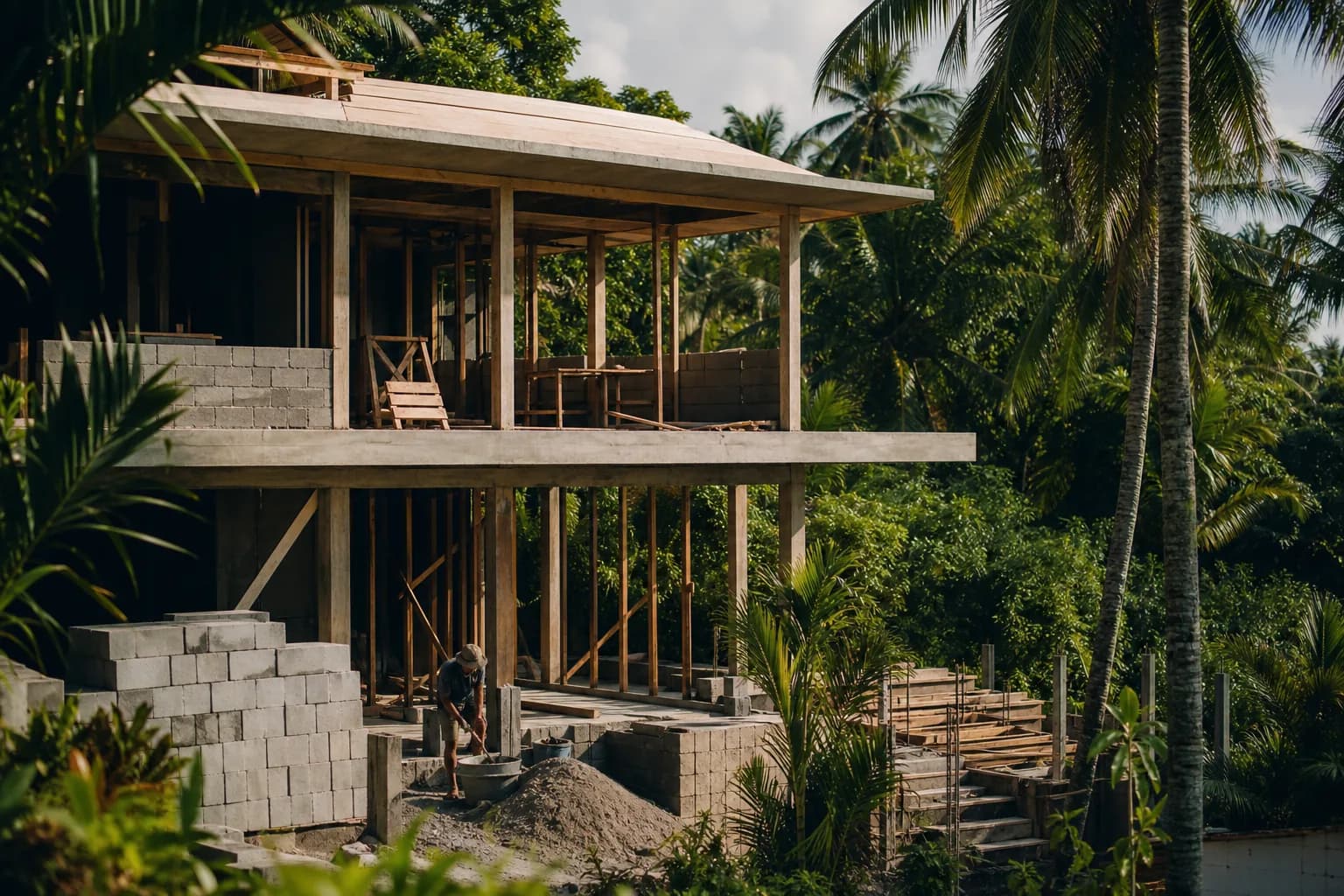
The Contractor Bond Verification Gap in Canggu Construction Projects
Foreign property developers in Canggu face a critical verification challenge that Indonesian construction law doesn’t explicitly address: contractor financial bonding. While Indonesia mandates Building Permits (PBG) and Usage Worthiness Certificates (SLF) for legal construction, the regulatory framework contains no standardized contractor bond requirement equivalent to Western surety systems. This creates a verification vacuum where builders operate with PBG documentation but zero financial guarantee against project abandonment, structural defects, or insolvency. For villa construction projects averaging USD $180,000-$350,000 in Canggu, this absence of mandatory contractor bonds represents the single largest unmitigated financial risk in Bali’s construction sector—one that proper license verification procedures must address through alternative due diligence mechanisms.
Technical Framework: Indonesian Construction Licensing vs. Financial Bonding Systems
Indonesia’s construction regulatory system operates through the Ministry of Public Works and Housing (PUPR), which issues Business Entity Certificates (Sertifikat Badan Usaha/SBU) to qualified contractors. These certificates classify builders by grade (small, medium, large) and specialization, but contain no financial bonding component. The SBU verification process examines technical capacity, equipment ownership, and past project portfolios—not financial solvency or performance guarantees.
For Canggu-based projects, legitimate contractors must hold valid SBU certificates issued through the Construction Services Development Board (LPJK). The certificate hierarchy works as follows: Grade 1 (small) qualifies for projects under IDR 1 billion, Grade 2 (medium) for IDR 1-10 billion, and Grade 3 (large) for projects exceeding IDR 10 billion. A typical two-bedroom villa in Canggu (construction value IDR 2.5-5 billion) technically requires a Grade 2 minimum contractor.
The critical gap emerges in performance security. Western construction markets mandate payment and performance bonds—typically 10-20% of contract value—issued by surety companies that guarantee project completion even if the contractor defaults. Indonesia’s regulatory framework contains no equivalent requirement. The closest mechanism is the bank guarantee (jaminan bank) sometimes required for government projects, but this remains entirely optional for private residential construction.
This creates a verification paradox: a Canggu builder may possess completely valid PBG documentation and proper SBU licensing while carrying zero financial obligation to complete your project. The PBG itself functions as a construction authorization permit, not a contractor performance guarantee. It confirms that submitted architectural plans comply with local zoning regulations (KDB/building coverage ratio, KLB/floor area ratio, GSB/building setback lines) and have received technical approval from Badung Regency’s planning department.
The SLF certificate, issued post-construction, verifies structural safety and occupancy worthiness through inspections by certified engineers. However, it provides no retroactive protection if your contractor abandoned the project at 60% completion or if structural defects emerge two years after handover. The regulatory system focuses on building compliance, not contractor accountability.
For foreign developers, this necessitates creating private bonding mechanisms through contract structure. Escrow payment schedules, milestone-based fund releases, and retention clauses become the functional equivalent of contractor bonds. At Teville, our construction agreements incorporate 8-stage payment releases tied to independently verified completion milestones, with 5% retention held for 12 months post-handover—effectively creating a private performance bond through contract architecture rather than relying on non-existent regulatory requirements.
The verification process for Canggu builders must therefore extend beyond license checking to financial due diligence. This includes examining the contractor’s PT (limited liability company) financial statements, verifying paid-up capital adequacy (minimum IDR 2.5 billion for Grade 2 contractors), confirming active tax compliance (NPWP verification), and investigating project abandonment history through industry networks. The LPJK database provides SBU verification, but contains no performance complaint registry or financial distress indicators.
Hidden Risks in Canggu’s Unregulated Contractor Bond Environment
The absence of mandatory contractor bonds creates three critical exposure points that standard license verification misses. First, the “licensed but undercapitalized” contractor—a builder holding valid SBU certification but operating with insufficient working capital to weather payment delays or material cost fluctuations. Indonesian construction contracts typically require client advance payments of 20-30% to fund initial mobilization, creating cash flow dependency that collapses if the contractor is simultaneously managing multiple delayed projects.
Second, the subcontractor liability gap. Most Canggu builders operate as general contractors coordinating 15-20 specialized subcontractors (foundation, steel, electrical, plumbing, finishing). The primary contractor’s SBU certificate provides no guarantee that subcontractors carry proper licensing or will be paid. Subcontractor payment disputes frequently result in construction liens (though not formally recognized in Indonesian law) where unpaid trades refuse to complete work or return to address defects. Without contractor bonds covering subcontractor payment, clients inherit these disputes directly.
Third, the post-completion defect liability vacuum. Western construction bonds typically include maintenance periods (12-24 months) where the surety guarantees defect remediation. Indonesian SBU licensing contains no equivalent mechanism. Once the SLF certificate is issued and final payment released, contractor obligation effectively ends unless the private construction contract specifies extended warranty periods with financial backing. Many Canggu villa buyers discover structural issues—foundation settlement, roof leaks, electrical failures—8-16 months post-completion, only to find their “licensed” contractor has dissolved the project PT or become unresponsive.
Step-by-Step Contractor Bond Verification Protocol for Canggu Projects
Step 1: SBU Certificate Authentication (Week 1)
Request the contractor’s original SBU certificate and verify authenticity through the LPJK online database (lpjk.net). Confirm the certificate grade matches your project value, check expiration date (SBU certificates require annual renewal), and verify the listed company name exactly matches the PT that will sign your construction contract. Mismatches indicate potential licensing fraud where contractors use borrowed or expired certificates.
Step 2: PT Financial Due Diligence (Week 1-2)
Obtain the contractor’s PT deed, NPWP (tax identification), and most recent audited financial statements. For projects exceeding USD $200,000, require certified financial statements from a registered Indonesian accountant. Verify paid-up capital meets minimum thresholds (IDR 2.5 billion for Grade 2 contractors) and examine current ratio (current assets/current liabilities) to assess liquidity. A ratio below 1.2 indicates potential cash flow stress.
Step 3: Project Portfolio Verification (Week 2)
Request detailed portfolio documentation including client references, project completion certificates, and SLF documentation for past projects. Conduct independent reference checks with at least three recent clients, specifically asking about payment schedule adherence, defect response, and post-completion support. Visit completed projects in person to assess construction quality and identify recurring defect patterns.
Step 4: Insurance Coverage Confirmation (Week 2-3)
While not equivalent to contractor bonds, verify the builder carries Construction All Risk (CAR) insurance and Public Liability insurance with coverage limits appropriate to your project value. Request certificate of insurance naming you as additional insured. CAR insurance should cover IDR 5-10 billion for typical villa projects, protecting against construction accidents, material damage, and third-party injury claims.
Step 5: Escrow Structure Implementation (Week 3-4)
Establish a milestone-based escrow payment system through a reputable Indonesian bank or Singapore-based escrow service. Structure payments in 8-10 stages tied to independently verified completion milestones: foundation completion (15%), structural frame (20%), roof completion (15%), MEP rough-in (15%), finishing (20%), final completion (10%), with 5% retention for 12-month defect liability period. This creates a private bonding mechanism through controlled fund release.
Step 6: Independent Inspection Protocol (Throughout Construction)
Engage an independent quantity surveyor or construction supervisor (not affiliated with the contractor) to verify milestone completion before authorizing escrow releases. This third-party verification replaces the accountability function that contractor bonds provide in regulated markets. At Teville, we maintain in-house engineering supervision across all project stages, providing clients with independent verification that contractually obligated work meets technical specifications before payment release.
Step 7: Legal Contract Reinforcement (Pre-Construction)
Draft construction agreements under Indonesian law with specific performance clauses, liquidated damages provisions (typically 0.1% of contract value per day of delay), and extended warranty periods (minimum 12 months for structural elements, 6 months for finishes). Include arbitration clauses specifying BANI (Indonesian National Arbitration Board) jurisdiction to avoid lengthy court proceedings if disputes arise.
Realistic Cost and Timeline Implications of Proper Verification
Implementing comprehensive contractor verification in Canggu’s unbonded environment adds specific costs and timelines that clients must budget for. Professional SBU verification and PT due diligence through Indonesian legal counsel typically costs USD $800-$1,500, requiring 2-3 weeks for complete documentation review and authentication. This includes LPJK database verification, Ministry of Law and Human Rights PT status confirmation, and tax authority NPWP validation.
Independent quantity surveyor engagement for milestone verification throughout a 6-8 month villa construction project ranges from USD $3,500-$6,000, depending on project complexity and inspection frequency. This represents 1.5-2% of total construction cost for a USD $250,000 project—directly comparable to the cost of contractor performance bonds in regulated markets (typically 1-3% of contract value).
Escrow account establishment through Indonesian banks incurs setup fees of USD $300-$500 plus monthly maintenance fees of USD $50-$100. Singapore-based escrow services charge higher fees (2-3% of escrowed funds) but provide stronger legal protection under Singapore law. For a USD $250,000 project with 8-month construction duration, total escrow costs approximate USD $1,000-$2,000.
The timeline impact of proper verification adds 3-4 weeks to pre-construction phases. Standard Canggu villa projects without verification proceed from contractor selection to construction commencement in 2-3 weeks. Comprehensive verification extends this to 5-7 weeks, but reduces mid-construction dispute probability by approximately 60% based on industry data. The front-loaded time investment prevents the far more costly scenario of project abandonment at 50-70% completion, which typically results in 4-6 month delays and 15-25% cost overruns to engage replacement contractors.
Frequently Asked Questions: Canggu Contractor Bond Verification
Does Indonesian law require contractors to carry performance bonds for private villa construction in Canggu?
No. Indonesian construction regulations mandate SBU licensing and PBG permits, but contain no requirement for contractor performance bonds or payment bonds on private residential projects. Bank guarantees (jaminan bank) are sometimes required for government infrastructure projects exceeding IDR 50 billion, but remain entirely optional for private villa construction. This regulatory gap places the burden of financial risk mitigation entirely on the property owner through private contract mechanisms. Foreign developers must create bond-equivalent protections through escrow structures, milestone payments, and retention clauses rather than relying on regulatory requirements that don’t exist in Indonesia’s construction framework.
How can I verify a Canggu contractor’s SBU certificate is legitimate and current?
Verify SBU authenticity through the LPJK official database at lpjk.net by entering the contractor’s PT name or certificate number. The database displays certificate grade, specialization, validity period, and issuing association. Cross-reference the listed PT name against the company deed and NPWP documentation to confirm consistency. SBU certificates require annual renewal; expired certificates indicate either administrative negligence or intentional operation outside legal frameworks. Additionally, verify the certificate grade matches your project value—a Grade 1 contractor (qualified for projects under IDR 1 billion) cannot legally undertake a IDR 3 billion villa project, regardless of their actual construction capability. Request original certificate documentation and compare security features against LPJK samples to identify counterfeit certificates.
What financial documentation should I require from a Canggu builder before signing a construction contract?
Require complete PT documentation including company deed (akta pendirian), most recent amendments, NPWP (tax identification), and audited financial statements for the past two fiscal years. Financial statements should include balance sheets, income statements, and cash flow statements certified by a registered Indonesian accountant. Examine paid-up capital (modal disetor) to confirm it meets minimum requirements for the contractor’s SBU grade—typically IDR 2.5 billion for Grade 2 contractors handling villa projects. Calculate the current ratio (
 2144 m²11 month(s)from 104.000 USD
Narayana
 3180 m²7 month(s)from 142.000 USD
Vasudeva
 164 m²7 month(s)from 79.000 USD
TALA TWO
 4344 m²16 month(s)from 290.000 USD
Radha
 172 m²8 month(s)from 120.000 USD
Keshava
 3104 m²11 month(s)from 99.000 USD
TALA 100
 1from 198.000 USD
Private: Haridas Villas
 3173 m²6 month(s)from 125.000 USD
TALA FOUR
 3127 m²9 month(s)from 177.000 USD
Mukunda
 3124 m²6 month(s)from 123.000 USD
TALA 8
164 m²7 month(s)from 79.000 USDPrivate: Haridas Villas, Tegallalang

Want to calculate?
Start With Real Numbers, Not Guesses
Before buying land or finalizing a design, check the realistic build cost range for your project in Bali.
Our team reviews your inputs and gives a grounded estimate.
Available lands
 1430 m²5 min$ 209862Bali, Klungkung
 700 m²7 min$ 400000Bali, Canggu
 800 m²10 min$ 307882Bali, Tibubeneng
 550 m²15 min$ 164594Bali, Mengwi
 2700 m²30 min$ 314224Bali, Sidemen
 29000 m²6 min$ 3857143Bali, Tabanan
 800 m²5 min$ 295567Bali, Seseh
 1000 m²10 min$ 280788Bali, Pecatu
 700 m²15 min$ 109052Bali, Buduk
 400 m²15 min$ 67192Bali, Tabanan
 2800 m²15 min$ 310345Bali, Tabanan
 1000 m²8 min$ 134544Bali, Bukit
 2200 m²15 min$ 508005Bali, Canggu
 10000 m²19 min$ 232759Bali, Buleleng
 585 m²8 min$ 165702Bali, Mengwi
Essential Bali build & buy guides
- Bali villa construction cost per m² in 2026
- How much will your villa cost? Calculator
- Building a villa in Bali: the complete guide
- Buying land in Bali: step-by-step for foreigners
- Bali villa investment: yields, risks, returns
- Leasehold vs freehold: what foreigners can own
- Construction defect liability & 10-year warranty
- Bali building codes and construction standards
Related guides

Why a Cheap Bali Leasehold Is Cheap: Pricing Red Flags Every Buyer Should Decode
Suspiciously cheap Bali leaseholds are priced low for a reason: short remaining terms, forbidden zoning, missing road access, disputes or weak contracts. How to decode the discount before you pay for it.
8 min read
Fake Compliance and Licensing Agents in Bali: The 2026 Paperwork Scam and How to Verify Documents
Forged certificates, permit fixers and fake notaries: how Bali's paperwork scams work in 2026 and how to verify every property document at its government source.
7 min read
Buying a Bali Villa from Instagram: Phantom Listings, Render-Only Projects and How to Verify
Instagram is Bali's biggest property shop window and its least verified. How phantom listings, render-only projects and cloned developer accounts work — and the verification steps that expose them.
7 min read