Bali Subcontractor Payment Verification: Prevent Mechanic s Liens
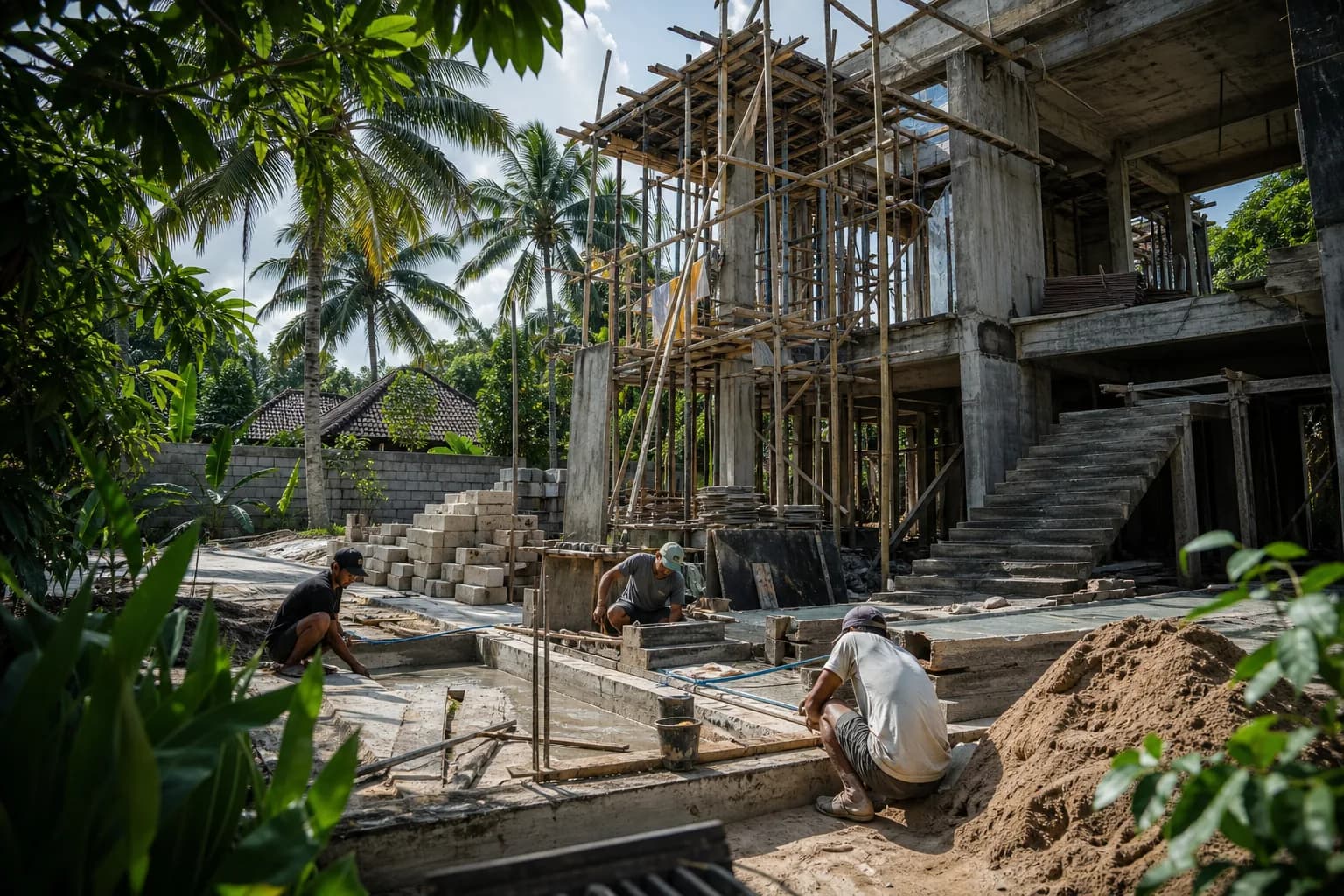
The Hidden Liability: When Your Bali Villa Project Faces Subcontractor Payment Claims
You’ve signed the main construction contract, transferred milestone payments to your general contractor, and watched your Bali villa take shape over six months. Then, three weeks before completion, a subcontractor arrives at your site claiming unpaid invoices totaling $18,000 for electrical work—threatening to file a mechanic’s lien against your property. Your contractor insists they paid everyone. Who’s telling the truth? Without proper subcontractor payment verification systems, foreign villa owners face a legal nightmare where Indonesian labor law, construction contracts, and property rights collide in ways that can delay occupancy, trigger legal disputes, and create unexpected financial obligations even when you’ve already paid your contractor in full.
Understanding Mechanic’s Liens in Bali’s Construction Legal Framework
Indonesia’s construction payment hierarchy operates fundamentally differently from Western lien systems, creating confusion for foreign property owners. Under Indonesian Civil Code Article 1149 and Labor Law 13/2003, subcontractors and material suppliers hold specific legal rights to claim payment directly from property owners when general contractors fail to fulfill payment obligations—regardless of whether the owner has already paid the contractor.
The 2026 Bali compliance framework introduces mandatory subcontractor payment verification as part of the Certificate of Proper Function (SLF) application process. Starting March 31, 2026, property owners must provide documented proof that all subcontractors, material suppliers, and laborers have received full payment before final building certification can be issued. This requirement links directly to PBG (Building Construction Permit) compliance, meaning incomplete payment verification can prevent legal occupancy even when physical construction is complete.
The technical mechanism works through a three-tier verification system: First, general contractors must submit detailed subcontractor payment ledgers showing all third-party engagements. Second, each subcontractor must provide signed payment confirmation (Surat Keterangan Pembayaran) acknowledging receipt of full compensation. Third, the property owner or their representative must verify these documents against the original construction contract’s scope of work, ensuring no gaps exist between contracted services and confirmed payments.
This system addresses a persistent problem in Bali’s construction sector: the “cascade payment failure” where general contractors receive milestone payments from owners but delay or withhold payments to subcontractors, using those funds for other projects or operational expenses. When contractors face financial difficulties or disappear mid-project, subcontractors exercise their legal right to pursue payment from the property owner—the party with the most to lose if construction halts or legal claims are filed.
The engineering implications extend beyond legal compliance. Unpaid subcontractors may have installed critical systems—structural steel reinforcement, waterproofing membranes, electrical panels, plumbing infrastructure—without proper completion or quality verification. If payment disputes arise, these subcontractors have little incentive to return for warranty work or system corrections. For tropical construction where waterproofing integrity and electrical safety are paramount, this creates long-term performance risks that manifest months or years after initial construction.
Foreign owners face additional vulnerability because Indonesian construction contracts often lack the detailed payment flow provisions common in Western agreements. A typical Bali villa contract might specify milestone payments to the general contractor but remain silent on subcontractor payment timing, verification methods, or owner protection mechanisms. This contractual gap, combined with language barriers and unfamiliarity with Indonesian commercial law, leaves owners exposed to claims they believed were the contractor’s responsibility.
The 2026 verification requirement also addresses permit compliance. Subcontractors performing specialized work—structural engineering, electrical installation, plumbing systems—must hold appropriate Indonesian trade certifications (SKA/SKT). Payment verification now requires confirming that paid subcontractors possessed valid credentials when performing work, linking payment legitimacy to technical qualification. This prevents situations where unqualified workers install critical systems, get paid, then disappear before defects emerge.
Critical Vulnerabilities: What Foreign Villa Owners Overlook
The most dangerous assumption foreign owners make is believing that paying their general contractor fulfills all payment obligations. Indonesian construction law doesn’t recognize this limitation—if your contractor fails to pay subcontractors, you remain potentially liable regardless of your payment history with the contractor. This legal principle catches owners completely off-guard, especially when they’ve maintained meticulous payment records with their primary contractor.
Many owners discover payment disputes only when applying for final building certification. The SLF application process now requires subcontractor payment documentation, meaning issues that festered during construction suddenly block legal occupancy. Owners face an impossible choice: pay subcontractors a second time to obtain certification, or engage in lengthy legal disputes while their completed villa sits unusable and their leasehold clock continues running.
The verification gap becomes particularly acute with material suppliers. While owners may track payments to labor subcontractors, they often overlook that cement suppliers, steel vendors, tile distributors, and equipment rental companies also hold payment claim rights. A contractor might pay for labor but delay material supplier payments, creating hidden liabilities. When suppliers file claims, owners struggle to verify whether materials were actually delivered to their project or diverted to other sites—a common practice among contractors managing multiple projects simultaneously.
Language barriers compound verification challenges. Subcontractor payment confirmations, supplier invoices, and labor agreements are typically in Bahasa Indonesia, using construction terminology that standard translation services misinterpret. Owners relying on basic translations miss critical details about payment conditions, work scope limitations, or outstanding balance clauses that create ongoing liability even after partial payments.
The timing vulnerability is equally critical. Most owners implement payment verification (if at all) only at project completion, when leverage has evaporated. Contractors know that owners desperate for SLF certification will pay disputed claims rather than delay occupancy. This creates perverse incentives where contractors deliberately create payment ambiguities, knowing owners will resolve them quickly at project end rather than risk certification delays.
Implementing Effective Subcontractor Payment Verification
Effective verification begins before construction starts, embedded directly into your construction contract. Your agreement with the general contractor must include specific clauses requiring progressive subcontractor payment documentation as a condition for receiving each milestone payment. This means before you release the 30% foundation completion payment, your contractor must provide signed payment confirmations from all subcontractors and suppliers involved in that phase—excavation teams, concrete suppliers, steel fabricators, formwork contractors.
Establish a three-document verification system for each construction phase: First, require your contractor to submit a detailed payment schedule listing every subcontractor and supplier engaged for that phase, with contracted amounts and payment terms. Second, before releasing your milestone payment, require signed payment confirmations (Surat Keterangan Pembayaran) from each listed subcontractor acknowledging receipt of payment for completed work. Third, implement random verification by directly contacting 2-3 subcontractors per phase to confirm payment receipt and work satisfaction.
Digital documentation is essential. Require all payment confirmations to include photographs of the subcontractor holding their signed statement alongside their Indonesian ID card (KTP), with the construction site visible in the background. This creates verifiable proof that the specific individual who performed work confirmed payment receipt, preventing situations where contractors forge signatures or obtain confirmations from individuals who never worked on your project.
Implement a project-specific escrow account structure where your milestone payments are deposited but not released to the general contractor until subcontractor payment verification is complete. This requires cooperation from your contractor but provides maximum protection—subcontractors get paid promptly, contractors receive funds only after proving payment, and you maintain leverage throughout construction. Indonesian banks offer construction escrow services specifically designed for this purpose, typically charging 0.5-1% of the escrow amount as administration fees.
For material suppliers, require delivery documentation that links specific materials to your project. Each delivery should include photographs showing materials being unloaded at your site, with timestamps and GPS coordinates. Cross-reference these delivery records against supplier payment confirmations to ensure you’re not paying for materials that were delivered elsewhere. This is particularly important for high-value items like structural steel, imported fixtures, or specialized waterproofing materials.
Engage a local construction supervisor or quantity surveyor who maintains direct relationships with the subcontractor community. This professional can verify payment claims through informal networks, identifying discrepancies before they become legal disputes. They can also assess whether claimed work was actually performed to specification, preventing situations where you verify payment for substandard work that requires later correction.
Create a master verification ledger that tracks every subcontractor and supplier from project start to SLF application. This document should include: company name and registration number, owner/manager contact information, work scope and contract value, payment schedule, actual payment dates, confirmation document references, and certification status. Update this ledger weekly, treating it as a critical project document equivalent to your construction drawings or permit files.
Before final payment to your general contractor, conduct a comprehensive site meeting with all major subcontractors present. This “payment confirmation assembly” allows you to directly verify that everyone has been paid, address any outstanding concerns, and obtain final sign-offs. Document this meeting with video recording, creating indisputable evidence that all parties confirmed payment satisfaction before project completion.
Financial Reality: Verification Costs and Payment Dispute Scenarios
Implementing proper subcontractor payment verification adds 2-4% to your overall project management costs but can prevent disputes costing 15-30% of your total construction budget. For a typical $350,000 villa project, expect to invest $7,000-14,000 in verification systems: escrow account administration ($3,500-5,000), independent payment auditing ($2,000-4,000), legal document review ($1,000-2,500), and digital documentation systems ($500-2,500).
Payment dispute resolution costs escalate rapidly. If a subcontractor files a formal claim, legal representation starts at $3,000-8,000 for straightforward cases, reaching $15,000-35,000 for complex disputes involving multiple parties or criminal fraud allegations. Court proceedings in Indonesian construction disputes typically require 8-18 months, during which your property remains in legal limbo—you cannot obtain SLF certification, cannot legally occupy the villa, and continue paying leasehold fees and property maintenance costs.
The hidden cost of delayed SLF certification is substantial. Each month of delay costs approximately 1.5-2.5% of your total project value in lost opportunity, ongoing security and maintenance expenses, leasehold fee continuation, and property deterioration. For a $350,000 project, this represents $5,250-8,750 monthly—meaning a six-month certification delay due to payment disputes costs $31,500-52,500, far exceeding the investment in proper verification systems.
Subcontractor payment claims typically range from $5,000-45,000 depending on trade specialty and project scale. Electrical subcontractors for a four-bedroom villa might claim $12,000-18,000, plumbing systems $8,000-15,000, tile and finishing work $15,000-25,000, and structural steel fabrication $20,000-35,000. If your contractor has failed to pay multiple subcontractors, you could face aggregate claims of $60,000-120,000 even after paying your contractor the full contract amount.
Frequently Asked Questions: Subcontractor Payment Verification
Can I be held liable for subcontractor payments if I’ve already paid my general contractor in full?
Yes, under Indonesian construction law, property owners can be held liable for unpaid subcontractor claims even when you’ve fulfilled all payment obligations to your general contractor. The legal principle is that subcontractors have performed work that improved your property, creating a direct relationship between their labor and your asset. If your contractor fails to pay them, they can pursue claims against you as the property owner and primary beneficiary of their work. This is why verification systems that confirm subcontractor payment before releasing funds to your general contractor are essential—they shift the liability back to where it contractually belongs while protecting you from cascade payment failures.
What specific documents do I need for the 2026 SLF subcontractor payment verification requirement?
The March 2026 compliance framework requires three categories of documentation: First, a comprehensive subcontractor ledger from your general contractor listing every third-party engagement with contract values, scope of work, and payment schedules. Second, individual payment confirmations (Surat Keterangan Pembayaran) from each subcontractor and material supplier, signed and stamped, acknowledging f
 1from 198.000 USD
Private: Haridas Villas
 3127 m²9 month(s)from 177.000 USD
Mukunda
 2144 m²11 month(s)from 104.000 USD
Narayana
 4344 m²16 month(s)from 290.000 USD
Radha
 172 m²8 month(s)from 120.000 USD
Keshava

Want to calculate?
 3104 m²11 month(s)from 99.000 USD
TALA 100
 164 m²7 month(s)from 79.000 USD
Private: Haridas Villas, Tegallalang
 3180 m²7 month(s)from 142.000 USD
Vasudeva
164 m²7 month(s)from 79.000 USDTALA TWO
 3173 m²6 month(s)from 125.000 USD
TALA FOUR
 3124 m²6 month(s)from 123.000 USD
TALA 8
Start With Real Numbers, Not Guesses
Before buying land or finalizing a design, check the realistic build cost range for your project in Bali.
Our team reviews your inputs and gives a grounded estimate.
Available lands
 1600 m²32 min$ 266010Bali, Tabanan
 3000 m²15 min$ 738916Bali, Cepaka
 700 m²15 min$ 90517Bali, Central Bali
 1300 m²10 min$ 348214Bali, Tabanan
 2115 m²5 min$ 1139547Bali, Pererenan
 800 m²8 min$ 113300Bali, Ungasan
 260 m²5 min$ 51872Bali, Kedungu
 7500 m²5 min$ 206281Bali, Kedungu
 1700 m²10 min$ 392549Bali, Nusadua
 3300 m²15 min$ 449889Bali, Tabanan
 550 m²5 min$ 217629Bali, Tabanan
 200 m²5 min$ 59113Bali, Bukit
 2200 m²15 min$ 508005Bali, Canggu
 7000 m²36 min$ 284483Bali, Gianyar
 1720 m²2 min$ 241478Bali, Tabanan
Essential Bali build & buy guides
- Bali villa construction cost per m² in 2026
- How much will your villa cost? Calculator
- Building a villa in Bali: the complete guide
- Buying land in Bali: step-by-step for foreigners
- Bali villa investment: yields, risks, returns
- Leasehold vs freehold: what foreigners can own
- Construction defect liability & 10-year warranty
- Bali building codes and construction standards
Related guides

Why a Cheap Bali Leasehold Is Cheap: Pricing Red Flags Every Buyer Should Decode
Suspiciously cheap Bali leaseholds are priced low for a reason: short remaining terms, forbidden zoning, missing road access, disputes or weak contracts. How to decode the discount before you pay for it.
8 min read
Fake Compliance and Licensing Agents in Bali: The 2026 Paperwork Scam and How to Verify Documents
Forged certificates, permit fixers and fake notaries: how Bali's paperwork scams work in 2026 and how to verify every property document at its government source.
7 min read
Buying a Bali Villa from Instagram: Phantom Listings, Render-Only Projects and How to Verify
Instagram is Bali's biggest property shop window and its least verified. How phantom listings, render-only projects and cloned developer accounts work — and the verification steps that expose them.
7 min read