Bali Construction Contract Red Flags: Spot Fraud
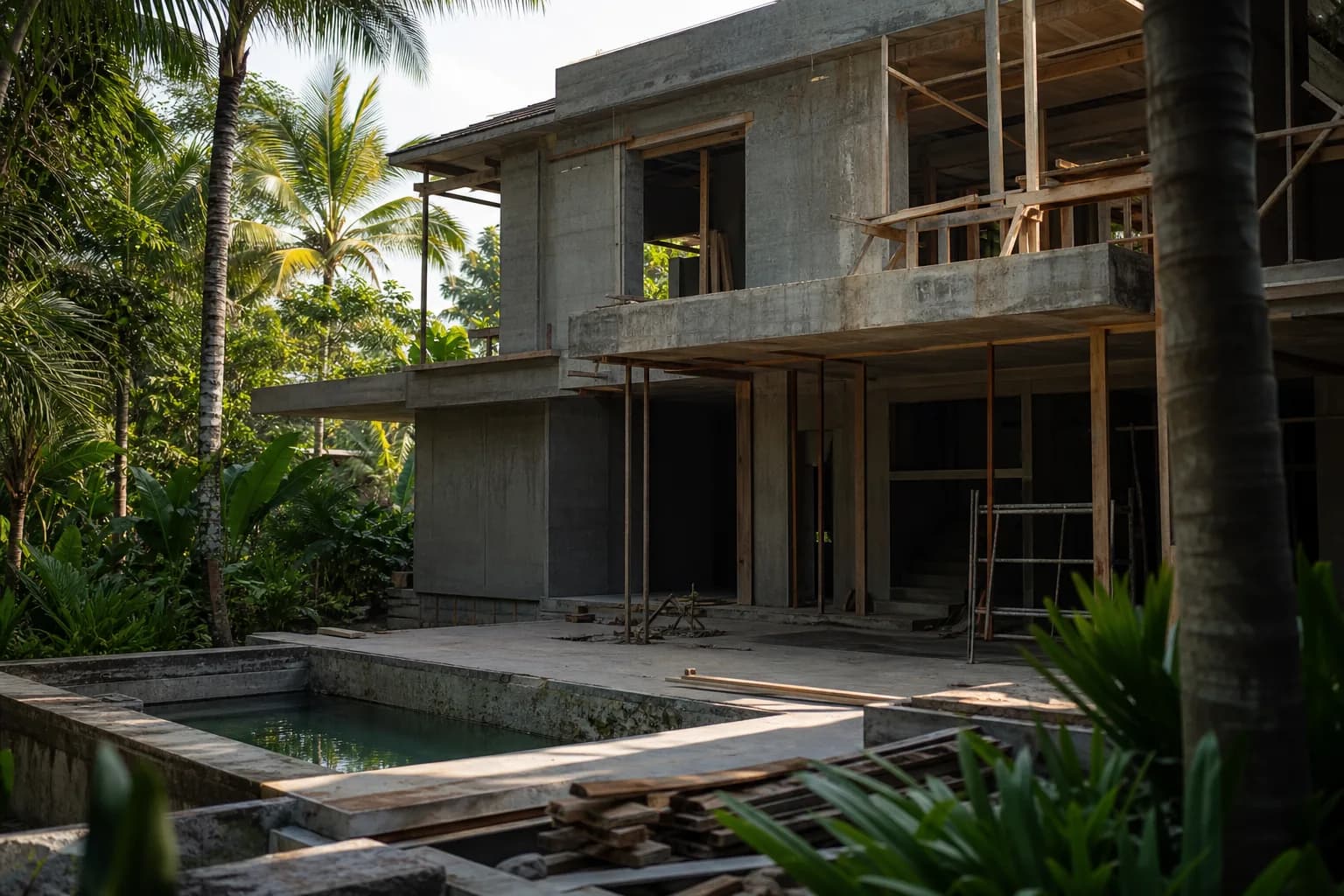
The Hidden Danger in Your Bali Construction Contract
You’ve found the perfect plot in Canggu, hired a contractor who promises luxury villa completion in eight months, and signed a contract that seemed reasonable at the time. Three months later, you discover the “fixed price” includes only structural work, permits were never filed, and the contractor’s license expired two years ago. This scenario plays out repeatedly across Bali in 2026, where construction fraud has become increasingly sophisticated. The difference between a successful build and a legal nightmare often lies in recognizing fraudulent clauses before signing. Understanding these red flags isn’t just about protecting your investment—it’s about ensuring your project meets Indonesian legal standards and structural integrity requirements that will stand for decades.
Anatomy of Fraudulent Construction Clauses in Bali
Fraudulent clauses in Bali construction contracts exploit the gap between international client expectations and Indonesian legal realities. These aren’t always obvious scams—many appear as standard industry practice until disputes arise.
The Informal Agreement Trap
The most dangerous red flag is reliance on informal agreements or contracts lacking proper Indonesian legal structure. In Bali’s construction industry, many contractors operate on handshake deals or simplified agreements that omit critical legal protections. A legitimate construction contract must reference specific Indonesian regulations including UU No. 2/2017 on Construction Services and Government Regulation No. 22/2020 on construction implementation regulations.
Fraudulent contractors deliberately keep contracts vague to maintain flexibility in interpretation. Watch for contracts that don’t specify the Indonesian legal jurisdiction, arbitration procedures under BANI (Indonesian National Arbitration Board), or reference to construction standards SNI (Standar Nasional Indonesia). At Teville’s construction process, every contract explicitly references applicable building codes, structural engineering standards, and dispute resolution mechanisms compliant with Indonesian law.
Licensing and Certification Omissions
A critical red flag is absence of contractor licensing verification clauses. Indonesian law requires construction service providers to hold valid IUJK (Izin Usaha Jasa Konstruksi) certificates appropriate to project scale. Fraudulent contracts either omit licensing references entirely or include vague statements like “contractor maintains all necessary permits” without specifying certificate numbers, grades, or verification procedures.
Legitimate contracts should explicitly state the contractor’s IUJK grade (small/K1, medium/K2, or large/K3), certificate number, and validity period. The contract should also require the contractor to provide certified copies of professional certifications for key personnel—structural engineers (SKA), architects (IPTB), and construction managers. Any resistance to including these specifics signals potential fraud.
Permit Responsibility Ambiguity
Perhaps the most financially devastating fraudulent clause involves unclear permit responsibility. Many contracts state “permits will be obtained” without specifying who bears responsibility, cost, or timeline. This ambiguity allows contractors to demand additional payments for permit processing or abandon projects when permit issues arise.
Red flag language includes: “permits to be arranged,” “permit costs estimated at,” or “client responsible for permit facilitation.” Legitimate contracts specify exact permit requirements (IMB building permit, environmental permits, utility connections), assign clear responsibility, include permit costs in fixed pricing, and establish timelines with penalty clauses for delays. The contract should also address what happens if permits are denied—refund terms, redesign responsibilities, and cost allocation.
Payment Structure Manipulation
Fraudulent payment clauses typically front-load contractor payments while back-loading deliverables. Watch for contracts requiring 50-70% upfront payment before substantial work begins, or payment schedules tied to time periods rather than verified completion milestones. Common fraudulent structures include large “mobilization fees” (exceeding 15-20% of contract value), vague milestone definitions like “foundation complete” without technical specifications, and absence of retention clauses (typically 5-10% held until defect liability period ends).
Legitimate payment structures tie disbursements to verified technical milestones: site preparation and foundation (20-25%), structural frame completion (20-25%), roof and external walls (15-20%), MEP rough-in (15-20%), finishing and fixtures (15-20%), with final 5-10% retained for 3-6 months post-completion. Each milestone should require third-party engineering verification before payment release.
Scope Definition Vagueness
Fraudulent contracts deliberately use ambiguous scope definitions to enable endless variation claims. Red flag phrases include “luxury finishes,” “high-quality materials,” “standard specifications,” or “as per common practice” without technical specifications, brand names, or quality standards. This vagueness allows contractors to install substandard materials while claiming contract compliance.
Every material specification should include manufacturer names, model numbers, technical standards (SNI codes), and acceptable alternatives. For example, instead of “quality tiles,” specify “60x60cm porcelain tiles, minimum Grade 1, water absorption <0.5%, slip resistance R10 minimum, brands: Arwana, Platinum, or equivalent." Structural specifications must reference concrete grades (K-225, K-300), steel reinforcement standards (BJTS 40, SNI 2052), and testing requirements.
Hidden Risks That Emerge After Signing
Even contracts that appear legitimate on surface review can contain hidden risks that only manifest during construction or disputes. These sophisticated fraudulent elements exploit technical knowledge gaps and cultural differences.
The Subcontractor Liability Shield
Many contracts include clauses stating “contractor may engage subcontractors at their discretion” without establishing liability chains. This allows primary contractors to disclaim responsibility for subcontractor failures, delays, or quality issues. When structural problems emerge, the contractor claims the subcontractor is responsible, while the subcontractor has no direct contractual relationship with you. You’re left pursuing legal action against an entity you never contracted with, who may lack assets or insurance.
Legitimate contracts establish that the primary contractor retains full liability for all subcontractor work, requires contractor approval for all subcontractors with submitted credentials, and mandates that subcontractors carry appropriate insurance with the client named as additional insured.
Force Majeure Exploitation
Force majeure clauses are standard in construction contracts, but fraudulent versions expand definitions to include routine circumstances. Watch for clauses listing “material price increases,” “labor shortages,” “permit delays,” or “weather conditions” as force majeure events. These are foreseeable construction risks that contractors should price into bids, not extraordinary circumstances.
Legitimate force majeure clauses limit coverage to truly unforeseeable events (natural disasters, war, government-mandated construction bans) and specify that contractors must demonstrate reasonable mitigation efforts before invoking the clause. The clause should also define remedies—typically time extensions without additional cost, not contract termination with partial payment retention.
Intellectual Property Traps
Some contracts include clauses granting contractors ownership of architectural plans, engineering drawings, or design elements. This prevents you from hiring alternative contractors if disputes arise, as the original contractor “owns” the plans. You’re forced to either reconcile with a fraudulent contractor or pay for complete redesign.
All design documents, architectural plans, engineering calculations, and project specifications should be explicitly owned by the client upon payment. The contract should grant you unlimited rights to use, modify, and share these documents with other contractors or engineers. At Teville, clients receive complete documentation packages including structural calculations, MEP system designs, and as-built drawings upon project completion.
Warranty Limitation Schemes
Fraudulent warranty clauses either omit warranties entirely or include so many exclusions that coverage becomes meaningless. Red flags include warranties shorter than industry standards (structural: 10 years, waterproofing: 5 years, finishes: 1-2 years), blanket exclusions for “improper maintenance” without defining proper maintenance, or requirements that only the original contractor can perform repairs, at rates they determine.
Legitimate warranties specify coverage periods by system, define covered defects explicitly, establish reasonable maintenance requirements with documentation, and allow third-party repairs with cost recovery from the original contractor if they’re unresponsive.
Step-by-Step Contract Review Process
Protecting yourself requires systematic contract analysis before signing. This process applies whether you’re reviewing a contractor’s proposed agreement or drafting your own terms.
Step 1: Verify Legal Foundation (Week 1)
Before reviewing contract content, verify the contracting entity’s legal status. Request the contractor’s complete business registration (NIB – Nomor Induk Berusaha), IUJK certificate with grade verification, NPWP tax identification, and professional certifications for key personnel. Cross-reference IUJK certificates through LPJK (Lembaga Pengembangan Jasa Konstruksi) online verification at lpjk.net. If the contractor resists providing these documents or offers expired certificates, terminate discussions immediately.
Verify the contractor’s physical business address and operational history. Fraudulent operators often use virtual offices or residential addresses. Visit the stated office location and request references from projects completed in the past 24 months with verifiable client contacts.
Step 2: Scope and Specification Audit (Week 1-2)
Review every scope item against technical specifications. Create a spreadsheet listing each deliverable with corresponding technical standards, material specifications, and quality benchmarks. Any item lacking specific technical definition is a red flag requiring clarification. For structural elements, verify that specifications reference appropriate SNI standards and include testing requirements (concrete slump tests, steel tensile testing, soil bearing capacity verification).
Compare the proposed scope against completed villa projects of similar scale. Significant omissions in standard systems (waterproofing membranes, proper drainage, termite treatment, electrical grounding) indicate either incompetence or intentional under-specification to enable variation claims later.
Step 3: Payment and Milestone Mapping (Week 2)
Map each payment milestone to specific, measurable deliverables. Reject time-based payment schedules. Each milestone should include technical completion criteria, required inspections or testing, documentation deliverables (progress photos, material certifications, test results), and verification procedures before payment release. Calculate the cumulative payment percentage at each milestone—if more than 30% is payable before substantial structural work is verifiable, renegotiate the schedule.
Ensure the contract includes retention (5-10% of total contract value) held until defect liability period completion, typically 3-6 months after practical completion. This retention provides leverage for addressing punch-list items and minor defects.
Step 4: Legal Protection Review (Week 2-3)
Engage an Indonesian construction lawyer to review dispute resolution clauses, liability provisions, insurance requirements, and termination terms. The lawyer should verify that the contract complies with Indonesian construction law, includes enforceable penalty clauses for delays or defects, establishes clear grounds for termination with cost recovery, and specifies arbitration procedures under BANI or Indonesian court jurisdiction.
Insurance requirements should mandate contractor’s all-risk insurance covering the full project value, professional indemnity insurance for design professionals, and workers’ compensation coverage. You should be named as additional insured on all policies with direct notification of any cancellations or lapses.
Step 5: Third-Party Technical Validation (Week 3-4)
Before signing, engage an independent structural engineer to review proposed structural specifications, foundation design, and seismic compliance. Bali is in a seismically active zone requiring specific structural provisions per SNI 1726 (earthquake resistance) and SNI 2847 (structural concrete). An independent review costs 15-25 million IDR but can identify specification deficiencies that would cost tens of millions to remediate later.
The engineer should verify that foundation design matches soil conditions (requiring soil testing if not already completed), structural frame design includes appropriate seismic detailing, and concrete and steel specifications meet minimum standards for the building class. Request a written opinion on specification adequacy before contract execution.
Step 6: Negotiation and Amendment (Week 4)
Armed with legal and technical reviews, negotiate amendments addressing identified red flags. Prioritize non-negotiable items: explicit licensing verification, detailed technical specifications, milestone-based payments with retention, comprehensive warranties, and clear dispute resolution. Be prepared to walk away if the contractor refuses reasonable protections—resistance to standard safeguards is itself a red flag indicating potential fraud.
Document all amendments in formal contract addendums signed and stamped by both parties. Verbal agreements or email confirmations are insufficient under Indonesian law. At Teville, we provide clients with comprehensive contract templates that include all standard protections, then customize based on specific project requirements and site conditions.
Realistic Cost Ranges for Contract Protection
Proper contract due diligence involves costs that many clients attempt to avoid, creating vulnerability to fraud. Understanding realistic investment in contract protection helps budget appropriately.
Legal Review Costs
Indonesian construction lawyer review for a standard villa construction contract (2-4 billion IDR project value) typically costs 15-30 million IDR for comprehensive review including contract drafting or amendment, legal entity verification, and consultation on dispute resolution options. This investment is approximately 0.5-1% of project value but can prevent disputes costing 20-50% of project value. Lawyers specializing in construction law charge 2-4 million IDR per hour, with typical contract reviews requiring 6-10 hours including research and documentation.
Technical Validation Expenses
Independent structural engineer review costs 15-25 million IDR for comprehensive specification analysis, structural design review, and written opinion. Soil testing (if not already completed) adds 8-15 million IDR depending on site conditions and required test depth. These technical validations represent less than 1% of construction costs but identify specification deficiencies that could compromise structural integrity or require expensive remediation.
Due Diligence Timeline
Proper contract review requires 3-4 weeks from initial contract receipt to final execution. Clients attempting to compress this timeline to 1-2 weeks significantly increase fraud risk by limiting time for thorough verification. The cost of delay (typically 0 IDR if you haven’t started construction) is infinitely less than the cost of discovering fraud after paying 50% of contract value to an unlicensed contractor.
Insurance Verification
Verifying contractor insurance coverage costs nothing but requires diligence. Request certificates of insurance directly from insurance providers, not just copies from contractors. Confirm coverage amounts match project value, verify policy validity periods extend through project completion plus warranty period, and ensure you’re named as additional insured. Insurance brokers can verify coverage for 2-3 million IDR if you lack direct insurer contacts.
For projects valued at 2-4 billion IDR, total contract protection costs (legal review, technical validation, insurance verification) typically range from 35-60 million IDR—approximately 1.5-2% of project value. This investment provides documented verification that your contractor is legally qualified, technically competent, and contractually bound to deliver specified quality. Compare this to the average cost of construction disputes in Bali, which typically exceed 30-40% of original contract value when legal fees, remediation costs, and project delays are included.
Frequently Asked Questions
What’s the most common fraudulent clause in Bali construction contracts?
The most prevalent fraudulent clause is ambiguous scope definition combined with front-loaded payment schedules. Contractors use vague material specifications like “high-quality finishes” without technical standards, then demand 50-60% payment upfront. Once paid, they install substandard materials while claiming contract compliance. The ambiguity makes legal recourse difficult since “high-quality” has no objective definition. Protect yourself by requiring specific material specifications including brand names, model numbers, and SNI standards, combined with milestone-based payments tied to verified completion rather than time periods. Never pay more than 25-30% before substantial structural work is completed and verified by independent inspection.
How can I verify a contractor’s IUJK license is legitimate?
Verify IUJK certificates through LPJK’s online system at lpjk.net using the certificate number provided by the contractor. The system shows certificate validity, grade classification, and registered business details. Cross-reference the business name and NIB number with the contractor’s business registration documents. Request a certified copy of the IUJK certificate with the contractor’s company stamp and director signature. Be aware that some fraudulent contractors present expired certificates or certificates registered to different business entities. If the contractor claims their IUJK is “being renewed” or provides reasons why you can’t verify it online, this is a critical red flag. Legitimate contractors readily provide verifiable, current IUJK certificates appropriate to your project scale. For projects exceeding 2 billion IDR, contractors should hold minimum K2 grade IUJK certification.
Should I accept a contract that makes me responsible for obtaining building permits?Before buying land or finalizing a design, check the realistic build cost range for your project in Bali.Our team reviews your inputs and gives a grounded estimate.
Available lands
 550 m²5 min$ 217629Bali, Tabanan
 615 m²15 min$ 113608Bali, Tabanan
 1158 m²12 min$ 291996Bali, Mengwi
 220 m²2 min$ 66565Bali, Cemagi
 1000 m²5 min$ 350431Bali, Drupadi
 911 m²15 min$ 248217Bali, Pererenan
 550 m²15 min$ 164594Bali, Mengwi
 2000 m²5 min$ 738916Bali, Ungasan
 7000 m²36 min$ 284483Bali, Gianyar
 700 m²15 min$ 162500Bali, Tabanan
 515 m²7 min$ 570813Bali, Canggu
 1410 m²15 min$ 390702Bali, Tabanan
 585 m²8 min$ 165702Bali, Mengwi
 1533 m²5 min$ 165666Bali, Cepaka
 6000 m²30 min$ 55419Bali, Tabanan
Essential Bali build & buy guides
- Bali villa construction cost per m² in 2026
- How much will your villa cost? Calculator
- Building a villa in Bali: the complete guide
- Buying land in Bali: step-by-step for foreigners
- Bali villa investment: yields, risks, returns
- Leasehold vs freehold: what foreigners can own
- Construction defect liability & 10-year warranty
- Bali building codes and construction standards
Related guides

Why a Cheap Bali Leasehold Is Cheap: Pricing Red Flags Every Buyer Should Decode
Suspiciously cheap Bali leaseholds are priced low for a reason: short remaining terms, forbidden zoning, missing road access, disputes or weak contracts. How to decode the discount before you pay for it.
8 min read
Fake Compliance and Licensing Agents in Bali: The 2026 Paperwork Scam and How to Verify Documents
Forged certificates, permit fixers and fake notaries: how Bali's paperwork scams work in 2026 and how to verify every property document at its government source.
7 min read
Buying a Bali Villa from Instagram: Phantom Listings, Render-Only Projects and How to Verify
Instagram is Bali's biggest property shop window and its least verified. How phantom listings, render-only projects and cloned developer accounts work — and the verification steps that expose them.
7 min read