Badung Contractor License Verification Performance Bond Costs B
The Hidden Cost of Unverified Contractors: Why Badung License Checks and Performance Bonds Matter
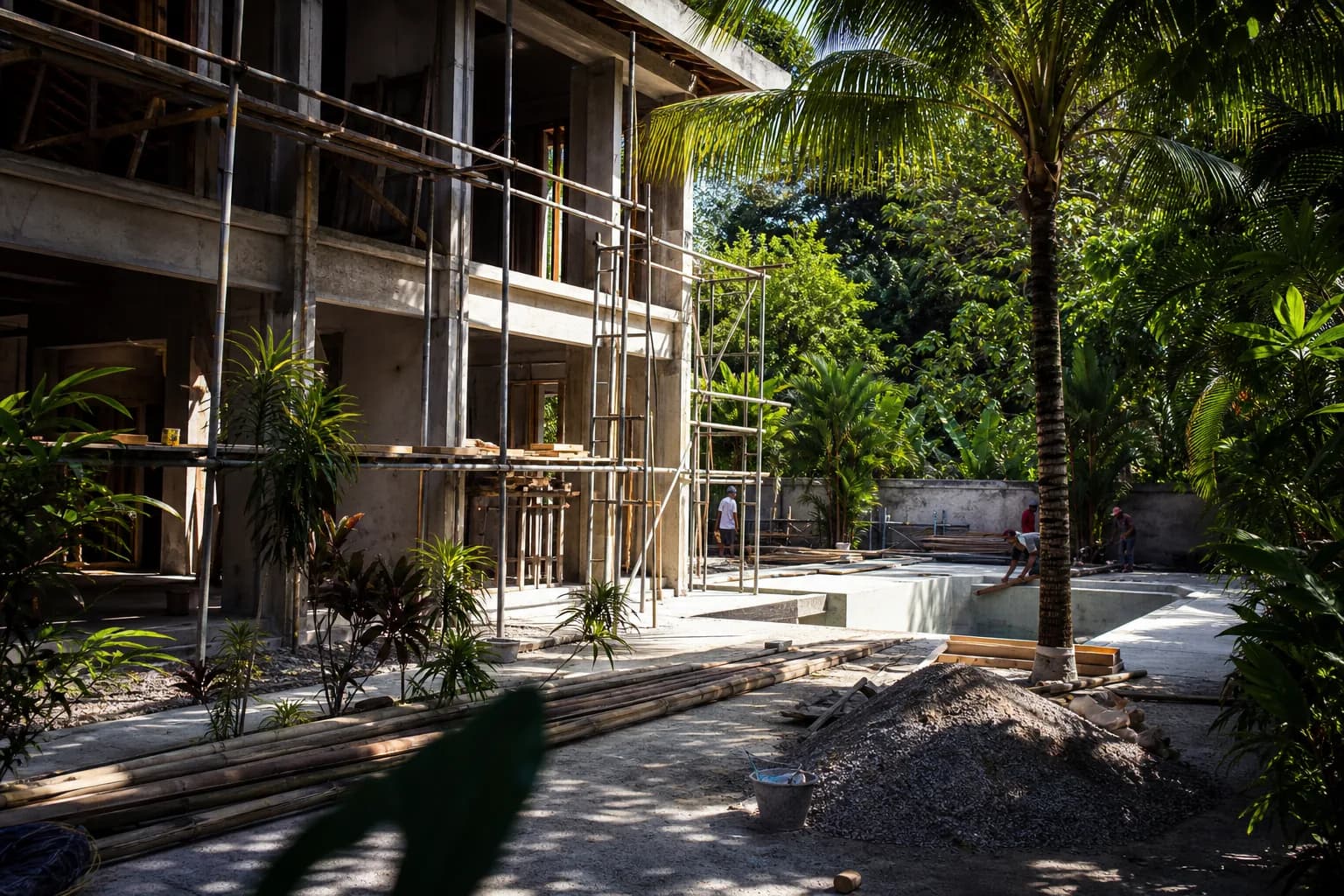
A foreign buyer in Canggu recently discovered their contractor lacked proper IUJK certification three months into construction—after transferring 40% of the project budget. The contractor had shown impressive portfolio photos and quoted competitive rates, but when structural issues emerged and the builder disappeared, the client had no legal recourse and no financial protection. This scenario repeats across Badung Regency because most buyers focus on design aesthetics and total project cost while overlooking two critical risk-mitigation mechanisms: formal contractor license verification through Badung’s DPMPTSP office and structured performance bond arrangements that protect capital deployment throughout the construction timeline.
In Badung specifically, where construction activity represents the highest volume in Bali and regulatory enforcement has intensified since 2024, the gap between licensed and unlicensed contractors creates measurable risk exposure. Performance bonds—financial instruments that guarantee contractor obligations—remain underutilized despite being standard practice in commercial construction. Understanding the verification process, associated costs, and bond structuring for residential villa projects in Badung directly impacts project completion rates and legal protection for foreign investors navigating Indonesia’s construction regulatory framework.
Technical Framework: Badung Contractor Licensing and Bond Mechanisms
Badung Regency operates under Indonesia’s national construction services law (UU No. 2/2017) but implements verification through the local Investment and One-Stop Integrated Services Office (DPMPTSP Badung). Legitimate construction contractors must hold an active IUJK (Izin Usaha Jasa Konstruksi) or the newer SBU (Sertifikat Badan Usaha) issued by LPJK (Lembaga Pengembangan Jasa Konstruksi). These certifications classify contractors by grade—small (B1), medium (B2), or large (B)—with corresponding project value limits and technical capability requirements.
For villa construction projects in Badung ranging from USD 150,000 to USD 500,000, contractors require minimum B1 classification with subgrade qualifications in building construction (BG001) and civil works (BG002). The license verification process involves checking three components: business entity legality (PT or CV registration with valid NIB), technical personnel certification (minimum one SKA-certified site manager), and financial capacity documentation (audited statements proving minimum capital requirements). Badung’s DPMPTSP maintains a digital registry, but cross-referencing with LPJK’s national database remains essential because local registrations can show active status while national certifications have lapsed.
Performance bonds in Indonesian construction operate as bank guarantees (jaminan pelaksanaan) typically valued at 5-10% of total contract value. For a USD 300,000 villa project, this represents IDR 225,000,000 to IDR 450,000,000 (approximately USD 15,000-30,000) held by a licensed bank as security against contractor default, timeline violations, or quality failures. The bond issuing process requires the contractor to deposit collateral with the bank—usually 30-50% of the bond value in cash or assets—which the bank then guarantees to the project owner. If the contractor fails to meet contractual obligations, the owner can claim against the bond without lengthy litigation.
The technical distinction between performance bonds and simple deposit retention matters significantly. A 30% upfront payment held by the contractor provides no protection if the contractor dissolves the business entity or transfers funds offshore. A bank-issued performance bond creates a separate legal obligation where the financial institution becomes liable regardless of the contractor’s solvency. In Badung’s construction environment, where contractor business continuity varies widely, this separation of financial risk from operational risk provides measurable protection.
Badung-specific considerations include the regency’s requirement for contractors working on properties above 200 square meters to register the construction project with DPMPTSP before commencing work. This registration triggers inspection protocols and creates an official record linking the licensed contractor to the specific project address. Without this registration, even a properly licensed contractor operates in a gray area where enforcement mechanisms become difficult to activate. The registration fee ranges from IDR 2,000,000 to IDR 5,000,000 depending on project classification, but it establishes the legal framework for both PBG (building permit) processing and performance bond enforcement.
Hidden Risks: What License Verification Actually Reveals
Most buyers request to see a contractor’s IUJK certificate but fail to verify three critical elements that determine actual legal standing. First, the certificate’s project value limit—a B1 contractor certified for projects up to IDR 1 billion cannot legally execute a IDR 5 billion villa construction, yet many accept contracts beyond their classification. Second, the expiration date and renewal status—IUJK certificates require annual renewal with updated financial statements and personnel certifications. A certificate issued in 2023 without 2025-2026 renewal stamps indicates the contractor is operating without current authorization. Third, the registered business address and tax compliance status—contractors frequently show certificates from dissolved business entities or companies with outstanding tax obligations that can result in project liens.
Performance bond costs reveal contractor financial health in ways that portfolio presentations cannot. When a contractor resists bond arrangements or cannot secure bank guarantees, it signals insufficient capital reserves or poor banking relationships—both indicators of operational instability. Established contractors with strong financial positions secure bonds at lower collateral rates (30-35%) because banks assess their default risk as minimal. Contractors requiring 50% collateral or offering “alternative” bond arrangements through non-bank entities demonstrate financial weakness that typically manifests as cash flow problems mid-project.
The absence of performance bonds in Badung villa construction contracts creates a specific vulnerability around material procurement timing. Contractors without bonds often use client deposits to fund other projects, purchasing materials for your villa only when the next client payment arrives. This creates cascading delays and quality compromises as contractors substitute specified materials with available alternatives. With a performance bond in place, the contractor must maintain adequate working capital independent of your payment schedule, because bond claims can be triggered by timeline violations regardless of payment status.
Step-by-Step Verification and Bond Implementation Process
Begin contractor verification by requesting the complete IUJK or SBU certificate package, which should include the primary certificate, classification details, and the most recent annual renewal stamp. Cross-reference the certificate number through LPJK’s online portal (https://portal.lpjk.net) to confirm active status and check for any sanctions or suspensions. Request the contractor’s NIB (Nomor Induk Berusaha) and verify business entity status through OSS (Online Single Submission) system to confirm the company remains legally active with current tax clearance.
For Badung-specific verification, contact DPMPTSP Badung directly (Jl. Raya Sempidi, Mengwi) or through their online service portal to confirm the contractor has registered previous projects in the regency and holds no outstanding violations. Request a list of completed projects in Badung from the past 24 months with owner contact information—legitimate contractors provide this readily, while problematic operators resist reference checks. Conduct site visits to at least two recent projects, focusing on structural elements rather than aesthetic finishes: foundation drainage systems, steel reinforcement quality, roof truss engineering, and electrical panel installations reveal technical competency.
Implement performance bond requirements during contract negotiation, not after signing. Specify in the construction agreement that the contractor must provide a bank-issued jaminan pelaksanaan equal to 10% of contract value before receiving the first payment installment. Acceptable issuing banks include BCA, Mandiri, BNI, BRI, or other licensed commercial banks—not cooperatives or non-bank financial institutions. The bond document must name you (or your Indonesian PT if using nominee structure) as beneficiary, specify the project address in Badung, list concrete performance milestones tied to payment schedules, and remain valid until final project completion plus 30 days.
Structure payment schedules to align with bond protection: 10% upon contract signing and bond delivery, 20% upon foundation completion, 20% upon structural frame completion, 20% upon roof and external walls completion, 20% upon mechanical/electrical/plumbing rough-in, and final 10% upon PBG issuance and defect rectification. This schedule ensures the performance bond value exceeds remaining contract obligations at each stage, maintaining financial leverage throughout the project. Include specific language that bond claims can be initiated for delays exceeding 30 days beyond agreed milestones or for quality failures identified by independent structural engineers.
Document the verification process formally: create a project file containing copies of all certificates, bank bond documents, DPMPTSP registration confirmation, and reference check notes. Share this file with your legal advisor and ensure your construction contract references these verified credentials specifically. If disputes arise, this documentation establishes that you conducted reasonable due diligence and contracted with a properly licensed entity, strengthening your legal position for enforcement actions or insurance claims.
Realistic Cost Structure: Badung License Verification and Bonds
Professional contractor license verification through a qualified legal advisor in Badung costs IDR 5,000,000 to IDR 8,000,000 (approximately USD 330-530) for comprehensive due diligence including LPJK database checks, DPMPTSP confirmation, business entity verification, and reference validation. This one-time cost at project initiation prevents significantly larger losses from contractor default or legal complications during construction.
Performance bond costs consist of two components: the bank’s guarantee fee and the contractor’s collateral opportunity cost. Banks charge 1-3% annually of the bond value as their guarantee fee—for a IDR 450,000,000 bond (10% of a USD 300,000 project), this represents IDR 4,500,000 to IDR 13,500,000 (USD 300-900) for a 12-month construction period. The contractor must also deposit 30-50% collateral with the bank, which represents IDR 135,000,000 to IDR 225,000,000 in locked capital. Financially stable contractors absorb these costs as standard business expenses, while undercapitalized contractors often request that clients pay the guarantee fee directly—a red flag indicating insufficient working capital.
DPMPTSP Badung project registration fees range from IDR 2,000,000 for simple residential structures under 200 square meters to IDR 5,000,000 for complex villa projects with pools and extensive site works. This registration must occur before construction commences and links directly to PBG processing. The PBG itself costs IDR 50,000,000 to IDR 150,000,000 in Badung depending on land area, building footprint, and structural complexity, with processing timelines of 4-8 months when properly documented.
Total risk-mitigation costs for proper contractor verification and performance bond implementation on a USD 300,000 villa project in Badung: approximately IDR 60,000,000 to IDR 85,000,000 (USD 4,000-5,700), representing roughly 2% of project value. This compares to average loss exposure of 30-60% of invested capital when contractors default without bonds or legal recourse—a risk-adjusted return on investment that makes verification and bonding essential rather than optional for foreign buyers in Bali’s construction market.
Frequently Asked Questions: Badung Contractor Licensing and Bonds
Can I verify a contractor’s Badung license status myself without hiring legal advisors?
Partial verification is possible through LPJK’s online portal (portal.lpjk.net) where you can check national SBU certificate status using the contractor’s certificate number. However, this only confirms the certificate exists—it doesn’t verify the business entity remains active, tax compliance is current, or the contractor has registered properly with DPMPTSP Badung. The local registration component requires either in-person verification at the Badung DPMPTSP office in Mengwi or formal inquiry through Indonesian legal representation. Most critically, self-verification cannot assess whether the contractor’s classification matches your project scope or identify sanctions and violations not reflected in the basic certificate database. Professional verification costs represent 0.2-0.3% of typical project values but provides documented due diligence that strengthens legal standing if disputes arise.
What happens if my contractor refuses to provide a performance bond for a villa project in Badung?
Contractor resistance to performance bonds typically indicates one of three conditions: insufficient financial capacity to secure bank guarantees, poor banking relationships due to previous defaults, or business practices that rely on using client deposits to fund operations across multiple projects. All three scenarios represent significant risk factors that should trigger immediate reconsideration of contractor selection. In Badung’s construction market, established contractors with strong track records routinely provide bonds for projects above USD 150,000 because they maintain adequate capital reserves and banking relationships. If a contractor claims bonds are “unnecessary” or “not standard practice” for residential projects, request detailed financial statements and bank references—legitimate contractors provide these transparently. Alternative approaches like escrow accounts or staged payments to material suppliers provide partial protection but lack the legal enforcement mechanisms of bank-issued bonds.
 164 m²7 month(s)from 79.000 USD
TALA TWO
 2144 m²11 month(s)from 104.000 USD
Narayana
 3180 m²7 month(s)from 142.000 USD
Vasudeva
 4344 m²16 month(s)from 290.000 USD
Radha
164 m²7 month(s)from 79.000 USDPrivate: Haridas Villas, Tegallalang
 3124 m²6 month(s)from 123.000 USD
TALA 8
 3173 m²6 month(s)from 125.000 USD
TALA FOUR

Want to calculate?
 1from 198.000 USD
Private: Haridas Villas
 172 m²8 month(s)from 120.000 USD
Keshava
 3104 m²11 month(s)from 99.000 USD
TALA 100
 3127 m²9 month(s)from 177.000 USD
Mukunda
Start With Real Numbers, Not Guesses
Before buying land or finalizing a design, check the realistic build cost range for your project in Bali.
Our team reviews your inputs and gives a grounded estimate.
Available lands
 6000 m²30 min$ 55419Bali, Tabanan
 5000 m²8 min$ 424877Bali, Ungasan
 2680 m²10 min$ 1732759Bali, Pererenan
 1300 m²10 min$ 348214Bali, Tabanan
 550 m²5 min$ 217629Bali, Tabanan
 1000 m²10 min$ 230911Bali, Kerobokan
 420 m²15 min$ 41897Bali, Tabanan
 800 m²8 min$ 113300Bali, Ungasan
 600 m²12 min$ 101970Bali, Mengwi
 10000 m²19 min$ 232759Bali, Buleleng
 500 m²15 min$ 124692Bali, Kaba Kaba
 500 m²2 min$ 175862Bali, Cemagi
 2200 m²15 min$ 508005Bali, Canggu
 2700 m²30 min$ 314224Bali, Sidemen
 680 m²15 min$ 110751Bali, Pererenan
Essential Bali build & buy guides
- Bali villa construction cost per m² in 2026
- How much will your villa cost? Calculator
- Building a villa in Bali: the complete guide
- Buying land in Bali: step-by-step for foreigners
- Bali villa investment: yields, risks, returns
- Leasehold vs freehold: what foreigners can own
- Construction defect liability & 10-year warranty
- Bali building codes and construction standards
Related guides

Why a Cheap Bali Leasehold Is Cheap: Pricing Red Flags Every Buyer Should Decode
Suspiciously cheap Bali leaseholds are priced low for a reason: short remaining terms, forbidden zoning, missing road access, disputes or weak contracts. How to decode the discount before you pay for it.
8 min read
Fake Compliance and Licensing Agents in Bali: The 2026 Paperwork Scam and How to Verify Documents
Forged certificates, permit fixers and fake notaries: how Bali's paperwork scams work in 2026 and how to verify every property document at its government source.
7 min read
Buying a Bali Villa from Instagram: Phantom Listings, Render-Only Projects and How to Verify
Instagram is Bali's biggest property shop window and its least verified. How phantom listings, render-only projects and cloned developer accounts work — and the verification steps that expose them.
7 min read