Uluwatu Temple Zone Construction Restrictions in Bali
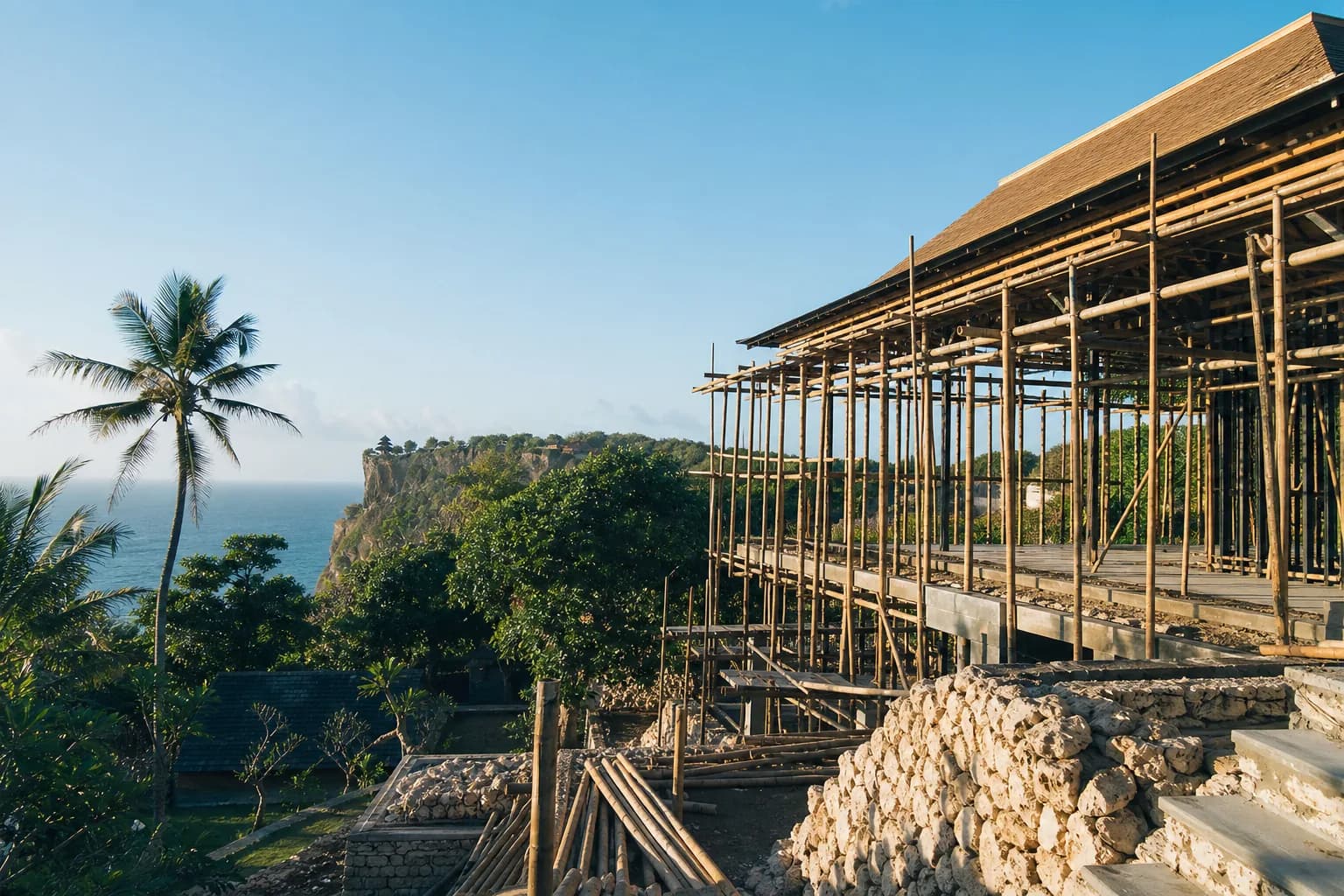
Why Uluwatu Temple Zone Construction Restrictions Create Unique Engineering and Legal Challenges
The Uluwatu Temple zone represents one of Bali’s most complex construction environments, where sacred heritage preservation intersects with aggressive coastal erosion and strict spatial regulations. Property developers face a multi-layered compliance framework: mandatory heritage setbacks from the temple complex, cliff-edge structural limitations following the controversial 2025 seawall installation, and environmental review protocols that can extend permitting timelines by 8-14 months. The April 2025 completion of the erosion-control seawall highlighted regulatory gaps—construction proceeded despite environmental criticism, yet subsequent projects now face intensified scrutiny and retroactive policy adjustments that weren’t clearly defined when many land purchases were finalized.
Technical Framework: Heritage Setbacks, Coastal Engineering Zones, and Sacred Boundary Regulations
Uluwatu Temple’s construction restrictions operate through three overlapping regulatory systems that create compound compliance requirements rarely encountered in other Bali regions. Understanding these technical frameworks is essential before land acquisition or design development begins.
Heritage Protection Radius and Sacred Space Setbacks
The temple complex maintains a protected heritage radius extending approximately 500 meters from the main temple structure, though exact boundaries remain subject to interpretation by local customary councils (banjar) and the Bali Cultural Heritage Preservation Office (BPCB). Within this zone, construction height is typically restricted to 15 meters maximum—significantly lower than the standard 18-meter limit in non-heritage areas. More critically, any structure visible from the temple’s primary ceremonial viewpoints requires additional aesthetic review, which introduces subjective approval criteria that can delay or modify architectural plans.
The sacred boundary concept (penyengker) adds another layer: traditional Balinese spatial law recognizes invisible spiritual boundaries that may not align with cadastral property lines. Projects within 200 meters of the temple often require ceremonial consultations with temple priests (pemangku) and formal approval from the temple management board, documented through a surat persetujuan that becomes part of the IMB (building permit) application package. This isn’t merely ceremonial—construction without this approval has resulted in work stoppages and mandatory structural modifications costing 15-30% of initial build budgets.
Post-Seawall Coastal Engineering Requirements
The controversial seawall project completed in April 2025 fundamentally altered construction engineering requirements for properties within 300 meters of the cliff edge. While the seawall addressed immediate erosion threatening the temple access pathway, it created new structural considerations:
- Vibration impact assessments: Any construction using pile-driving or heavy excavation equipment within 250 meters of the seawall now requires geotechnical studies demonstrating that construction vibrations won’t compromise seawall structural integrity or accelerate cliff subsidence in adjacent areas
- Drainage redirection protocols: The seawall altered natural water flow patterns; new construction must include engineered drainage systems that prevent water accumulation behind the seawall structure, typically adding 8-12 million IDR to site preparation costs
- Foundation depth limitations: Properties on the clifftop plateau face new restrictions on foundation depth (typically limited to 4 meters) to prevent destabilizing the geological layers above the seawall’s anchor points
These requirements emerged through technical bulletins issued between May-August 2025, creating retroactive compliance challenges for projects that received preliminary approvals before the seawall completion but hadn’t begun construction.
Environmental Review Intensification Post-2025
The environmental criticism surrounding the seawall project triggered policy adjustments that now affect all Uluwatu zone construction. The Bali Environmental Agency (BLH) implemented enhanced review protocols in June 2025, requiring:
Mandatory AMDAL (Environmental Impact Analysis) for any project exceeding 500 square meters of built area within the heritage zone—previously, this threshold was 1,000 square meters. The AMDAL process involves marine biology assessments if the property is within 400 meters of the coastline, archaeological surveys for sites within the 500-meter heritage radius, and visual impact studies demonstrating that the structure won’t obstruct ceremonial sightlines from the temple. This documentation package typically requires 4-6 months to compile and costs 45-85 million IDR depending on property size and complexity.
Coastal setback enforcement has become significantly stricter. While Bali’s general coastal regulation requires structures to be set back 100 meters from the high-tide line, Uluwatu zone enforcement now interprets this from the cliff edge rather than the beach below, effectively creating a 100-meter buffer from the clifftop boundary. Properties purchased before this interpretation shift (pre-mid-2025) may find their planned building envelopes no longer compliant, requiring design modifications that can reduce usable building area by 20-40%.
Hidden Risks: What Property Buyers and Developers Consistently Overlook
The Uluwatu Temple zone presents compliance risks that aren’t immediately apparent during land due diligence, often surfacing only during the permitting phase when design modifications become exponentially more expensive.
Customary Law Precedence Over Statutory Regulations
Bali’s dual legal system means that even properties with clean freehold or leasehold titles and proper zoning classifications can face construction restrictions based on adat (customary law) interpretations that supersede written regulations. The temple’s customary council can impose additional setbacks, height restrictions, or material requirements based on spiritual considerations that aren’t documented in municipal planning documents. We’ve encountered projects where foundations were already poured before discovering that the local banjar required an additional 15-meter setback from a sacred tree that wasn’t marked on any official survey—resulting in complete foundation redesign and 4-month schedule delays.
The “Visible from Temple” Subjective Standard
Architectural approval in the heritage zone includes a visual impact criterion that lacks objective measurement standards. Officials conduct site visits to determine whether a proposed structure would be “visually intrusive” when viewed from temple ceremonial areas. This subjective assessment has rejected designs for reasons including roof pitch angles, exterior color palettes, and even landscaping plans. The lack of clear guidelines means that design revisions can cycle through 3-5 iterations, each requiring 6-8 weeks for re-review, before achieving approval.
Seawall Maintenance Levy Uncertainty
Properties benefiting from the seawall’s erosion protection may face future maintenance levy assessments that weren’t disclosed during land purchase. As of February 2026, the funding mechanism for ongoing seawall maintenance remains undefined, but preliminary discussions suggest annual levies of 5-15 million IDR for clifftop properties within the protected zone. This represents an ongoing operational cost that affects long-term property economics but isn’t typically included in initial feasibility calculations.
Step-by-Step Process: Navigating Uluwatu Zone Construction Compliance
Phase 1: Pre-Acquisition Technical Due Diligence (4-6 Weeks)
Step 1: Commission a specialized heritage zone survey that maps not just cadastral boundaries but also identifies sacred trees, ceremonial pathways, and customary use areas that may restrict building placement. Standard topographic surveys don’t capture these elements—you need a surveyor experienced with adat land considerations. Cost: 8-15 million IDR.
Step 2: Obtain written confirmation from the local banjar regarding any customary restrictions, required ceremonial approvals, and historical precedents for construction in the immediate area. This should be documented in Indonesian with English translation and include specific setback distances from any identified sacred elements. Request this before finalizing land purchase agreements.
Step 3: Conduct preliminary geotechnical investigation focusing on cliff stability if the property is within 400 meters of the coastal edge. Post-seawall, this should include vibration sensitivity analysis and foundation depth recommendations that account for the altered geological stress patterns. Cost: 25-40 million IDR for comprehensive coastal geotechnical study.
Phase 2: Design Development with Compliance Integration (8-12 Weeks)
Step 4: Develop architectural concepts that incorporate maximum setbacks from the outset—assume 500 meters from temple structures, 100 meters from cliff edges, and 15-20 meters from any identified sacred elements. Design for the 15-meter height limit and include visual impact mitigation through strategic landscaping and earth-tone material palettes.
Step 5: Engage with the temple management board early in the design phase, presenting conceptual drawings and requesting preliminary feedback before detailed engineering begins. This informal consultation (often facilitated through local fixers who understand temple protocols) can identify deal-breaking concerns before significant design investment occurs. Budget 5-8 million IDR for facilitation and ceremonial courtesies.
Step 6: Prepare the AMDAL documentation package concurrently with architectural development. The environmental review timeline is the critical path item—starting this process early can save 2-3 months on overall project delivery. Work with environmental consultants who have specific Uluwatu zone experience and existing relationships with BLH reviewers.
Phase 3: Permitting and Approval Sequence (6-10 Months)
Step 7: Submit the IMB application with complete AMDAL documentation, temple management approval letters, banjar endorsement, and geotechnical reports. The Uluwatu zone review involves multiple agencies—BPCB for heritage impact, BLH for environmental compliance, and the district planning office for zoning conformance. These reviews occur sequentially, not concurrently, extending timelines significantly.
Step 8: Prepare for site inspection visits from each reviewing agency. These inspections often identify additional requirements not specified in written regulations—having your architect and structural engineer present during inspections to immediately address technical questions can prevent additional review cycles.
Step 9: Obtain the ceremonial approval (melaspas tanah) from temple priests before commencing any ground disturbance. This ceremony should occur after IMB issuance but before mobilization, and requires coordination with the temple’s ceremonial calendar—certain months are prohibited for ground-breaking in the temple zone. Ceremony costs: 3-7 million IDR depending on property size and required offerings.
Phase 4: Construction Execution with Ongoing Compliance (12-18 Months)
Step 10: Implement vibration monitoring if within 250 meters of the seawall, with daily logs submitted to the district public works office. Non-compliance can result in immediate work stoppages that are difficult to reverse.
Step 11: Schedule construction activities around major temple ceremonies—Piodalan (temple anniversary) and Galungan/Kuningan periods typically require 3-5 day work stoppages. Your construction timeline should include buffer allowances for these ceremonial periods, which aren’t always predictable far in advance.
Realistic Cost and Timeline Implications for Uluwatu Zone Projects
Construction in the Uluwatu Temple zone carries premium compliance costs that typically add 12-18% to baseline construction budgets compared to unrestricted areas in Canggu or Seminyak.
Permitting and Compliance Cost Ranges
- Enhanced due diligence (heritage survey, geotechnical, customary consultations): 40-70 million IDR
- AMDAL preparation and submission: 45-85 million IDR
- Temple and customary approvals (facilitation, ceremonies, documentation): 15-30 million IDR
- Extended architectural revision cycles: 20-35 million IDR in additional design fees
- Specialized engineering (vibration analysis, coastal foundation design): 30-50 million IDR
Total pre-construction compliance premium: 150-270 million IDR beyond standard permitting costs.
Construction Timeline Extensions
Standard villa construction in unrestricted Bali locations: 10-14 months from permit to completion. Uluwatu Temple zone projects: 18-24 months, with the extension primarily driven by:
- Permitting phase: +4-6 months due to multi-agency heritage review
- Ceremonial work stoppages: +2-3 weeks distributed across construction phase
- Specialized foundation work: +3-4 weeks for coastal engineering requirements
- Inspection frequency: +2-3 weeks cumulative due to additional heritage compliance inspections
Per-Square-Meter Cost Implications
For a typical 300-square-meter villa, Uluwatu zone construction costs range from 28-35 million IDR per square meter for quality construction (compared to 24-30 million IDR in unrestricted areas). This premium reflects specialized engineering, extended project management timelines, and compliance-driven design constraints that reduce construction efficiency.
Frequently Asked Questions: Uluwatu Temple Zone Construction Specifics
Can I build a two-story villa within the 500-meter heritage radius if I stay under 15 meters height?
Yes, but with significant caveats. The 15-meter height limit technically permits two-story construction, but the visual impact
 3180 m²7 month(s)from 142.000 USD
Vasudeva
 3127 m²9 month(s)from 177.000 USD
Mukunda
 164 m²7 month(s)from 79.000 USD
Private: Haridas Villas, Tegallalang
 172 m²8 month(s)from 120.000 USD
Keshava
 3104 m²11 month(s)from 99.000 USD
TALA 100
 3124 m²6 month(s)from 123.000 USD
TALA 8
164 m²7 month(s)from 79.000 USDTALA TWO
 4344 m²16 month(s)from 290.000 USD
Radha

Want to calculate?
 2144 m²11 month(s)from 104.000 USD
Narayana
 1from 198.000 USD
Private: Haridas Villas
 3173 m²6 month(s)from 125.000 USD
TALA FOUR
Start With Real Numbers, Not Guesses
Before buying land or finalizing a design, check the realistic build cost range for your project in Bali.
Our team reviews your inputs and gives a grounded estimate.
Available lands
 2800 m²2 min$ 713793Bali, Kedungu
 1158 m²12 min$ 291996Bali, Mengwi
 550 m²5 min$ 217629Bali, Tabanan
 1000 m²10 min$ 184729Bali, Kutuh South Bali
 1350 m²5 min$ 283467Bali, Pecatu
 3000 m²15 min$ 1246921Bali, Tabanan
 444 m²10 min$ 111000Bali, Tabanan
 2000 m²5 min$ 738916Bali, Ungasan
 1700 m²10 min$ 392549Bali, Nusadua
 1000 m²8 min$ 134544Bali, Bukit
 700 m²7 min$ 400000Bali, Canggu
 200 m²5 min$ 59113Bali, Bukit
 2400 m²7 min$ 496552Bali, Canggu
 500 m²10 min$ 107143Bali, Tabanan
 1300 m²10 min$ 348214Bali, Tabanan
Essential Bali build & buy guides
- Bali villa construction cost per m² in 2026
- How much will your villa cost? Calculator
- Building a villa in Bali: the complete guide
- Buying land in Bali: step-by-step for foreigners
- Bali villa investment: yields, risks, returns
- Leasehold vs freehold: what foreigners can own
- Construction defect liability & 10-year warranty
- Bali building codes and construction standards
Related guides
Moving to Bali: Rent vs Buy vs Build in 2026 — Break-Even Math and an Honest Framework
Renting, buying and building in Bali compared with 2026 numbers: what each path costs, where the break-even sits, and a decision framework keyed to how long you actually plan to stay.
7 min read
North Bali Airport and Property Prices: What It Really Means for Lovina and Amed
A fact-first 2026 look at the North Bali airport project — what is confirmed versus announced — and what it genuinely means for land prices and buying decisions in Lovina, Kubutambahan and Amed.
7 min read
Where to Buy or Build a Villa in Bali in 2026: Area-by-Area Comparison
An honest 2026 comparison of Bali's five main buying areas — Canggu, Pererenan, Uluwatu, Ubud and Sanur — with indicative land prices, demand profiles, zoning risks and who each area actually suits.
7 min read