Bali Construction Trends 2024: Modern Building Techniques
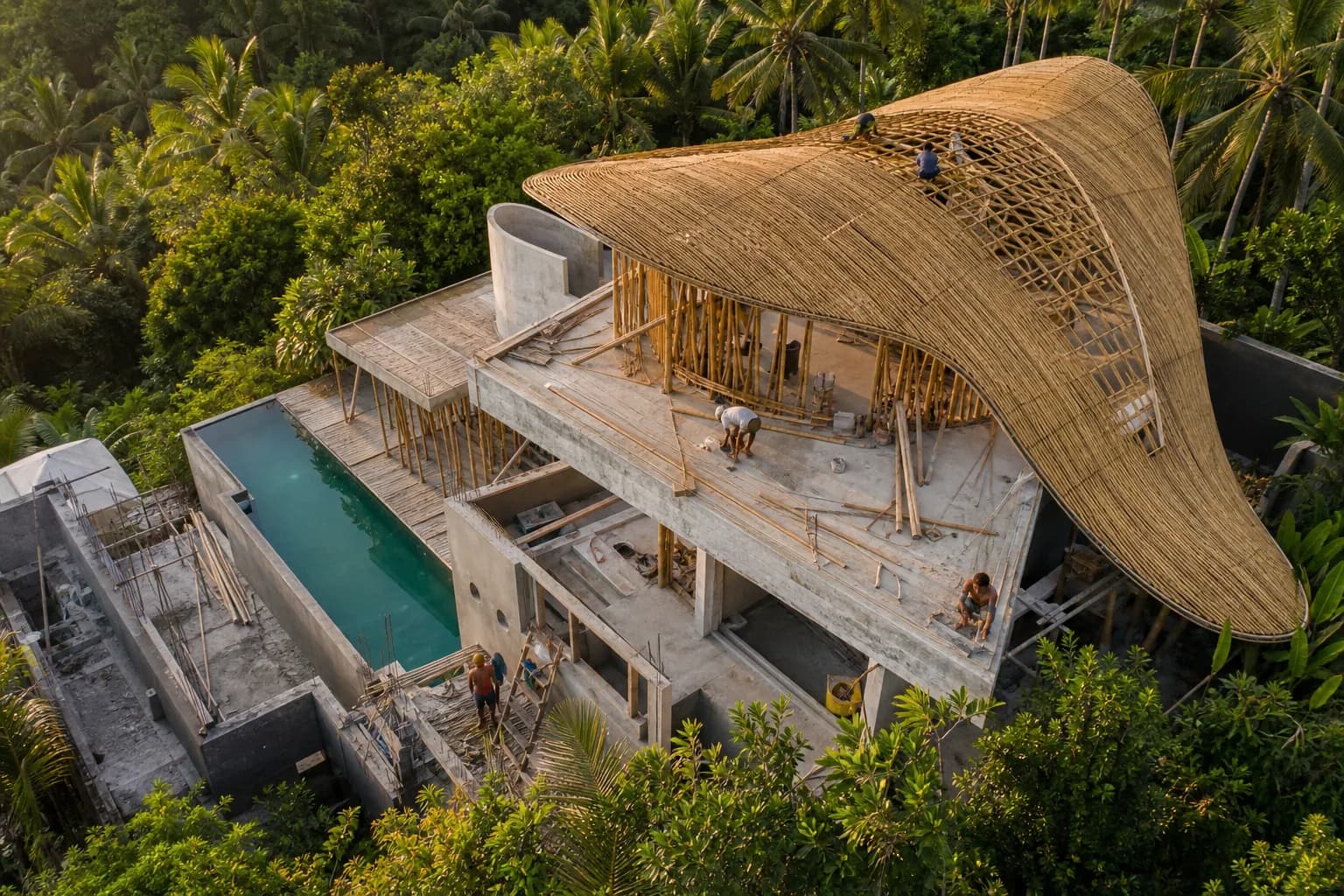
# Bali Construction Trends 2026: A Comprehensive Guide to Building in Paradise
Introduction: The Evolution of Bali’s Construction Landscape
The Bali construction market has undergone a remarkable transformation as we move through 2026, evolving from a speculative frontier into a mature, sophisticated development ecosystem. For investors, developers, and property owners considering construction projects in Bali, understanding current bali construction trends is no longer optional—it’s essential for project success and financial viability.
Today’s Bali construction sector is characterized by heightened quality standards, stricter regulatory compliance, and a decisive shift toward sustainable, high-end developments. Construction costs have stabilized within the $1,000 to $1,800 per square meter range for finished villas, reflecting both market maturity and the premium placed on quality craftsmanship. This stabilization represents a significant departure from the volatile pricing of previous years, offering developers greater predictability in project planning and budgeting.
The market now favors strategic, well-planned investments over opportunistic speculation. Managed resort communities, eco-conscious designs, and properties that cater to the discerning international buyer dominate the development pipeline. For construction companies like Teville, this environment demands technical excellence, regulatory expertise, and a deep understanding of tropical engineering principles that can withstand Bali’s unique environmental challenges.
The Challenge: Navigating Bali’s Complex Construction Environment
Building in Bali presents a unique constellation of challenges that distinguish it from construction projects in more conventional markets. The island’s tropical climate, complex regulatory framework, and evolving market expectations create a demanding environment where only properly planned and executed projects succeed.
The first major challenge involves regulatory compliance and land rights. Foreign investors must navigate Indonesia’s intricate property ownership laws, which restrict freehold ownership for non-Indonesians. The leasehold system, typically structured as 25-year terms with extension options, requires careful legal structuring. Construction permits involve multiple government agencies, each with specific requirements and timelines. The IMB (Izin Mendirikan Bangunan) building permit process alone can take 3-6 months when properly managed, but delays are common when documentation is incomplete or relationships with local authorities are underdeveloped.
Environmental factors present the second critical challenge. Bali’s tropical climate subjects buildings to intense UV radiation, high humidity levels exceeding 80%, heavy monsoon rains, and salt-laden coastal air in beach locations. These conditions accelerate material degradation, promote mold growth, and test structural integrity in ways that temperate-climate construction never encounters. Standard construction materials and techniques from other regions often fail catastrophically within months of completion without proper tropical adaptation.
The third challenge centers on quality control and contractor reliability. The Bali construction market includes a wide spectrum of operators, from highly professional firms to undercapitalized contractors lacking proper technical expertise. Material substitution, substandard workmanship, and project abandonment have plagued numerous developments. The 2026 market’s emphasis on quality has raised the stakes—buyers and investors now demand international-standard construction with verifiable quality assurance processes.
Finally, the shift toward high-end developments has elevated technical requirements. Modern Bali villas incorporate sophisticated systems: infinity pools with complex hydraulics, advanced climate control, smart home automation, and renewable energy integration. These systems require specialized engineering knowledge and skilled installation that many local contractors cannot provide. The gap between market expectations and available technical capability represents a significant risk factor for developers.
Technical Considerations: Engineering for Tropical Excellence
Successful construction in Bali demands a comprehensive understanding of tropical engineering principles, material science, and climate-responsive design. The technical approach must address the island’s unique environmental stressors while meeting international quality standards.
Foundation and Structural Engineering
Bali’s geological diversity requires site-specific foundation design. Coastal areas often feature sandy soils with high water tables, necessitating deep pile foundations or reinforced raft systems. Inland locations may encounter volcanic rock or clay soils with varying bearing capacities. Proper soil investigation through bore tests is non-negotiable—a minimum of three bore holes per building site provides essential data for foundation engineering.
Structural design must account for seismic activity, as Bali sits within an active tectonic zone. Reinforced concrete frame construction with proper steel reinforcement ratios (minimum 1.5% for columns, 0.8% for beams) provides necessary earthquake resistance. Column spacing should not exceed 4 meters for residential structures, and beam depths must follow the span-to-depth ratio of 1:12 for adequate deflection control.
The concrete mix itself requires tropical optimization. A minimum grade of K-300 (approximately 25 MPa compressive strength) with reduced water-cement ratios (maximum 0.5) ensures durability in humid conditions. Admixtures including waterproofing compounds and corrosion inhibitors protect embedded steel reinforcement from moisture penetration and chloride attack in coastal zones.
Moisture Management and Waterproofing
Effective moisture management separates successful Bali construction from premature failure. The waterproofing strategy must address multiple ingress points: rising damp from ground contact, direct rain penetration, and condensation from humidity differentials.
Below-grade waterproofing requires a multi-layer approach: a polyethylene damp-proof membrane beneath the ground slab, cementitious waterproofing on foundation walls, and a drainage system directing groundwater away from the structure. For basement construction or below-grade rooms, tanking systems using crystalline waterproofing technology provide superior protection against hydrostatic pressure.
Roof waterproofing demands equal attention. While traditional tile roofing provides aesthetic appeal, the underlayment system determines actual weather protection. A combination of waterproof membrane, proper flashing at penetrations, and adequate roof pitch (minimum 30 degrees for tile roofs) prevents water infiltration. Flat roof sections require torch-on membrane systems or liquid-applied waterproofing with UV-resistant top coats.
Wall systems benefit from cavity construction or external insulation finishing systems (EIFS) that create a drainage plane behind the exterior finish. This allows any moisture that penetrates the outer layer to drain away without reaching the structural wall. Weep holes at the base of cavity walls and proper head flashing above openings complete the moisture management strategy.
Material Selection for Longevity
Material choices directly impact long-term performance and maintenance costs. The bali construction trends in 2026 strongly favor durable, low-maintenance materials that withstand tropical conditions.
For structural elements, marine-grade stainless steel (316 grade) should replace standard steel in coastal locations within 5 kilometers of the ocean. All exposed steel elements require hot-dip galvanization followed by powder coating for maximum corrosion protection. Aluminum window and door frames must be anodized or powder-coated; raw aluminum corrodes rapidly in salt air.
Timber selection requires careful specification. Tropical hardwoods like merbau, bangkirai, and ironwood offer natural durability, but sustainable sourcing certification is increasingly important to environmentally conscious buyers. All timber should be kiln-dried to 12-15% moisture content and treated with boron-based preservatives against termites and fungal decay. Engineered wood products like laminated veneer lumber (LVL) provide dimensional stability superior to solid timber for structural applications.
External finishes must resist UV degradation and biological growth. Acrylic-based external paints with mildewcides outperform traditional oil-based products. Natural stone cladding should be sealed with penetrating sealers that allow vapor transmission while repelling water. Porcelain tiles rated for external use provide excellent durability for outdoor flooring, with slip-resistance ratings of R11 or higher for pool decks and wet areas.
Climate Control and Ventilation
Effective climate control in Bali’s tropical environment requires integrated mechanical and passive strategies. Air conditioning systems must be properly sized—undersized units run continuously without achieving comfort, while oversized units short-cycle and fail to dehumidify effectively. Heat load calculations should account for Bali’s solar intensity, with cooling capacities typically ranging from 600-800 BTU per square meter for well-insulated spaces.
Passive ventilation through cross-flow design reduces mechanical cooling loads. Window placement should capture prevailing breezes while high-level openings allow hot air to escape through stack effect. Ceiling heights of 3.5-4 meters in living areas enhance natural ventilation and create a sense of spaciousness that buyers expect in high-end Bali properties.
Dehumidification deserves specific attention. Relative humidity above 70% promotes mold growth and material degradation. Dedicated dehumidification systems or air conditioning units with enhanced dehumidification modes maintain indoor humidity at optimal levels of 50-60%. Proper vapor barriers in wall and ceiling assemblies prevent moisture migration into building cavities where it can condense on cooler surfaces.
Risk Factors: What Can Go Wrong and How to Prevent It
Understanding and mitigating construction risks in Bali requires proactive planning and continuous oversight. The consequences of inadequate risk management range from budget overruns to structural failure and legal complications.
Legal and Regulatory Risks
The most severe risks involve legal compliance failures. Building without proper permits can result in demolition orders, regardless of construction quality or investment value. The permit process requires coordination between multiple agencies: the local planning office (DPMPTSP), environmental agency (DLHK), and sometimes tourism authorities for commercial developments.
Land title verification must be thorough. Engaging a reputable notary (PPAT) to conduct title searches and verify ownership chains prevents costly disputes. For leasehold properties, the lease agreement must be properly registered at the land office (BPN) to be enforceable. Hak Pakai titles for foreign-owned PT PMA companies require specific documentation and minimum investment thresholds that vary by location.
Zoning compliance is equally critical. Bali’s spatial planning regulations (RTRW) designate specific land uses for different areas. Building in agricultural zones (sawah) or protected areas without proper conversion permits invites legal action. The 2026 regulatory environment shows increased enforcement, with authorities more willing to act against non-compliant developments.
Construction Quality Risks
Quality failures typically stem from inadequate supervision, material substitution, or contractor inexperience. The risk mitigation strategy must include multiple checkpoints throughout the construction process.
Material testing should be mandatory for critical components. Concrete cylinder tests verify mix strength, steel reinforcement should be tested for tensile strength and ductility, and soil compaction tests ensure proper foundation preparation. Third-party testing laboratories provide independent verification that protects against contractor shortcuts.
Workmanship quality requires daily site supervision by qualified engineers. Critical construction phases—foundation pouring, structural frame erection, waterproofing installation—demand continuous oversight. Photographic documentation at each stage creates an audit trail and facilitates quality verification.
The risk of contractor default increases with project complexity and duration. Payment structures should tie disbursements to verified completion milestones rather than time-based schedules. Retention amounts (typically 5-10% of contract value) held until final completion and defect rectification provide leverage to ensure proper project closeout.
Environmental and Climate Risks
Bali’s tropical environment presents ongoing risks that extend beyond initial construction. Termite infestation can compromise structural timber within months if proper treatment and barriers are not installed. Chemical soil treatment around the building perimeter and physical barriers using stainless steel mesh or granite particles provide multi-layered protection.
Flooding risk requires careful site analysis. Low-lying areas near rice fields or natural drainage paths may experience seasonal inundation. Minimum finished floor levels should be set at least 50 centimeters above the highest recorded flood level, with proper site drainage directing water away from structures.
Coastal erosion affects beachfront properties, particularly during monsoon seasons. Setback requirements from the high-water mark (typically 100 meters for new construction) provide buffer zones, but erosion patterns can change. Coastal engineering assessments should inform development decisions in vulnerable locations.
The Construction Process: From Concept to Completion
A successful Bali construction project follows a structured process that manages complexity while maintaining flexibility for site-specific adaptations. Understanding each phase and its requirements enables realistic scheduling and budget planning.
Phase 1: Site Analysis and Feasibility (4-6 weeks)
The process begins with comprehensive site analysis. Topographic surveys establish existing ground levels and identify natural features. Geotechnical investigations through bore tests reveal soil co
 3173 m²6 month(s)from 125.000 USD
TALA FOUR
 3127 m²9 month(s)from 177.000 USD
Mukunda
 164 m²7 month(s)from 79.000 USD
Private: Haridas Villas, Tegallalang
 3124 m²6 month(s)from 123.000 USD
TALA 8
 3180 m²7 month(s)from 142.000 USD
Vasudeva
 3104 m²11 month(s)from 99.000 USD
TALA 100
 2144 m²11 month(s)from 104.000 USD
Narayana
 4344 m²16 month(s)from 290.000 USD
Radha
 1from 198.000 USD
Private: Haridas Villas
164 m²7 month(s)from 79.000 USDTALA TWO

Want to calculate?
 172 m²8 month(s)from 120.000 USD
Keshava
Start With Real Numbers, Not Guesses
Before buying land or finalizing a design, check the realistic build cost range for your project in Bali.
Our team reviews your inputs and gives a grounded estimate.
Available lands
 18900 m²2 min$ 6912931Bali, Pecatu
 29000 m²6 min$ 3857143Bali, Tabanan
 2000 m²15 min$ 110837Bali, Karangasem
 300 m²55 min$ 32475Bali, Tegelalang
 7000 m²36 min$ 284483Bali, Gianyar
 1362 m²15 min$ 335468Bali, Tumbak
 1700 m²10 min$ 392549Bali, Nusadua
 200 m²11 min$ 89286Bali, Tabanan
 1350 m²5 min$ 283467Bali, Pecatu
 200 m²5 min$ 59113Bali, Bukit
 7250 m²56 min$ 235714Bali, Tabanan
 6000 m²10 min$ 1330049Bali, Kutuh South Bali
 2800 m²15 min$ 310345Bali, Tabanan
 8313 m²15 min$ 716670Bali, Buduk
 700 m²7 min$ 400000Bali, Canggu
Essential Bali build & buy guides
- Bali villa construction cost per m² in 2026
- How much will your villa cost? Calculator
- Building a villa in Bali: the complete guide
- Buying land in Bali: step-by-step for foreigners
- Bali villa investment: yields, risks, returns
- Leasehold vs freehold: what foreigners can own
- Construction defect liability & 10-year warranty
- Bali building codes and construction standards
Related guides
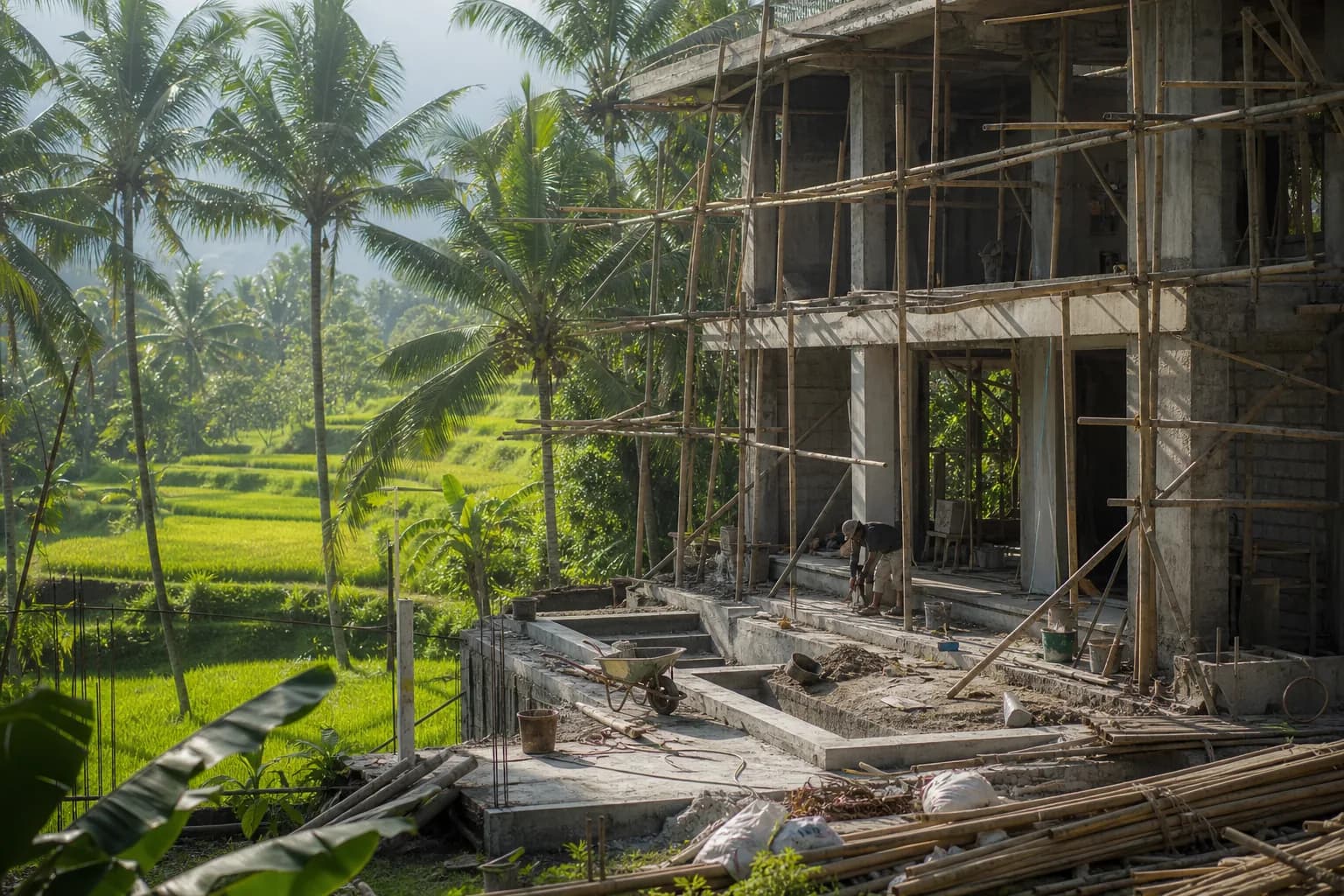
Moving to Bali: Rent vs Buy vs Build in 2026 — Break-Even Math and an Honest Framework
Renting, buying and building in Bali compared with 2026 numbers: what each path costs, where the break-even sits, and a decision framework keyed to how long you actually plan to stay.
7 min read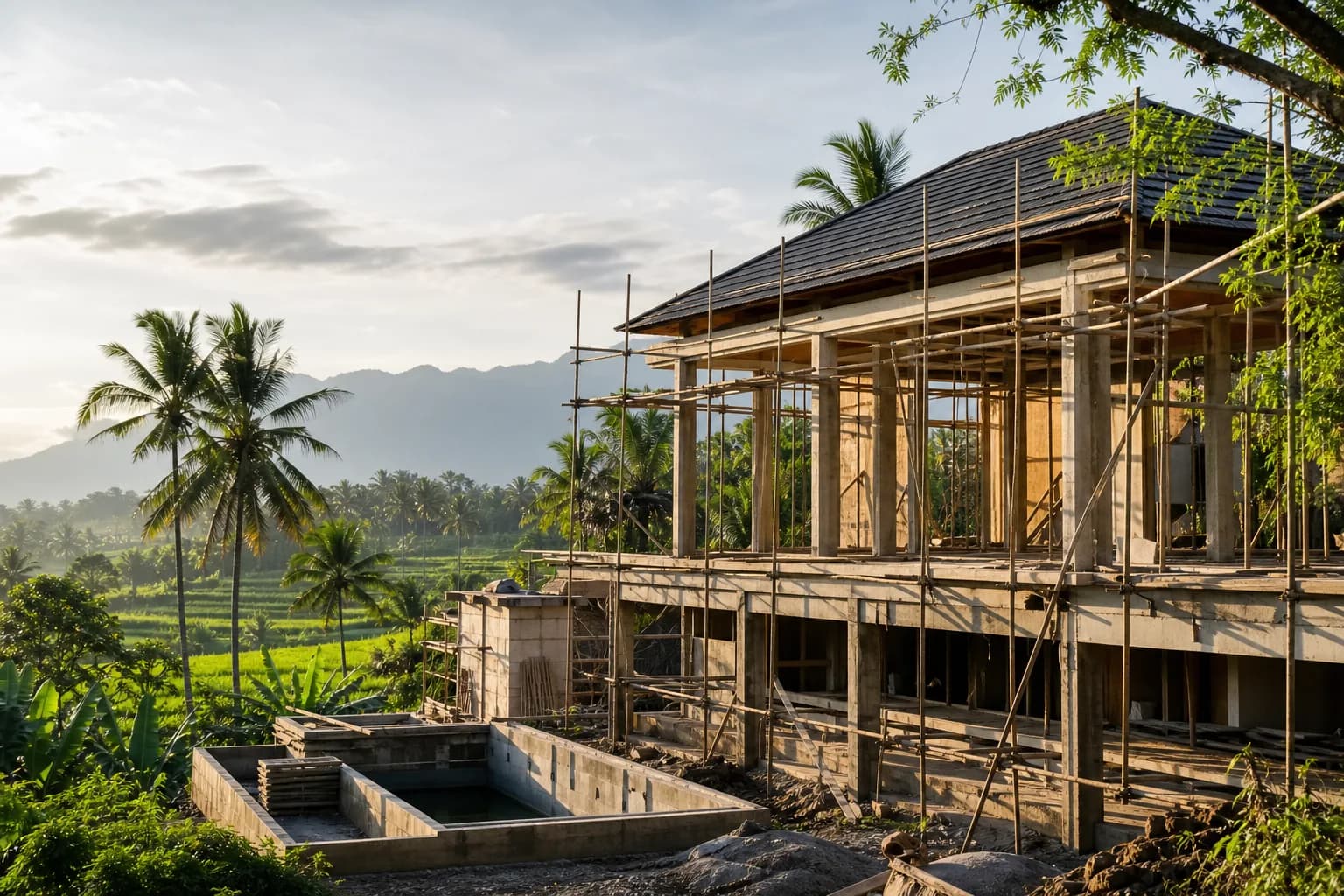
North Bali Airport and Property Prices: What It Really Means for Lovina and Amed
A fact-first 2026 look at the North Bali airport project — what is confirmed versus announced — and what it genuinely means for land prices and buying decisions in Lovina, Kubutambahan and Amed.
7 min read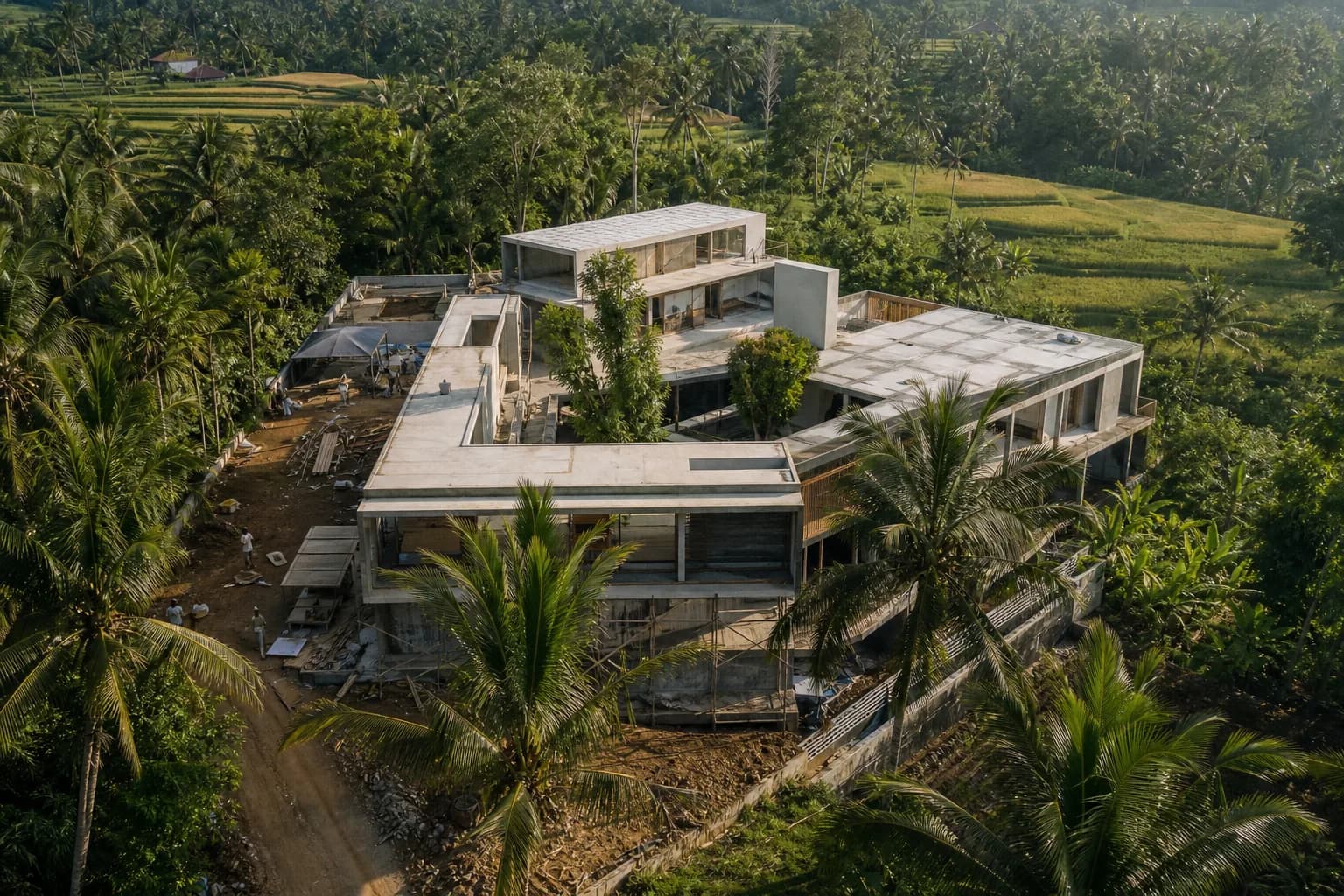
Where to Buy or Build a Villa in Bali in 2026: Area-by-Area Comparison
An honest 2026 comparison of Bali's five main buying areas — Canggu, Pererenan, Uluwatu, Ubud and Sanur — with indicative land prices, demand profiles, zoning risks and who each area actually suits.
7 min read