Kuta Groundwater Contamination Testing Remediation Costs Bali
Why Kuta Groundwater Contamination Testing Is Non-Negotiable Before Land Purchase
Kuta’s decades of intensive tourism development, aging septic infrastructure, and proximity to coastal saltwater intrusion zones create a unique groundwater contamination risk profile that most land buyers completely overlook until construction begins. Unlike inland Bali regions, Kuta’s shallow water table—often 2-4 meters below surface—combined with dense commercial activity means your future villa site may sit above groundwater contaminated with nitrates, E. coli, heavy metals, or saline intrusion. Indonesian environmental law (UU No. 32/2009) technically requires groundwater quality assessment for construction projects, yet enforcement remains inconsistent. The real issue: discovering contamination after purchasing land can trigger remediation costs exceeding IDR 500 million or force complete redesign of your water supply system, foundation drainage, and septic placement—expenses that destroy project feasibility before a single foundation is poured.
Technical Framework: Kuta Groundwater Testing Standards and Legal Requirements
Groundwater contamination testing in Kuta operates under overlapping Indonesian regulatory frameworks that create confusion for foreign buyers. The primary legislation—Government Regulation No. 22/2021 on Environmental Protection and Management—establishes water quality standards, while regional Bali Governor Regulation No. 16/2016 specifically addresses groundwater extraction permits (SIPA – Surat Izin Pengambilan Air Tanah). However, these regulations focus primarily on extraction volume rather than contamination assessment protocols.
For construction projects in Kuta, the technical testing requirements depend on your intended groundwater use. If you plan to drill a well for construction water, irrigation, or backup supply, you’re legally required to obtain SIPA approval, which theoretically includes water quality verification. The Badung Regency Environmental Agency (Dinas Lingkungan Hidup) maintains authority over testing protocols, requiring analysis of minimum 15 parameters: pH, TDS (Total Dissolved Solids), turbidity, color, odor, temperature, nitrate, nitrite, ammonia, iron, manganese, chloride, sulfate, total coliform, and E. coli.
The engineering reality in Kuta is more complex. The area sits within what hydrogeologists classify as a “stressed aquifer zone”—the shallow unconfined aquifer experiences contamination from three primary vectors. First, legacy septic systems from pre-2000 development leak untreated wastewater directly into permeable volcanic soil. Second, saltwater intrusion from over-extraction has pushed the freshwater-saltwater interface inland by approximately 200-400 meters over the past two decades, particularly affecting areas within 1 kilometer of the coastline. Third, surface runoff from roads, parking areas, and commercial zones introduces petroleum hydrocarbons and heavy metals into the groundwater recharge zones.
Professional contamination assessment for construction sites requires a phased approach. Phase 1 involves desktop analysis reviewing historical land use, proximity to known contamination sources (gas stations, industrial sites, waste disposal areas), and regional hydrogeological mapping. Phase 2 requires physical soil boring and groundwater sampling from test wells drilled to your anticipated extraction depth—typically 15-40 meters in Kuta depending on location. Samples must be analyzed by accredited laboratories (those certified by KAN – Komite Akreditasi Nasional) within 24 hours of collection to ensure bacterial count accuracy.
The critical technical distinction: standard SIPA testing checks for potability and basic safety, but construction-grade contamination assessment must evaluate parameters that affect building systems. High chloride content (>250 mg/L) accelerates rebar corrosion in concrete foundations. Sulfate concentrations above 400 mg/L attack cement compounds, reducing structural lifespan by 30-50%. Total Dissolved Solids exceeding 1,500 mg/L indicate saline intrusion that renders groundwater unusable for construction mixing, irrigation, or pool filling—forcing complete reliance on PDAM municipal supply or expensive reverse osmosis systems.
For villa construction projects in Kuta, we’ve documented groundwater chloride levels ranging from 180 mg/L in northern Kuta (near Kerobokan border) to over 800 mg/L in southern coastal zones (Tuban, near airport). This 4x variation within 3 kilometers demonstrates why site-specific testing is non-negotiable—regional data provides zero predictive value for your specific parcel.
Hidden Risks: What Land Buyers Miss in Kuta’s Contamination Landscape
The most expensive mistake is assuming that clear, odorless groundwater equals safe groundwater. We’ve tested wells in Kuta that appeared pristine but contained fecal coliform counts exceeding 1,000 CFU/100mL (safe drinking water standard: 0 CFU/100mL) and nitrate levels above 50 mg/L indicating septic contamination. Visual inspection reveals nothing—bacterial and chemical contamination requires laboratory analysis.
Second critical oversight: buyers focus exclusively on their own parcel while ignoring adjacent land use. A villa plot in Kuta may have clean soil, but if the neighboring property operates a restaurant with failing septic system or the uphill property has underground fuel storage, groundwater contamination migrates through the aquifer regardless of property boundaries. Groundwater flows follow hydraulic gradients, not land titles. In Kuta’s relatively flat topography with shallow water tables, contamination plumes can extend 50-100 meters from source points.
Third risk: timing of testing. Many buyers conduct groundwater assessment during dry season (April-October) when water tables drop and contamination concentrations increase due to reduced dilution. Wet season testing (November-March) may show acceptable parameters that deteriorate significantly during dry months when you’re actually constructing. Professional assessment requires sampling across both seasonal extremes or applying safety factors to dry-season results.
The legal risk compounds the technical risk. If post-construction testing reveals your groundwater well contaminates neighboring properties or violates environmental standards, the Badung Environmental Agency can issue administrative sanctions, construction halts, or mandatory remediation orders. Indonesian environmental law applies strict liability—you’re responsible for contamination emanating from your property even if you didn’t cause the original pollution. This liability extends throughout the leasehold period for foreign-owned projects.
Step-by-Step Process: Conducting Proper Kuta Groundwater Contamination Assessment
Step 1: Desktop Environmental Site Assessment (1-2 weeks). Engage a qualified environmental consultant to review historical aerial imagery, land use records, and proximity analysis. Key investigation points include: distance to coastline (saltwater intrusion risk), presence of gas stations within 500m radius (petroleum hydrocarbon risk), density of septic systems in 100m radius (bacterial/nitrate risk), and elevation relative to surrounding properties (groundwater flow direction). Cost range: IDR 8-15 million for comprehensive desktop study.
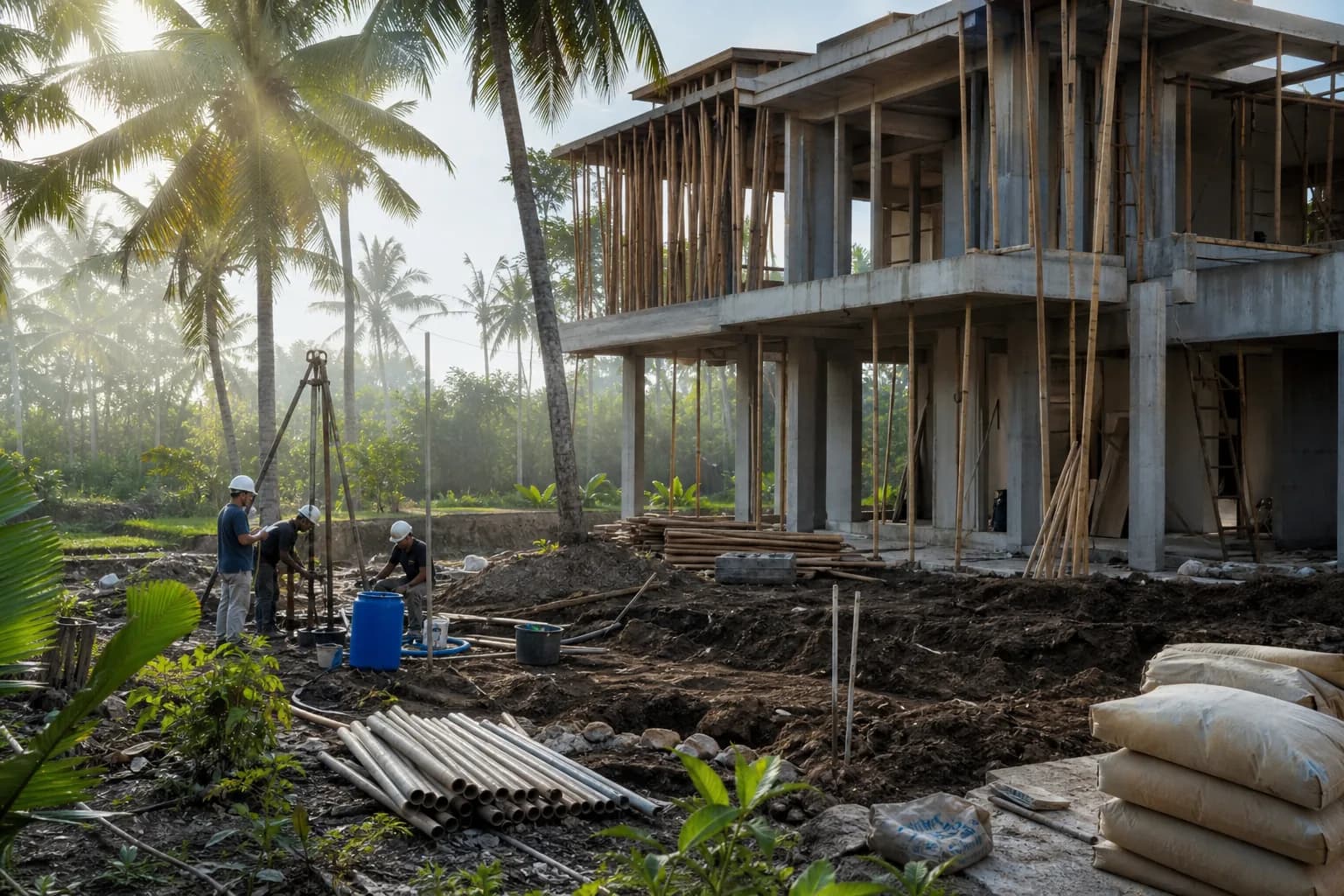
Step 2: Preliminary Soil and Groundwater Sampling (1 week). Drill minimum two test boreholes to anticipated well depth—typically 20-35 meters in Kuta. One borehole should target your planned well location; the second should be positioned downgradient (direction of groundwater flow) to assess potential contamination migration. Collect soil samples at 2-meter intervals during drilling to identify contaminated soil layers that may leach into groundwater. Extract groundwater samples using low-flow sampling techniques to avoid artificial aeration or contamination. Cost: IDR 25-40 million including drilling, sampling, and laboratory analysis.
Step 3: Comprehensive Laboratory Analysis (3-5 days). Submit samples to KAN-accredited laboratory for full parameter testing. Essential parameters for Kuta construction sites: bacteriological (total coliform, E. coli, fecal streptococci), inorganic chemicals (nitrate, nitrite, ammonia, chloride, sulfate, TDS, hardness), metals (iron, manganese, lead, arsenic if near former agricultural land), and if near commercial zones, petroleum hydrocarbons (BTEX compounds, TPH). Request analysis against both Indonesian drinking water standards (Permenkes 492/2010) and construction water quality guidelines. Laboratory costs: IDR 8-18 million depending on parameter count.
Step 4: Hydrogeological Assessment and Risk Mapping (1 week). Professional hydrogeologist interprets laboratory results within site-specific geological context. Critical deliverables include: aquifer classification (confined vs unconfined), groundwater flow direction mapping, contamination source identification, seasonal variation prediction, and construction impact assessment. This analysis determines whether contamination is localized and remediable or regional and permanent. Cost: IDR 12-20 million for professional hydrogeological report.
Step 5: Remediation Feasibility and Cost Estimation (if contamination detected). If testing reveals contamination exceeding construction standards, evaluate three options: (a) drill deeper wells to access uncontaminated aquifer layers—viable if contamination is shallow, typically adding IDR 30-60 million to well costs; (b) install treatment systems (filtration, UV sterilization, reverse osmosis)—capital cost IDR 80-200 million plus ongoing operational expenses; (c) abandon groundwater use entirely and rely on municipal PDAM supply—requires upgraded connection capacity, storage tanks, and backup systems, total cost IDR 60-150 million depending on project scale.
Step 6: Integration with Construction Planning. Contamination assessment results must inform foundation design (sulfate-resistant cement if high sulfate levels), drainage system design (contaminated groundwater requires sealed drainage to prevent soil contact), septic system placement (minimum 50m horizontal separation from wells, positioned downgradient), and landscape irrigation planning (contaminated groundwater may require treatment or alternative sources). These design modifications add 3-8% to base construction costs but prevent catastrophic long-term failures.
Realistic Cost Ranges and Timeline Expectations for Kuta Projects
Complete groundwater contamination assessment for a standard villa plot (500-1000m²) in Kuta ranges from IDR 55-95 million, representing approximately 1.5-2.5% of typical land purchase costs. Timeline from engagement to final report: 4-6 weeks assuming no delays in laboratory processing or drilling equipment availability.
If contamination is detected and remediation required, costs escalate significantly based on contamination type and severity. Bacterial contamination (most common in Kuta) typically requires UV sterilization systems (IDR 25-45 million installed) plus chlorination backup (IDR 8-15 million). Chemical contamination—particularly saltwater intrusion—demands reverse osmosis systems ranging from IDR 120-280 million for villa-scale installations with 5,000-10,000 liters daily capacity. These systems require replacement membranes every 2-3 years (IDR 15-30 million) and consume significant electricity, adding IDR 2-4 million monthly to operational costs.
Soil remediation for contaminated sites—necessary if petroleum hydrocarbons or heavy metals are detected—represents the most expensive scenario. Excavation and off-site disposal of contaminated soil costs IDR 800,000-1,500,000 per cubic meter including transportation to licensed disposal facilities in East Java (Bali has no hazardous waste treatment facilities). A moderately contaminated 500m² site with 2-meter contamination depth requires removing 1,000 cubic meters, totaling IDR 800 million-1.5 billion. This scenario typically renders construction economically unfeasible.
The hidden cost: project timeline extension. Discovering contamination after land purchase but before construction adds 3-6 months for remediation system design, procurement, and installation. If contamination is severe enough to require Environmental Impact Assessment (AMDAL) modification or additional permits, delays extend to 8-12 months. For villa development projects operating on leasehold agreements, these delays consume valuable lease years while generating zero return.
Frequently Asked Questions: Kuta Groundwater Contamination Specifics
Is groundwater contamination testing legally required before purchasing land in Kuta, or only before drilling wells?
Indonesian law does not explicitly require contamination testing before land purchase—the requirement triggers when you apply for groundwater extraction permits (SIPA) during construction phase. However, this creates a dangerous gap: you can legally purchase contaminated land, discover the contamination only when applying for well permits, then face remediation costs that exceed the land value. Professional due diligence demands testing before purchase, not after. The Badung Environmental Agency can reject SIPA applications if groundwater quality fails standards, leaving you with land but no legal water access. We’ve documented cases where buyers purchased Kuta land at IDR 8-12 million/m², discovered severe saltwater intrusion during permit application, then faced choices between IDR 200+ million remediation systems or abandoning groundwater use entirely. Pre-purchase testing costs 1-2% of land price but prevents 100% loss scenarios.
How deep do wells need to be drilled in Kuta to avoid contaminated shallow groundwater layers?
Kuta’s hydrogeology features a shallow unconfined aquifer (2-15 meters depth) that’s highly vulnerable to surface contamination, and a deeper semi-confined aquifer (25-60 meters) with better protection from surface pollutants. However, drilling deeper doesn’t guarantee clean water—saltwater intrusion in coastal Kuta affects aquifers down to 40+ meters in some locations. The effective depth depends on your specific site’s distance from coast and local extraction rates. Northern Kuta (Seminyak border) typically finds acceptable water quality at 20-30 meters. Central Kuta requires 30-40 meters. Southern Kuta near airport often shows saline intrusion even at 50+ meters, making groundwater use economically unviable. The only reliable method: d
 3124 m²6 month(s)from 123.000 USD
TALA 8
 2144 m²11 month(s)from 104.000 USD
Narayana
 164 m²7 month(s)from 79.000 USD
Private: Haridas Villas, Tegallalang
 1from 198.000 USD
Private: Haridas Villas
 4344 m²16 month(s)from 290.000 USD
Radha

Want to calculate?
 3104 m²11 month(s)from 99.000 USD
TALA 100
164 m²7 month(s)from 79.000 USDTALA TWO
 3173 m²6 month(s)from 125.000 USD
TALA FOUR
 172 m²8 month(s)from 120.000 USD
Keshava
 3127 m²9 month(s)from 177.000 USD
Mukunda
 3180 m²7 month(s)from 142.000 USD
Vasudeva
Start With Real Numbers, Not Guesses
Before buying land or finalizing a design, check the realistic build cost range for your project in Bali.
Our team reviews your inputs and gives a grounded estimate.
Available lands
 8313 m²15 min$ 716670Bali, Buduk
 928 m²15 min$ 910123Bali, Pererenan
 422 m²15 min$ 93547Bali, Kerobokan
 500 m²15 min$ 124692Bali, Kaba Kaba
 1300 m²10 min$ 312192Bali, Kutuh South Bali
 420 m²15 min$ 41897Bali, Tabanan
 1200 m²2 min$ 155172Bali, Klungkung
 1600 m²32 min$ 266010Bali, Tabanan
 325 m²15 min$ 44472Bali, Ungasan
 250 m²15 min$ 40025Bali, Munggu
 3300 m²15 min$ 449889Bali, Tabanan
 6000 m²30 min$ 55419Bali, Tabanan
 300 m²55 min$ 32475Bali, Tegelalang
 220 m²2 min$ 66565Bali, Cemagi
 1660 m²10 min$ 343448Bali, Kerobokan
Essential Bali build & buy guides
- Bali villa construction cost per m² in 2026
- How much will your villa cost? Calculator
- Building a villa in Bali: the complete guide
- Buying land in Bali: step-by-step for foreigners
- Bali villa investment: yields, risks, returns
- Leasehold vs freehold: what foreigners can own
- Construction defect liability & 10-year warranty
- Bali building codes and construction standards
Related guides
Visas and Bali Property: What Ownership Does and Does Not Give You
Buying a Bali villa does not grant you residency — a persistent myth that sells property. What the investor KITAS and the second-home visa actually require in 2026, how property fits into each pathway, and how to plan a build alongside a visa strategy.
8 min read
Bali Property Contracts and Indonesian Language Law: Dual-Language Pitfalls That Void Deals
Indonesian law requires property agreements with Indonesian parties to exist in Indonesian — and the two language versions can quietly diverge. What the language law demands in 2026, the real court history, and the dual-language pitfalls that damage Bali deals.
8 min read
Bali Land Certificates Decoded: SHM, HGB, Hak Pakai and Girik Explained for Buyers
A buyer's decoder for Bali land certificates: what SHM, HGB, Hak Pakai and girik actually mean, why girik lost standalone legal force in February 2026, and how to verify a title before you commit.
9 min read