Karangasem Lava Field Construction Costs Permits Bali
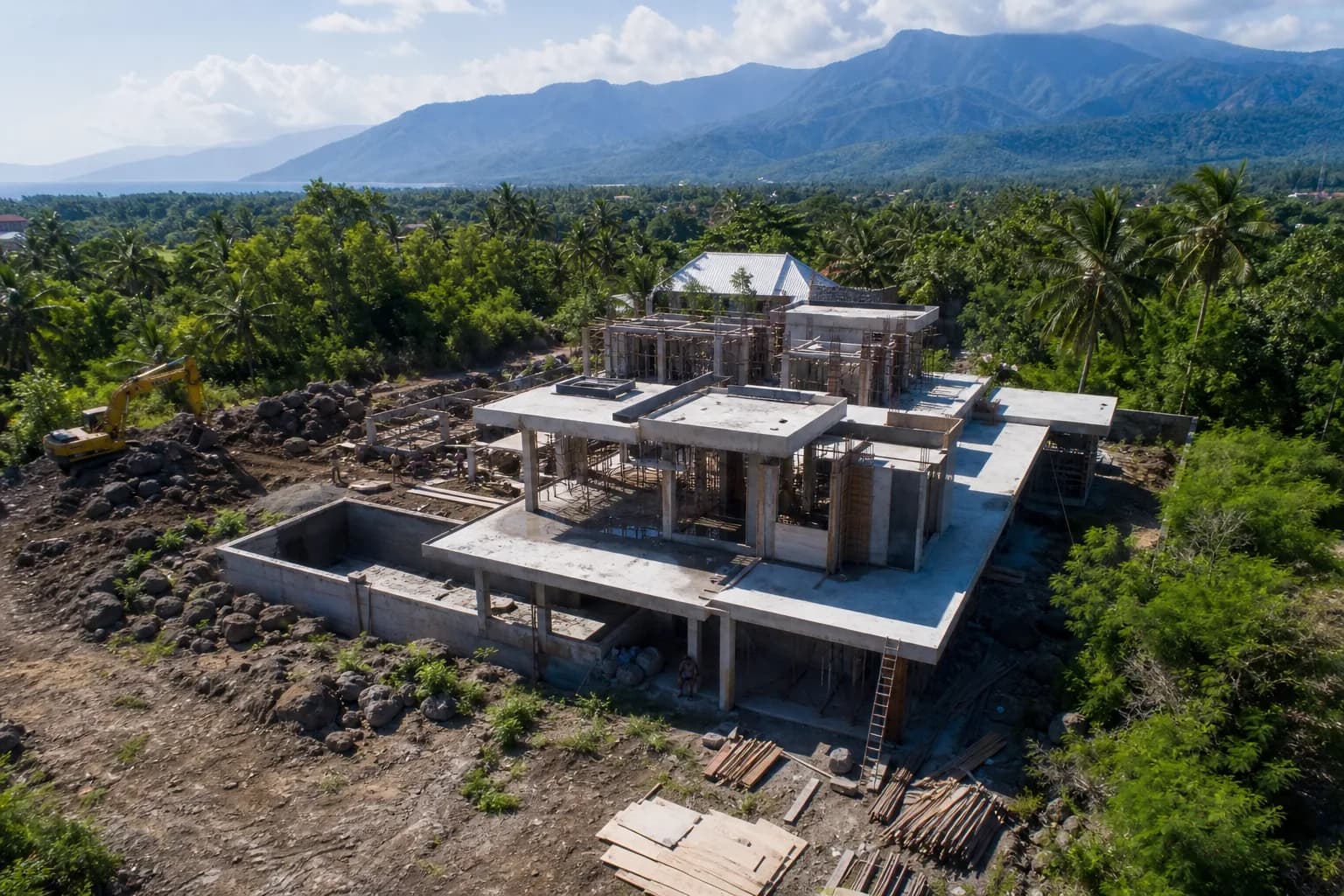
Why Karangasem Lava Field Construction Demands Specialized Geotechnical Investigation
Building on Karangasem’s volcanic lava fields presents one of Bali’s most technically demanding construction scenarios. The regency’s eastern coastline, shaped by Mount Agung’s historical eruptions, features solidified basaltic lava flows, pyroclastic deposits, and highly variable subsurface conditions that standard foundation systems cannot accommodate. Property buyers attracted to Karangasem’s raw landscapes and lower land prices often underestimate the geotechnical survey complexity and permit approval timeline required for lava field construction. Without proper subsurface investigation documenting load-bearing capacity, volcanic rock composition, and groundwater interaction with porous lava formations, construction permits remain unattainable—and structural failure risks become unacceptably high.
Technical Geology of Karangasem Lava Fields: Engineering Implications
Karangasem’s construction sites, particularly in areas like Amed, Tulamben, and Kubu, sit atop geological formations created by Mount Agung’s eruptions over centuries. The 1963 eruption alone deposited extensive lava flows that cooled into irregular basaltic formations with internal voids, gas pockets, and unpredictable density variations. These characteristics create specific engineering challenges that differentiate lava field construction from standard Bali villa projects.
The subsurface typically consists of three distinct strata: surface weathered lava (0.5-2 meters depth) with high porosity and low bearing capacity; intermediate fractured basalt (2-6 meters) with variable density and void spaces; and deeper consolidated volcanic rock with acceptable load-bearing properties. Standard penetration testing (SPT) often encounters refusal at shallow depths due to hard basalt layers, requiring specialized drilling equipment and rotary core sampling to accurately assess subsurface conditions.
Groundwater behavior in lava fields differs fundamentally from sedimentary soils. Porous lava acts as an aquifer, allowing rapid water movement through interconnected void spaces. During Bali’s monsoon season (November-March), groundwater tables can rise dramatically, filling subsurface cavities and reducing effective bearing capacity. This seasonal variation must be documented through multi-season monitoring, extending geotechnical investigation timelines beyond typical 2-3 week surveys.
The Indonesian National Standard (SNI 8460:2017) for geotechnical investigation requires minimum three boreholes for residential construction sites under 500 square meters, with depth reaching stable bearing strata or 10 meters minimum. For lava field sites, engineering practice demands additional investigation points due to lateral geological variability—a lava flow may contain solid basalt columns adjacent to rubble zones within 5-meter distances. Teville’s engineering protocols for volcanic terrain typically specify 4-6 investigation points for standard villa plots, with borehole depths extending to 12-15 meters to confirm stable founding conditions.
Laboratory testing of lava field samples focuses on unconfined compressive strength of intact basalt cores, point load index for fractured zones, and permeability testing to assess drainage characteristics. Results typically show compressive strengths ranging from 15-80 MPa for weathered to fresh basalt, compared to 0.5-2 MPa for typical Bali clay soils. However, this strength advantage applies only to intact rock—void spaces and fracture zones may require complete excavation and engineered fill replacement.
Foundation design for lava fields generally employs one of three strategies: shallow footings bearing on excavated and leveled basalt platforms (requiring extensive rock breaking); deep pile foundations drilled through variable strata to competent rock (expensive but reliable); or hybrid systems using ground improvement techniques like void grouting combined with reinforced grade beams. The geotechnical report must provide specific bearing capacity values and foundation recommendations that satisfy both structural engineers and permit authorities.
Hidden Risks in Karangasem Lava Field Development
The primary risk foreign buyers overlook is assuming that hard volcanic rock automatically provides superior foundation conditions. While intact basalt offers excellent bearing capacity, the irregular distribution of voids, fractures, and weathered zones creates differential settlement risks that exceed those of uniform clay sites. A villa foundation spanning both solid basalt and rubble-filled zones will experience uneven settlement, causing structural cracking and potential failure.
Permit authorities in Karangasem Regency have become increasingly stringent regarding geotechnical documentation for lava field sites following several foundation failures in coastal construction projects. The local Public Works Department (Dinas PUPR) now requires peer review of geotechnical reports by certified Indonesian geotechnical engineers, adding 3-4 weeks to permit timelines and additional review costs of $1,200-$2,000 USD. Buyers who budget only for standard permit processing encounter unexpected delays when authorities reject inadequate subsurface investigations.
Excavation costs on lava fields dramatically exceed standard earthwork rates. Mechanical excavators struggle with hard basalt, requiring hydraulic rock breakers or controlled blasting—techniques that increase excavation costs from typical $8-12 per cubic meter to $45-80 per cubic meter for rock removal. A standard villa requiring 200 cubic meters of excavation may face $9,000-$16,000 in earthwork costs versus $1,600-$2,400 on sedimentary sites. These figures rarely appear in preliminary budgets, causing significant cost overruns during construction mobilization.
Groundwater management presents another concealed challenge. Porous lava allows rapid water infiltration, but also permits sewage effluent migration into aquifers that supply nearby communities. Environmental permits (UKL-UPL) for lava field construction now mandate sealed septic systems or biodigester installations rather than standard absorption fields, adding $3,500-$6,000 to wastewater infrastructure costs. Failure to address this during permit application results in rejection and complete redesign of sanitation systems.
Step-by-Step Geotechnical Survey and Permit Process for Lava Field Sites
The technical pathway for Karangasem lava field construction begins with site access verification and geological reconnaissance. Before engaging geotechnical consultants, confirm that drilling equipment can physically access the property—many coastal lava field plots lack paved access, requiring temporary road construction for drill rig mobilization. This preliminary work costs $800-$1,500 and prevents aborted survey attempts.
Phase 1: Geotechnical Investigation (Weeks 1-4)
- Engage Indonesian-certified geotechnical consultant with volcanic terrain experience (verify previous Karangasem projects)
- Conduct site reconnaissance to identify surface lava formations, fracture patterns, and vegetation indicators of subsurface conditions
- Execute minimum 4 boreholes using rotary drilling equipment capable of coring hard basalt (standard SPT rigs insufficient)
- Perform in-situ testing: SPT in weathered zones, rock quality designation (RQD) for fractured basalt, permeability testing in suspected void areas
- Extract core samples for laboratory testing: unconfined compressive strength, point load index, specific gravity, absorption capacity
- Install temporary groundwater monitoring wells if seasonal variation assessment required (extends timeline 8-12 weeks for wet/dry season data)
Phase 2: Geotechnical Report and Foundation Design (Weeks 5-7)
- Geotechnical engineer prepares comprehensive report documenting subsurface stratigraphy, bearing capacity zones, groundwater conditions, and foundation recommendations
- Report must comply with SNI 8460:2017 standards and include specific allowable bearing pressures for shallow foundations or pile capacity calculations
- Structural engineer develops foundation design based on geotechnical recommendations—this integration is critical for permit approval
- For lava field sites, foundation drawings must show rock excavation limits, void treatment methods, and drainage provisions
Phase 3: Permit Application Assembly (Weeks 8-10)
- Compile Izin Mendirikan Bangunan (IMB) application package including geotechnical report, structural calculations, architectural drawings, and site plan
- Submit to Karangasem Regency DPMPTSP (One-Stop Investment Service) with complete technical documentation
- Geotechnical report undergoes peer review by regency-appointed consultant—prepare for technical clarifications or supplementary investigation requests
- Environmental compliance documentation (UKL-UPL) must address groundwater protection measures specific to porous lava aquifer conditions
Phase 4: Permit Review and Approval (Weeks 11-18)
- Technical review by Public Works Department focuses on foundation adequacy for documented subsurface conditions
- Common review comments for lava field projects: insufficient borehole depth, inadequate void treatment specifications, missing seasonal groundwater data
- Respond to technical queries with supplementary investigation or design modifications—delays of 3-5 weeks common for initial submissions
- Final IMB issuance following satisfactory technical review and fee payment (calculated on building area and construction value)
Throughout this process, working with construction partners experienced in Karangasem’s geological conditions proves essential. Teville’s engineering-driven construction process integrates geotechnical investigation with foundation design and permit coordination, preventing the disconnects that cause permit rejections and construction delays.
Realistic Cost Ranges for Karangasem Lava Field Geotechnical and Permit Work
Geotechnical investigation costs for lava field sites range from $12,000-$18,000 USD for standard residential villa plots (500-1000 square meters), significantly exceeding the $8,000-$12,000 typical for sedimentary soil sites. This premium reflects specialized drilling equipment requirements, increased borehole depths, core sample extraction and testing, and extended field time for hard rock penetration. Projects requiring seasonal groundwater monitoring add $3,000-$5,000 for well installation and multi-month observation periods.
Permit processing fees in Karangasem Regency follow standardized calculations: IMB fees equal approximately 0.5-0.8% of construction value (for $300,000 villa, expect $1,500-$2,400 in base permit fees). However, lava field projects incur additional technical review costs of $1,200-$2,000 for mandatory geotechnical peer review, plus environmental permit fees of $800-$1,500 for groundwater protection compliance documentation.
Total pre-construction technical costs for Karangasem lava field villa projects typically range $15,000-$23,000 USD, broken down as: geotechnical investigation $12,000-$18,000; permit fees and reviews $2,000-$3,500; environmental compliance documentation $1,000-$1,500. These figures assume straightforward subsurface conditions—sites with extensive void zones or contaminated groundwater may require supplementary investigation adding $4,000-$8,000.
Timeline expectations: geotechnical investigation and reporting requires 6-8 weeks; permit application assembly 2-3 weeks; permit review and approval 8-12 weeks. Total pre-construction timeline of 16-23 weeks represents the realistic path for lava field projects, compared to 10-14 weeks for standard Bali construction sites. Buyers should budget both the cost premium and extended timeline when evaluating Karangasem land opportunities.
Frequently Asked Questions: Karangasem Lava Field Construction Geotechnical and Permit Requirements
Can I skip the geotechnical survey if my Karangasem land has visible solid rock at the surface?
No. Surface basalt appearance provides no reliable indication of subsurface conditions. Lava flows commonly contain solid surface crusts overlying rubble zones, gas pockets, or weathered material at depth. Indonesian building codes (SNI 8460:2017) mandate subsurface investigation for all construction regardless of surface geology, and Karangasem permit authorities strictly enforce this requirement for volcanic terrain. Attempting construction without geotechnical documentation results in permit denial and potential stop-work orders if construction proceeds illegally. The survey cost of $12,000-$18,000 prevents foundation failures that could cost $80,000-$150,000 to remediate.
Why do Karangasem lava field geotechnical surveys cost more than investigations in Canggu or Seminyak?
Lava field investigations require specialized rotary drilling equipment capable of coring hard basalt rock, whereas standard soil sites use conventional SPT drilling rigs. Core drilling proceeds at 2-3 meters per day versus 8-10 meters per day for soil boring, increasing field time and equipment costs. Additionally, lava field boreholes must extend deeper (12-15 meters versus 8-10 meters) to reach stable founding strata below variable volcanic deposits. Laboratory testing of rock cores—unconfined compressive strength, point load index—costs more than standard soil classification tests. The combined effect increases investigation costs by 40-60% compared to sedimentary sites.
What foundation type works best for Karangasem lava field construction, and how does this affect costs?
Foundation selection depends on specific subsurface conditions documented in the geotechnical report. Sites with shallow competent basalt (2-3 meters depth) typically use excavated footings bearing directly on leveled rock platforms—this requires expensive rock breaking but provides excellent bearing capacity. Sites with deep weathered zones or extensive voids require drilled pile foundations extending 8-12 meters to stable rock, increasing foundation costs by $25,000-$45,000 for standard villas. Hybrid systems using void grouting and reinforced grade beams offer middle-ground solutions. Your geotechnical engineer and structural designer must collaborate on foundation selection—this integration is why Teville’s

Want to calculate?
 3127 m²9 month(s)from 177.000 USD
Mukunda
 172 m²8 month(s)from 120.000 USD
Keshava
 2144 m²11 month(s)from 104.000 USD
Narayana
 164 m²7 month(s)from 79.000 USD
TALA TWO
 3180 m²7 month(s)from 142.000 USD
Vasudeva
 4344 m²16 month(s)from 290.000 USD
Radha
 3124 m²6 month(s)from 123.000 USD
TALA 8
 1from 198.000 USD
Private: Haridas Villas
 3104 m²11 month(s)from 99.000 USD
TALA 100
164 m²7 month(s)from 79.000 USDPrivate: Haridas Villas, Tegallalang
 3173 m²6 month(s)from 125.000 USD
TALA FOUR
Start With Real Numbers, Not Guesses
Before buying land or finalizing a design, check the realistic build cost range for your project in Bali.
Our team reviews your inputs and gives a grounded estimate.
Available lands
 889 m²15 min$ 145612Bali, Cepaka
 250 m²15 min$ 40025Bali, Munggu
 2000 m²15 min$ 523000Bali, Canggu
 680 m²15 min$ 110751Bali, Pererenan
 911 m²15 min$ 248217Bali, Pererenan
 7900 m²25 min$ 413485Bali, Tabanan
 300 m²55 min$ 32475Bali, Tegelalang
 1600 m²32 min$ 266010Bali, Tabanan
 1362 m²15 min$ 335468Bali, Tumbak
 1533 m²5 min$ 165666Bali, Cepaka
 260 m²5 min$ 51872Bali, Kedungu
 700 m²15 min$ 162500Bali, Tabanan
 1700 m²10 min$ 632257Bali, Kuta
 3254 m²5 min$ 631800Bali, All
 3700 m²15 min$ 738177Bali, Tabanan
Essential Bali build & buy guides
- Bali villa construction cost per m² in 2026
- How much will your villa cost? Calculator
- Building a villa in Bali: the complete guide
- Buying land in Bali: step-by-step for foreigners
- Bali villa investment: yields, risks, returns
- Leasehold vs freehold: what foreigners can own
- Construction defect liability & 10-year warranty
- Bali building codes and construction standards
Related guides
Visas and Bali Property: What Ownership Does and Does Not Give You
Buying a Bali villa does not grant you residency — a persistent myth that sells property. What the investor KITAS and the second-home visa actually require in 2026, how property fits into each pathway, and how to plan a build alongside a visa strategy.
8 min read
Bali Property Contracts and Indonesian Language Law: Dual-Language Pitfalls That Void Deals
Indonesian law requires property agreements with Indonesian parties to exist in Indonesian — and the two language versions can quietly diverge. What the language law demands in 2026, the real court history, and the dual-language pitfalls that damage Bali deals.
8 min read
Bali Land Certificates Decoded: SHM, HGB, Hak Pakai and Girik Explained for Buyers
A buyer's decoder for Bali land certificates: what SHM, HGB, Hak Pakai and girik actually mean, why girik lost standalone legal force in February 2026, and how to verify a title before you commit.
9 min read