Ubud Slope Stabilization Costs: Terraced Villa Construction Bali
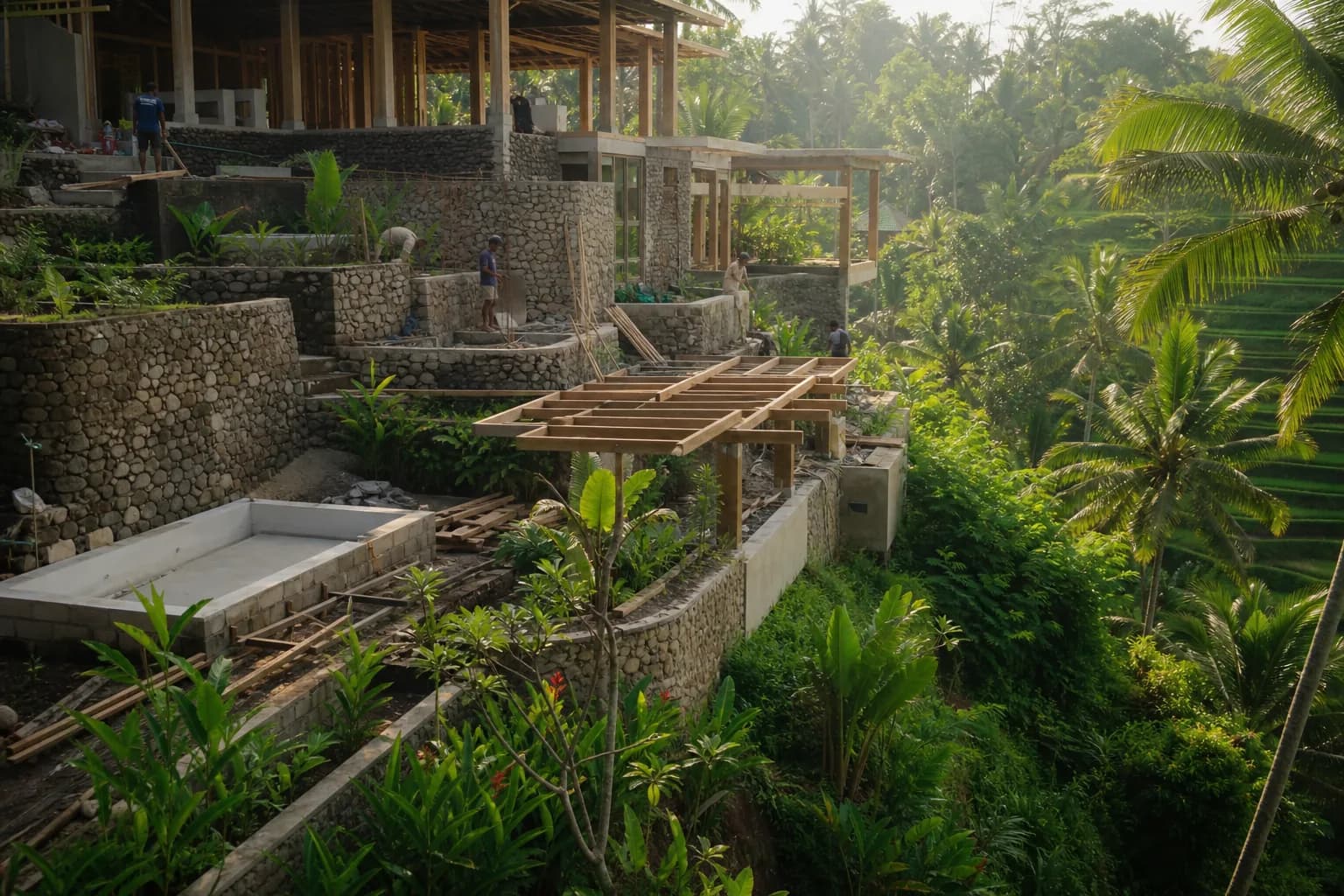
Why Ubud’s Steep Terrain Demands Specialized Terraced Construction Budgeting
Building on Ubud’s dramatic hillside plots requires far more than standard foundation work. The region’s volcanic slopes, seasonal monsoon erosion, and clay-rich soils create engineering challenges that transform simple land into complex terraced construction projects. Property buyers consistently underestimate slope stabilization costs—often discovering that earthworks, retaining structures, and drainage systems consume 25-40% of total construction budgets before a single villa wall rises. Understanding terraced construction costs in Ubud means accounting for geotechnical surveys, engineered retaining walls, subsurface drainage networks, and long-term erosion prevention systems that protect both structural integrity and investment value over decades of tropical weather exposure.
Engineering Requirements for Ubud Slope Stabilization and Terraced Foundations
Ubud’s topography sits within Bali’s central volcanic ridge system, where slopes frequently exceed 15-30 degrees and soil composition varies dramatically within single plots. Successful terraced construction begins with comprehensive geotechnical investigation—soil boring tests to 6-8 meters depth, percolation analysis for drainage capacity, and slope stability calculations under saturated conditions during peak monsoon periods.
The engineering approach typically involves creating multiple building platforms through cut-and-fill operations, with each terrace requiring independent structural support. Retaining wall systems form the backbone of slope stabilization, with three primary construction methods dominating Ubud projects:
Reinforced concrete cantilever walls remain the most common solution for height differences of 2-4 meters. These structures require steel reinforcement (minimum 12mm diameter bars at 200mm spacing), concrete strength of K-300 or higher, and foundation depths reaching 1.5 times the wall height. Proper drainage integration—weep holes at 2-meter intervals, gravel backfill layers, and geotextile fabric separation—prevents hydrostatic pressure buildup that causes wall failure.
Gabion basket systems offer flexible, permeable alternatives for terraces up to 3 meters high. Wire mesh cages filled with volcanic stone provide natural drainage while accommodating minor ground movement. However, gabion construction requires careful stone selection (150-250mm diameter), galvanized or PVC-coated wire (minimum 3mm thickness), and proper foundation preparation to prevent settling.
Anchored soil nail walls represent advanced solutions for challenging slopes exceeding 5 meters. This technique involves drilling steel reinforcement bars into stable soil layers, then constructing shotcrete facing over the secured slope. While more expensive initially, soil nailing minimizes excavation volume and construction time on extremely steep terrain.
Beyond retaining structures, comprehensive drainage engineering proves critical for long-term stability. Ubud receives 2,000-3,000mm annual rainfall, with intense monsoon events delivering 100mm+ in single days. Effective systems integrate multiple components: subsurface French drains behind retaining walls, surface swales directing runoff away from structures, catch basins at terrace transitions, and outlet pipes discharging to natural drainage courses or infiltration zones.
Indonesian building regulations (PU Regulation 29/2006) mandate structural engineering certification for retaining walls exceeding 1.5 meters height, requiring licensed civil engineers to seal construction drawings and supervise critical phases. Ubud’s Gianyar Regency building department enforces additional slope construction requirements, including mandatory geotechnical reports for sites with gradients above 20% and increased foundation depth specifications in hillside zones.
The terracing process itself follows systematic sequences: initial site clearing and topographic survey, bulk earthwork creating rough platforms, retaining wall construction from lowest terrace upward, drainage system installation concurrent with wall building, compaction and stabilization of building pads, and final grading with erosion control measures. Each phase requires inspection and approval before proceeding, with particular scrutiny on drainage functionality and retaining wall reinforcement placement.
Hidden Cost Factors and Common Budgeting Mistakes in Slope Projects
The most expensive oversight in Ubud terraced construction involves inadequate initial site assessment. Property buyers often budget for visible retaining walls while missing subsurface requirements—drainage systems can cost $80-150 per linear meter when properly engineered, yet many projects allocate nothing for this critical infrastructure until water damage appears.
Access logistics dramatically impact slope stabilization costs. Ubud’s narrow village roads and steep site approaches frequently prevent concrete truck access, forcing manual material transport or expensive concrete pumping services ($400-800 per day). Projects requiring crane rental for retaining wall formwork or material placement add $600-1,200 daily to budgets, yet these needs only become apparent during construction when delays prove costly.
Soil disposal represents another hidden expense. Cut-and-fill operations generate 30-50% excess material on typical slope sites, requiring off-site removal. Gianyar Regency prohibits dumping in rice fields or waterways, limiting disposal to approved sites 15-30km from Ubud. Transportation costs of $15-25 per cubic meter quickly accumulate when projects generate 200-400 cubic meters of excess soil.
Seasonal timing affects both costs and feasibility. Earthwork and retaining wall construction during monsoon season (November-March) faces weather delays, soil saturation complications, and reduced concrete curing quality. Smart scheduling concentrates slope work in dry months (April-October), but this requires advance planning that rushed projects sacrifice, leading to weather-related cost overruns of 15-30%.
Many buyers underestimate the compounding effect of slope complexity on overall villa construction costs. Beyond direct stabilization expenses, terraced sites increase foundation costs (stepped footings, varied depths), complicate utility installation (pumping requirements, extended pipe runs), and extend construction timelines by 2-4 months compared to flat sites—timeline extensions that translate to additional supervision, equipment rental, and financing costs.
Step-by-Step Process for Budgeting Terraced Construction in Ubud
Phase 1: Comprehensive Site Analysis (Weeks 1-3)
Commission professional topographic survey with 0.5-meter contour intervals, identifying existing drainage patterns, soil type variations, and vegetation requiring preservation. Engage licensed geotechnical engineer for soil boring tests at proposed building locations and retaining wall positions. Expect survey costs of $800-1,500 and geotechnical investigation fees of $1,200-2,500 depending on site size and complexity. These reports form the foundation for accurate cost estimation and prevent expensive mid-construction surprises.
Phase 2: Engineering Design and Permit Preparation (Weeks 4-8)
Work with structural engineers to develop terracing plans, retaining wall specifications, and drainage system designs based on geotechnical findings. This phase produces construction drawings meeting Indonesian building codes and Gianyar Regency requirements. Engineering fees typically range $3,000-6,000 for comprehensive slope stabilization design. Simultaneously prepare IMB (building permit) applications including required slope construction documentation—environmental impact assessments for sites above 25% gradient, structural calculations sealed by licensed engineers, and drainage plans showing discharge points.
Phase 3: Detailed Cost Estimation (Weeks 9-10)
Develop line-item budgets covering earthwork quantities (calculated from cut-fill analysis), retaining wall materials and labor (priced per cubic meter of wall volume), drainage components (per linear meter of pipe and number of structures), site access improvements, and contingency reserves. Professional quantity surveyors charge $1,500-3,000 for detailed slope project estimates but prevent the 20-40% budget overruns common in projects using rough approximations. Request quotes from multiple earthwork contractors, comparing equipment capabilities and timeline commitments.
Phase 4: Contractor Selection and Value Engineering (Weeks 11-13)
Evaluate contractors based on slope construction experience, equipment ownership (excavators, compactors, concrete pumps), and verifiable Ubud project references. Review completed terraced villa projects to assess quality standards and problem-solving approaches. Conduct value engineering sessions identifying cost optimization opportunities—perhaps gabion walls instead of concrete in specific locations, or phased construction allowing initial terraces to settle before upper level work begins. Avoid selecting contractors solely on lowest price; slope work quality directly impacts long-term structural performance.
Phase 5: Phased Budget Allocation (Weeks 14-16)
Structure payment schedules aligned with construction milestones: 15% upon earthwork completion and terrace formation, 30% after retaining wall construction and drainage installation, 25% following compaction and building pad certification, 20% upon villa foundation completion, and 10% retention released after final inspection and monsoon season performance verification. This phasing protects against contractor default while ensuring quality at each critical stage. Maintain 15-20% contingency reserves for unforeseen conditions—rock layers requiring breaking, underground water springs, or soil conditions differing from initial surveys.
Realistic Cost Ranges for Ubud Terraced Construction in 2026
Current market rates for slope stabilization and terraced construction in Ubud reflect both material costs and specialized labor requirements. Comprehensive terraced site preparation, including earthwork, retaining walls, and drainage systems, typically ranges $180-320 per square meter of building platform area created, with costs varying based on slope severity and height differences.
Specific component costs break down as follows: Reinforced concrete retaining walls cost $280-450 per cubic meter of wall volume (including excavation, reinforcement, formwork, concrete, and finishing). Gabion systems run $180-280 per cubic meter. Subsurface drainage installation averages $90-140 per linear meter for French drain systems with proper gravel backfill and geotextile fabric. Surface drainage structures (catch basins, swales, outlet pipes) add $2,500-5,000 per terrace level depending on complexity.
For a typical 500-square-meter building footprint on moderate Ubud slope (15-20% gradient) requiring two terrace levels with 2.5-meter retaining walls, expect total slope stabilization costs of $90,000-160,000 before villa construction begins. This represents 18-28% of total project budgets for mid-range villa construction at current rates of $1,000-1,800 per square meter for finished buildings.
Timeline expectations for terraced site preparation span 12-18 weeks from earthwork commencement to certified building pad completion, weather dependent. Projects scheduled during dry season (May-September) achieve faster completion, while monsoon season work extends timelines by 30-50% due to weather delays and soil drying requirements between construction phases.
Frequently Asked Questions About Ubud Slope Stabilization Costs
How do I determine if my Ubud land requires terraced construction or can use simpler foundation solutions?
Any site with average slope exceeding 10-12% (approximately 6-7 degree angle) requires terracing for safe villa construction. Measure slope by calculating elevation change divided by horizontal distance—if your plot drops 3 meters over 20 meters horizontal distance, that’s 15% slope requiring terraced approach. Plots with localized steep sections but overall gentle grades might use stepped foundations instead of full terracing, reducing costs by 40-60%. Commission topographic survey before land purchase to understand true terracing requirements; many Ubud plots appear gentler than actual measurements reveal. Geotechnical investigation determines if soil conditions allow standard terracing or require specialized solutions like soil nailing, significantly impacting budgets.
What percentage of my total construction budget should I allocate to slope stabilization in Ubud?
Budget allocation depends on slope severity and site conditions. Gentle slopes (10-15% gradient) typically require 15-22% of total construction budget for terracing and stabilization. Moderate slopes (15-25%) demand 22-32% allocation. Steep terrain (25%+ gradient) can consume 32-45% of budgets before villa construction begins. These percentages assume professional engineering, quality materials, and comprehensive drainage systems. Projects cutting corners on slope work to reduce initial costs inevitably face expensive remediation—budget adequately from the start. Request detailed cost breakdowns during design phase, and maintain 18-25% contingency reserves specifically for slope-related work, as subsurface conditions frequently differ from initial assessments.
Can I phase terraced construction to spread costs over time, or must everything be completed before building the villa?
Phasing is technically possible but rarely advisable for slope stability reasons. The lowest terrace and its retaining wall must be completed first, as it supports upper levels. Each subsequent terrace depends on the one below achieving full structural stability—typically requiring 3-6 months settling time after construction. Attempting to build villa foundations on recently constructed terraces risks differential settlement and structural damage. The most cost-effective approach completes all earthwork, retaining walls, and drainage systems in single mobilization, then allows 2-3 month settling period (ideally including one monsoon season) before villa foundation work begins. This timeline frustrates buyers eager to start building, but prevents the expensive foundation repairs that result from premature construction on unsettled terraces. Some projects successfully phase upper terraces
 3104 m²11 month(s)from 99.000 USD
TALA 100

Want to calculate?
 1from 198.000 USD
Private: Haridas Villas
 4344 m²16 month(s)from 290.000 USD
Radha
 172 m²8 month(s)from 120.000 USD
Keshava
 3180 m²7 month(s)from 142.000 USD
Vasudeva
 3124 m²6 month(s)from 123.000 USD
TALA 8
 3127 m²9 month(s)from 177.000 USD
Mukunda
 2144 m²11 month(s)from 104.000 USD
Narayana
 3173 m²6 month(s)from 125.000 USD
TALA FOUR
 164 m²7 month(s)from 79.000 USD
Private: Haridas Villas, Tegallalang
164 m²7 month(s)from 79.000 USDTALA TWO
Start With Real Numbers, Not Guesses
Before buying land or finalizing a design, check the realistic build cost range for your project in Bali.
Our team reviews your inputs and gives a grounded estimate.
Available lands
 585 m²8 min$ 165702Bali, Mengwi
 680 m²15 min$ 110751Bali, Pererenan
 1158 m²12 min$ 291996Bali, Mengwi
 2200 m²3 min$ 183842Bali, Berawa
 420 m²15 min$ 41897Bali, Tabanan
 6000 m²10 min$ 1330049Bali, Kutuh South Bali
 200 m²5 min$ 59113Bali, Bukit
 1430 m²5 min$ 209862Bali, Klungkung
 1950 m²7 min$ 150092Bali, Tabanan
 1410 m²15 min$ 390702Bali, Tabanan
 1300 m²10 min$ 348214Bali, Tabanan
 800 m²10 min$ 307882Bali, Tibubeneng
 1533 m²5 min$ 165666Bali, Cepaka
 7000 m²36 min$ 284483Bali, Gianyar
 1000 m²10 min$ 384852Bali, Canggu
Essential Bali build & buy guides
- Bali villa construction cost per m² in 2026
- How much will your villa cost? Calculator
- Building a villa in Bali: the complete guide
- Buying land in Bali: step-by-step for foreigners
- Bali villa investment: yields, risks, returns
- Leasehold vs freehold: what foreigners can own
- Construction defect liability & 10-year warranty
- Bali building codes and construction standards
Related guides
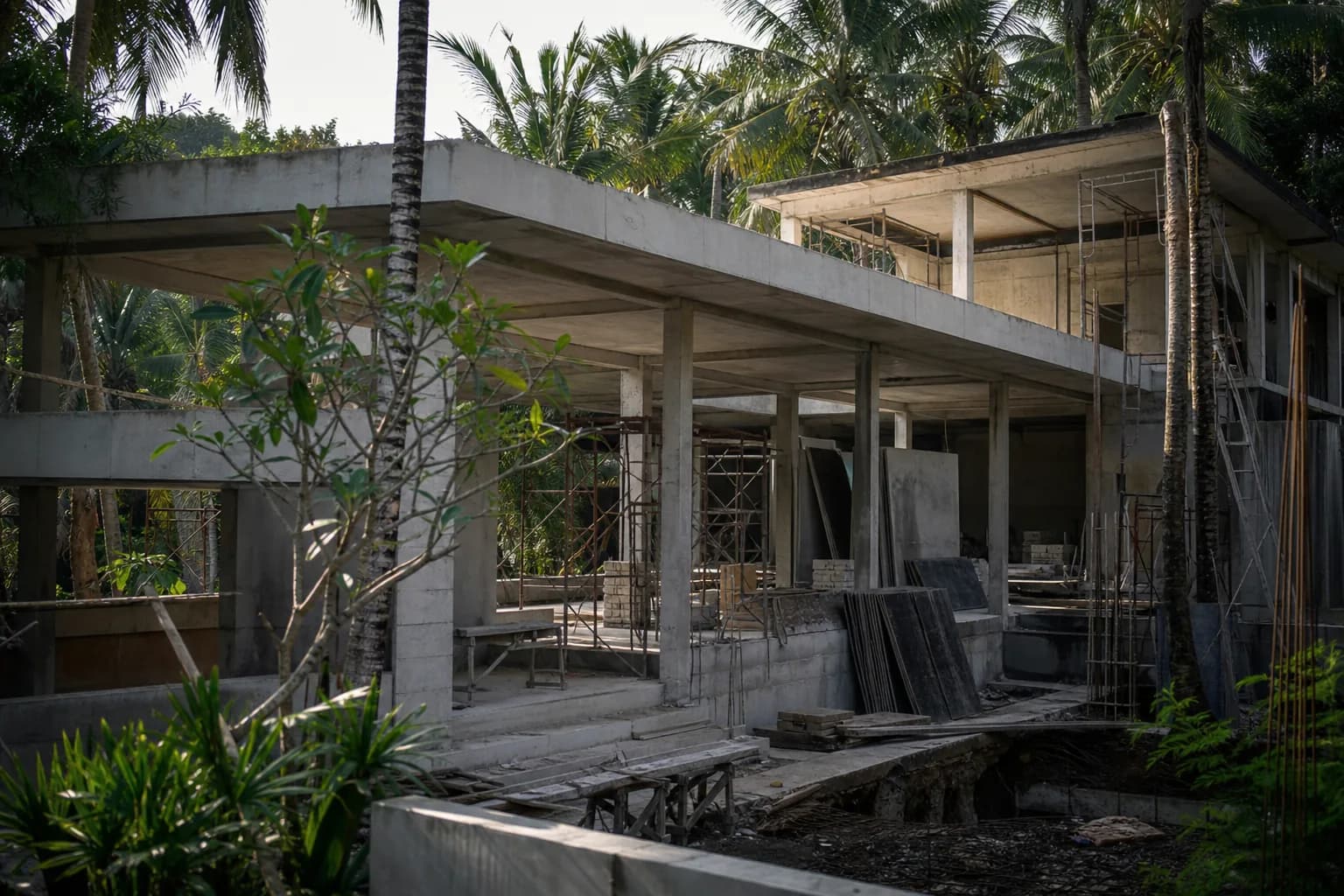
Leasehold Depreciation in Bali: How Remaining Term Affects Resale Value — and What Offsets It
A Bali leasehold is a depreciating right on land plus an ageing building — but the loss of value is neither linear nor unmanageable. How remaining term drives resale price, where the danger lines sit, and the clauses and decisions that protect your exit.
7 min read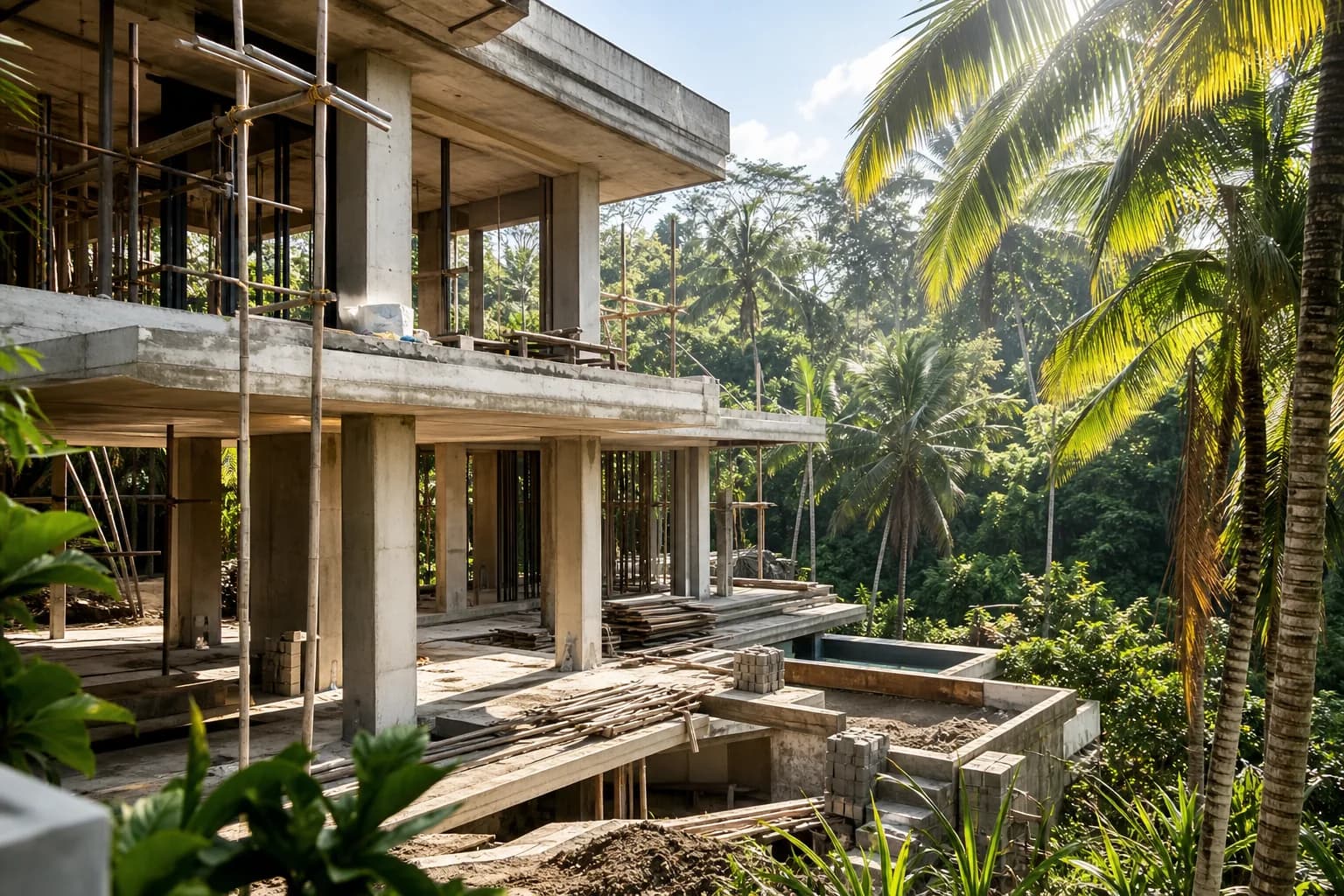
Annual Holding Costs of a Bali Villa: A Realistic Owner's Budget
The purchase price is only the entry ticket. Here is what a Bali villa actually costs to hold each year — staff, utilities, pool, maintenance, insurance, taxes and management — with realistic 2026 numbers and a sample budget.
7 min read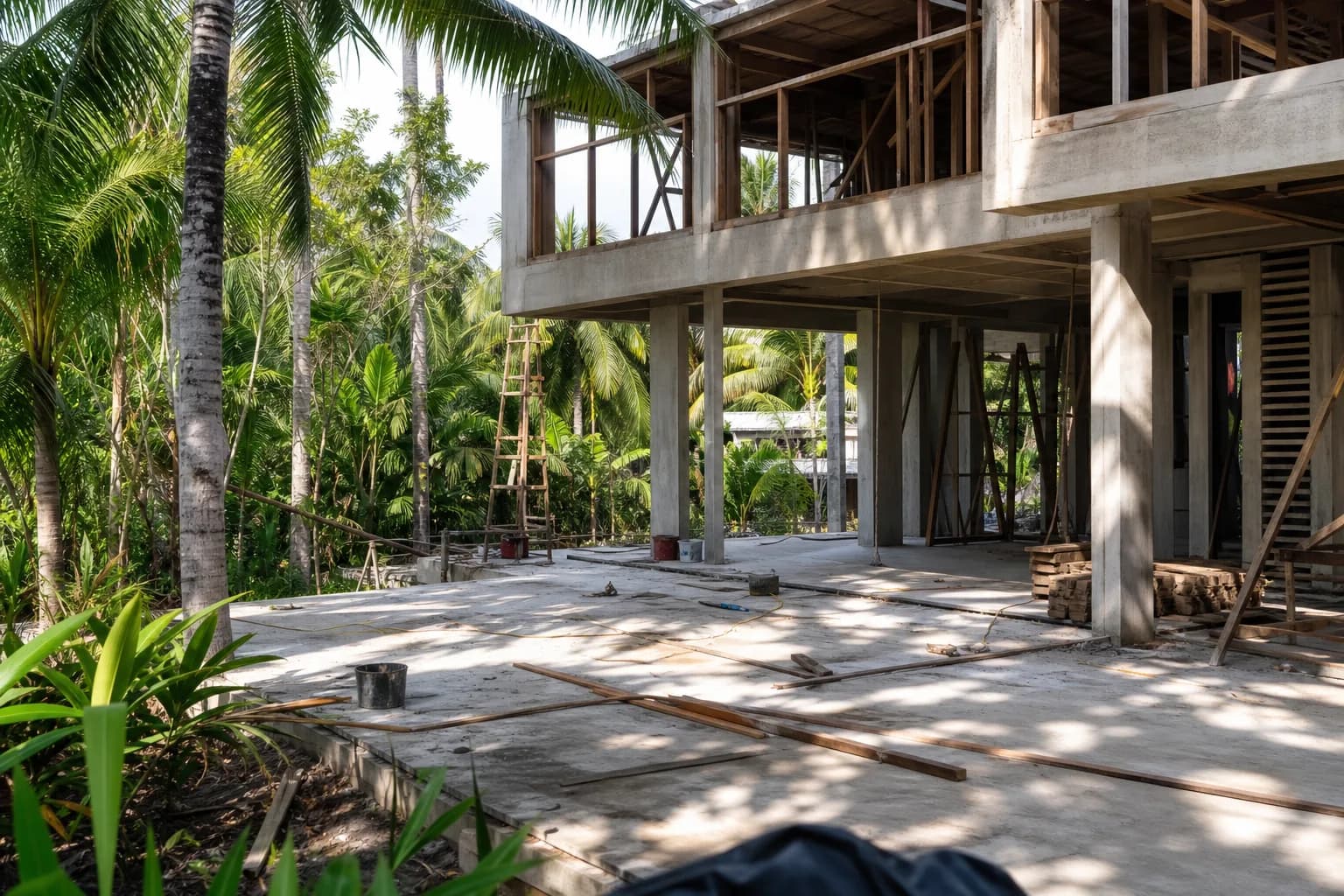
Transferring Money to Indonesia for a Property Purchase: Banking, Documentation and Safe Practice
Moving six figures across borders is the least glamorous part of buying in Bali, and the part most buyers under-prepare for. This guide covers the rupiah rule, notary escrow, transfer documentation, and the paper trail that protects a future exit.
8 min read