Jimbaran Bay Seawall Budget: Bali Tidal Surge Protection
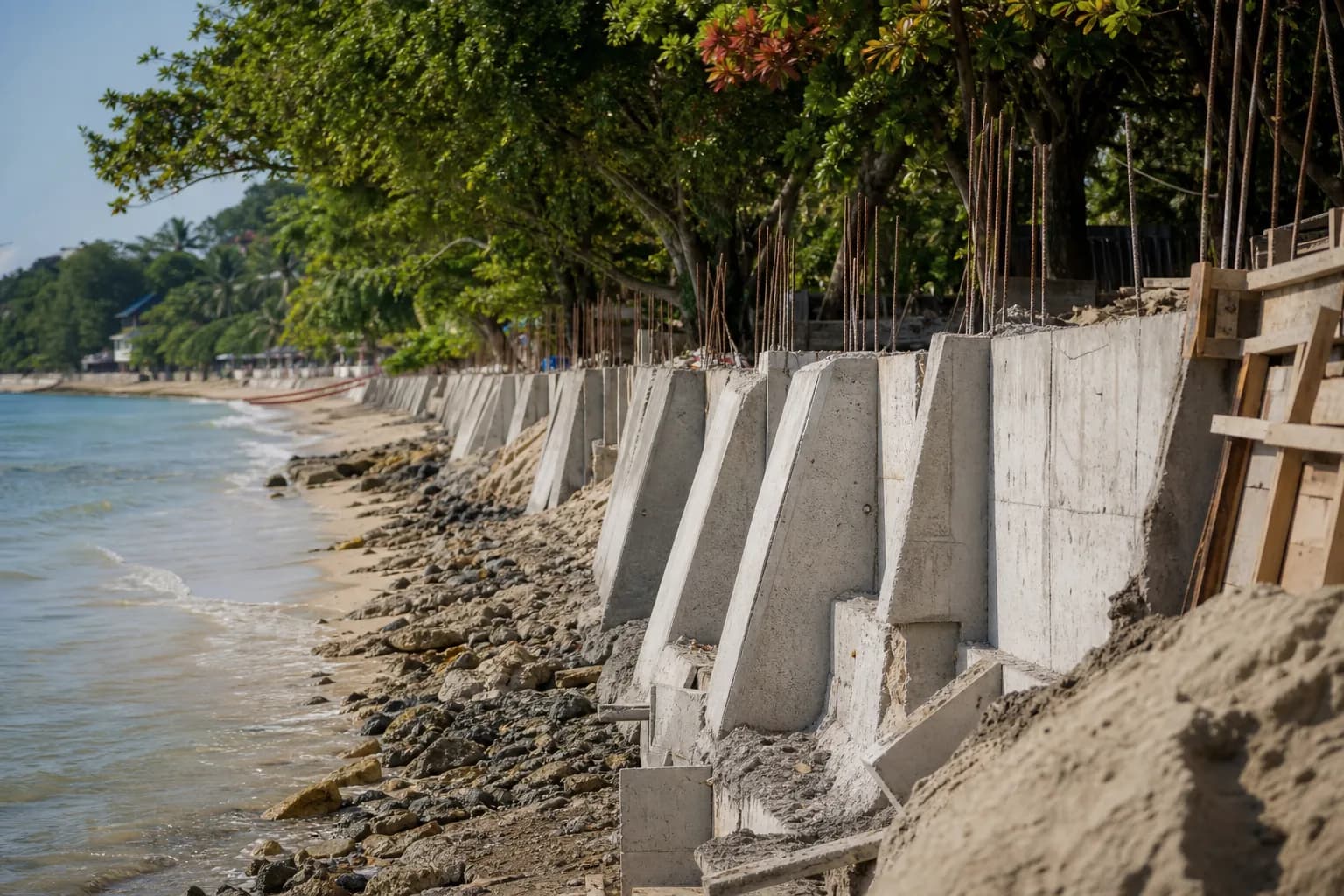
Jimbaran Bay Tidal Surge Protection: Seawall Budget Analysis
Jimbaran Bay’s coastal properties face an engineering challenge that most villa developers discover too late: the Indonesian government’s Rp260 billion breakwater investment along Kuta Beach signals a broader coastal vulnerability crisis affecting premium beachfront construction zones. When planning villa construction cost Bali projects within 200 meters of Jimbaran’s shoreline, the question isn’t whether tidal surge protection is necessary—it’s how to budget for seawall infrastructure that meets both structural engineering standards and Indonesia’s increasingly stringent coastal zone regulations without derailing your entire construction timeline.
The Engineering Reality of Jimbaran Bay Coastal Construction
Jimbaran Bay’s geological profile presents a specific challenge for villa developers: the bay’s gradual slope and fine sand composition create accelerated erosion patterns during monsoon season, with documented tidal surge events reaching 1.8-2.3 meters above mean high water during extreme weather cycles. The Bali government’s 2026 breakwater completion target for Jimbaran Bay addresses macro-level coastal protection, but individual property owners remain legally responsible for site-specific surge mitigation under Indonesia’s Coastal Zone Management Law (UU No. 27/2007).
From a tropical construction engineering perspective, seawall design for Jimbaran Bay properties must account for three critical factors: wave energy dissipation coefficients specific to the bay’s bathymetry, soil bearing capacity in saturated sand conditions (typically 80-120 kN/m² in this zone), and the corrosive marine environment that degrades standard reinforcement steel within 8-12 years without proper specification.
The structural engineering requirements differ significantly from inland Bali villa construction projects. Seawalls in this coastal zone require:
- Foundation depth: Minimum 2.5-3.5 meters below mean low water to prevent undermining from scour
- Concrete specification: Marine-grade mix with minimum 400 kg/m³ cement content and silica fume additives for chloride resistance
- Reinforcement: Epoxy-coated or stainless steel rebar (316L grade) with 75mm minimum cover
- Drainage systems: Weep holes and geotextile backing to prevent hydrostatic pressure buildup
- Wave return walls: Curved or stepped profiles to redirect wave energy rather than absorb direct impact
The government’s breakwater project provides regional wave attenuation, but properties within the 100-meter coastal setback zone still require independent surge protection. Under current building permits Bali regulations, any structure within this zone must submit coastal engineering assessments (AMDAL-UKL/UPL) that model 50-year storm surge scenarios—a requirement that adds 8-12 weeks to permit processing and typically costs USD $4,500-$7,200 for the technical studies alone.
Material selection becomes critical in this marine environment. Standard Portland cement concrete experiences 30-40% strength degradation within five years due to chloride penetration and sulfate attack. Marine-grade specifications using supplementary cementitious materials (fly ash, slag cement, or silica fume) increase material costs by 35-45% but extend structural life from 15 years to 40+ years—a calculation that fundamentally changes lifecycle budget analysis.
The geotechnical reality of Jimbaran’s coastal soils requires specialized foundation approaches. Soil borings consistently show 3-5 meters of loose to medium-dense sand overlying coral limestone bedrock. Seawall foundations must either reach bedrock (requiring expensive drilling and anchoring) or utilize driven concrete piles with minimum 300mm diameter, spaced at 1.5-2.0 meter centers. The pile-supported approach typically adds USD $180-$240 per linear meter to foundation costs but provides the only reliable solution for preventing differential settlement that causes seawall cracking and failure.
Hidden Risks Developers Miss in Coastal Protection Budgeting
The most expensive mistake in Jimbaran Bay coastal construction is treating seawall installation as a standalone line item rather than an integrated component of site development. Three critical budget traps consistently derail projects:
Permit sequencing failures: Coastal construction permits require approval from both local building authorities (DPMPTSP) and the Ministry of Marine Affairs and Fisheries. Developers who begin seawall construction before securing marine permits face stop-work orders and mandatory deconstruction—a scenario we documented in 2024 where a Jimbaran property owner lost USD $67,000 in completed seawall work due to permit sequencing errors.
Inadequate site access planning: Seawall construction requires heavy equipment access to the beach zone during specific tidal windows. Properties without dedicated construction easements often discover that neighboring landowners can legally block equipment access, forcing expensive helicopter concrete placement or manual construction methods that triple labor costs. The access negotiation and legal documentation process adds 4-8 weeks and USD $3,200-$5,800 in legal fees that rarely appear in initial budgets.
Maintenance reserve underestimation: Marine structures require annual inspection and maintenance cycles that cost 3-5% of initial construction value annually. A USD $85,000 seawall generates USD $2,550-$4,250 in annual maintenance obligations—costs that affect long-term property operating budgets but are rarely factored into initial villa construction cost Bali feasibility analysis. Properties under leasehold Bali arrangements face additional complexity, as lease agreements must explicitly define seawall maintenance responsibility between leaseholder and landowner.
Step-by-Step Seawall Budget Development Process
Accurate seawall budgeting for Jimbaran Bay properties requires a structured engineering approach that integrates with overall villa development planning:
Phase 1: Coastal Engineering Assessment (Weeks 1-3)
Commission a qualified coastal engineer (registered with Ikatan Ahli Kelautan Indonesia) to conduct site-specific analysis including bathymetric survey, wave climate modeling, and soil investigation. This assessment determines design wave height, surge elevation, and foundation requirements. Budget allocation: USD $6,500-$9,200 for properties under 1,000m² beach frontage. The assessment produces technical specifications that become mandatory attachments for permit applications.
Phase 2: Regulatory Compliance Mapping (Weeks 2-4)
Engage legal counsel specializing in coastal zone law to verify setback compliance, identify required permits (typically 4-6 separate approvals), and confirm that proposed seawall design meets both national standards (SNI 8460:2017 for coastal structures) and local Badung Regency requirements. This phase prevents the permit rejection cycle that adds 3-6 months to project timelines. Budget allocation: USD $3,800-$5,500 for legal review and permit strategy development.
Phase 3: Integrated Design Development (Weeks 4-8)
Work with your construction partner—firms like Teville’s engineering team specialize in this integration—to develop seawall designs that coordinate with villa foundation systems, drainage infrastructure, and landscape architecture. The seawall becomes part of the overall site engineering package rather than an isolated element. This integration typically reduces total project costs by 12-18% compared to sequential construction approaches.
Phase 4: Contractor Pre-Qualification (Weeks 6-9)
Marine construction requires specialized capabilities that most general contractors lack. Pre-qualify contractors based on: previous coastal structure portfolio, marine equipment inventory (concrete pumps with 50+ meter reach, pile driving rigs), and insurance coverage for marine construction risks. Request itemized quotes that separate foundation work, structural concrete, drainage systems, and finishing—this transparency reveals budget padding and allows accurate cost comparison.
Phase 5: Phased Construction Scheduling (Weeks 10-24)
Seawall construction must align with dry season windows (April-October) and coordinate with villa foundation work to share mobilization costs. Develop a construction schedule that sequences seawall foundation installation, villa foundation work, and seawall superstructure completion to minimize equipment double-handling. This scheduling optimization typically saves USD $8,500-$12,000 on a standard villa project by sharing crane rental, concrete pump mobilization, and site supervision costs.
Realistic Seawall Budget Ranges for Jimbaran Bay Properties
Based on 2024-2025 construction data from completed Jimbaran Bay projects, seawall costs break down into specific categories:
Basic gravity seawall (2.5m height, 30m length): USD $42,000-$58,000 including marine-grade concrete, pile foundations, and basic drainage. This specification meets minimum regulatory requirements for moderate exposure sites.
Engineered wave return seawall (3.0m height, 30m length): USD $67,000-$89,000 including curved wave deflection profile, enhanced drainage systems, and architectural finishing. Recommended for properties within 50 meters of mean high water.
Integrated coastal protection system (seawall + groyne + beach nourishment): USD $125,000-$175,000 for comprehensive protection of 40-50 meter beach frontage. Required for properties experiencing active erosion or located in high-energy wave zones.
Timeline expectations: 14-18 weeks from permit submission to seawall completion, assuming no permit complications. Add 6-8 weeks if marine ministry approvals require environmental impact assessments.
These figures represent 18-25% of total villa construction cost Bali for beachfront properties—a proportion that shocks developers accustomed to inland construction economics but reflects the engineering reality of building in coastal zones.
Frequently Asked Questions: Jimbaran Bay Seawall Budgeting
Does the government’s 2026 breakwater project eliminate the need for private seawalls?
No. The Jimbaran Bay breakwater provides regional wave attenuation but doesn’t eliminate site-specific surge protection requirements. Indonesian coastal regulations (Permen KP No. 17/2013) mandate that property owners within 100 meters of the high-water mark implement independent coastal protection measures. The breakwater reduces design wave heights by approximately 30-40%, which lowers seawall construction costs but doesn’t eliminate the legal requirement. Properties must still demonstrate surge protection capability in permit applications.
Can seawall costs be financed separately from villa construction loans?
Indonesian banks typically treat seawalls as essential infrastructure rather than optional improvements, requiring seawall completion before releasing final construction loan tranches. International lenders often exclude marine structures from standard construction financing due to specialized risk profiles. The practical approach: incorporate seawall costs into total project budgets from initial feasibility analysis. For leasehold Bali properties, negotiate whether seawall investment increases lease valuation or remains leaseholder property at lease termination—this affects financing structure significantly.
What happens if I build a villa without proper seawall protection in Jimbaran Bay?
Beyond structural risk, you face legal liability. Properties that experience erosion-related damage to neighboring parcels can be held financially responsible under Indonesian civil code. More immediately, building permits for coastal zone construction require approved coastal protection plans—attempting to bypass this requirement results in permit denial or revocation. Insurance companies exclude surge damage from standard property policies if required protection measures weren’t implemented, leaving owners personally liable for reconstruction costs that often exceed original construction budgets.
How do seawall maintenance costs compare to other villa infrastructure?
Marine structures require more intensive maintenance than inland construction. Annual seawall maintenance (inspection, crack repair, drainage cleaning, protective coating renewal) costs 3-5% of initial construction value—approximately USD $2,100-$4,500 annually for a USD $70,000 seawall. By comparison, villa building maintenance typically runs 1.5-2% of construction value. Factor this differential into long-term operating budgets, especially for rental villa operations where maintenance reserves must cover both building and coastal protection infrastructure.
Can I use the government’s Kuta Beach breakwater cost (Rp260 billion) to estimate my seawall budget?
No. Government coastal infrastructure projects include regional planning, environmental studies, public consultation processes, and large-scale marine construction that don’t translate to private property budgets. The Kuta breakwater cost (approximately USD $16.5 million at current exchange rates) covers 1.2 kilometers of protection—roughly USD $13,750 per linear meter. Private seawalls cost USD $1,400-$3,000 per linear meter due to smaller scale but higher finishing standards. Use project-specific engineering assessments rather than government infrastructure costs for accurate budgeting. Review completed coastal villa projects for realistic private development cost benchmarks.
Engineering-Driven Approach to Coastal Construction Budgeting
Jimbaran Bay seawall budgeting requires integration of marine engineering, regulatory compliance, and construction sequencing from initial project conception. The USD $42,000-$175,000 cost range for seawall protection represents 18-25% of total beachfront villa construction budgets—a proportion that demands early-stage planning rather than late-stage accommodation. Properties that treat coastal protection as engineering infrastructure rather than optional amenity achieve better regulatory outcomes, lower lifecycle costs, and enhanced structural durabili

Want to calculate?
 3173 m²6 month(s)from 125.000 USD
TALA FOUR
 3124 m²6 month(s)from 123.000 USD
TALA 8
 4344 m²16 month(s)from 290.000 USD
Radha
 1from 198.000 USD
Private: Haridas Villas
 3127 m²9 month(s)from 177.000 USD
Mukunda
 164 m²7 month(s)from 79.000 USD
Private: Haridas Villas, Tegallalang
 2144 m²11 month(s)from 104.000 USD
Narayana
 3104 m²11 month(s)from 99.000 USD
TALA 100
164 m²7 month(s)from 79.000 USDTALA TWO
 172 m²8 month(s)from 120.000 USD
Keshava
 3180 m²7 month(s)from 142.000 USD
Vasudeva
Start With Real Numbers, Not Guesses
Before buying land or finalizing a design, check the realistic build cost range for your project in Bali.
Our team reviews your inputs and gives a grounded estimate.
Available lands
 680 m²15 min$ 110751Bali, Pererenan
 3700 m²15 min$ 738177Bali, Tabanan
 1700 m²10 min$ 392549Bali, Nusadua
 3900 m²10 min$ 432266Bali, Tabanan
 1660 m²10 min$ 343448Bali, Kerobokan
 5000 m²8 min$ 424877Bali, Ungasan
 608 m²15 min$ 310377Bali, Seminyak
 2130 m²10 min$ 495776Bali, Pecatu
 700 m²15 min$ 90517Bali, Central Bali
 750 m²15 min$ 187038Bali, Kerobokan
 204 m²5 min$ 40899Bali, Kedungu
 500 m²15 min$ 124692Bali, Kaba Kaba
 500 m²10 min$ 107143Bali, Tabanan
 800 m²10 min$ 307882Bali, Tibubeneng
 1533 m²5 min$ 165666Bali, Cepaka
Essential Bali build & buy guides
- Bali villa construction cost per m² in 2026
- How much will your villa cost? Calculator
- Building a villa in Bali: the complete guide
- Buying land in Bali: step-by-step for foreigners
- Bali villa investment: yields, risks, returns
- Leasehold vs freehold: what foreigners can own
- Construction defect liability & 10-year warranty
- Bali building codes and construction standards
Related guides
True Closing Costs of a Bali Purchase: Notary, Taxes and Fees on Top of the Price
What you really pay on top of a Bali property price in 2026: notary fees, transfer and lease taxes, VAT on developer units — with realistic totals for each deal type and a worked example.
7 min read
Bali Property Taxes for Foreigners: BPHTB, PPh and PBB-P2 — Who Pays What and When
A clear 2026 breakdown of the three taxes every foreign buyer meets in Bali — BPHTB, PPh and PBB-P2 — with who pays what, on which value, and at which point in the deal.
9 min read
Swimming Pool Construction Cost in Bali (2026): Real Prices by Size and Type
What a swimming pool really costs to build in Bali in 2026 — by size, structure and finish — plus running costs, common quote traps and where pools go wrong in the tropics.
3 min read