Tabanan Rice Field Building Permits Agricultural Land Restricti
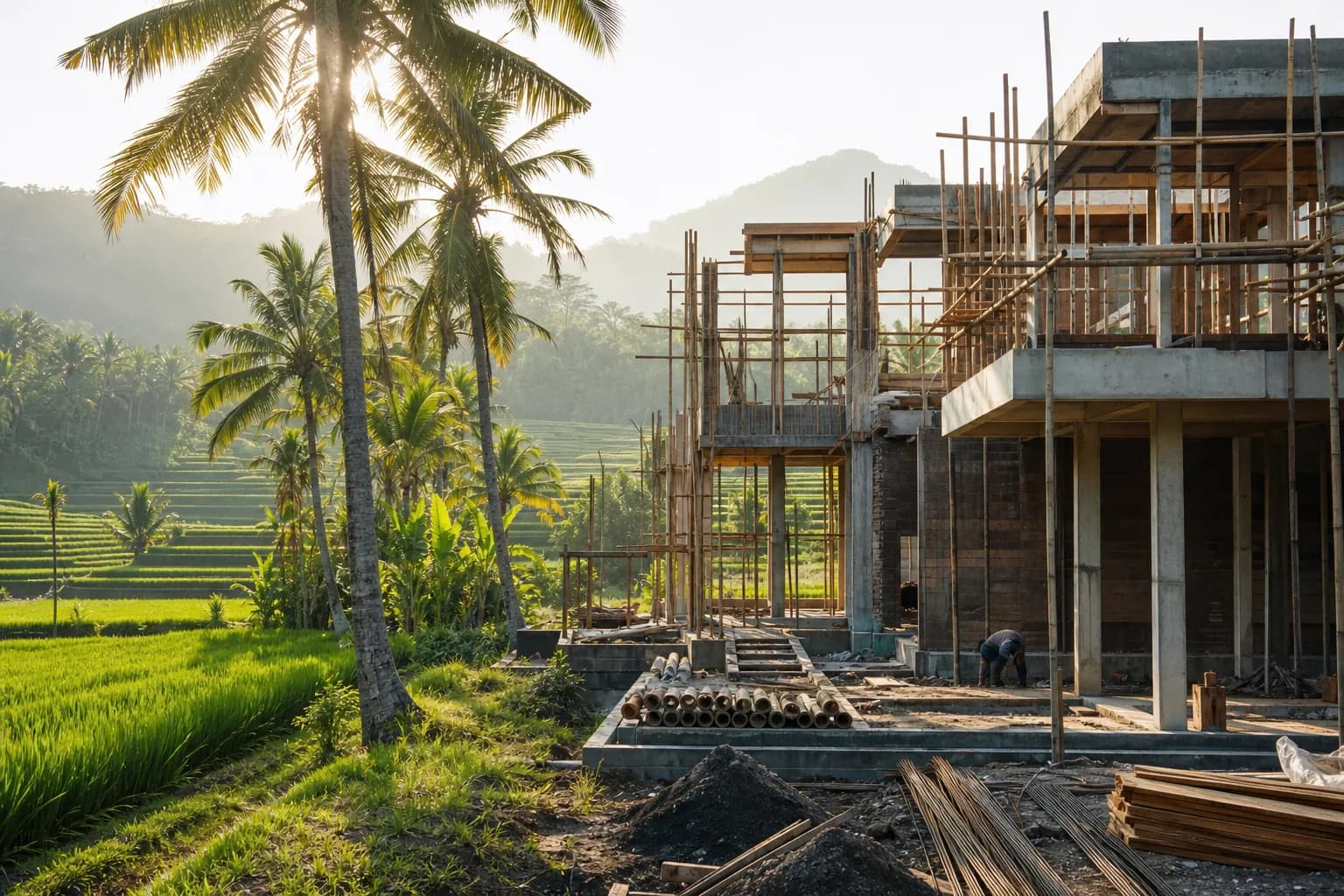
Why Tabanan Rice Field Land Can No Longer Be Converted for Villa Construction
Tabanan regency, historically Bali’s most productive agricultural zone, has become the epicenter of strict rice field conversion restrictions that fundamentally change construction feasibility analysis. As of February 2026, the provincial moratorium on agricultural land conversion means that productive rice fields in Tabanan—regardless of ownership structure—cannot receive new building permits for residential or commercial development. This isn’t a temporary policy shift; it represents a permanent regulatory framework protecting Bali’s food security infrastructure. For construction planning, this creates a binary outcome: land parcels classified as productive agricultural zones are now unbuildable, while properly zoned residential or mixed-use parcels remain viable with standard permitting processes.
Technical Classification Systems Determining Tabanan Land Buildability
Understanding Tabanan’s rice field conversion restrictions requires analyzing three overlapping regulatory frameworks that determine whether a specific parcel can receive construction permits. The provincial spatial planning document (RTRW Provinsi Bali) designates broad agricultural protection zones across Tabanan’s subdistricts—Kediri, Tabanan, Marga, and Penebel contain the highest concentration of protected sawah (irrigated rice field) areas. Within these zones, the regency-level spatial plan (RTRW Kabupaten Tabanan) further classifies land into LP2B (Lahan Pertanian Pangan Berkelanjutan—Sustainable Food Agricultural Land) and non-LP2B categories.
LP2B designation creates absolute construction prohibition. These parcels, identified through soil productivity analysis and irrigation infrastructure mapping, cannot be converted under any circumstances. The designation protects approximately 18,600 hectares of Tabanan’s most productive rice terraces, particularly in the Jatiluwih UNESCO World Heritage buffer zones and the subak-irrigated valleys of southern Tabanan. Land certificates (either Hak Milik for Indonesian citizens or leasehold agreements for foreign-structured ownership) make no difference—LP2B classification overrides ownership rights for development purposes.
Non-LP2B agricultural land in Tabanan faces equally restrictive conditions under the 2026 moratorium. While theoretically these parcels could previously undergo conversion through provincial approval processes, the current moratorium has suspended all new conversion permits indefinitely. The distinction matters for long-term planning: LP2B land will never become buildable, while non-LP2B agricultural parcels might become eligible if future policy changes occur—though no timeline exists for moratorium lifting.
The third classification layer involves IMB (Izin Mendirikan Bangunan—building permit) zoning at the village level. Tabanan villages maintain their own spatial plans that must align with regency and provincial frameworks. A parcel might avoid LP2B designation but still fall within village-level agricultural protection zones that prohibit residential construction. This creates situations where land appears buildable on provincial maps but cannot receive village-level construction approval—a critical verification step that requires physical inspection of village spatial planning documents at the kelurahan office.
Practical verification requires obtaining three documents: the provincial RTRW map showing agricultural protection zones, the regency LP2B registry (available at Dinas Pertanian Kabupaten Tabanan), and the village spatial plan from the local kelurahan. GPS coordinates of the specific parcel must be cross-referenced against all three documents. Teville’s land verification process includes this multi-layer spatial analysis before any construction feasibility assessment, as documented in our verified lands inventory where only pre-cleared parcels appear.
Hidden Compliance Traps in Tabanan Agricultural Land Transactions
The most dangerous assumption in Tabanan land acquisition involves relying on seller representations about “conversion potential” or “pending permit applications.” Under the moratorium, no pending applications will be processed for agricultural land conversion—existing applications filed before the moratorium date remain in indefinite suspension. Sellers marketing rice field parcels as “investment opportunities” or “future development sites” are either uninformed about current regulations or deliberately misrepresenting buildability status.
A second critical risk involves partially converted land. Some Tabanan parcels show existing structures on rice field land—small farming shelters, irrigation equipment storage, or older residential buildings predating strict enforcement. These structures do not establish precedent for new construction permits. The moratorium applies to new permit applications regardless of existing structures, and attempting to expand or rebuild existing structures on agricultural land will trigger enforcement action. The presence of a building does not indicate the land has been legally converted to residential zoning.
Leasehold agreements on Tabanan rice fields create particularly complex liability scenarios. Foreign investors often enter 25-30 year lease agreements on agricultural parcels with verbal assurances about future conversion possibilities. Under current regulations, these leases provide land use rights for agricultural purposes only—any construction beyond agricultural support structures violates both the lease terms and provincial land use regulations. The leaseholder bears legal responsibility for unpermitted construction, potentially facing structure demolition orders and lease termination without compensation. This risk extends to nominee arrangements where Indonesian citizens hold title on behalf of foreign investors; the beneficial owner cannot compel the title holder to pursue illegal conversion.
Compliant Construction Pathways in Tabanan Regency
Viable villa construction in Tabanan requires identifying parcels with pre-existing residential zoning or mixed-use classification outside LP2B boundaries. The verification process begins with obtaining the land certificate (SHM—Sertifikat Hak Milik or leasehold agreement) and requesting a Surat Keterangan Rencana Kota (SKRK—City Planning Certificate) from the Tabanan regency spatial planning office (Dinas PUPR). The SKRK document definitively states whether the parcel falls within residential, commercial, agricultural protection, or mixed-use zones.
For parcels showing residential or mixed-use zoning on the SKRK, the next verification step involves confirming the land is not listed in the LP2B registry. This requires a written request to Dinas Pertanian with the land certificate number and GPS coordinates. The department issues a formal letter (typically within 14 business days) confirming LP2B status or exemption. Only parcels with both residential SKRK classification and LP2B exemption can proceed to IMB application.
The IMB application process in Tabanan follows standard Bali protocols but requires additional agricultural impact assessment if the parcel is within 100 meters of active rice fields. This assessment, conducted by a certified environmental consultant, evaluates potential impacts on irrigation water flow, subak system integrity, and adjacent agricultural productivity. The assessment typically costs 15-25 million IDR and adds 3-4 weeks to the permit timeline. Designs must incorporate drainage systems that prevent construction runoff from contaminating irrigation channels—a technical requirement that affects site grading and foundation design.
For foreign ownership structures, Tabanan construction on compliant parcels typically uses PT PMA (foreign investment company) holding leasehold rights, or Indonesian spouse/partner ownership under Hak Milik. The ownership structure must be finalized before IMB application, as the permit is issued to the legal entity or individual holding land rights. Teville’s construction process, detailed at our methodology page, includes ownership structure verification as a prerequisite to design development, preventing situations where completed designs cannot receive permits due to ownership complications.
Timeline expectations for compliant Tabanan construction: SKRK verification (2-3 weeks), LP2B confirmation (2 weeks), environmental assessment if required (3-4 weeks), IMB application processing (8-12 weeks for residential villas under 400m²), construction phase (6-9 months for 2-3 bedroom villa). Total timeline from land verification to completion: 12-16 months assuming no regulatory delays.
Construction Cost Implications of Tabanan Zoning Compliance
Compliant residential parcels in Tabanan command significant price premiums over agricultural land due to scarcity created by the moratorium. Verified residential-zoned land in desirable Tabanan locations (Canggu border areas, Tanah Lot vicinity, elevated parcels with rice field views) ranges from 8-15 million IDR per are (100m²), compared to 3-6 million IDR per are for agricultural land that cannot be developed. This price differential reflects actual buildability—paying premium prices for verified residential land eliminates the risk of purchasing unbuildable agricultural parcels.
Environmental assessment requirements for parcels near active rice fields add 15-25 million IDR to pre-construction costs, plus potential design modifications to meet drainage and setback requirements. These modifications might include elevated foundation systems to prevent groundwater contamination (adding 150-250 million IDR to foundation costs for a 200m² villa), or enhanced stormwater management systems with filtration before discharge (8-15 million IDR).
Construction costs in Tabanan align with broader Bali ranges when using compliant parcels: 18-25 million IDR per m² for quality construction with tropical engineering standards, as detailed in Teville’s completed villa projects. A 250m² three-bedroom villa on verified residential land in Tabanan requires total investment of 6.5-8.5 billion IDR including land acquisition (assuming 500m² plot), design and permitting, construction, and landscape development.
Frequently Asked Questions: Tabanan Rice Field Construction Restrictions
Can I buy Tabanan rice field land now and wait for the moratorium to end before building?
This strategy carries substantial risk with no guaranteed timeline. The moratorium has no specified end date and represents long-term provincial policy protecting food security. LP2B-designated land will never become buildable regardless of moratorium status. Non-LP2B agricultural land might theoretically become eligible for conversion if future policy changes occur, but this could take 5-10+ years with no certainty. Meanwhile, you’ll pay annual property taxes on unbuildable land with no productive use unless you maintain agricultural operations. Financially, purchasing verified residential-zoned land provides immediate construction capability rather than speculative waiting on policy changes that may never materialize.
What happens if I build on Tabanan rice field land without permits?
Unpermitted construction on agricultural land in Tabanan triggers enforcement action from multiple agencies. The regency spatial planning office (Dinas PUPR) issues stop-work orders and can mandate structure demolition at owner expense. The agricultural department (Dinas Pertanian) can impose fines up to 500 million IDR for illegal land conversion under provincial agricultural protection regulations. For foreign ownership structures, immigration authorities may become involved if the violation suggests misuse of investment permits or visa conditions. Insurance companies will not cover unpermitted structures, and future sale becomes impossible as buyers cannot obtain legal title transfer for properties with outstanding violations. The financial loss extends beyond construction costs to include demolition expenses, fines, and complete land value write-off.
Are there exceptions for small agricultural support buildings on Tabanan rice fields?
Provincial regulations allow limited agricultural support structures on rice field land without full IMB permits: equipment storage sheds under 50m², temporary farming shelters, and irrigation infrastructure. These structures must serve active agricultural operations and cannot include residential amenities (permanent kitchens, bathrooms, sleeping quarters). The structures must use temporary construction methods (wooden posts, non-permanent foundations) and cannot exceed 4 meters in height. Attempting to build residential villas disguised as “farm buildings” will trigger enforcement—inspectors evaluate actual use, utility connections, and structural permanence. For legitimate agricultural operations, these support structures require notification to the village office but not full IMB processing.
How can I verify if specific Tabanan land is actually buildable before purchasing?
Comprehensive verification requires three official documents obtained directly from government offices, not from sellers or brokers. First, request a Surat Keterangan Rencana Kota (SKRK) from Dinas PUPR Kabupaten Tabanan using the land certificate number—this confirms zoning classification. Second, obtain LP2B status confirmation from Dinas Pertanian Tabanan with a written request including GPS coordinates. Third, visit the local kelurahan office to review the village spatial plan and confirm no village-level restrictions apply. These documents should be obtained before signing any purchase agreements or making deposits. Teville’s land consultation service, accessible through our verified lands page, includes this multi-agency verification process, providing written confirmation of buildability before any client commitment.
What are the long-term risks of buying Tabanan land with “pending” conversion permits?
All pending conversion permit applications for agricultural land filed before the moratorium remain in indefinite suspension—they are neither approved nor formally rejected, creating legal limbo. Sellers cannot provide timeline estimates for approval because processing has stopped entirely. If you purchase land with pending permits, you acquire the application status but gain no priority for future processing if the moratorium lifts. The pending permit does not protect the land from LP2B designation, which could o
 3127 m²9 month(s)from 177.000 USD
Mukunda
 4344 m²16 month(s)from 290.000 USD
Radha
 3173 m²6 month(s)from 125.000 USD
TALA FOUR
 3180 m²7 month(s)from 142.000 USD
Vasudeva
 3124 m²6 month(s)from 123.000 USD
TALA 8

Want to calculate?
 164 m²7 month(s)from 79.000 USD
TALA TWO
 1from 198.000 USD
Private: Haridas Villas
 172 m²8 month(s)from 120.000 USD
Keshava
 3104 m²11 month(s)from 99.000 USD
TALA 100
164 m²7 month(s)from 79.000 USDPrivate: Haridas Villas, Tegallalang
 2144 m²11 month(s)from 104.000 USD
Narayana
Start With Real Numbers, Not Guesses
Before buying land or finalizing a design, check the realistic build cost range for your project in Bali.
Our team reviews your inputs and gives a grounded estimate.
Available lands
 2700 m²30 min$ 314224Bali, Sidemen
 1000 m²8 min$ 134544Bali, Bukit
 550 m²5 min$ 217629Bali, Tabanan
 10000 m²19 min$ 232759Bali, Buleleng
 770 m²5 min$ 163578Bali, Kedungu
 750 m²15 min$ 187038Bali, Kerobokan
 3700 m²15 min$ 738177Bali, Tabanan
 1000 m²10 min$ 184729Bali, Kutuh South Bali
 3000 m²15 min$ 1246921Bali, Tabanan
 1600 m²32 min$ 266010Bali, Tabanan
 1000 m²10 min$ 230911Bali, Kerobokan
 550 m²15 min$ 164594Bali, Mengwi
 7250 m²56 min$ 235714Bali, Tabanan
 300 m²55 min$ 32475Bali, Tegelalang
 700 m²15 min$ 109052Bali, Buduk
Essential Bali build & buy guides
- Bali villa construction cost per m² in 2026
- How much will your villa cost? Calculator
- Building a villa in Bali: the complete guide
- Buying land in Bali: step-by-step for foreigners
- Bali villa investment: yields, risks, returns
- Leasehold vs freehold: what foreigners can own
- Construction defect liability & 10-year warranty
- Bali building codes and construction standards
Related guides
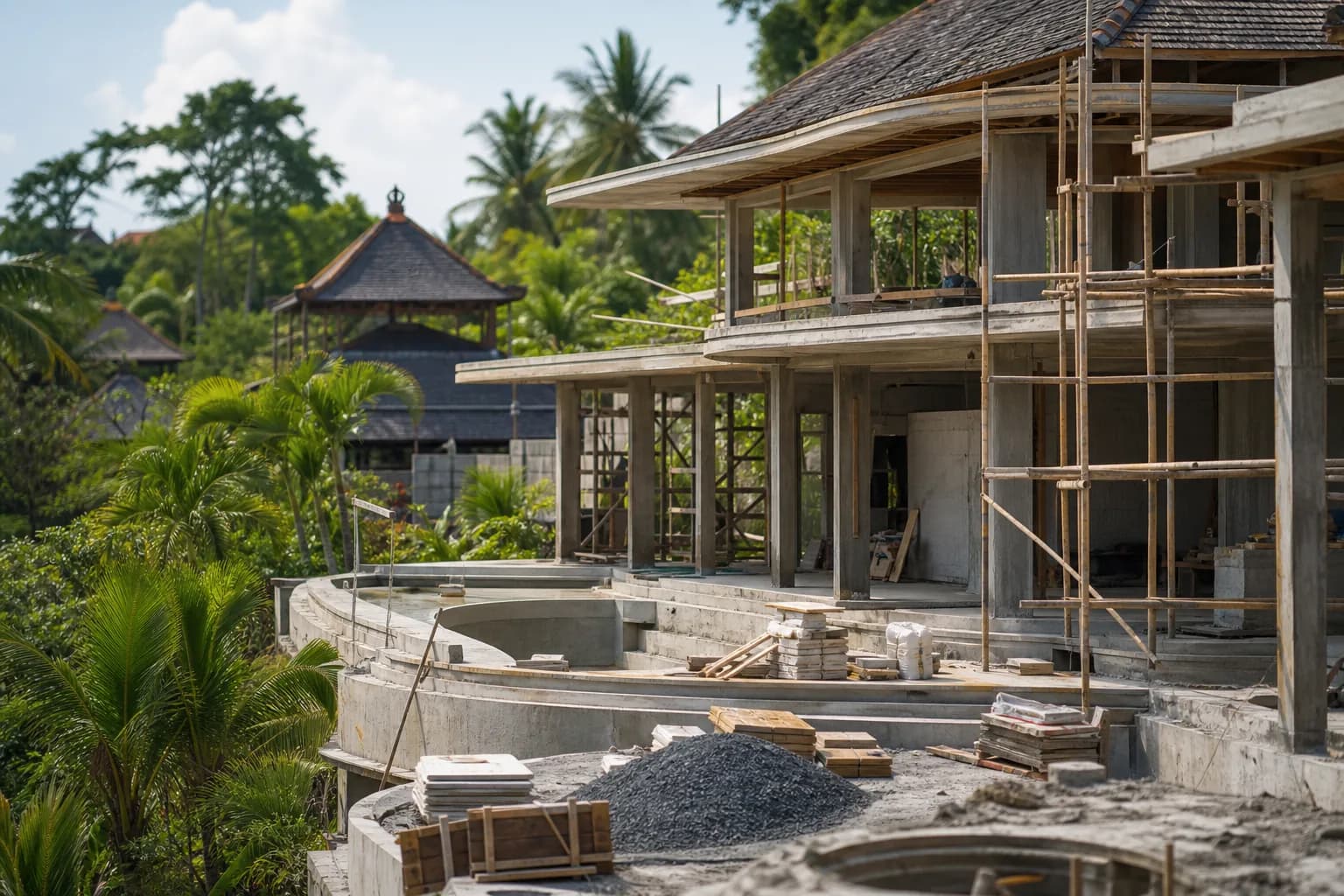
Choosing a General Contractor in Bali: Red Flags, Questions and Contract Must-Haves
A practical filter for hiring a general contractor in Bali: the red flags that end conversations, the questions professionals answer with documents, and the contract clauses no villa build should start without.
7 min read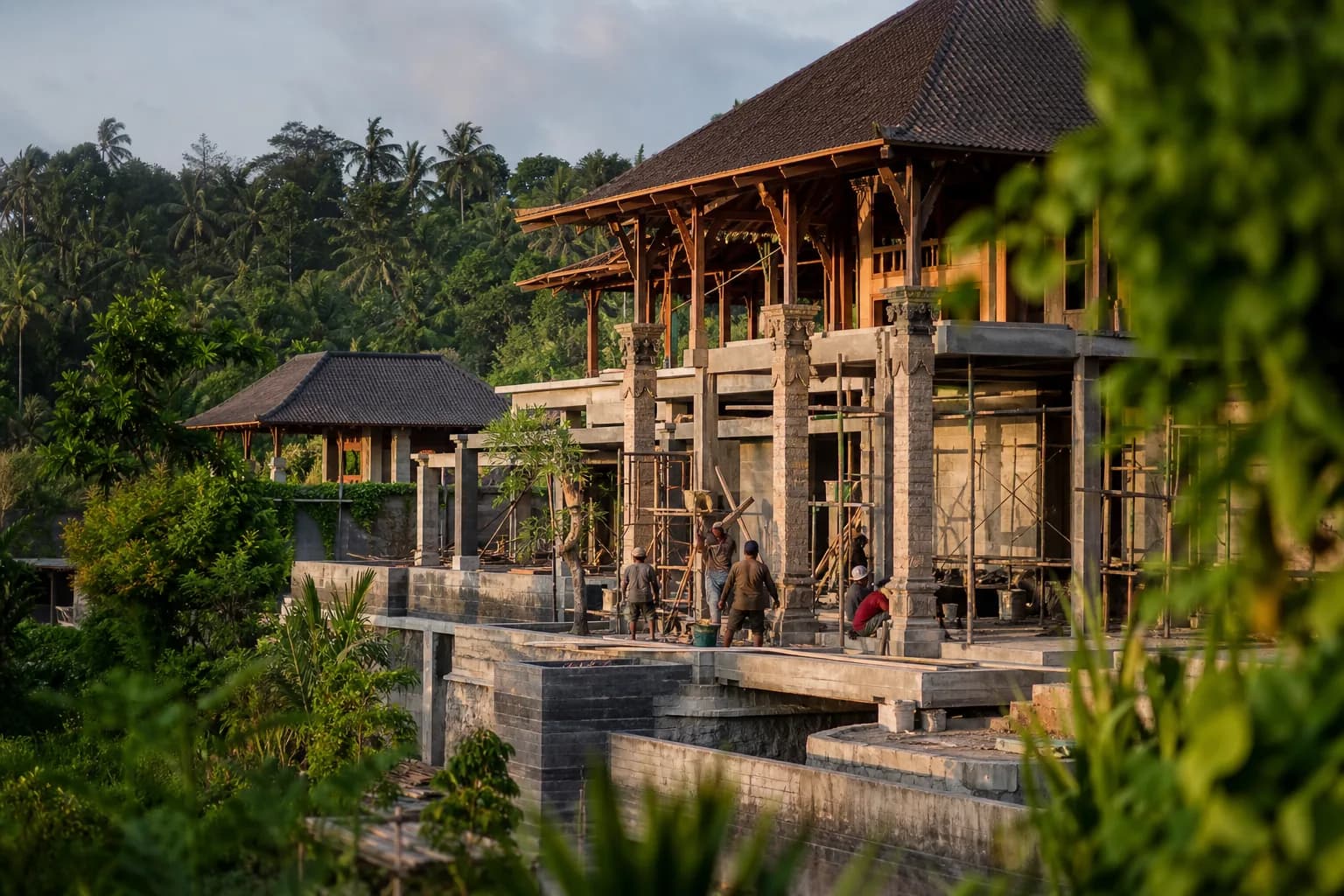
Construction Cost Overruns in Bali: Why Budgets Blow Up — and the Contract Terms That Prevent It
Most Bali construction budgets do not blow up in one disaster — they leak through vague scope, unpriced change orders and open-ended contracts. The real causes of cost overruns, and the specific contract terms, payment structure and contingency planning that prevent them.
8 min read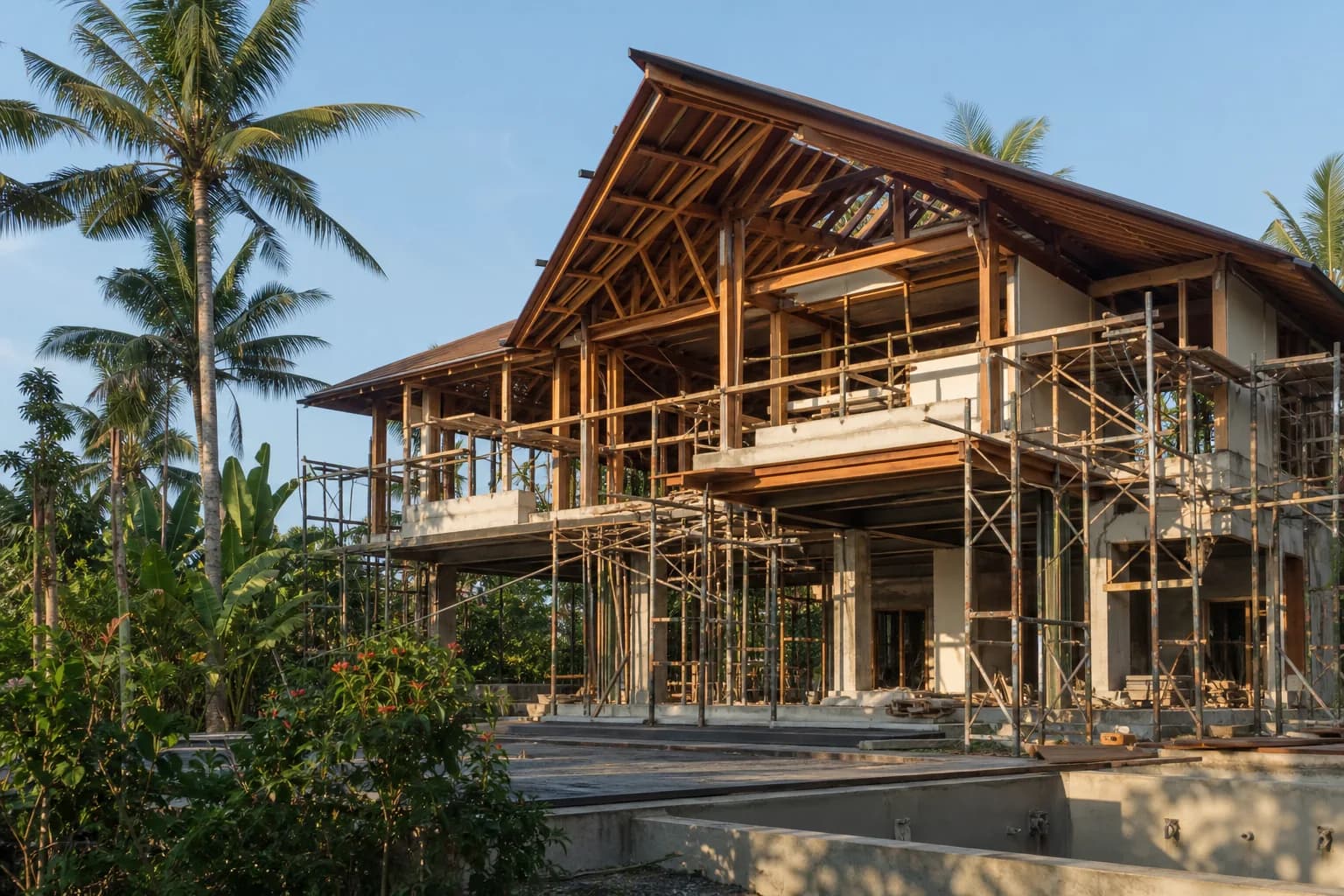
Build vs Buy a Villa in Bali in 2026: The Full Comparison
Building a Bali villa typically costs 20–30% less than buying comparable turnkey stock, but takes 8–16 months and demands more decisions. A full, honest comparison of cost, time, control, risk and resale — plus who should choose which route.
7 min read