Reverse Osmosis vs UV: Bali Groundwater Treatment ROI
Reverse Osmosis vs UV Sterilization: Bali Groundwater Treatment ROI
When completing villa construction or renovation projects in Bali, property owners face a critical MEP systems decision: which water treatment technology delivers the best return on investment for Bali’s challenging groundwater conditions? With TDS levels in Bali boreholes ranging from 800-3,500 ppm and microbial contamination present in 60% of private wells, choosing between reverse osmosis and UV sterilization isn’t just about water quality—it’s about protecting your property investment, ensuring guest satisfaction, and minimizing long-term operational costs. As Bali villa construction specialists, we’ve installed over 150 whole-house water filtration systems across Canggu, Seminyak, and Ubud, and the ROI difference between these technologies can exceed 200% over a five-year period depending on your specific groundwater profile.
Technical Deep Dive: Understanding RO and UV Technologies for Bali Groundwater
Reverse osmosis systems force water through semi-permeable membranes with pore sizes of 0.0001 microns, physically removing dissolved salts, heavy metals, pesticides, and microorganisms. For Bali villa construction projects, RO systems typically consist of pre-filtration stages (sediment and carbon filters), high-pressure pumps (150-300 PSI), RO membranes, post-filtration, and remineralization units. The technology excels at reducing TDS from 2,000+ ppm down to 50-150 ppm, making it essential for coastal properties where saltwater intrusion affects groundwater quality.
UV sterilization uses ultraviolet-C light at 254 nanometers wavelength to disrupt the DNA of bacteria, viruses, and protozoa, rendering them unable to reproduce. Commercial-grade UV systems for finishing works Bali projects require 30-40 mJ/cm² dosage for effective disinfection. The technology doesn’t remove particles, chemicals, or dissolved solids—it purely addresses biological contamination. UV chambers must maintain water flow rates between 15-45 liters per minute for residential applications, with lamp replacement every 9,000-12,000 hours of operation.
Bali’s tropical climate creates unique challenges for both technologies. High humidity accelerates corrosion in RO system components, requiring 316-grade stainless steel housings rather than standard plastic. Groundwater temperatures averaging 28-32°C reduce RO membrane efficiency by 15-20% compared to temperate climates, necessitating larger membrane surface areas. UV systems face power stability issues—voltage fluctuations common in Bali can damage ballasts and reduce lamp lifespan by 30%.
The groundwater chemistry across Bali varies dramatically. Coastal areas (Seminyak, Canggu, Sanur) show chloride levels of 400-1,200 mg/L and sodium levels of 300-800 mg/L due to seawater intrusion. Central regions (Ubud, Gianyar) present high iron content (0.8-3.5 mg/L) and manganese (0.3-1.2 mg/L), causing staining and taste issues. Northern areas face agricultural runoff with nitrate levels reaching 25-45 mg/L. These variations directly impact which technology delivers superior ROI.
For MEP systems Bali installations, RO systems require dedicated electrical circuits (220V, 10-15 amps), drainage for reject water (typically 30-50% of input water), and adequate space (0.8-1.5 m² for residential systems). UV systems need minimal space (0.2-0.4 m²), standard electrical connections (220V, 2-4 amps), and no drainage, but demand consistent water pressure (2.5-4.0 bar) and pre-filtration to prevent UV lamp fouling from sediment.
Installation Process: Whole-House Water Treatment System Integration
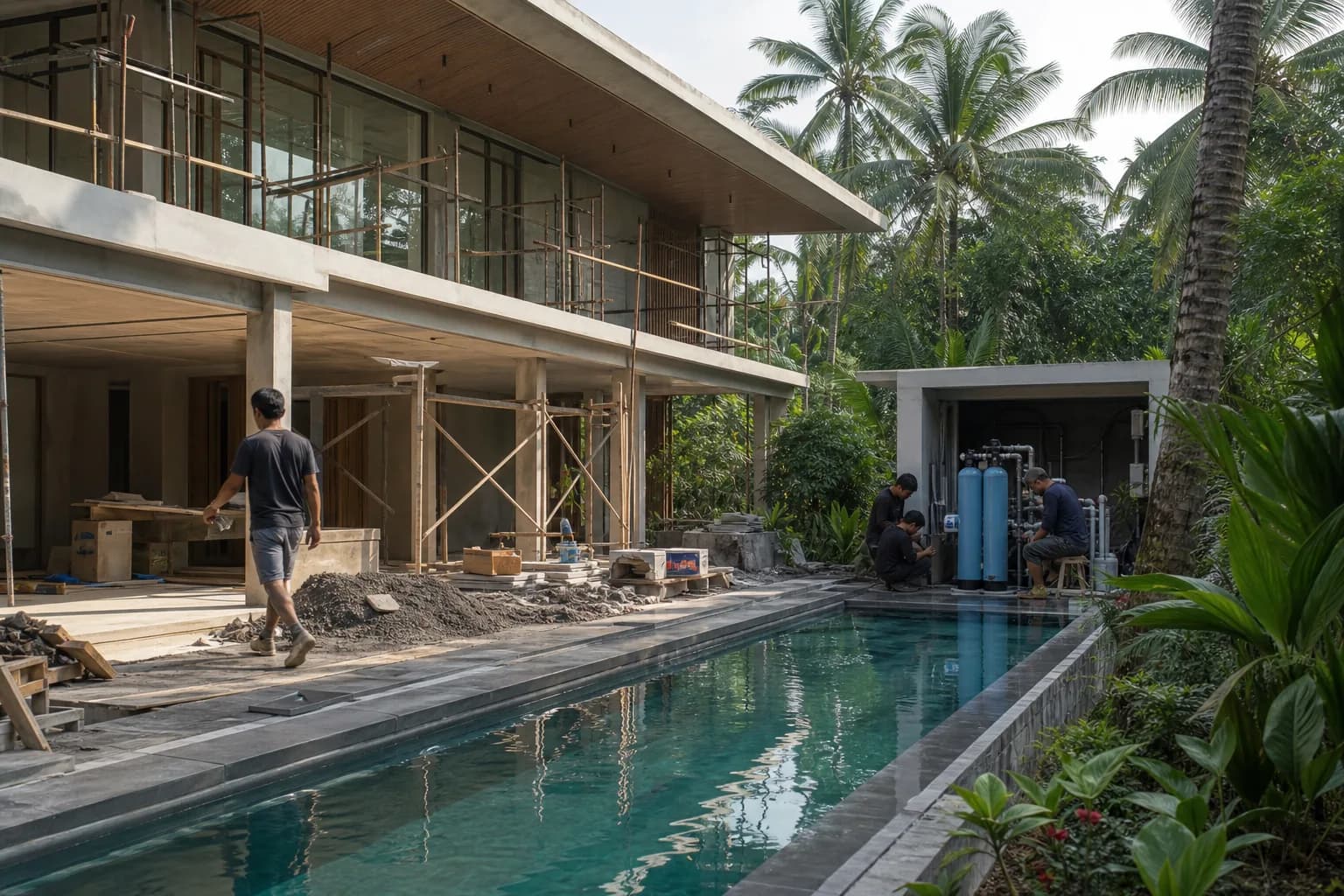
The installation sequence for whole-house water filtration during villa renovation Bali projects begins with comprehensive water testing. We collect samples from the borehole or well at three different times over 48 hours, testing for TDS, pH, hardness, iron, manganese, chlorides, nitrates, total coliform, and E. coli. This data determines whether RO, UV, or combination systems deliver optimal ROI. Testing costs Rp 2,500,000-4,500,000 but prevents expensive system mismatches.
For RO system installation, we first install pre-filtration stages immediately after the pressure tank. A 20-micron sediment filter removes sand and silt, followed by a 5-micron carbon block filter for chlorine and organic compounds. These pre-filters protect the expensive RO membranes from premature fouling. The high-pressure pump mounts on vibration-dampening pads with flexible connections to minimize noise transmission through villa structures—critical for guest comfort in rental properties.
RO membrane housings require horizontal mounting with adequate clearance (minimum 60cm) for membrane replacement. We install pressure gauges before and after membranes to monitor performance degradation. The reject water line connects to drainage with a flow restrictor maintaining proper membrane pressure. Post-filtration includes remineralization cartridges adding calcium and magnesium back to prevent the “flat” taste of pure RO water—essential for villa guest satisfaction.
UV sterilization installation begins with pre-filtration to achieve water clarity below 5 NTU (nephelometric turbidity units). Sediment filters (5-micron) and carbon filters remove particles that could shield microorganisms from UV exposure. The UV chamber mounts vertically or horizontally depending on space constraints, with the lamp orientation ensuring complete water exposure. We install flow restrictors maintaining optimal contact time—too fast and disinfection fails, too slow and pressure drops excessively.
Electrical integration for both systems requires dedicated circuits with surge protection. Bali’s frequent lightning strikes during monsoon season (November-March) can destroy UV ballasts and RO control boards. We install Type 2 surge protectors (minimum 40kA rating) at the distribution panel and Type 3 protectors at equipment locations. All wiring uses marine-grade cable with UV-resistant insulation suitable for tropical humidity.
For combination systems delivering maximum ROI in challenging groundwater conditions, the sequence is: sediment pre-filter → carbon pre-filter → RO system → remineralization → UV sterilization → distribution. This configuration removes chemical contaminants via RO, then ensures zero microbial contamination via UV as a final barrier. The UV system operates on already-filtered water, extending lamp life and ensuring consistent disinfection performance.
System commissioning includes pressure testing all connections at 1.5x operating pressure, verifying flow rates match design specifications, and conducting post-installation water testing. We document baseline TDS readings, UV intensity measurements, and system pressures for future maintenance reference. All installations include clearly labeled service valves, pressure relief valves, and emergency shutoff locations—essential for property managers unfamiliar with the systems.
Materials & Specifications: Component Selection for Tropical Durability
RO membrane selection critically impacts long-term ROI. Filmtec (DOW) TW30 series membranes handle Bali’s high-temperature groundwater better than standard membranes, maintaining 95-98% rejection rates at 30°C. For high-salinity coastal locations, we specify brackish water membranes (BW30 series) with 99.5% salt rejection. Membrane lifespan in Bali averages 24-36 months versus 36-48 months in temperate climates due to higher fouling rates from organic matter and iron bacteria.
Housing materials must resist Bali’s corrosive environment. Fiberglass-reinforced housings with 316 stainless steel end caps outperform standard plastic housings, which crack from UV exposure and thermal cycling. All metal components require marine-grade stainless steel (316 or 316L)—standard 304 stainless corrodes within 18-24 months in coastal humidity. O-rings and seals must be EPDM or Viton rather than standard nitrile, which degrades rapidly in tropical heat.
UV lamp specifications for Bali villa construction require amalgam lamps rather than standard low-pressure lamps. Amalgam technology maintains consistent UV output across Bali’s temperature variations (24-35°C ambient), whereas standard lamps lose 30-40% effectiveness above 30°C. Lamp wattage should provide 40 mJ/cm² minimum dosage at maximum flow rate—we typically specify 55-watt lamps for 20-30 LPM residential systems.
Quartz sleeves protecting UV lamps must be high-purity fused quartz with >90% UV transmittance. Lower-grade quartz reduces disinfection effectiveness by 25-35%. Sleeve cleaning frequency in Bali averages every 3-4 months due to iron and manganese deposits—systems should include removable sleeves with tool-free access for maintenance.
Control systems and monitoring equipment separate professional installations from basic setups. TDS meters with continuous monitoring alert property managers to membrane failure before water quality degrades. UV intensity sensors verify lamp effectiveness, triggering replacement alerts before disinfection fails. For rental villas, these monitoring systems prevent guest complaints and protect property reputation—worth the additional Rp 8,000,000-12,000,000 investment.
Cost Breakdown: Investment Analysis for Bali Water Treatment Systems
Whole-house RO system costs for typical 3-4 bedroom villas range from Rp 45,000,000-85,000,000 installed. This includes: pre-filtration (Rp 6,000,000), high-pressure pump (Rp 8,500,000), RO membranes and housings (Rp 18,000,000), post-filtration and remineralization (Rp 5,500,000), installation labor (Rp 7,000,000-12,000,000). Premium systems with automated monitoring add Rp 15,000,000-25,000,000.
UV sterilization systems cost Rp 18,000,000-35,000,000 installed for whole-house applications. Components include: pre-filtration (Rp 4,500,000), UV chamber and lamp (Rp 9,000,000-15,000,000), flow control and monitoring (Rp 2,500,000), installation labor (Rp 2,000,000-4,500,000). Commercial-grade systems with intensity monitoring cost Rp 28,000,000-42,000,000.
Annual operating costs differ significantly. RO systems consume 800-1,200 kWh annually (Rp 1,400,000-2,100,000 at Bali electricity rates), require membrane replacement every 2-3 years (Rp 12,000,000-18,000,000), and pre-filter changes quarterly (Rp 2,400,000 annually). Total annual RO operating cost: Rp 7,800,000-12,500,000.
UV systems consume 350-550 kWh annually (Rp 600,000-950,000), require lamp replacement every 12-18 months (Rp 3,500,000-5,500,000), and pre-filter changes quarterly (Rp 1,800,000 annually). Total annual UV operating cost: Rp 5,900,000-8,250,000. However, UV alone doesn’t address chemical contamination requiring bottled water supplementation.
ROI calculations for rental villas show RO systems pay back in 3.5-5 years through eliminated bottled water costs (Rp 15,000,000-25,000,000 annually for 4-bedroom villa), increased booking rates (guests prefer properties with quality tap water), and reduced plumbing maintenance from scale buildup. UV systems pay back in 2-3 years but may still require bottled drinking water if TDS exceeds 500 ppm.
Common Mistakes: Avoiding Costly Water Treatment Failures
The most expensive mistake in finishing works Bali is undersizing systems for actual water demand. Many contractors install residential-grade systems rated for 15 LPM in villas with 6-8 bathrooms requiring 35-45 LPM peak flow. This causes pressure drops, incomplete treatment, and premature component failure. Always calculate peak demand including simultaneous shower, toilet, and kitchen use plus 30% buffer for Bali’s low-pressure municipal water or borehole fluctuations.
Installing RO systems without proper pre-filtration destroys membranes within 6-12 months instead of 24-36 months. Bali groundwater contains iron bacteria, manganese, and sediment requiring multi-stage pre-filtration. We’ve replaced membranes costing Rp 15,000,000 in villas where contractors skipped the Rp 4,500,000 pre-filtration system—false economy that triples long-term costs.
UV system failures typically result from inadequate pre-filtration allowing turbidity above 5 NTU. Suspended particles shield bacteria from UV exposure, allowing microbial contamination despite operational UV lamps. Post-installation water testing revealing coliform bacteria usually traces to turbidity issues, not UV system failure. Installing turbidity meters (Rp 3,500,000) prevents this problem in areas with high sediment groundwater.
Electrical installation shortcuts cause 40% of system failures we repair. Using standard cable instead of marine-grade wiring, omitting surge protection, or sharing circuits with high-draw appliances leads to control board failures, pump burnout, and UV ballast damage. Proper electrical installation adds Rp 3,000,000-5,000,000 but prevents Rp 12,000,000-18,000,000 repair costs and system downtime affecting rental income.
Neglecting drainage planning for RO reject water creates flooding and foundation issues. RO systems discharge 30-50% of input water as concentrate containing removed contaminants. This must drain to appropriate locations—not into septic systems (causes overload) or near foundations (causes erosion). Proper drainage design during villa renovation Bali prevents expensive remediation.
The biggest ROI mistake is choosing technology based solely on initial cost rather than water quality analysis. Installing UV-only systems in high-TDS coastal areas leaves guests with salty, unpalatable water requiring bottled water supplementation—negating the UV system investment. Conversely, installing expensive RO systems where groundwater has low TDS but only microbial issues wastes capital that UV sterilization would address at 40% lower cost.
Frequently Asked Questions: Bali Water Treatment System Selection
Should I install RO, UV, or both for my Bali villa construction project?
The decision depends on your specific groundwater analysis results. If TDS exceeds 800 ppm or you have coastal location with saltwater intrusion, RO is essential for palatability and appliance protection—UV alone won’t address dissolved salts. If TDS is below 500 ppm but microbial contamination exists, UV provides cost-effective disinfection. For comprehensive protection in rental villas where water quality directly impacts reviews and bookings, combination systems deliver best ROI despite higher initial investment. We recommend water testing before finalizing MEP systems Bali specifications to optimize your investment.
How m 3127 m²9 month(s)from 177.000 USD
Mukunda

Want to calculate?
 3104 m²11 month(s)from 99.000 USD
TALA 100
 3124 m²6 month(s)from 123.000 USD
TALA 8
 3173 m²6 month(s)from 125.000 USD
TALA FOUR
 164 m²7 month(s)from 79.000 USD
Private: Haridas Villas, Tegallalang
 3180 m²7 month(s)from 142.000 USD
Vasudeva
 172 m²8 month(s)from 120.000 USD
Keshava
 1from 198.000 USD
Private: Haridas Villas
 4344 m²16 month(s)from 290.000 USD
Radha
164 m²7 month(s)from 79.000 USDTALA TWO
 2144 m²11 month(s)from 104.000 USD
Narayana
Start With Real Numbers, Not Guesses
Before buying land or finalizing a design, check the realistic build cost range for your project in Bali.
Our team reviews your inputs and gives a grounded estimate.
Available lands
 700 m²7 min$ 400000Bali, Canggu
 2230 m²15 min$ 410573Bali, Padonan
 750 m²15 min$ 187038Bali, Kerobokan
 500 m²2 min$ 175862Bali, Cemagi
 1950 m²7 min$ 150092Bali, Tabanan
 500 m²15 min$ 124692Bali, Kaba Kaba
 1200 m²2 min$ 155172Bali, Klungkung
 2800 m²2 min$ 713793Bali, Kedungu
 1350 m²5 min$ 283467Bali, Pecatu
 700 m²8 min$ 165517Bali, Umalas
 770 m²5 min$ 163578Bali, Kedungu
 18900 m²2 min$ 6912931Bali, Pecatu
 1410 m²15 min$ 390702Bali, Tabanan
 250 m²15 min$ 40025Bali, Munggu
 1000 m²10 min$ 184729Bali, Kutuh South Bali
Essential Bali build & buy guides
- Bali villa construction cost per m² in 2026
- How much will your villa cost? Calculator
- Building a villa in Bali: the complete guide
- Buying land in Bali: step-by-step for foreigners
- Bali villa investment: yields, risks, returns
- Leasehold vs freehold: what foreigners can own
- Construction defect liability & 10-year warranty
- Bali building codes and construction standards
Related guides
Villa Handover in Bali: Snagging Checklist and What to Test Before Final Payment
A disciplined villa handover in Bali: room-by-room snagging tests, numbered defect documentation, the PBG/SLF and warranty documents to insist on, and payment terms that keep leverage until the list is closed.
7 min read
Energy-Efficient Villa in Bali: Solar, Insulation and Passive Cooling That Pay Back
Which energy-efficiency measures actually pay back in Bali's tropical climate — passive design and roof insulation first, efficient equipment second, and self-consumption solar last — with honest 2026 numbers.
7 min read
Choosing a General Contractor in Bali: Red Flags, Questions and Contract Must-Haves
A practical filter for hiring a general contractor in Bali: the red flags that end conversations, the questions professionals answer with documents, and the contract clauses no villa build should start without.
7 min read