PVC vs CPVC Hot Water Piping in Bali: Temperature Tolerance
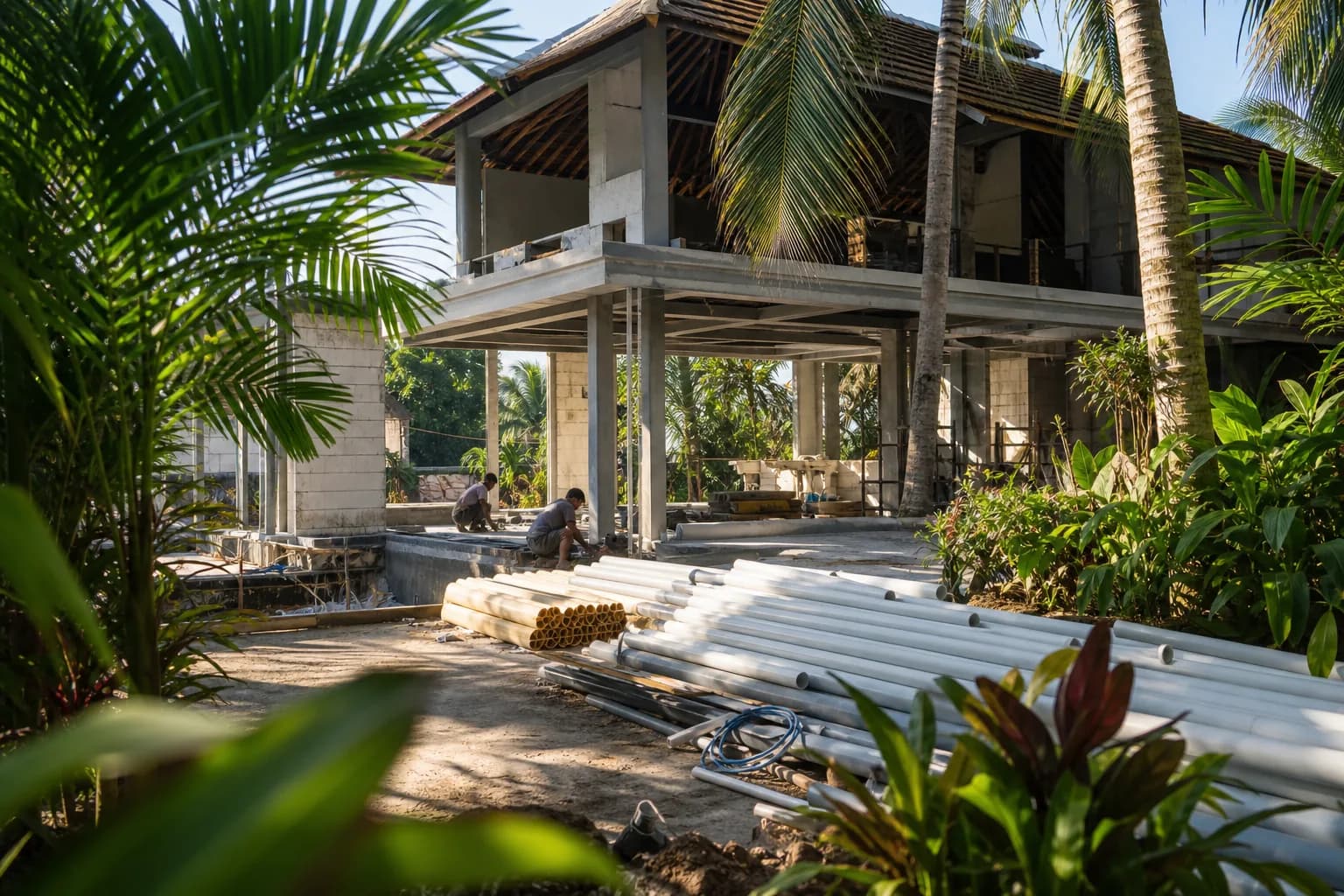
The Hot Water Piping Dilemma: Why Your Bali Villa’s Plumbing System Needs the Right Material Choice
When installing a plumbing system in Bali’s tropical climate, villa owners and contractors face a critical decision that directly impacts long-term performance: choosing between PVC and CPVC for hot water piping. The stakes are high—incorrect material selection leads to softened pipes, joint failures, and costly emergency repairs during peak occupancy seasons. With Bali’s ambient temperatures regularly exceeding 32°C and hot water systems operating at 60-80°C, the temperature tolerance difference between these materials becomes a make-or-break factor for villa construction and renovation projects.
Technical Deep Dive: Understanding PVC vs CPVC in Tropical Hot Water Applications
The fundamental difference between PVC (Polyvinyl Chloride) and CPVC (Chlorinated Polyvinyl Chloride) lies in their molecular structure and resulting thermal performance. CPVC undergoes an additional chlorination process that increases its chlorine content from 56.7% to 63-69%, fundamentally altering its temperature resistance capabilities—a critical factor for MEP systems Bali installations.
Temperature Tolerance Specifications
Standard PVC pipe maintains structural integrity up to 60°C (140°F) under continuous pressure conditions. Beyond this threshold, the material begins to soften, losing its pressure-bearing capacity and dimensional stability. In contrast, CPVC withstands continuous operating temperatures up to 93°C (200°F), with short-term tolerance extending to 100°C. For Bali villa construction projects, this 33°C difference represents the margin between system reliability and premature failure.
Bali’s tropical environment compounds these thermal challenges. Incoming municipal water temperatures often reach 28-32°C before any heating occurs. When solar water heaters or electric systems raise temperatures to the standard 65-75°C range for domestic use, PVC pipes operate dangerously close to their maximum threshold. Factor in direct sun exposure on roof-mounted pipes or inadequately insulated runs, and surface temperatures can spike an additional 10-15°C above the water temperature.
Material Performance Under Tropical Conditions
CPVC’s superior performance stems from its glass transition temperature of 115°C compared to PVC’s 82°C. This higher transition point means CPVC maintains rigidity and pressure resistance throughout normal hot water system operation. The material’s tensile strength remains stable at 55-60 MPa even at elevated temperatures, while PVC experiences significant strength degradation above 50°C.
Pressure ratings tell the complete story. Schedule 80 CPVC maintains 400 PSI rating at 23°C and still delivers 100 PSI at 93°C. Equivalent PVC drops from 630 PSI at 23°C to unsafe levels at just 60°C. For villa plumbing systems requiring reliable 40-60 PSI operating pressure with safety margins, CPVC provides the necessary performance envelope.
Chemical Resistance and Water Quality Considerations
Bali’s water chemistry varies significantly by region. Coastal areas experience higher chloride content, while volcanic soil regions may have elevated mineral concentrations. CPVC demonstrates superior resistance to chlorine and chloramine disinfectants commonly used in municipal water treatment, maintaining integrity even with chlorine concentrations up to 5 ppm at elevated temperatures. This resistance proves essential for finishing works Bali projects where long-term durability determines renovation intervals.
The chlorination process that creates CPVC also enhances its resistance to scale buildup and biofilm formation at higher temperatures—a significant advantage in tropical climates where bacterial growth accelerates. PVC’s lower temperature tolerance means it cannot be used in systems requiring periodic thermal disinfection, a recommended practice for vacation villas with intermittent occupancy.
Installation Process: CPVC Hot Water System Implementation for Bali Villas
Pre-Installation Planning and System Design
Successful CPVC installation begins with comprehensive system mapping. At Teville, our construction process includes detailed MEP coordination to prevent conflicts with structural elements and other building systems. Map all hot water runs from the heating source to each fixture, identifying pipe sizes based on fixture unit calculations. Standard Bali villa installations typically use 20mm (3/4″) mains with 15mm (1/2″) branch lines to individual fixtures.
Calculate thermal expansion requirements—CPVC expands approximately 6mm per 10 meters for every 50°C temperature increase. Install expansion loops or flexible connectors on long straight runs exceeding 6 meters. Position pipe hangers at maximum 1-meter intervals for horizontal runs and 1.5 meters for vertical runs to prevent sagging under thermal expansion.
Material Preparation and Cutting
Use dedicated CPVC cutting tools—ratchet cutters or fine-tooth saws (32 teeth per inch minimum). Never use PVC cutters, as they create excessive burrs that compromise joint integrity. Deburr all cut ends thoroughly using a reaming tool or fine sandpaper, removing both internal and external burrs. Any remaining debris creates stress concentration points that fail under thermal cycling.
Inspect pipe ends for out-of-round conditions. Bali’s heat can deform stored pipes; reject any sections with ovality exceeding 5%. Store CPVC materials in shaded areas below 40°C to prevent pre-installation degradation.
Solvent Cement Application Technique
CPVC requires specific solvent cement formulated for high-temperature applications—never substitute PVC cement. The two-step process uses primer followed by cement. Apply primer to both pipe and fitting surfaces, extending coverage 15mm beyond insertion depth. The primer softens the CPVC surface for optimal cement penetration.
Apply cement immediately after primer while surfaces remain tacky. Use dauber size appropriate to pipe diameter—oversized applicators waste material and create drips, while undersized tools provide insufficient coverage. Apply cement in a single direction to avoid air bubbles, covering the entire insertion depth plus 10mm. Apply a second coat to the pipe end only.
Insert pipe into fitting with a quarter-turn motion to distribute cement evenly. Hold firmly for 30 seconds—Bali’s heat accelerates initial set but proper holding time ensures complete joint formation. Wipe excess cement immediately; dried cement creates stress risers. Allow cure time based on ambient temperature: 15 minutes at 30°C before handling, 2 hours before pressure testing, 24 hours before full system operation.
System Integration and Testing
Install isolation valves at strategic locations—minimum at water heater inlet/outlet and each bathroom/kitchen zone. Use brass ball valves rated for 93°C service; standard PVC valves fail in hot water applications. Install pressure relief valves rated at 150% of system operating pressure.
Pressure test the complete system at 1.5x operating pressure for minimum 2 hours. In Bali’s heat, perform testing during cooler morning hours to establish baseline performance. Mark all joints with test date for quality documentation. Insulate all hot water pipes with closed-cell foam insulation minimum 13mm thick to prevent heat loss and protect against accidental contact.
Materials & Specifications: Selecting Components for Bali’s Climate
CPVC Pipe Specifications
Specify Schedule 80 CPVC for all hot water applications in villa renovation Bali projects. Schedule 80 provides superior pressure rating and impact resistance compared to Schedule 40, essential for installations in high-traffic areas or where pipes may experience mechanical stress. Standard sizes for villa applications: 15mm (1/2″) for fixture branches, 20mm (3/4″) for bathroom/kitchen mains, 25mm (1″) for main distribution from water heater.
Verify CPVC pipe meets ASTM D2846 standards with NSF-61 certification for potable water contact. Reject any pipe showing discoloration, surface crazing, or storage damage. Quality CPVC maintains consistent cream/beige color throughout—color variations indicate manufacturing inconsistencies or UV degradation.
Fittings and Connection Components
Use only CPVC-specific fittings manufactured to ASTM F439 standards. Common fittings for villa installations include: 90-degree elbows for direction changes, tees for branch connections, couplings for straight joins, reducing bushings for size transitions, and threaded adapters for fixture connections. Brass threaded adapters provide superior durability compared to plastic alternatives for water heater and fixture connections.
Transition fittings require special attention when connecting CPVC to existing PVC cold water lines or metal components. Use brass or stainless steel transition unions with proper dielectric separation when connecting to dissimilar metals. Never direct-connect CPVC to copper without proper transition fittings—galvanic corrosion accelerates in Bali’s humid climate.
Solvent Cement and Primer Selection
Specify two-step CPVC cement systems rated for tropical applications. Orange-colored CPVC primer provides visual confirmation of coverage. Medium-bodied cement works best for Bali’s climate—heavy-bodied formulations set too quickly in high heat, while light-bodied versions may not provide adequate gap-filling for minor imperfections. Purchase cement in quantities for immediate use; opened containers degrade rapidly in humid conditions.
Support and Insulation Materials
Install UV-resistant pipe hangers with rubber-lined clamps to accommodate thermal expansion without abrading pipe surfaces. Specify closed-cell elastomeric foam insulation with minimum 13mm wall thickness and vapor barrier facing. Bali’s humidity requires complete vapor sealing to prevent condensation within insulation, which reduces thermal performance and promotes mold growth.
Cost Breakdown: Investment Analysis for CPVC Hot Water Systems
Material Costs for Standard Villa Installation
For a typical 3-bedroom Bali villa requiring approximately 40 meters of hot water piping, material costs break down as follows: CPVC pipe (Schedule 80) costs IDR 45,000-65,000 per meter depending on diameter, totaling IDR 2,000,000-2,600,000 for complete pipe requirements. Fittings add approximately 30% to pipe costs, averaging IDR 700,000-900,000 for a standard installation with 25-30 connection points.
Solvent cement and primer cost IDR 350,000-450,000 for sufficient quantity including waste allowance. Pipe hangers, supports, and mounting hardware add IDR 400,000-550,000. Insulation materials contribute IDR 800,000-1,200,000 depending on coverage requirements and quality grade. Total material investment ranges IDR 4,250,000-5,700,000 for complete CPVC hot water system.
Labor and Installation Costs
Professional installation by experienced MEP systems Bali contractors costs IDR 3,500,000-5,000,000 for complete system including pressure testing and commissioning. This represents 2-3 days of skilled labor for a standard villa. Installation complexity increases costs—multiple stories, concealed pipe runs, or integration with existing systems add 20-40% to base labor rates.
Our cost estimation process accounts for site-specific factors affecting installation efficiency. Difficult access, coordination with other trades, or accelerated schedules impact final labor costs.
Comparative Cost Analysis: CPVC vs PVC
PVC materials cost approximately 30-40% less than CPVC initially—tempting for budget-conscious projects. However, PVC failure in hot water applications typically occurs within 2-5 years, requiring complete system replacement. Emergency repairs during villa occupancy cost 3-4x standard installation rates due to access difficulties and expedited material procurement. The 10-15 year service life of properly installed CPVC systems delivers superior lifecycle value despite higher initial investment.
Long-Term Value Considerations
Factor maintenance costs into total ownership analysis. CPVC systems require minimal maintenance beyond periodic valve servicing and insulation inspection. PVC hot water installations demand constant monitoring, frequent joint repairs, and eventual complete replacement. For villa projects targeting premium rental markets, system reliability directly impacts guest satisfaction and operational continuity.
Common Mistakes: Avoiding CPVC Installation Failures in Bali
Improper Material Storage and Handling
Storing CPVC in direct sunlight or on hot surfaces degrades material properties before installation. Bali’s intense UV exposure breaks down pipe surface integrity, creating micro-cracks that propagate under pressure. Store all CPVC materials in covered, ventilated areas below 40°C. Reject any pipe showing surface chalking or color changes—these indicate UV damage that compromises long-term performance.
Incorrect Solvent Cement Application
The most common installation failure stems from inadequate cement coverage or improper cure time. Rushing the primer-cement sequence or skipping primer entirely creates weak joints that fail under thermal cycling. Applying cement to wet surfaces (common in Bali’s humidity) prevents proper solvent action. Ensure surfaces are completely dry before cement application. Insufficient holding time allows joints to shift before initial set, creating gaps that leak under pressure.
Inadequate Thermal Expansion Accommodation
Rigidly fixing long pipe runs without expansion accommodation causes stress failures at joints and supports. CPVC’s thermal expansion coefficient requires deliberate design consideration. Install expansion loops on runs exceeding 6 meters, or use flexible connectors at direction changes. Position fixed supports strategically to control expansion direction—typically at mid-points of long runs with sliding supports at ends.
Mixing PVC and CPVC Components
Using PVC fittings with CPVC pipe or vice versa creates joints with mismatched thermal expansion rates. The differential expansion under temperature cycling causes joint separation and leaks. Similarly, using PVC cement on CPVC creates weak bonds that fail prematurely. Maintain strict material segregation during installation—color-code materials and tools t
 3180 m²7 month(s)from 142.000 USD
Vasudeva
 164 m²7 month(s)from 79.000 USD
TALA TWO
 2144 m²11 month(s)from 104.000 USD
Narayana
 172 m²8 month(s)from 120.000 USD
Keshava
 3127 m²9 month(s)from 177.000 USD
Mukunda
164 m²7 month(s)from 79.000 USDPrivate: Haridas Villas, Tegallalang
 3124 m²6 month(s)from 123.000 USD
TALA 8
 3173 m²6 month(s)from 125.000 USD
TALA FOUR

Want to calculate?
 3104 m²11 month(s)from 99.000 USD
TALA 100
 4344 m²16 month(s)from 290.000 USD
Radha
 1from 198.000 USD
Private: Haridas Villas
Start With Real Numbers, Not Guesses
Before buying land or finalizing a design, check the realistic build cost range for your project in Bali.
Our team reviews your inputs and gives a grounded estimate.
Available lands
 13000 m²1 min$ 920567Bali, Pekutatan
 700 m²15 min$ 162500Bali, Tabanan
 29000 m²6 min$ 3857143Bali, Tabanan
 1000 m²10 min$ 230911Bali, Kerobokan
 1362 m²15 min$ 335468Bali, Tumbak
 2800 m²15 min$ 310345Bali, Tabanan
 2000 m²10 min$ 243842Bali, Mengwi
 1100 m²8 min$ 280419Bali, Ungasan
 680 m²15 min$ 110751Bali, Pererenan
 1300 m²10 min$ 312192Bali, Kutuh South Bali
 800 m²10 min$ 307882Bali, Tibubeneng
 615 m²15 min$ 113608Bali, Tabanan
 2400 m²7 min$ 496552Bali, Canggu
 18900 m²2 min$ 6912931Bali, Pecatu
 700 m²7 min$ 400000Bali, Canggu
Essential Bali build & buy guides
- Bali villa construction cost per m² in 2026
- How much will your villa cost? Calculator
- Building a villa in Bali: the complete guide
- Buying land in Bali: step-by-step for foreigners
- Bali villa investment: yields, risks, returns
- Leasehold vs freehold: what foreigners can own
- Construction defect liability & 10-year warranty
- Bali building codes and construction standards
Related guides
How to Build a Villa in Bali: The Complete Step-by-Step Process (2026)
Every stage of building a villa in Bali as a foreigner — from securing land and permits to handover — with realistic timelines, costs and the mistakes that derail first-time builders.
5 min read
Moisture-Resistant Gypsum Board Finishing with Epoxy Primer Bali
Learn how moisture-resistant gypsum boards with epoxy primer boost durability, finish quality, and mold resistance in Bali projects. Great for Bali homes.
10 min read
Marine-Grade Timber Joinery Finishing Corrosion Protection Bali
Discover marine-grade timber joinery finishing and corrosion protection in Bali. Durable coastal timber care, coatings, and maintenance for lasting protection.
8 min read