Pre-Filter Sediment Sizing for Bali Groundwater TDS Levels
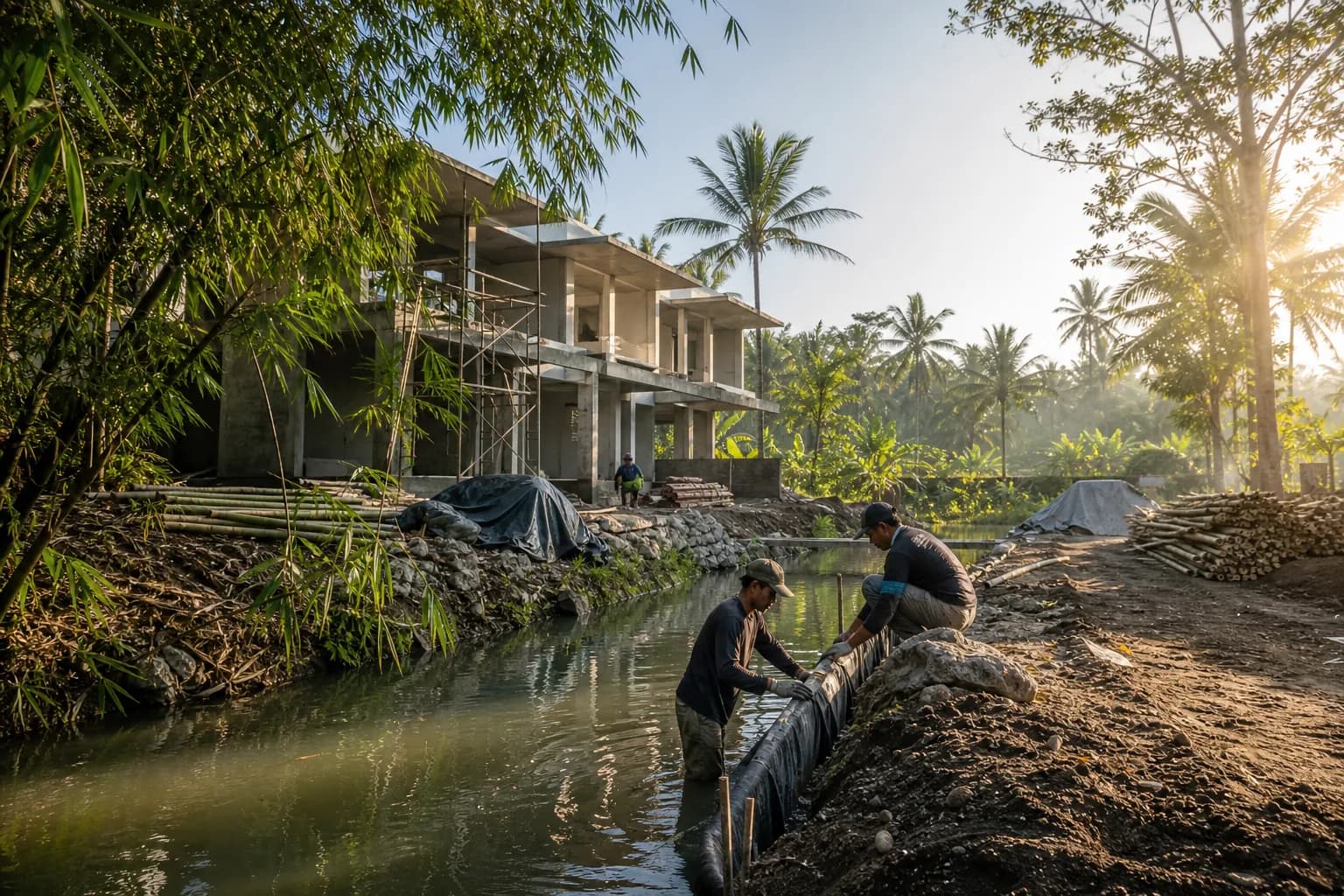
Pre-Filter Sediment Sizing for Bali Groundwater TDS Levels
Bali’s groundwater presents unique challenges for whole-house water filtration systems, particularly when it comes to selecting the correct pre-filter sediment sizing. With TDS (Total Dissolved Solids) levels frequently exceeding 800 ppm in coastal areas and volcanic sediment contamination inland, improper pre-filter sizing leads to rapid membrane fouling, reduced system efficiency, and premature equipment failure. The critical question for villa construction and renovation projects isn’t whether to install sediment pre-filtration, but rather which micron rating and filter media configuration will protect downstream RO membranes while handling Bali’s specific groundwater composition. This technical decision directly impacts long-term maintenance costs and water quality outcomes.
Understanding Bali’s Groundwater Composition and Pre-Filter Requirements
Bali’s groundwater chemistry varies dramatically by region, requiring location-specific pre-filter sizing strategies. Coastal areas like Canggu and Seminyak experience saltwater intrusion with TDS levels between 600-1,200 ppm, while inland volcanic regions like Ubud contain iron oxide particles and silica sediment that create different filtration challenges. The key to effective pre-filter sediment sizing lies in understanding the relationship between particle size distribution and filter media specifications.
For water filtration Bali installations, we specify sediment pre-filters based on a three-stage micron reduction approach. The initial stage uses 20-micron polypropylene wound filters to capture larger volcanic sediment and rust particles common in Bali’s aging infrastructure. This protects the second stage 5-micron pleated filter, which removes fine silt and clay particles that characterize groundwater from rice paddy areas. The final 1-micron carbon block filter addresses chlorine, organic compounds, and ultra-fine sediment before water reaches the RO membrane.
The uniformity coefficient of filter media becomes critical in tropical climates where biological growth accelerates. Sand-based pre-filters, while common in commercial applications, require uniformity coefficients below 1.5 to prevent channeling in Bali’s warm water conditions. However, for residential villa installations, we’ve found that cartridge-based systems with graded density polypropylene media provide superior performance with lower maintenance requirements. The graded density design—tighter at the core, looser at the exterior—extends filter life by utilizing the entire media depth rather than surface loading alone.
Bali’s high humidity and temperature fluctuations create additional considerations for pre-filter housing materials. Standard plastic housings crack under UV exposure and thermal stress, particularly when installed in outdoor utility areas common in Bali villa construction. We specify reinforced polypropylene or stainless steel housings with EPDM O-rings rated for continuous 40°C operation. The housing size must accommodate flow rates of 15-20 liters per minute for typical three-bedroom villas while maintaining pressure drop below 0.5 bar across the pre-filter assembly.
TDS reduction expectations must be realistic: sediment pre-filters primarily remove particulate matter, not dissolved solids. A properly sized pre-filter assembly will reduce turbidity from 15-20 NTU to below 1 NTU, protecting RO membranes from abrasive wear and extending their operational life from 18 months to 36+ months. The actual TDS reduction occurs at the RO stage, but without adequate pre-filtration, membrane fouling reduces rejection rates from 96% to below 85% within six months, defeating the entire system’s purpose.
Installation Process for Multi-Stage Pre-Filter Systems
Proper installation of sediment pre-filters for Bali groundwater requires careful attention to sequence, positioning, and pressure management. The installation process begins during the MEP systems Bali coordination phase, typically occurring after rough plumbing but before wall finishing.
Step 1: Location Selection and Mounting
Position the pre-filter assembly on the main water line immediately after the pressure pump and pressure tank, before any branch lines. Mount filter housings on a reinforced backing board—we use 18mm marine plywood treated with epoxy coating—secured to concrete or masonry walls. Never mount on lightweight partition walls; the combined weight of three filter housings plus water exceeds 25kg. Maintain 60cm clearance below housings for cartridge replacement and install a floor drain within 1 meter to handle filter changes and potential leaks.
Step 2: Pressure Regulation Integration
Install a pressure gauge before the first filter housing and after the final stage. Bali’s municipal water pressure varies wildly from 1.5 to 4 bar; install a pressure reducing valve set to 3 bar maximum to prevent housing failure. Include a pressure relief valve rated at 6 bar as a safety backup. This pressure management is critical for finishing works Bali projects where consistent water pressure affects fixture performance throughout the villa.
Step 3: Sequential Filter Installation
Install housings in descending micron order: 20-micron, then 5-micron, then 1-micron carbon block. Use brass or stainless steel nipples between housings—never use PVC in pressurized applications. Apply PTFE tape (12-15 wraps) on all threaded connections, wrapping in the direction of thread rotation. Hand-tighten housings using the spanner wrench provided; over-tightening cracks the housing rim.
Step 4: Bypass Valve Configuration
Install a three-valve bypass assembly allowing isolation of the entire pre-filter system for maintenance without shutting down household water. This configuration uses two ball valves on the main line (inlet and outlet) plus one bypass valve. During filter changes, close inlet/outlet valves and open bypass to maintain water service to non-filtered outlets like garden taps.
Step 5: System Flushing and Testing
Before connecting to the RO system, flush each filter stage individually for 5 minutes to remove carbon fines and manufacturing residue. Check all connections at full pressure for 30 minutes. Measure pressure drop across the assembly; readings above 0.7 bar indicate installation issues or defective cartridges. Document baseline pressure readings for future maintenance reference.
Materials and Specifications for Tropical Performance
Material selection for Bali’s tropical environment requires upgrading beyond standard specifications. For filter housings, specify clear or blue-tinted reinforced polypropylene rated for continuous 40°C operation and 8 bar pressure rating. Avoid white opaque housings that hide sediment accumulation and make visual inspection impossible. Housing O-rings must be EPDM or silicone—never use standard nitrile rubber which degrades rapidly in Bali’s heat.
For the 20-micron first stage, use wound polypropylene cartridges with a graded density structure. String-wound filters provide superior sediment holding capacity (1.5-2kg per cartridge) compared to melt-blown alternatives. The 5-micron second stage should use pleated polyester media with 2.5 square meters of surface area in a 10-inch cartridge, providing 3-4 month service life in typical Bali groundwater conditions.
The final 1-micron stage requires a carbon block cartridge combining mechanical filtration with chemical adsorption. Specify coconut shell activated carbon with minimum 1000 mg/L chlorine reduction capacity and 0.5 micron absolute rating. This protects RO membranes from both particulate damage and chlorine degradation, which is critical given Bali’s inconsistent water treatment practices.
All connecting hardware must be corrosion-resistant: brass or 316 stainless steel for fittings, CPVC or stainless steel for piping in the filter assembly area. Standard PVC becomes brittle under UV exposure in outdoor installations common in villa renovation Bali projects. Pressure gauges should be glycerin-filled to dampen vibration and extend accuracy in pump-supplied systems.
Cost Breakdown for Complete Pre-Filter Installation
A professionally installed three-stage sediment pre-filter system for a typical Bali villa involves both equipment and labor costs. Filter housings (set of three reinforced 10-inch clear housings): Rp 2,400,000-3,200,000. Initial filter cartridge set (20-micron wound, 5-micron pleated, 1-micron carbon block): Rp 850,000-1,100,000. Mounting hardware including marine plywood backing board, stainless steel brackets, and fasteners: Rp 450,000-600,000.
Pressure management components add Rp 1,200,000-1,800,000, including pressure reducing valve, pressure relief valve, and two pressure gauges. Bypass valve assembly with three ball valves and connecting brass fittings: Rp 800,000-1,100,000. Piping modifications and connections typically require Rp 600,000-900,000 in materials depending on existing plumbing configuration.
Professional installation labor for a complete pre-filter assembly ranges from Rp 2,500,000-3,500,000, including pressure testing and system commissioning. This assumes standard installation conditions; complex retrofits in finished villas may increase labor costs by 30-40%. Total installed cost for a quality three-stage pre-filter system: Rp 8,800,000-12,200,000.
Ongoing maintenance costs include replacement cartridges every 3-4 months: Rp 850,000-1,100,000 per change, or approximately Rp 3,000,000-4,000,000 annually. However, this investment extends RO membrane life from 18 to 36+ months, saving Rp 4,500,000-6,000,000 in membrane replacement costs over three years. For detailed project costing, visit our cost estimation page.
Common Installation Mistakes and Prevention Strategies
The most frequent error in Bali pre-filter installations is incorrect micron sequencing. Installing filters in ascending rather than descending micron order causes immediate clogging of fine filters with coarse sediment, reducing 3-month cartridges to 2-week service life. Always verify the sequence: largest micron rating first, smallest last before RO membrane.
Inadequate pressure regulation causes premature housing failure and O-ring leaks. Bali’s pressure pumps often deliver 4-5 bar, exceeding the 3.5 bar optimal operating pressure for standard filter housings. Without a pressure reducing valve, housings develop stress cracks within 6-12 months. The solution: always install PRV set to 3 bar maximum, with pressure gauges confirming actual operating pressure.
Poor mounting practices lead to catastrophic failures. Mounting filter assemblies on lightweight walls or using inadequate fasteners results in the entire assembly tearing free under water weight and pressure cycling. We’ve responded to multiple emergency calls where improperly mounted systems flooded utility rooms. Prevention requires mounting to structural walls using 10mm stainless steel anchors rated for 50kg load each, with marine-grade backing boards distributing stress.
Neglecting bypass valve installation creates maintenance nightmares. Without bypass capability, every filter change requires shutting down the entire villa’s water supply, inconveniencing occupants and often leading to delayed maintenance. The three-valve bypass assembly adds minimal cost but provides enormous operational flexibility, allowing filter changes while maintaining water service to the property.
Using incompatible O-ring materials causes persistent leaking. Standard nitrile rubber O-rings degrade within months in Bali’s heat, requiring constant re-tightening and eventual housing replacement. Specify EPDM or silicone O-rings from the initial installation, and keep spares on hand. During filter changes, inspect O-rings for compression set or cracking and replace proactively rather than waiting for leaks to develop.
Frequently Asked Questions
How often should I replace sediment pre-filters in Bali’s groundwater conditions?
Replacement frequency depends on your specific water quality and usage patterns. For typical Bali groundwater with 15-20 NTU turbidity, expect to replace the 20-micron first stage every 2-3 months, the 5-micron second stage every 3-4 months, and the 1-micron carbon block every 4-6 months. Coastal areas with higher sediment loads may require more frequent changes. Monitor pressure drop across the filter assembly; when it exceeds 1 bar, immediate replacement is necessary regardless of time elapsed. Visual inspection of clear housings provides early warning—when the first stage cartridge appears completely brown or black, it’s time for replacement.
Can I use larger micron ratings to reduce replacement frequency and costs?
While tempting, using larger micron ratings (like 50-micron first stage) to extend service life actually increases total system costs. Larger micron filters allow more fine sediment to reach downstream filters and RO membranes, accelerating their degradation. The proper approach uses appropriately sized pre-filters (20-5-1 micron sequence) that protect expensive RO membranes. Spending an extra Rp 1,000,000 annually on pre-filter cartridges saves Rp 4,500,000 in premature membrane replacement. For Bali villa construction projects, we design systems for optimal protection rather than minimal maintenance frequency.
What pressure drop is acceptable across a three-stage pre-filter assembly?
New, clean filters should show 0.3-0.5 bar pressure drop across the entire three-stage assembly at normal flow rates (15-20 LPM). As filters load with sediment, pressure drop increases. Replace filters when pressure drop reaches 1.0 bar, even if the scheduled replacement interval hasn’t arrived. Pressure drops exceeding 1.5 bar indicate severely clogged filters that restrict flow and stress the pressure pump. Install pressure gauges before and after the filter assembly to monitor this critical parameter. Excessive pressure drop also reduces RO system efficiency by limiting feed water flow rate.
Should pre-filters be installed before or after the pressure tank?
Always install sediment pre-filters after the pressure pump and pressure tank, on the distribution side. Installing filters before the pump exposes them to suction conditions that can collapse cartridges and allows sediment to accumulate in the pressure tank, creating a secondary contamination source. The correct sequence is: groun
 1from 198.000 USD
Private: Haridas Villas
 3180 m²7 month(s)from 142.000 USD
Vasudeva
 172 m²8 month(s)from 120.000 USD
Keshava
 3124 m²6 month(s)from 123.000 USD
TALA 8
 164 m²7 month(s)from 79.000 USD
TALA TWO

Want to calculate?
 2144 m²11 month(s)from 104.000 USD
Narayana
 3173 m²6 month(s)from 125.000 USD
TALA FOUR
164 m²7 month(s)from 79.000 USDPrivate: Haridas Villas, Tegallalang
 3127 m²9 month(s)from 177.000 USD
Mukunda
 4344 m²16 month(s)from 290.000 USD
Radha
 3104 m²11 month(s)from 99.000 USD
TALA 100
Start With Real Numbers, Not Guesses
Before buying land or finalizing a design, check the realistic build cost range for your project in Bali.
Our team reviews your inputs and gives a grounded estimate.
Available lands
 2700 m²30 min$ 314224Bali, Sidemen
 1000 m²10 min$ 384852Bali, Canggu
 204 m²5 min$ 40899Bali, Kedungu
 1100 m²8 min$ 280419Bali, Ungasan
 2115 m²5 min$ 1139547Bali, Pererenan
 1230 m²15 min$ 132543Bali, Tegallalang
 29000 m²6 min$ 3857143Bali, Tabanan
 928 m²15 min$ 910123Bali, Pererenan
 3254 m²5 min$ 631800Bali, All
 2130 m²10 min$ 495776Bali, Pecatu
 6000 m²30 min$ 55419Bali, Tabanan
 515 m²7 min$ 570813Bali, Canggu
 400 m²15 min$ 67192Bali, Tabanan
 1000 m²10 min$ 230911Bali, Kerobokan
 2230 m²15 min$ 410573Bali, Padonan
Essential Bali build & buy guides
- Bali villa construction cost per m² in 2026
- How much will your villa cost? Calculator
- Building a villa in Bali: the complete guide
- Buying land in Bali: step-by-step for foreigners
- Bali villa investment: yields, risks, returns
- Leasehold vs freehold: what foreigners can own
- Construction defect liability & 10-year warranty
- Bali building codes and construction standards
Related guides
How to Build a Villa in Bali: The Complete Step-by-Step Process (2026)
Every stage of building a villa in Bali as a foreigner — from securing land and permits to handover — with realistic timelines, costs and the mistakes that derail first-time builders.
5 min read
Moisture-Resistant Gypsum Board Finishing with Epoxy Primer Bali
Learn how moisture-resistant gypsum boards with epoxy primer boost durability, finish quality, and mold resistance in Bali projects. Great for Bali homes.
10 min read
Marine-Grade Timber Joinery Finishing Corrosion Protection Bali
Discover marine-grade timber joinery finishing and corrosion protection in Bali. Durable coastal timber care, coatings, and maintenance for lasting protection.
8 min read