Powder-Coated Aluminum vs Teak: Bali Coastal Corrosion
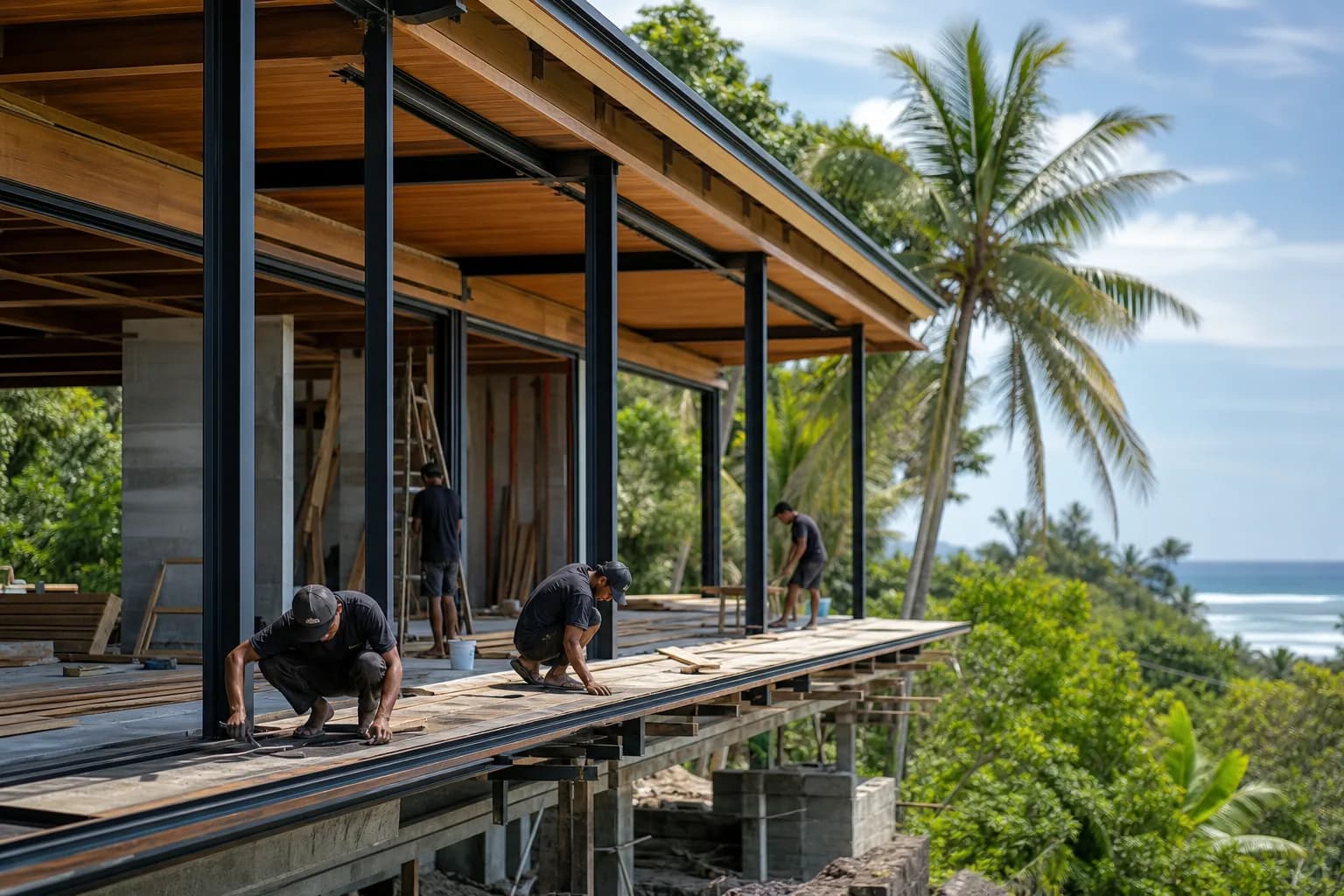
Powder-Coated Aluminum vs Teak Frame Corrosion: Bali Coastal Salt Spray
When completing finishing works for coastal villas in Bali, selecting outdoor furniture frames that withstand salt spray corrosion becomes a critical decision that impacts both aesthetics and long-term maintenance costs. Villa owners in areas like Canggu, Uluwatu, and Seminyak frequently face premature furniture degradation within 18-24 months due to incorrect material selection. The question isn’t simply about choosing between powder-coated aluminum and teak—it’s about understanding how each material performs under Bali’s specific coastal conditions, where salt concentration, humidity levels exceeding 80%, and intense UV exposure create a uniquely aggressive environment that accelerates corrosion processes far beyond typical tropical climates.
Technical Deep Dive: Material Performance in Bali’s Coastal Environment
Bali’s coastal microclimate presents a perfect storm for material degradation. Salt particles carried by onshore winds deposit chloride ions that penetrate protective coatings and initiate electrochemical corrosion processes. Understanding the molecular-level interaction between these materials and salt spray is essential for villa renovation Bali projects.
Powder-Coated Aluminum: Barrier Protection Mechanics
Powder-coated aluminum frames utilize a dual-defense system. The aluminum substrate naturally forms a passive aluminum oxide layer (Al₂O₃) approximately 2-10 nanometers thick, which provides inherent corrosion resistance. The powder coating—typically polyester, polyurethane, or epoxy-based—adds a 60-120 micron barrier that prevents chloride ion penetration. High-quality marine-grade powder coatings for Bali villa construction should meet AAMA 2604 standards minimum, though AAMA 2605 specifications offer superior salt spray resistance tested to 4,000+ hours in ASTM B117 chambers.
The critical vulnerability occurs at coating breaches. When chips or scratches expose bare aluminum, galvanic corrosion can initiate if dissimilar metals contact the frame. In Bali’s 80-85% relative humidity environment, even microscopic coating failures allow moisture ingress. The aluminum oxide layer reforms quickly, but repeated wet-dry cycles in salt-laden air create pitting corrosion that compromises structural integrity over 3-5 years without intervention.
Application quality determines longevity. Frames must undergo chromate or zirconium-based pre-treatment before powder application. Electrostatic spray application at 60-80 kV ensures uniform coating thickness, followed by curing at 180-200°C for 15-20 minutes. Inferior application processes—common in budget furniture manufacturing—result in thin spots, poor adhesion, and premature failure in coastal installations.
Teak Frame: Biological Resistance and Natural Oils
Tectona grandis (teak) contains natural silica deposits and oil content ranging from 1.3-1.5% that provide inherent moisture resistance. The wood’s tight grain structure (density 630-720 kg/m³ for Grade A teak) limits water absorption to 10-12% even in saturated conditions. Unlike aluminum’s electrochemical corrosion, teak faces biological degradation and UV-induced lignin breakdown.
Salt spray doesn’t corrode teak in the traditional sense—it accelerates surface weathering. Chloride ions draw moisture into surface cells, promoting fungal colonization and accelerating the silvering process where UV radiation degrades lignin polymers. Untreated teak in Bali’s coastal zones transitions from golden-brown to silver-gray within 6-9 months, compared to 18-24 months in less aggressive climates. This aesthetic change doesn’t compromise structural integrity for decades, but surface checking (fine cracks) can develop if moisture content fluctuates dramatically between wet and dry seasons.
The critical factor for finishing works Bali projects is teak grade and origin. Plantation teak (25-30 year rotation) exhibits wider growth rings and lower oil content than old-growth teak (60+ years), making it more susceptible to moisture-related movement and checking. Indonesian plantation teak performs adequately in coastal applications with proper maintenance, while Myanmar or Thai old-growth teak offers superior dimensional stability.
Installation Process: Proper Setup for Coastal Durability
Powder-Coated Aluminum Frame Installation
Step 1: Pre-Installation Inspection – Examine all powder-coated surfaces under direct sunlight for coating defects, thin spots, or manufacturing damage. Use a coating thickness gauge to verify 80+ micron coverage on all exposed surfaces. Reject frames with visible coating irregularities, as these will fail rapidly in salt spray environments.
Step 2: Hardware Selection and Isolation – Use only 316-grade stainless steel fasteners (not 304-grade, which pits in chloride environments). Apply dielectric isolation washers between aluminum frames and dissimilar metal components to prevent galvanic corrosion. This is critical for MEP systems Bali integration where electrical conduits may contact furniture frames.
Step 3: Protective Coating Application – Apply marine-grade wax or polymer sealant to all powder-coated surfaces before installation. This adds a sacrificial barrier that absorbs initial salt deposition and can be renewed quarterly. Focus on horizontal surfaces, joints, and any areas where water may pool.
Step 4: Drainage Consideration – Position frames to prevent water accumulation in hollow sections. Drill 6-8mm weep holes at low points of tubular aluminum members to allow moisture escape. Seal holes with breathable membrane to prevent insect nesting while allowing vapor transmission.
Step 5: Elevation and Ventilation – Install furniture on raised platforms or adjustable feet to maintain 50-75mm clearance from ground surfaces. This prevents splash-back during rain and promotes air circulation that accelerates drying, reducing sustained moisture contact time.
Teak Frame Installation
Step 1: Moisture Content Verification – Use a pin-type moisture meter to confirm teak moisture content between 12-15% before installation. Wood outside this range will experience excessive movement as it equilibrates with Bali’s ambient humidity, potentially causing joint failure or warping.
Step 2: Pre-Treatment Application – Apply penetrating teak oil or sealer within 48 hours of installation. Use products containing UV inhibitors and mildewcides specifically formulated for tropical coastal environments. Two coats minimum, allowing 24-hour drying between applications. This initial treatment is crucial for long-term performance in villa renovation Bali projects.
Step 3: Joint Assembly and Hardware – Assemble mortise-and-tenon or dowel joints using marine-grade adhesives (resorcinol or epoxy-based). Use 316 stainless steel or bronze hardware exclusively. Pre-drill all fastener holes 0.5mm undersized to prevent splitting, and countersink screws 3-4mm below surface for wood plug coverage.
Step 4: Expansion Gap Planning – Allow 2-3mm expansion gaps between teak components to accommodate seasonal moisture-related movement. Bali’s wet season (November-March) can increase teak moisture content by 3-5%, causing measurable dimensional changes in large furniture pieces.
Step 5: Surface Finishing – For clients preferring maintained golden color, establish quarterly maintenance schedule immediately. For natural weathering, apply only clear water-repellent sealer to slow moisture ingress while allowing silvering process. Document client preference explicitly in project handover materials.
Materials & Specifications: What Works in Bali’s Coastal Zone
Powder-Coated Aluminum Specifications
Aluminum Alloy: 6063-T5 or 6061-T6 extrusions provide optimal strength-to-weight ratio and corrosion resistance. Wall thickness minimum 2.0mm for structural members, 1.5mm for decorative elements. Avoid 5000-series alloys despite higher strength—they’re more susceptible to stress corrosion cracking in chloride environments.
Powder Coating: Specify polyester-TGIC or polyurethane formulations with minimum 80-micron dry film thickness. Require salt spray test certification (ASTM B117) showing 2,000+ hours without coating failure. Color selection impacts performance—lighter colors reflect UV better, reducing thermal cycling stress that can crack coatings.
Pre-Treatment: Chromate-free zirconium or titanium-based conversion coatings meet environmental standards while providing excellent adhesion. Verify pre-treatment through supplier documentation—this step is frequently skipped in budget manufacturing.
Teak Wood Specifications
Grade and Origin: Specify Grade A teak with tight, straight grain and minimal sapwood content (less than 10% of any component). Indonesian plantation teak aged 25+ years provides good value for Bali villa construction. For premium projects, specify Myanmar or Thai teak aged 40+ years.
Moisture Content: Kiln-dried to 12-14% moisture content, verified by supplier certification. Air-dried teak often retains 18-22% moisture content, leading to excessive post-installation movement.
Treatment Products: Penetrating teak oils containing UV absorbers (benzotriazoles or benzophenones) and fungicides (copper naphthenate or zinc compounds). Avoid film-forming varnishes—they trap moisture and fail rapidly in Bali’s climate, requiring complete removal and refinishing.
Cost Breakdown: Investment Analysis for Coastal Furniture
Powder-Coated Aluminum Frame Costs
Material Costs: High-quality powder-coated aluminum outdoor furniture frames range from Rp 3,500,000-8,500,000 per seating piece (chair/lounger) depending on design complexity and coating specification. Dining tables with aluminum frames cost Rp 12,000,000-25,000,000 for 6-8 person capacity. Premium marine-grade specifications add 25-35% to base costs but extend service life from 5-7 years to 12-15 years in coastal installations.
Installation Labor: Professional installation including proper hardware selection, protective coating application, and positioning runs Rp 500,000-1,200,000 per furniture piece for finishing works Bali projects. This includes site preparation and drainage considerations.
Maintenance Costs: Quarterly cleaning and wax application costs Rp 150,000-300,000 per piece annually when performed by maintenance staff. Touch-up powder coating for minor damage runs Rp 800,000-1,500,000 per piece, requiring professional application facilities.
Teak Frame Costs
Material Costs: Grade A Indonesian plantation teak furniture ranges from Rp 5,500,000-12,000,000 per seating piece, with dining tables costing Rp 18,000,000-45,000,000. Premium old-growth teak commands 60-100% premium over plantation teak but offers superior dimensional stability and longevity exceeding 30 years.
Installation Labor: Teak furniture installation including pre-treatment application and proper assembly runs Rp 600,000-1,500,000 per piece, slightly higher than aluminum due to treatment requirements.
Maintenance Costs: Quarterly oiling and cleaning for maintained finish costs Rp 200,000-400,000 per piece annually. Clients choosing natural weathering reduce maintenance to annual cleaning at Rp 100,000-200,000 per piece. Complete refinishing every 3-5 years costs Rp 1,200,000-2,500,000 per piece including sanding and re-oiling.
Common Mistakes: Avoiding Coastal Installation Failures
Powder-Coated Aluminum Errors
Mistake 1: Using Standard-Grade Powder Coating – Many suppliers provide furniture with automotive-grade powder coating (AAMA 2603) rather than architectural-grade (AAMA 2604/2605). Standard coatings fail within 18-24 months in Bali’s coastal salt spray, showing chalking, fading, and corrosion. Always verify coating specification through independent testing documentation before purchase.
Mistake 2: Mixing Metal Types – Installing aluminum frames with steel fasteners or brackets creates galvanic cells that accelerate corrosion dramatically. Even 304 stainless steel can cause issues—only 316-grade stainless or bronze hardware should contact aluminum in coastal environments. This mistake appears frequently in MEP systems Bali integration where electrical contractors use incompatible fasteners.
Mistake 3: Ignoring Drainage – Hollow aluminum sections without weep holes trap condensation and rainwater, creating sustained moisture contact that degrades powder coating from inside out. This internal corrosion remains invisible until structural failure occurs, typically after 3-4 years in coastal installations.
Teak Frame Errors
Mistake 1: Installing Wet Teak – Using teak with moisture content above 16% guarantees excessive shrinkage, joint failure, and surface checking as wood equilibrates with ambient conditions. This mistake is common when furniture arrives directly from humid storage or during Bali’s wet season without proper acclimatization period.
Mistake 2: Film-Forming Finishes – Applying polyurethane varnish or lacquer to teak in coastal environments traps moisture beneath the film, causing finish failure, black mold growth, and accelerated wood degradation. These finishes require complete removal within 12-18 months, adding significant maintenance costs to villa renovation Bali budgets.
Mistake 3: Inadequate Initial Treatment – Skipping pre-installation oil treatment or applying insufficient coats allows rapid moisture ingress and UV damage. The first 6 months of exposure are critical—untreated teak develops deep surface checking that cannot be reversed, permanently compromising appearance even with subsequent maintenance.
Frequently Asked Questions
How long does powder-coated aluminum furniture last in Bali’s coastal areas?
High-quality marine-grade powder-coated aluminum furniture with AAMA 2605 coating specification lasts 12-15 years in Bali’s coastal salt spray environment with proper quarterly maintenance. Standard-grade coatings (AAMA 2603) typicall
 4344 m²16 month(s)from 290.000 USD
Radha

Want to calculate?
 1from 198.000 USD
Private: Haridas Villas
 3124 m²6 month(s)from 123.000 USD
TALA 8
 164 m²7 month(s)from 79.000 USD
TALA TWO
 172 m²8 month(s)from 120.000 USD
Keshava
 3180 m²7 month(s)from 142.000 USD
Vasudeva
 3104 m²11 month(s)from 99.000 USD
TALA 100
 2144 m²11 month(s)from 104.000 USD
Narayana
 3127 m²9 month(s)from 177.000 USD
Mukunda
164 m²7 month(s)from 79.000 USDPrivate: Haridas Villas, Tegallalang
 3173 m²6 month(s)from 125.000 USD
TALA FOUR
Start With Real Numbers, Not Guesses
Before buying land or finalizing a design, check the realistic build cost range for your project in Bali.
Our team reviews your inputs and gives a grounded estimate.
Available lands
 1720 m²2 min$ 241478Bali, Tabanan
 3300 m²15 min$ 449889Bali, Tabanan
 200 m²11 min$ 89286Bali, Tabanan
 1660 m²10 min$ 343448Bali, Kerobokan
 2000 m²15 min$ 523000Bali, Canggu
 1000 m²10 min$ 184729Bali, Kutuh South Bali
 325 m²15 min$ 44472Bali, Ungasan
 2400 m²7 min$ 496552Bali, Canggu
 608 m²15 min$ 310377Bali, Seminyak
 610 m²10 min$ 165271Bali, Seminyak
 615 m²15 min$ 113608Bali, Tabanan
 260 m²5 min$ 51872Bali, Kedungu
 2000 m²5 min$ 738916Bali, Ungasan
 3254 m²5 min$ 631800Bali, All
 2130 m²10 min$ 495776Bali, Pecatu
Essential Bali build & buy guides
- Bali villa construction cost per m² in 2026
- How much will your villa cost? Calculator
- Building a villa in Bali: the complete guide
- Buying land in Bali: step-by-step for foreigners
- Bali villa investment: yields, risks, returns
- Leasehold vs freehold: what foreigners can own
- Construction defect liability & 10-year warranty
- Bali building codes and construction standards
Related guides
Villa Handover in Bali: Snagging Checklist and What to Test Before Final Payment
A disciplined villa handover in Bali: room-by-room snagging tests, numbered defect documentation, the PBG/SLF and warranty documents to insist on, and payment terms that keep leverage until the list is closed.
7 min read
Energy-Efficient Villa in Bali: Solar, Insulation and Passive Cooling That Pay Back
Which energy-efficiency measures actually pay back in Bali's tropical climate — passive design and roof insulation first, efficient equipment second, and self-consumption solar last — with honest 2026 numbers.
7 min read
Choosing a General Contractor in Bali: Red Flags, Questions and Contract Must-Haves
A practical filter for hiring a general contractor in Bali: the red flags that end conversations, the questions professionals answer with documents, and the contract clauses no villa build should start without.
7 min read