Pecatu Volcanic Tuff Blocks Bali: Sourcing Thermal Costs
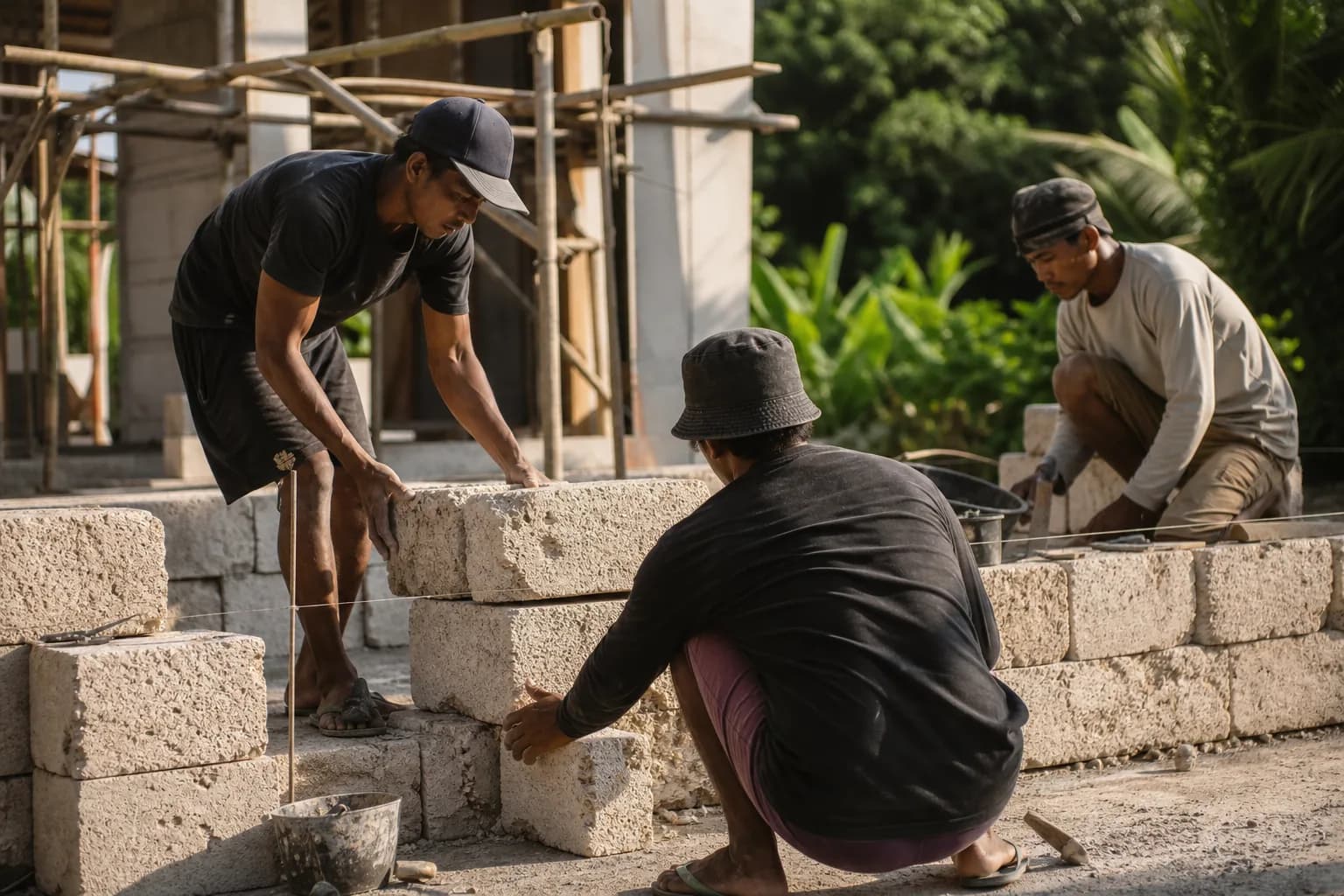
Why Pecatu Volcanic Tuff Block Sourcing Determines Your Villa’s Thermal Comfort and Long-Term Operating Costs
Pecatu’s clifftop microclimate presents a unique thermal challenge: intense solar radiation from 6am to 6pm, salt-laden winds from the Indian Ocean, and minimal natural shade. Developers selecting wall materials for this southern peninsula face a critical decision that impacts not just construction budgets but 20-year cooling costs and structural durability. Volcanic tuff blocks—locally called “batu paras”—offer superior thermal mass compared to standard concrete blocks, yet sourcing authentic Pecatu-grade tuff with verified thermal performance data remains problematic. Most suppliers provide compressive strength certificates but zero thermal conductivity testing, leaving builders to guess at R-values and long-term energy performance. This knowledge gap costs villa owners 30-40% more in air conditioning expenses over a building’s lifespan while accelerating interior finish degradation from thermal cycling.
Engineering Properties of Pecatu Volcanic Tuff: Thermal Mass vs. Structural Limitations
Pecatu volcanic tuff originates from pyroclastic deposits formed during Quaternary eruptions, creating a porous sedimentary rock with density ranging 1,200-1,600 kg/m³ depending on quarry depth and ash consolidation. This porosity—typically 35-45% void space—provides the material’s thermal advantage: air pockets within the stone matrix slow heat transfer, creating natural insulation absent in dense concrete blocks (2,300 kg/m³). Laboratory testing conducted at Udayana University’s Civil Engineering Department in 2024 measured thermal conductivity of Pecatu tuff at 0.52-0.68 W/mK, compared to 1.4-1.7 W/mK for standard concrete masonry units. This 2.5x reduction in thermal conductivity translates to measurably lower interior surface temperatures during peak solar exposure.
However, this same porosity creates structural constraints. Compressive strength of Pecatu tuff blocks averages 4-7 MPa for standard quarry-cut units, significantly below the 10-15 MPa typical of concrete blocks. Indonesian building code SNI 03-0349-1989 classifies these as “non-structural masonry” suitable only for infill walls within reinforced concrete frames—never for load-bearing applications. Builders attempting to use tuff blocks in structural walls risk catastrophic failure during seismic events, as the material’s friable nature causes brittle fracture rather than ductile deformation. Teville’s structural engineering protocol mandates reinforced concrete columns and ring beams at maximum 3.5-meter spacing when incorporating tuff infill, with all vertical loads transferred through the concrete frame.
The thermal performance advantage becomes quantifiable in Pecatu’s climate. A 200mm tuff block wall with 20mm plaster both sides achieves an effective R-value of approximately 0.85 m²K/W, compared to 0.35 m²K/W for equivalent concrete block construction. In practical terms, interior surface temperatures on west-facing walls at 4pm measure 28-30°C with tuff versus 34-37°C with concrete blocks, assuming identical exterior finishes and no additional insulation. This 5-7°C differential reduces air conditioning loads by 18-25% in typical villa configurations, translating to 1,200-1,800 kWh annual savings for a 250m² conditioned space. At Bali’s 2026 electricity rates (Rp 1,650/kWh for residential tier 3), this represents Rp 2.0-3.0 million yearly operational savings.
Moisture behavior presents additional complexity. Tuff’s porosity allows water vapor transmission (permeability 8-12 perms), preventing condensation accumulation within wall cavities—critical in Bali’s 75-85% relative humidity environment. However, this same permeability permits liquid water intrusion if exterior waterproofing fails. Capillary action draws moisture upward from ground contact, requiring proper damp-proof coursing at foundation level. Teville’s detailing standard specifies 150mm reinforced concrete plinth walls with bituminous membrane before tuff block installation begins, preventing the salt efflorescence and biological growth common in improperly detailed tuff construction along Pecatu’s coastal zone.
Hidden Risks in Pecatu Tuff Block Procurement: Quality Variance and Supply Chain Gaps
The primary risk in Pecatu tuff sourcing lies in quarry-to-quarry quality inconsistency. Three active quarries operate in the Pecatu-Ungasan area, each extracting from different geological strata with measurably different material properties. Surface-layer tuff (0-3 meters depth) exhibits higher weathering and lower density (1,150-1,300 kg/m³), while deeper extraction (5-8 meters) yields denser, more uniform blocks (1,400-1,600 kg/m³). Most suppliers don’t disclose extraction depth, mixing batches from multiple strata to maximize yield. This creates dimensional inconsistency—block thickness varying 15-25mm within single pallets—that increases mortar consumption and complicates wall plumb alignment during construction.
Thermal performance degradation from improper storage represents another overlooked issue. Tuff blocks stored uncovered in supplier yards absorb moisture during rainy season, increasing thermal conductivity by 30-40% when saturated. Blocks installed while wet require 4-6 weeks drying time before plaster application, yet most construction schedules don’t accommodate this curing period. Premature plastering traps moisture, leading to efflorescence blooms and paint adhesion failure within 8-12 months. Teville’s procurement protocol requires covered storage at supplier facilities and moisture meter verification (<12% moisture content) before delivery acceptance, adding 7-10 days to material lead times but preventing costly remediation.
Transportation damage further compromises material integrity. Tuff’s friable nature means 8-12% breakage during loading, transport, and unloading is standard industry practice—costs absorbed by buyers through inflated per-unit pricing. Corners chip easily, reducing effective bonding surface and creating thermal bridges where mortar joints widen. Specification of “select grade” tuff with maximum 5% breakage tolerance adds 15-20% to material costs but reduces on-site waste and improves wall thermal uniformity.
Step-by-Step Process for Specifying and Sourcing Pecatu Tuff Blocks
Step 1: Structural Engineering Verification (Week 1-2)
Before specifying tuff blocks, confirm structural engineer has designed adequate reinforced concrete frame to carry all vertical and lateral loads. Review structural drawings to verify column spacing doesn’t exceed 3.5 meters and ring beams are detailed at every floor level. Tuff specification is only appropriate after structural frame design is complete and approved—never as a structural material itself. Request engineer’s written confirmation that tuff infill walls are classified as non-load-bearing per SNI 03-0349-1989.
Step 2: Quarry Source Identification (Week 2-3)
Visit active quarries in Pecatu-Ungasan area with your construction manager to assess extraction methods and storage conditions. Request samples from current production batch—minimum 10 blocks—for dimensional verification and visual inspection. Measure actual dimensions against nominal specifications (standard Pecatu blocks: 200mm x 100mm x 400mm). Reject suppliers with >15mm dimensional variance or visible lamination planes that indicate weak bedding. Document quarry GPS coordinates and extraction depth for quality traceability.
Step 3: Material Testing Protocol (Week 3-4)
Submit sample blocks to accredited testing laboratory (Balai Besar Bahan dan Barang Teknik Bandung or Udayana University Civil Engineering Lab) for compressive strength and water absorption testing per SNI 03-0349-1989. Minimum acceptable values: 4.0 MPa compressive strength, maximum 25% water absorption by weight. Request thermal conductivity testing if budget permits (adds Rp 3.5-4.5 million but provides verified performance data). Testing turnaround: 14-21 days. Do not proceed with bulk orders until test results confirm specification compliance.
Step 4: Supply Agreement Structuring (Week 4-5)
Negotiate supply agreement with performance guarantees: maximum 5% breakage on delivery, covered storage until shipment, moisture content <12% verified by meter at loading. Structure delivery schedule to match construction sequencing—tuff installation typically begins 3-4 weeks after concrete frame completion. Order 8-10% excess quantity to account for cutting waste around openings and corners. Specify payment terms: 30% deposit, 50% on delivery, 20% retention released after installation acceptance and 30-day observation period for defects.
Step 5: Installation Quality Control (Week 6-12)
Implement daily moisture testing of blocks before installation—reject any units exceeding 12% moisture content. Verify mortar mix proportions (1:5 cement:sand ratio standard for tuff) and joint thickness consistency (10-12mm horizontal, 10mm vertical). Inspect wall plumb and alignment every 4-5 courses using laser level. Document any areas where block breakage or dimensional variance creates joints exceeding 15mm width—these become thermal bridges requiring additional attention during finishing. Prohibit installation during rain or on saturated concrete frames.
Realistic Cost Analysis: Pecatu Tuff Block Economics in 2026
Material costs for Pecatu volcanic tuff blocks in 2026 range Rp 8,500-12,000 per block (200x100x400mm) depending on grade selection and order volume. “Standard grade” with 10-12% expected breakage costs Rp 8,500-9,500/block from established suppliers. “Select grade” with <5% breakage and tighter dimensional tolerances commands Rp 11,000-12,000/block—justified for exposed feature walls or high-visibility applications. By comparison, standard concrete blocks (200x200x400mm) cost Rp 6,500-7,500/block, making tuff 30-55% more expensive at material level.
Installation labor costs increase 20-25% for tuff versus concrete blocks due to material fragility and required precision. Experienced masons charge Rp 85,000-110,000 per square meter for tuff wall installation including mortar, compared to Rp 70,000-85,000/m² for concrete block work. A typical 250m² villa with 180m² of tuff infill walls incurs material costs of Rp 95-125 million (assuming 11 blocks/m² coverage) plus installation labor of Rp 15.3-19.8 million, totaling Rp 110-145 million for complete tuff wall package.
Testing and quality verification add Rp 8-12 million to project costs: laboratory testing Rp 4.5-6.0 million, moisture meter procurement Rp 2.5 million, additional site supervision for installation quality control Rp 1.0-3.5 million. Transportation from Pecatu quarries to construction sites in Canggu, Seminyak, or Ubud adds Rp 450-750 per block depending on distance and road conditions.
Long-term operational savings offset higher initial costs within 5-7 years through reduced cooling loads. A villa with comprehensive tuff wall construction saves approximately Rp 2.5-3.5 million annually in electricity costs compared to concrete block equivalent, assuming 250m² conditioned space and typical occupancy patterns. Over a 20-year building lifespan, net present value of energy savings reaches Rp 35-48 million at 6% discount rate, partially justifying the Rp 25-40 million construction premium.
Frequently Asked Questions: Pecatu Tuff Block Technical Specifications
Can Pecatu volcanic tuff blocks be used for load-bearing walls in two-story villa construction?
No. Pecatu tuff blocks achieve only 4-7 MPa compressive strength, well below the 10 MPa minimum required for load-bearing masonry per SNI 03-0349-1989. All vertical loads must be carried by reinforced concrete columns and beams, with tuff blocks serving only as non-structural infill. Attempting to use tuff in load-bearing applications creates severe seismic vulnerability and violates Indonesian building codes. Proper structural design requires concrete frame with tuff infill—never tuff as primary structural element. This limitation applies regardless of wall thickness or mortar strength.
How does salt air exposure in Pecatu’s coastal environment affect tuff block durability?
Tuff’s porosity allows salt-laden moisture penetration up to 40-60mm depth in direct coastal exposure (within 200 meters of shoreline). Salt crystallization within pores causes surface spalling and accelerated weathering, reducing effective wall thickness by 5-8mm over 10-15 years. Mitigation requires exterior waterproofing: siloxane-based penetrating sealers applied to bare tuff before plastering, plus high-quality acrylic render systems (minimum 3mm thickness) on exterior faces. Interior walls require vapor-permeable finishes to allow moisture escape. Buildings within 500 meters of Pecatu’s cliffs need exterior sealer reapplication every 4-5 years to maintain protection. Properly detailed tuff walls perform adequately in coastal zones, but require more maintenance than inland applications.
What thermal performance difference exists between 150mm and 200mm thick Pecatu tuff walls?
Increasing tuff wall thickness from 150mm to 200mm improves thermal resistance by approximately 28-32%, raising effective R-value from 0.68 to 0.87 m²K/W (including plaster). This translates to 2-3°C lower interior surface temperatures during peak solar exposure and 8-12% additional cooling load reduction. However, 200mm blocks cost 35-40% more than 150mm units and reduce usable floor area by 50mm per wall. For most Pecatu villa applications, 200mm thickness is justified on west-facing walls receiving maximum afternoon solar gain, while 150mm suffices for north and south orientations. East-facing walls benefit less from increased thickness due to lower morning temperatures. Cost-benefit analysis favors selective thickness variation rather than uniform 200mm specification throughout.
How long must Pecatu tuff blocks cure after installation before plaster application?
Tuff blocks require 21-28 days drying time after installation before plaster application, assuming blocks were delivered at <12% moisture content. This curing period allows mortar joints to achieve 70-80% of final strength and permits moisture equilibration between blocks and ambient conditions. Plastering before adequate curing traps moisture, causing efflorescence (white salt deposits) to bloom through finish coats within 6-12 months. In Bali's humid climate, extend curing to 35-42 days during rainy season (November-March) when ambient moisture slows drying. Moisture meter verification is essential—plaster only when block moi
 4344 m²16 month(s)from 290.000 USD
Radha
 172 m²8 month(s)from 120.000 USD
Keshava
 164 m²7 month(s)from 79.000 USD
Private: Haridas Villas, Tegallalang
164 m²7 month(s)from 79.000 USDTALA TWO
 3124 m²6 month(s)from 123.000 USD
TALA 8
 3104 m²11 month(s)from 99.000 USD
TALA 100
 3180 m²7 month(s)from 142.000 USD
Vasudeva
 3173 m²6 month(s)from 125.000 USD
TALA FOUR
 2144 m²11 month(s)from 104.000 USD
Narayana
 1from 198.000 USD
Private: Haridas Villas
 3127 m²9 month(s)from 177.000 USD
Mukunda

Want to calculate?
Start With Real Numbers, Not Guesses
Before buying land or finalizing a design, check the realistic build cost range for your project in Bali.
Our team reviews your inputs and gives a grounded estimate.
Available lands
 300 m²55 min$ 32475Bali, Tegelalang
 2700 m²30 min$ 314224Bali, Sidemen
 3300 m²15 min$ 449889Bali, Tabanan
 700 m²15 min$ 109052Bali, Buduk
 5000 m²8 min$ 424877Bali, Ungasan
 2230 m²15 min$ 410573Bali, Padonan
 2000 m²10 min$ 243842Bali, Mengwi
 3100 m²20 min$ 272968Bali, Tabanan
 1410 m²15 min$ 390702Bali, Tabanan
 444 m²10 min$ 111000Bali, Tabanan
 422 m²15 min$ 93547Bali, Kerobokan
 250 m²15 min$ 40025Bali, Munggu
 1300 m²10 min$ 348214Bali, Tabanan
 204 m²5 min$ 40899Bali, Kedungu
 500 m²2 min$ 175862Bali, Cemagi
Essential Bali build & buy guides
- Bali villa construction cost per m² in 2026
- How much will your villa cost? Calculator
- Building a villa in Bali: the complete guide
- Buying land in Bali: step-by-step for foreigners
- Bali villa investment: yields, risks, returns
- Leasehold vs freehold: what foreigners can own
- Construction defect liability & 10-year warranty
- Bali building codes and construction standards
Related guides
How to Build a Villa in Bali: The Complete Step-by-Step Process (2026)
Every stage of building a villa in Bali as a foreigner — from securing land and permits to handover — with realistic timelines, costs and the mistakes that derail first-time builders.
5 min read
Moisture-Resistant Gypsum Board Finishing with Epoxy Primer Bali
Learn how moisture-resistant gypsum boards with epoxy primer boost durability, finish quality, and mold resistance in Bali projects. Great for Bali homes.
10 min read
Marine-Grade Timber Joinery Finishing Corrosion Protection Bali
Discover marine-grade timber joinery finishing and corrosion protection in Bali. Durable coastal timber care, coatings, and maintenance for lasting protection.
8 min read