Jimbaran Bay Typhoon Roof Costs Wind Load Calculations Bali
Why Jimbaran Bay’s Coastal Wind Exposure Demands Specialized Roof Engineering
Jimbaran Bay’s stunning clifftop and beachfront villa sites present a critical engineering challenge that many developers discover too late: the coastal wind environment requires fundamentally different structural calculations than inland Bali locations. Unlike sheltered Ubud valleys or protected Canggu rice field sites, Jimbaran’s exposed southwestern coastline faces direct Indian Ocean wind patterns, salt-laden air, and seasonal monsoon gusts that can exceed 120 km/h. The question isn’t whether to engineer for wind loads—it’s whether your roof structure will survive the first major storm season intact, or become another cautionary tale of collapsed cantilevers and torn membrane roofing that plague underengineered coastal villas across southern Bali.
Technical Deep Dive: Wind Load Calculations for Jimbaran Bay Coastal Construction
Wind load engineering for Jimbaran Bay requires applying international structural standards adapted to Indonesia’s tropical coastal conditions. The primary calculation framework follows ASCE 7-22 (American Society of Civil Engineers) or the Indonesian equivalent SNI 1727:2020 for minimum design loads, but Jimbaran’s specific exposure category fundamentally changes the numbers.
Exposure Category Classification
Jimbaran Bay sites typically fall into Exposure Category C or D under ASCE standards. Exposure D applies to beachfront properties within 200 meters of the high-water line with unobstructed wind flow across open water for at least 1.5 kilometers—this describes most premium Jimbaran villa sites from Jimbaran Beach north to Tegal Wangi. Exposure D increases design wind pressure by approximately 35-40% compared to Exposure B (suburban/inland) calculations. A roof designed for 1.2 kPa inland pressure may require 1.65-1.8 kPa design capacity in Jimbaran’s coastal zone.
Basic Wind Speed and Velocity Pressure
Indonesia’s meteorological data establishes Bali’s basic wind speed at approximately 35-40 m/s (126-144 km/h) for 50-year return period events. However, Jimbaran’s southwestern exposure to Indian Ocean weather systems warrants conservative engineering using 40 m/s minimum. The velocity pressure equation (qz = 0.613 × Kz × Kzt × Kd × V² × I) incorporates topographic factors (Kzt) that increase significantly for clifftop sites—Jimbaran’s limestone cliffs can create wind acceleration zones requiring Kzt values of 1.15-1.25 versus 1.0 for flat terrain.
Roof Geometry and Pressure Coefficients
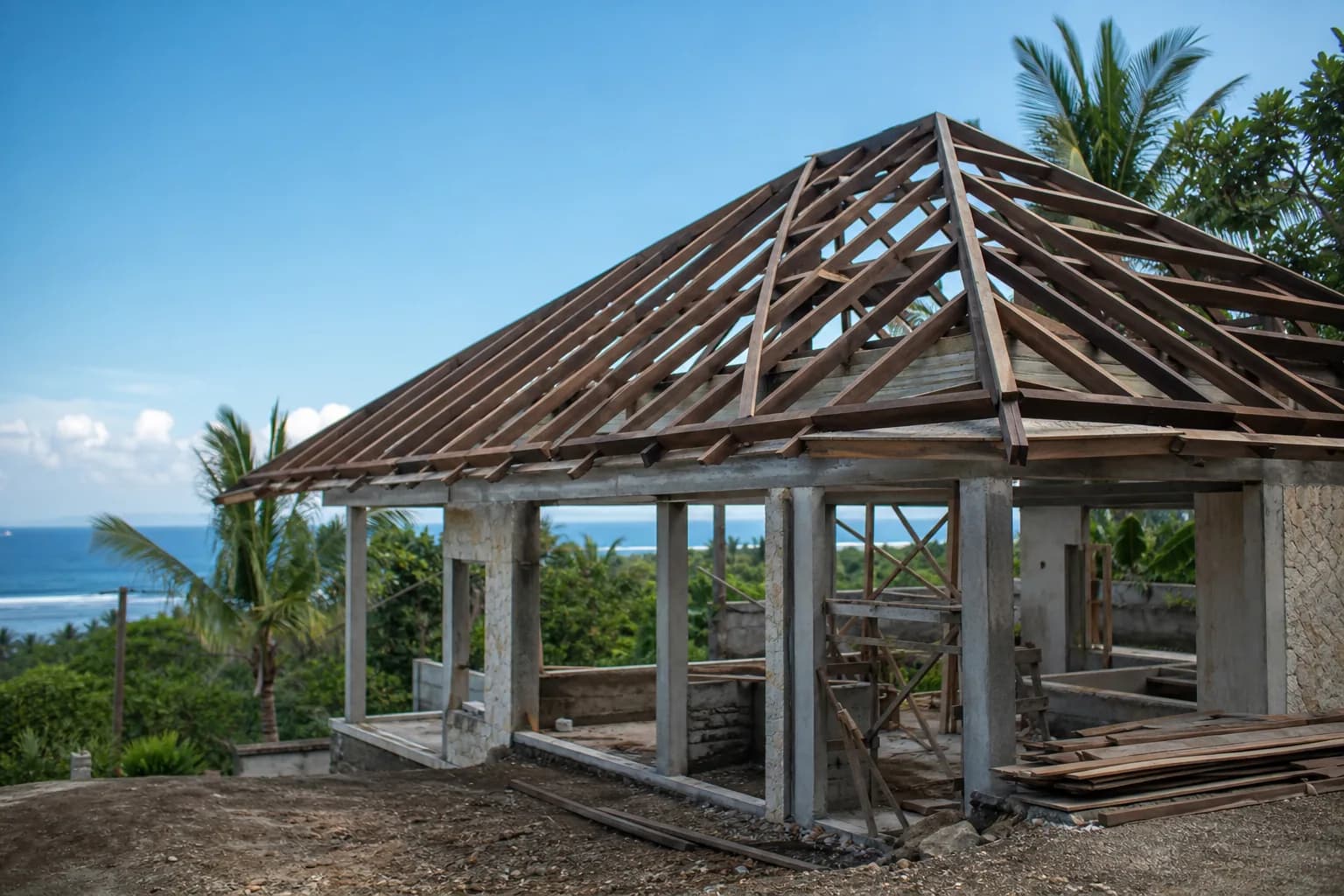
Bali’s signature wide-eave tropical roofs create substantial uplift forces. A typical 3-meter roof overhang experiences negative pressure coefficients (Cp) of -1.8 to -2.2 on the windward edge during storm conditions. For a 200 m² villa roof with 2.5-meter overhangs, this translates to approximately 15-18 kN of uplift force on exposed eave sections—equivalent to suspending a 1,500 kg vehicle from your roof edge. Traditional Balinese timber joinery without engineered steel connections cannot resist these forces, explaining why you see torn-off roof sections after every major storm season.
Typhoon-Rating vs. Standard Construction
While Bali doesn’t experience true typhoons (cyclones rarely form within 5° of the equator), the term “typhoon-rated” in construction specifications refers to wind resistance exceeding 150 km/h sustained winds with gusts to 185 km/h—roughly equivalent to Category 2 hurricane standards. This requires:
- Continuous load path engineering: Every structural element from roof membrane to foundation must transfer wind loads without weak points
- Steel reinforcement schedules: Minimum D16 rebar at 150mm centers in ring beams, with hurricane ties connecting roof trusses to structural columns
- Fastener specifications: Stainless steel A4-grade bolts and brackets rated for 8+ kN pullout resistance in concrete
- Membrane attachment: Mechanically fastened or fully-adhered systems, never just ballasted weight
Standard Bali construction uses gravity-based roof systems where weight alone resists uplift—adequate for inland sites but catastrophically inadequate for Jimbaran’s wind environment. The engineering difference isn’t subtle: typhoon-rated construction requires approximately 40-60% more structural steel and 25-35% more labor for connection detailing.
Hidden Risks: What Developers Miss in Jimbaran Coastal Projects
The most expensive mistake in Jimbaran villa construction is assuming your architect’s beautiful renderings account for wind engineering. Most architectural firms provide aesthetic designs with structural notes like “engineer to local standards”—which contractors interpret as minimum-cost compliance rather than performance-based design for actual site conditions.
The IMB Permit Gap
Indonesia’s Izin Mendirikan Bangunan (IMB) building permit process requires structural calculations, but enforcement focuses on seismic loads (Bali is Zone 6 seismic) rather than wind loads. Your IMB approval doesn’t guarantee wind-appropriate engineering—it confirms you submitted calculations, not that those calculations reflect Jimbaran’s coastal exposure. We’ve reviewed dozens of permitted designs using Exposure B wind loads for beachfront sites that clearly require Exposure D analysis.
Material Substitution During Construction
Specifications call for stainless steel hurricane ties; the contractor installs galvanized mild steel to save Rp 15 million. Your roof connections corrode within 18 months in salt air, losing 60% of rated capacity before the first major storm. This substitution pattern repeats across fasteners, sealants, and membrane grades—each degrading wind resistance while remaining visually identical during construction inspection.
The “Bali Style” Structural Conflict
Clients request dramatic cantilevers, floating roof planes, and minimal visible structure—all working against wind load requirements. A 4-meter cantilevered roof edge requires either massive hidden steel (expensive) or visible knee braces (aesthetically rejected). The compromise is often undersized structure that looks perfect but fails structurally. Jimbaran’s clifftop sites amplify this issue: the views demand glass walls and open pavilions, but wind engineering requires solid shear walls and braced frames.
Step-by-Step Process: Engineering Wind-Resistant Roofs for Jimbaran Sites
Step 1: Site-Specific Wind Assessment (Week 1-2)
Commission a qualified structural engineer to perform site wind analysis before architectural design begins. This assessment should include:
- Topographic survey identifying elevation, distance from coastline, and surrounding terrain
- Exposure category determination per ASCE 7 or SNI 1727 methodology
- Basic wind speed selection with appropriate return period (50-year minimum, 100-year recommended for high-value villas)
- Preliminary design wind pressure calculations for various roof geometries
Cost: $1,200-2,400 for professional wind engineering study. This investment prevents $40,000-80,000 in structural redesign after architectural plans are complete.
Step 2: Integrated Structural-Architectural Design (Week 3-8)
Your architect and structural engineer must work simultaneously, not sequentially. The structural engineer provides maximum cantilever limits, required shear wall locations, and column grid constraints before the architect finalizes spatial layouts. For Jimbaran projects, this typically means:
- Limiting roof overhangs to 2.0-2.5 meters without supplementary steel bracing
- Incorporating structural walls at 6-8 meter intervals to resist lateral wind loads
- Designing roof slopes of 15-25 degrees (lower slopes reduce wind uplift compared to traditional steep Balinese roofs)
- Specifying continuous ridge beams and perimeter ring beams with full structural connection details
Step 3: Material Specification for Coastal Environment (Week 9-10)
Standard material specifications fail in Jimbaran’s salt-air environment. Your engineer must specify:
- Stainless steel grade A4 (316) for all exposed fasteners and connections—not A2 (304) which corrodes in coastal conditions
- Hot-dip galvanized structural steel minimum Z350 coating for roof trusses and framing
- Concrete minimum K-300 grade with 50mm cover over reinforcement in all exposed elements
- Mechanically-fastened or fully-adhered roof membranes—specify fastener spacing at 150mm centers for perimeter zones
Step 4: IMB Submission with Wind Load Documentation (Week 11-14)
Submit building permit applications to Badung Regency with complete structural calculations including wind load analysis. Ensure your submission package includes:
- Signed and stamped calculations from an Indonesian-licensed structural engineer (SIPIL certification)
- Wind load calculation sheets showing exposure category, velocity pressure, and component design
- Connection details for all roof-to-wall and wall-to-foundation interfaces
- Material specifications with coastal-grade requirements clearly noted
Processing time: 6-10 weeks for Jimbaran area IMB permits, assuming complete documentation.
Step 5: Construction Supervision and Testing (Month 4-10)
Wind-resistant construction requires inspection at critical stages:
- Foundation completion: Verify anchor bolt placement and embedment depth before concrete pour
- Structural frame erection: Inspect all bolted connections for proper torque and washer installation
- Roof membrane installation: Verify fastener type, spacing, and penetration depth
- Final testing: Commission pull-tests on representative roof connections (minimum 3 locations) to verify 1.5x design load capacity
Teville’s construction supervision includes structural inspection at each critical stage, with photographic documentation of concealed connections before they’re covered. Review our construction process methodology for quality control protocols.
Realistic Cost Analysis: Typhoon-Rated Roofing for Jimbaran Villas
Wind-engineered roof systems cost significantly more than standard Bali construction, but the premium is predictable and justifiable:
Structural Engineering Fees
- Basic structural design (standard inland villa): $3,500-5,000
- Wind-engineered design (Jimbaran coastal): $6,500-9,500
- Premium increase: 60-85% for comprehensive wind analysis and connection detailing
Roof Structure Costs (per m² of roof area)
- Standard Bali timber roof with clay tiles: $180-240/m²
- Wind-rated steel truss with hurricane ties: $280-360/m²
- Typhoon-rated steel frame with engineered membrane: $420-580/m²
For a typical 250 m² roof area (covering approximately 180 m² villa footprint with overhangs), expect:
- Standard construction: $45,000-60,000
- Wind-engineered construction: $70,000-90,000
- Premium typhoon-rated system: $105,000-145,000
Long-Term Cost Perspective
The $40,000-60,000 premium for proper wind engineering represents 4-6% of total villa construction cost ($800,000-1,200,000 typical range for quality Jimbaran villas). Compare this to:
- Emergency roof repairs after storm damage: $25,000-80,000
- Insurance deductibles and premium increases: $8,000-15,000 annually
- Rental income loss during repairs: $12,000-30,000 (3-6 month closure)
- Structural damage to interior from water intrusion: $40,000-120,000
The engineering premium pays for itself if it prevents a single major storm failure. For detailed cost estimation specific to your Jimbaran site, use our construction cost calculator with coastal engineering options selected.
Frequently Asked Questions: Jimbaran Wind Engineering
Do I need typhoon-rated construction if my Jimbaran site is 500 meters from the beach?
Distance from coastline matters, but elevation and terrain exposure matter more. A clifftop site 500 meters inland with unobstructed southwestern exposure requires similar wind engineering to beachfront properties. Sites in Jimbaran’s protected valleys (near Udayana University area) may qualify for reduced wind loads, but this requires site-specific engineering assessment—never assume reduced requirements without professional analysis. The elevation difference between Jimbaran Beach and clifftop sites like Tegal Wangi creates wind acceleration zones that actually increase design pressures despite being “inland.”
Can I use traditional Balinese alang-alang thatch roofing in Jimbaran’s wind environment?
Alang-alang thatch is architecturally beautiful but structurally problematic for high-wind coastal sites. Traditional thatch installation uses bamboo battens and rattan ties—adequate for inland protected sites but insufficient for Jimbaran wind loads. If you require thatch aesthetics, specify a hybrid system: engineered structural roof deck with proper wind connections, topped with thatch as a non-structural finish layer. This approach costs $320-450/m² versus $180-240/m² for traditional thatch, but provides wind resistance while maintaining visual character. Expect thatch replacement every 4-6 years in coastal salt air regardless of structural system.
How do Jimbaran wind loads compare to Uluwatu or Pecatu areas?
Uluwatu and Pecatu clifftop sites face similar or greater wind exposure than Jimbaran Bay—both require Exposure D calculations for properties within 200 meters of cliff edges. The key difference is elevation: Uluwatu’s 70-100 meter cliff heights create more severe wind acceleration than Jimbaran’s 15-40 meter elevations. If you’re considering land in multiple southern Bali locations, budget 15-20% higher structural costs for Uluwatu clifftop sites versus comparable Jimbaran locations. Review available <
 3127 m²9 month(s)from 177.000 USD
Mukunda
 3180 m²7 month(s)from 142.000 USD
Vasudeva

Want to calculate?
 1from 198.000 USD
Private: Haridas Villas
 164 m²7 month(s)from 79.000 USD
Private: Haridas Villas, Tegallalang
 3173 m²6 month(s)from 125.000 USD
TALA FOUR
 3124 m²6 month(s)from 123.000 USD
TALA 8
 172 m²8 month(s)from 120.000 USD
Keshava
 2144 m²11 month(s)from 104.000 USD
Narayana
 4344 m²16 month(s)from 290.000 USD
Radha
 3104 m²11 month(s)from 99.000 USD
TALA 100
164 m²7 month(s)from 79.000 USDTALA TWO
Start With Real Numbers, Not Guesses
Before buying land or finalizing a design, check the realistic build cost range for your project in Bali.
Our team reviews your inputs and gives a grounded estimate.
Available lands
 220 m²2 min$ 66565Bali, Cemagi
 3000 m²15 min$ 1246921Bali, Tabanan
 3100 m²15 min$ 257697Bali, Tegallalang
 7900 m²25 min$ 413485Bali, Tabanan
 2400 m²7 min$ 496552Bali, Canggu
 6000 m²30 min$ 55419Bali, Tabanan
 325 m²15 min$ 44472Bali, Ungasan
 8313 m²15 min$ 716670Bali, Buduk
 1362 m²15 min$ 335468Bali, Tumbak
 2000 m²15 min$ 523000Bali, Canggu
 1200 m²2 min$ 155172Bali, Klungkung
 2000 m²5 min$ 738916Bali, Ungasan
 2230 m²15 min$ 410573Bali, Padonan
 18900 m²2 min$ 6912931Bali, Pecatu
 3300 m²15 min$ 449889Bali, Tabanan
Essential Bali build & buy guides
- Bali villa construction cost per m² in 2026
- How much will your villa cost? Calculator
- Building a villa in Bali: the complete guide
- Buying land in Bali: step-by-step for foreigners
- Bali villa investment: yields, risks, returns
- Leasehold vs freehold: what foreigners can own
- Construction defect liability & 10-year warranty
- Bali building codes and construction standards
Related guides
Energy-Efficient Villa in Bali: Solar, Insulation and Passive Cooling That Pay Back
Which energy-efficiency measures actually pay back in Bali's tropical climate — passive design and roof insulation first, efficient equipment second, and self-consumption solar last — with honest 2026 numbers.
7 min read
Choosing a General Contractor in Bali: Red Flags, Questions and Contract Must-Haves
A practical filter for hiring a general contractor in Bali: the red flags that end conversations, the questions professionals answer with documents, and the contract clauses no villa build should start without.
7 min read
Construction Cost Overruns in Bali: Why Budgets Blow Up — and the Contract Terms That Prevent It
Most Bali construction budgets do not blow up in one disaster — they leak through vague scope, unpriced change orders and open-ended contracts. The real causes of cost overruns, and the specific contract terms, payment structure and contingency planning that prevent them.
8 min read