Gravity vs Pump Greywater Systems: Bali Sloped Site
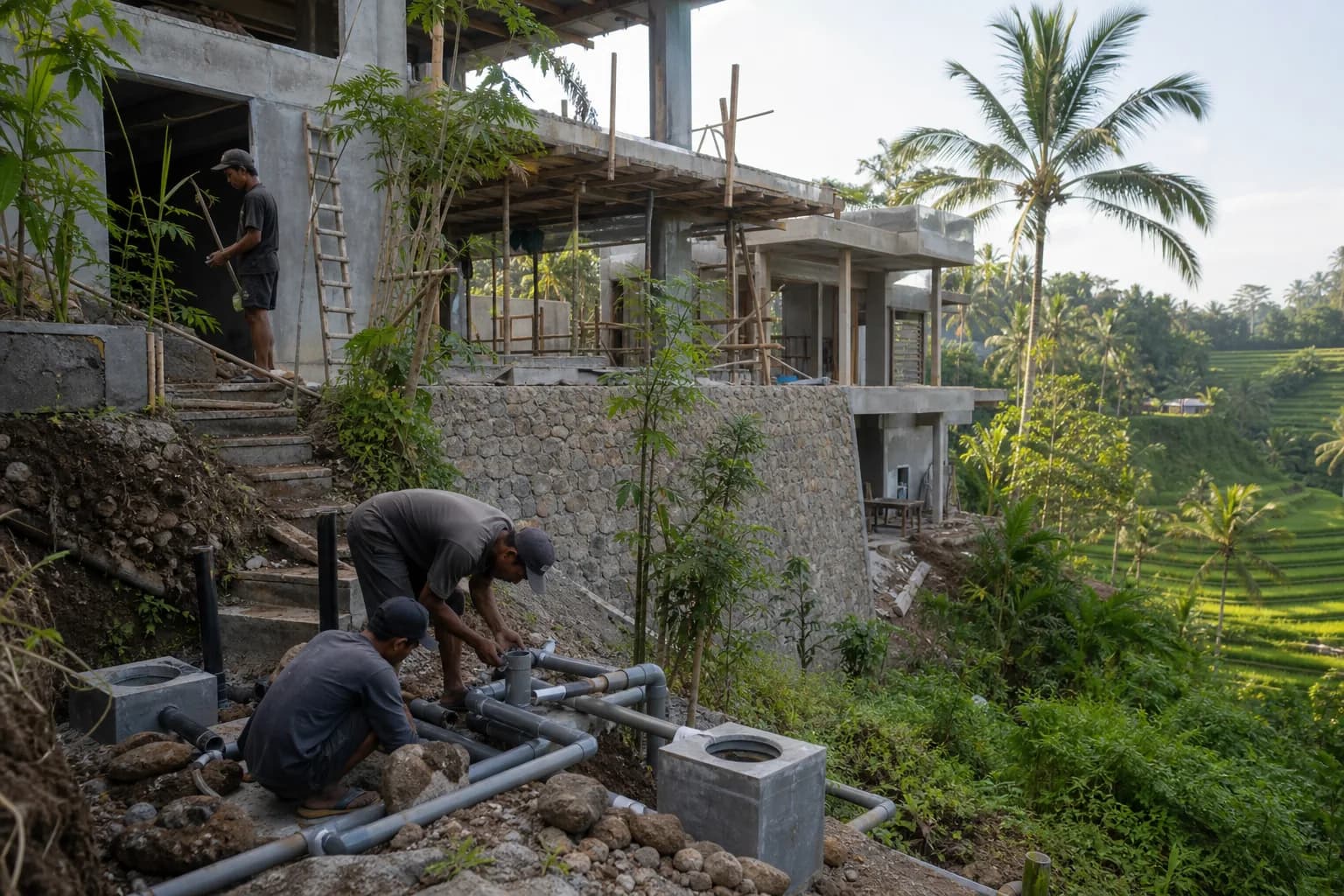
Gravity vs Pump Greywater Systems: Bali Sloped Site Installation
When designing plumbing systems for hillside villas in Bali’s Ubud, Canggu, or Uluwatu regions, the choice between gravity-fed and pump-driven greywater systems becomes critical. Many villa sites feature dramatic slopes that seem ideal for gravity drainage, yet the reality of achieving consistent 2% gradients (1/4 inch per foot) across terraced foundations often proves impossible without extensive structural modifications. The question facing villa developers in 2026 isn’t whether slope exists, but whether natural topography alone can reliably move greywater from bathrooms, kitchens, and laundry facilities to treatment systems or irrigation zones without pump assistance—a decision that impacts both initial construction costs and long-term system reliability in Bali’s tropical climate.
Technical Deep Dive: Understanding Greywater Flow Dynamics on Bali Slopes
Greywater systems in Bali villa construction must handle wastewater from showers, sinks, and washing machines while excluding toilet waste. The fundamental physics governing system selection involves flow velocity, pipe diameter, and gradient consistency—factors complicated by Bali’s terraced construction methods and volcanic soil conditions.
Gravity System Requirements and Limitations
Pure gravity systems require minimum 2% slope (20mm drop per meter) for 50mm diameter pipes, increasing to 3% for 40mm pipes to prevent sediment accumulation. On paper, a villa site with 15-degree natural slope appears perfect for gravity drainage. However, Bali’s typical construction reality involves multiple floor levels, split-level designs, and foundation stepping that creates localized flat zones or even reverse slopes within the overall downward trajectory.
The critical challenge emerges in bathroom pod installations. A master bathroom positioned mid-slope may sit on a foundation pad that’s perfectly level for tile installation. To achieve gravity flow from this level pad to a downslope collection point requires either: routing pipes through structural beams (compromising integrity), creating raised floor sections (reducing ceiling heights in tropical designs where ventilation matters), or installing external pipe runs that become maintenance nightmares in Bali’s humid, vegetation-heavy environment.
Tropical climate factors further complicate gravity systems. Bali’s biofilm growth in slow-moving greywater pipes occurs within 3-4 weeks during rainy season, compared to 8-12 weeks in temperate climates. Insufficient flow velocity (below 0.6 m/s) allows soap scum, hair, and organic matter to accumulate, creating blockages that gravity alone cannot clear. The 2% minimum gradient assumes clean water flow—greywater’s higher viscosity and particulate content actually requires 2.5-3% slopes for reliable long-term operation.
Pump System Advantages in Sloped Terrain
Modern greywater pump systems for MEP systems Bali installations utilize compact sump chambers (60-80 liter capacity) positioned at convenient low points, with pumps forcing water uphill or across flat sections to reach treatment zones. This approach offers several advantages on sloped sites: bathroom fixtures can drain to nearby collection points regardless of foundation level, pipe runs can follow structurally sound paths rather than forcing gradient requirements, and flow velocity remains consistently high (1.2-1.5 m/s) preventing biofilm accumulation.
Contemporary pump technology has evolved significantly. Grundfos Sololift2 and similar systems designed for greywater applications feature grinder mechanisms handling hair and small debris, automatic float switches, and sealed units preventing odor escape. Power consumption averages 400-600 watts during 2-3 minute pump cycles, translating to minimal electrical costs (approximately 15,000-25,000 IDR monthly for typical villa usage).
The key consideration for Bali installations involves backup power integration. Pump systems require either battery backup or generator connection to maintain function during Bali’s occasional power interruptions. This adds complexity but ensures system reliability during the rainy season when greywater volumes peak and drainage becomes most critical.
Installation Process: Implementing Each System Type
Gravity System Installation on Sloped Sites
Gravity system installation begins during foundation work, requiring precise coordination between structural and plumbing teams. The process for finishing works Bali projects follows this sequence:
Step 1: Slope Analysis and Pipe Routing – Survey actual foundation levels after concrete curing, not design drawings. Use laser levels to verify continuous downward gradient from each fixture group to collection points. Map routes avoiding structural penetrations through load-bearing beams. On Bali sites, this often means external pipe runs along retaining walls or through landscaped areas.
Step 2: Pipe Installation and Support – Install 50mm uPVC Schedule 40 pipes (minimum wall thickness 3.0mm for tropical UV exposure) with joints every 3 meters maximum. Use stainless steel hangers (grade 316 for coastal areas) with rubber isolation to prevent pipe movement noise. Maintain consistent 2.5% gradient verified at each support point—critical because Bali’s soil settlement can alter gradients within first year.
Step 3: Inspection Chambers and Cleanouts – Position 300mm inspection chambers every 10 meters and at each direction change exceeding 45 degrees. Bali’s vegetation growth requires accessible cleanout points—buried chambers become impossible to locate within 6 months. Install chambers with extended risers to finished grade level, using lockable covers to prevent debris entry.
Step 4: Testing and Commissioning – Conduct water flow testing at full fixture flow rates (12 liters/minute for showers, 8 liters/minute for sinks) to verify velocity and identify slow sections. This reveals gradient errors before landscaping covers pipe runs.
Pump System Installation Process
Step 1: Sump Chamber Positioning – Install 80-liter polyethylene sump chambers at convenient low points near bathroom clusters. Position 300-500mm below finished floor level, with access hatches flush-mounted in floor or external wall access panels. Chambers require 50mm ventilation pipes extending above roof level to prevent pressure buildup and odor issues.
Step 2: Pump Selection and Installation – Mount greywater pumps on chamber bases using vibration-dampening mounts. Connect inlet pipes with flexible couplings allowing pump removal for maintenance. Install check valves on discharge lines preventing backflow. For Bali coastal areas, specify pumps with stainless steel impellers and seals rated for high-humidity environments.
Step 3: Electrical Integration – Run dedicated 220V circuits with RCD protection (30mA trip current) to each pump location. Install waterproof junction boxes rated IP65 minimum. Integrate float switches with 100mm differential between pump-on and pump-off levels, preventing short-cycling that reduces pump lifespan.
Step 4: Discharge Routing and Backup Power – Route discharge pipes to treatment systems or irrigation zones using 32mm pressure-rated pipes. Install battery backup systems (12V 100Ah deep-cycle batteries with automatic chargers) or generator transfer switches ensuring pump operation during power outages.
Materials & Specifications for Tropical Performance
Material selection for plumbing system Bali installations must account for UV exposure, humidity, and soil chemistry:
Pipe Materials: uPVC Schedule 40 (3.0mm wall thickness minimum) for all gravity drainage. Avoid thin-wall DWV pipe—Bali’s UV intensity degrades exposed pipes within 18 months. For pump discharge lines, use Schedule 80 uPVC or HDPE pressure pipe rated 6 bar minimum. All external pipes require UV-stabilized formulations with titanium dioxide content above 2%.
Pump Specifications: Greywater pumps must feature: 400-600 watt motors, automatic float switches, grinder mechanisms for hair/debris, sealed units preventing odor escape, and stainless steel (grade 316) wetted components for coastal installations. Recommended models include Grundfos Sololift2 D-2, SFA Sanivite, or equivalent systems with proven tropical performance records.
Sump Chambers: Polyethylene chambers (80-100 liter capacity) with sealed lids, integrated ventilation connections, and removable pump bases. Avoid concrete chambers in Bali—groundwater infiltration and cracking from soil movement create maintenance issues. Chamber walls should be minimum 8mm thickness with UV-stabilized resin.
Fittings and Connections: Use solvent-welded joints for all permanent connections. Rubber compression fittings deteriorate in 2-3 years under Bali conditions. Install unions at pump connections and key maintenance points. All metal components (hangers, clamps, fasteners) must be stainless steel grade 316 or hot-dip galvanized—standard galvanizing fails within 12 months in coastal humidity.
Cost Breakdown: Investment Analysis for Each System
Realistic pricing for villa renovation Bali greywater systems (2026 rates, excluding VAT):
Gravity System Costs
- uPVC pipe and fittings (50mm, per meter installed): 85,000-120,000 IDR
- Inspection chambers (300mm, installed): 450,000-650,000 IDR each
- Stainless steel hangers and supports: 35,000-50,000 IDR per support point
- Labor (skilled plumber, per day): 350,000-500,000 IDR
- Typical 3-bathroom villa (40 meters pipe run): 8,500,000-12,000,000 IDR total
Pump System Costs
- Greywater pump unit (Grundfos/SFA quality): 8,500,000-12,500,000 IDR
- Sump chamber (80L polyethylene, installed): 1,800,000-2,500,000 IDR
- Electrical work (dedicated circuit, RCD protection): 1,200,000-1,800,000 IDR
- Battery backup system (optional): 3,500,000-5,000,000 IDR
- Discharge piping (32mm pressure pipe, 20 meters): 1,500,000-2,200,000 IDR
- Typical 3-bathroom villa (2 pump stations): 24,000,000-35,000,000 IDR total
Operating costs differ significantly: gravity systems require annual cleaning (500,000-800,000 IDR) while pump systems add electricity (300,000 IDR annually) plus pump replacement every 7-10 years (9,000,000 IDR). Over 15-year lifespan, gravity systems cost approximately 18,000,000 IDR total versus pump systems at 42,000,000 IDR—but this assumes gravity systems function reliably without gradient modifications.
Common Mistakes and Prevention Strategies
Mistake 1: Assuming Site Slope Equals Pipe Gradient – Villa developers see 20-degree hillside slopes and specify gravity systems, overlooking that individual foundation pads are level. Prevention: Conduct post-foundation laser surveys verifying actual pipe routing gradients before committing to gravity-only design. Budget for pump systems if continuous 2.5% gradient cannot be achieved without structural compromises.
Mistake 2: Undersized Gravity Pipes – Using 40mm pipes to reduce costs creates chronic blockage issues in Bali’s biofilm-prone environment. Prevention: Specify 50mm minimum diameter for all greywater mains, increasing to 75mm for runs exceeding 15 meters or serving more than 3 bathrooms. The material cost difference (30,000 IDR per meter) is negligible compared to annual cleaning expenses.
Mistake 3: Inadequate Pump Ventilation – Sealed sump chambers without proper ventilation create pressure buildup, forcing sewer gases through fixture traps into living spaces. Prevention: Install 50mm ventilation pipes from each sump chamber extending minimum 500mm above roof level, with insect screens preventing pest entry. Position vents away from outdoor living areas.
Mistake 4: Single Pump for Multiple Bathrooms – Routing all greywater to one central pump creates single-point failure risk and requires extensive pipe runs. Prevention: Install distributed pump stations serving bathroom clusters, limiting each pump to 2-3 fixtures maximum. This reduces pipe complexity and provides redundancy if one pump fails.
Mistake 5: No Backup Power Planning – Pump systems without backup power fail during rainy season power outages when drainage is most critical. Prevention: Integrate battery backup (12V 100Ah deep-cycle) with automatic switching, or connect pumps to villa generator circuits with priority switching ensuring pump operation before non-essential loads.
Frequently Asked Questions
Can I convert a gravity system to pump-assisted if drainage problems develop?
Yes, retrofit pump installations are common in villa renovation Bali projects. The process involves installing sump chambers at existing low points, cutting into gravity pipes to redirect flow into sumps, and adding pump discharge lines to original drainage routes. Costs range 15,000,000-22,000,000 IDR per pump station including electrical work. This approach salvages existing pipe infrastructure while solving gradient inadequacy issues. Teville regularly performs these conversions on properties where original gravity systems failed due to insufficient slope or biofilm accumulation.
How do pump systems perform during Bali’s frequent power outages?
Without backup power, pump systems cease functioning during outages, with sump chambers providing temporary storage (80-100 liters typically). For average villa usage, this provides 4-6 hours buffer before overflow risk. Battery backup systems (3,500,000-5,000,000 IDR installed) extend operation to 24-48 hours depending on usage. Generator integration offers unlimited runtime but requires proper transfer switching. Most Teville projects in areas with unreliable power include battery backup as standard specification, particularly for coastal Canggu and Uluwatu locations where outages exceed 2 hours monthly.
What maintenance differences exist between gravity and pump systems?
Gravity systems require annual professional cleaning (500,000-800,000 IDR) involving high-pressure jetting to remove biofilm and sediment accumulation. Inspection chambers need quarterly checking during rainy season. Pump systems require 6-monthly sump chamber cleaning (300,000-400,000 IDR), annual pump inspect

Want to calculate?
 4344 m²16 month(s)from 290.000 USD
Radha
 164 m²7 month(s)from 79.000 USD
TALA TWO
 3124 m²6 month(s)from 123.000 USD
TALA 8
 3173 m²6 month(s)from 125.000 USD
TALA FOUR
 3127 m²9 month(s)from 177.000 USD
Mukunda
 3180 m²7 month(s)from 142.000 USD
Vasudeva
 172 m²8 month(s)from 120.000 USD
Keshava
 2144 m²11 month(s)from 104.000 USD
Narayana
164 m²7 month(s)from 79.000 USDPrivate: Haridas Villas, Tegallalang
 3104 m²11 month(s)from 99.000 USD
TALA 100
 1from 198.000 USD
Private: Haridas Villas
Start With Real Numbers, Not Guesses
Before buying land or finalizing a design, check the realistic build cost range for your project in Bali.
Our team reviews your inputs and gives a grounded estimate.
Available lands
 2000 m²5 min$ 1440887Bali, Pecatu
 610 m²10 min$ 165271Bali, Seminyak
 1000 m²10 min$ 303571Bali, Tabanan
 3300 m²15 min$ 449889Bali, Tabanan
 700 m²15 min$ 90517Bali, Central Bali
 2680 m²10 min$ 1732759Bali, Pererenan
 1410 m²15 min$ 390702Bali, Tabanan
 700 m²8 min$ 165517Bali, Umalas
 3100 m²20 min$ 272968Bali, Tabanan
 325 m²15 min$ 44472Bali, Ungasan
 204 m²5 min$ 40899Bali, Kedungu
 1375 m²10 min$ 447044Bali, Canggu
 750 m²15 min$ 187038Bali, Kerobokan
 1230 m²15 min$ 132543Bali, Tegallalang
 1100 m²8 min$ 280419Bali, Ungasan
Essential Bali build & buy guides
- Bali villa construction cost per m² in 2026
- How much will your villa cost? Calculator
- Building a villa in Bali: the complete guide
- Buying land in Bali: step-by-step for foreigners
- Bali villa investment: yields, risks, returns
- Leasehold vs freehold: what foreigners can own
- Construction defect liability & 10-year warranty
- Bali building codes and construction standards
Related guides
Villa Handover in Bali: Snagging Checklist and What to Test Before Final Payment
A disciplined villa handover in Bali: room-by-room snagging tests, numbered defect documentation, the PBG/SLF and warranty documents to insist on, and payment terms that keep leverage until the list is closed.
7 min read
Energy-Efficient Villa in Bali: Solar, Insulation and Passive Cooling That Pay Back
Which energy-efficiency measures actually pay back in Bali's tropical climate — passive design and roof insulation first, efficient equipment second, and self-consumption solar last — with honest 2026 numbers.
7 min read
Choosing a General Contractor in Bali: Red Flags, Questions and Contract Must-Haves
A practical filter for hiring a general contractor in Bali: the red flags that end conversations, the questions professionals answer with documents, and the contract clauses no villa build should start without.
7 min read