Denpasar Seismic Building Code Retrofit Costs Bali
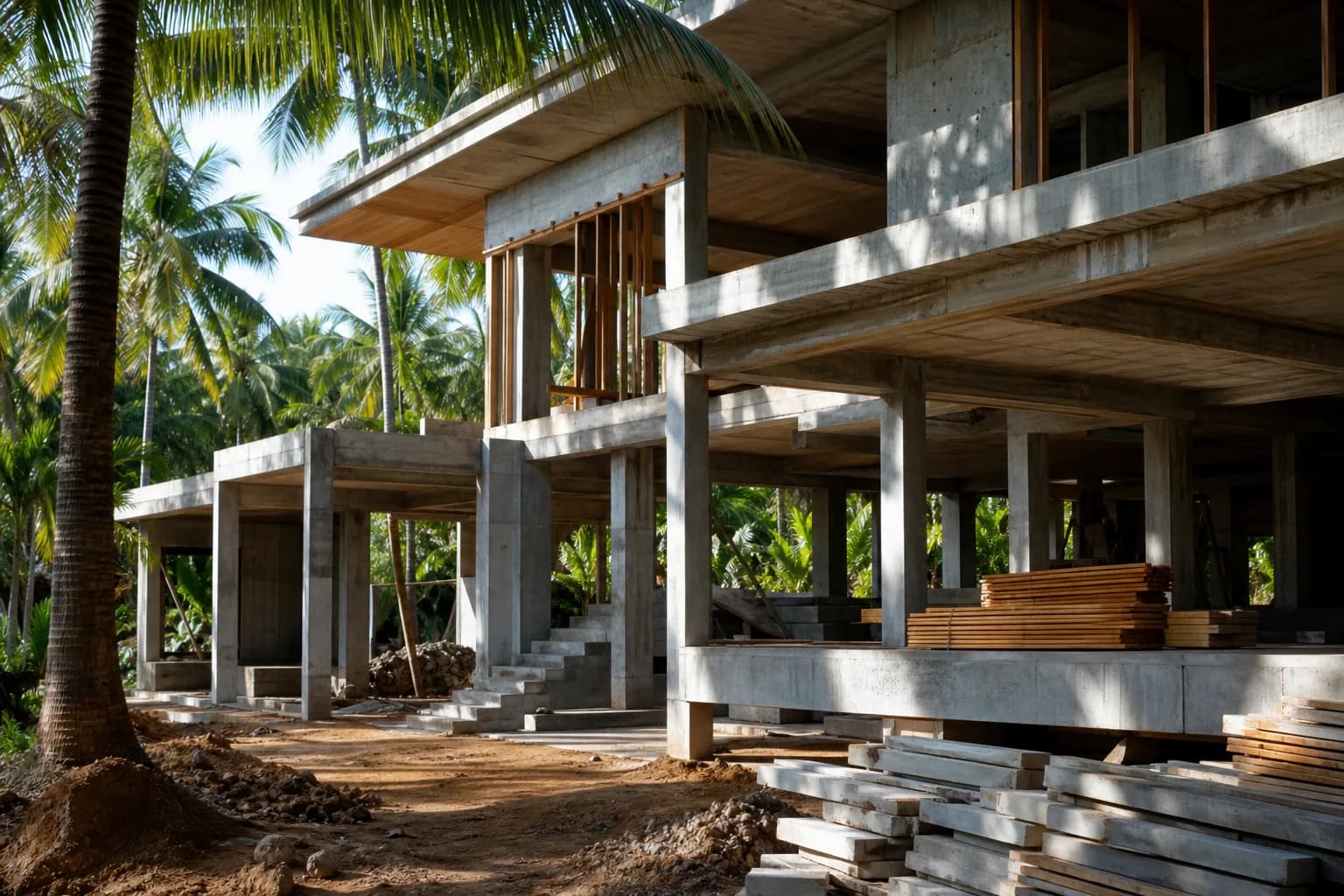
Why Denpasar’s Seismic Classification Changes Everything for Your Villa Construction Budget
Denpasar sits within Indonesia’s designated seismic zone 4—the second-highest earthquake risk classification in the national building code system. This technical designation isn’t administrative paperwork; it fundamentally alters structural engineering requirements, foundation depth calculations, reinforcement schedules, and construction costs for every villa project. Property developers who budget for standard tropical construction without accounting for Denpasar’s seismic load factors face mid-project cost escalations of 18-27% when engineers identify non-compliant structural designs. The question isn’t whether seismic codes apply to your Denpasar villa—it’s whether your construction partner understands the specific SNI 1726 and SNI 2847 requirements that govern reinforced concrete design in this seismic zone, and how retrofit obligations affect existing structures you’re considering for renovation.
Technical Requirements: SNI Seismic Standards for Denpasar Construction
Indonesia’s National Standardization Agency (Badan Standardisasi Nasional) mandates compliance with SNI 1726:2019 for seismic load calculations and SNI 2847:2019 for structural concrete design in earthquake zones. Denpasar’s classification requires specific engineering responses that directly impact construction methodology and material quantities.
Seismic Design Category and Ground Motion Parameters
Denpasar falls within Seismic Design Category D under SNI 1726, requiring special moment-resisting frames for reinforced concrete structures. The peak ground acceleration (PGA) values for Denpasar range from 0.4g to 0.5g depending on precise location and soil classification. This means structural engineers must design for lateral forces equivalent to 40-50% of the building’s weight acting horizontally—a calculation that fundamentally changes column dimensions, beam reinforcement, and foundation design compared to non-seismic construction.
Soil classification becomes critical in Denpasar’s varied geology. The coastal areas near Sanur typically present Site Class D or E soils (stiff soil or soft clay), which amplify seismic waves and require additional structural capacity. Projects on these soil types need geotechnical investigations to depths of 30 meters minimum, with soil boring reports documenting shear wave velocity and bearing capacity under dynamic loading conditions.
Mandatory Structural Elements for Seismic Compliance
Denpasar villa construction under current seismic codes requires specific structural configurations that differ markedly from standard tropical residential design. Moment-resisting frames must connect beams and columns with continuous reinforcement through joints, creating ductile connections that absorb earthquake energy through controlled deformation rather than brittle failure. This requires minimum column dimensions of 300mm x 300mm for two-story structures, with longitudinal reinforcement ratios between 1.0% and 6.0% of the gross column area.
Beam-column joints—the critical zones where seismic forces concentrate—must include closed stirrup confinement at 100mm spacing within joint regions, compared to 200-300mm spacing in non-seismic designs. This doubling of transverse reinforcement alone increases steel quantities by 15-20% in structural frames. Foundation systems must incorporate tie beams (sloof) connecting all column bases in both directions, preventing differential movement during ground shaking. These tie beams require minimum dimensions of 200mm x 300mm with continuous top and bottom reinforcement.
Material Specifications and Quality Control
Seismic design in Denpasar mandates concrete compressive strength minimums of K-300 (approximately 25 MPa) for structural elements, compared to K-225 often used in non-critical construction. Steel reinforcement must meet SNI 2052 specifications for deformed bars with minimum yield strength of 400 MPa and specific ductility characteristics measured by elongation ratios. The code prohibits smooth bar reinforcement in primary structural elements due to inadequate bond strength under cyclic loading.
Quality control requirements escalate significantly: concrete cylinder testing at 7, 14, and 28 days for every 50 cubic meters poured, reinforcement mill certificates verifying steel grade and chemical composition, and mandatory structural inspections at foundation, frame, and roof stages by certified engineers. These quality assurance protocols add 3-5% to construction timelines but prevent the catastrophic failures observed in substandard construction during the 2018 Lombok earthquakes 100 kilometers east of Denpasar.
Hidden Risks: What Property Developers Miss in Seismic Compliance
The most expensive mistakes in Denpasar villa construction stem from misunderstanding how seismic requirements interact with Bali’s tropical building traditions and foreign ownership structures.
The Leasehold Retrofit Trap
Foreign buyers acquiring existing villas through leasehold arrangements rarely conduct seismic compliance audits before purchase. Many older structures built before 2012—when Indonesia updated seismic maps and strengthened code enforcement—lack adequate lateral bracing, proper beam-column detailing, or sufficient foundation tie systems. Discovering these deficiencies after lease execution creates a financial dilemma: investing $45,000-$85,000 in structural retrofits for a property you don’t own, or operating a villa that may not survive a moderate earthquake. Lease agreements seldom specify responsibility for seismic upgrades, leaving foreign lessees exposed to both financial loss and potential liability if structural failure causes injury.
The IMB Inspection Reality
Building permits (Izin Mendirikan Bangunan) in Denpasar now require structural engineering calculations stamped by Indonesian-licensed civil engineers with earthquake design certification. Generic architectural drawings without seismic load analysis will be rejected at the permit stage. However, many developers only discover this after purchasing land and commissioning preliminary designs from architects unfamiliar with SNI seismic standards. The resulting redesign process adds 6-10 weeks and $8,000-$15,000 in engineering fees to projects that assumed architectural drawings would suffice for permitting.
The Open-Plan Seismic Conflict
Contemporary villa designs favor open-plan layouts with minimal interior walls and large glass openings—aesthetically appealing but structurally problematic in seismic zones. Removing walls eliminates shear resistance, forcing structural frames to carry all lateral loads. This requires larger columns, deeper beams, and more complex foundation systems that conflict with the visual lightness clients expect. Developers who insist on fully open ground floors without understanding the structural implications face either significant cost increases for heavy structural frames or dangerous compromises in seismic capacity. The engineering solution—strategic placement of reinforced concrete core walls around stairwells and service areas—requires early integration into architectural design, not post-design addition.
Step-by-Step Process: Ensuring Seismic Compliance in Your Denpasar Villa Project
Phase 1: Site-Specific Seismic Assessment (Weeks 1-3)
Before architectural design begins, commission a geotechnical investigation with seismic parameters. The soil boring report must document soil classification per SNI 1726 Table 3, determine site class (typically C, D, or E in Denpasar), and provide bearing capacity under both static and seismic loading conditions. This investigation costs $2,800-$4,500 for typical villa sites but prevents foundation redesign later. Request specific seismic design parameters including mapped spectral acceleration values (Ss and S1) for your exact coordinates—these vary across Denpasar’s districts and directly affect structural design requirements.
Phase 2: Integrated Structural-Architectural Design (Weeks 4-10)
Engage structural engineers simultaneously with architects, not sequentially. The structural engineer should hold Indonesian certification (Sertifikat Keahlian Ahli Struktur) and demonstrate experience with SNI 1726 seismic design. During schematic design, establish the structural system—typically special moment-resisting frames for villas—and locate primary lateral load-resisting elements. This early integration allows architects to design around structural requirements rather than forcing engineers to retrofit structure into completed architectural plans.
Review preliminary structural drawings for seismic-specific elements: column sizes adequate for moment frame behavior (minimum 300mm x 300mm), beam depths sufficient for ductile detailing (typically span/12 for seismic frames versus span/15 for non-seismic), foundation tie beam layouts connecting all columns, and reinforcement schedules showing closed stirrup confinement in critical zones. These drawings should reference specific SNI code sections governing each design decision, demonstrating compliance rather than asserting it.
Phase 3: Permit Submission with Seismic Documentation (Weeks 11-16)
Denpasar’s building permit application requires structural calculations demonstrating seismic compliance, not just architectural drawings. The submission package must include: seismic load analysis showing lateral force calculations per SNI 1726, structural member design calculations proving adequate capacity under combined gravity and seismic loads, foundation design calculations incorporating soil parameters from geotechnical reports, and detailed reinforcement drawings showing bar sizes, spacing, and lap splice lengths in critical zones.
The reviewing engineer at Denpasar’s building department (Dinas Penanaman Modal dan Pelayanan Terpadu Satu Pintu) will specifically check seismic design category determination, spectral acceleration values used in calculations, and structural detailing in beam-column joints. Incomplete seismic documentation triggers permit rejection and resubmission delays of 4-8 weeks. Working with construction partners experienced in Denpasar’s permit process—like Teville’s documented construction methodology—streamlines this critical approval phase.
Phase 4: Construction with Seismic Quality Control (Months 5-12)
Seismic-compliant construction requires inspection protocols beyond standard building supervision. Critical inspection points include: foundation excavation verification of bearing stratum matching geotechnical report, reinforcement placement before concrete pour with photographic documentation of stirrup spacing in joint zones, concrete strength testing with cylinder samples taken during each major pour, and structural frame inspection before masonry or finishing work conceals reinforcement details.
Insist on construction documentation showing: mill certificates for reinforcing steel verifying grade and ductility, concrete batch plant certifications for mix designs, and inspection reports signed by the responsible structural engineer at each critical stage. These documents become essential if you later sell the property or need to demonstrate code compliance for insurance purposes. Teville’s completed villa projects maintain comprehensive construction documentation including seismic compliance records for each structural element.
Realistic Cost Implications: Seismic Design and Retrofit Budgets
New Construction Cost Premiums
Seismic-compliant construction in Denpasar adds 12-18% to structural costs compared to non-seismic tropical residential design. For a typical 250-square-meter two-story villa, this translates to $28,000-$42,000 in additional structural expenses covering increased reinforcement quantities, larger member dimensions, enhanced foundation systems, and specialized engineering. The total construction cost for seismic-compliant villas in Denpasar ranges from $1,450-$1,850 per square meter depending on finishes and site conditions, compared to $1,250-$1,550 for equivalent non-seismic construction in lower-risk zones.
Engineering fees for seismic design run $12,000-$18,000 for comprehensive structural calculations, drawings, and construction supervision on villa projects. Geotechnical investigations with seismic parameters add $2,800-$4,500. These professional services represent 4-6% of total construction budgets but ensure compliance with life-safety codes that protect both investment and occupants.
Retrofit Cost Ranges for Existing Structures
Seismic retrofitting of existing Denpasar villas varies dramatically based on original construction quality and required intervention level. Basic retrofits addressing critical deficiencies—adding foundation tie beams, installing shear walls in strategic locations, strengthening beam-column joints with fiber-reinforced polymer wraps—cost $35,000-$65,000 for typical two-story villas. Comprehensive retrofits bringing pre-2012 structures to current SNI 1726 standards can reach $75,000-$125,000, approaching 40-50% of the building’s replacement cost.
Retrofit assessment by qualified structural engineers costs $3,500-$6,000 and should precede any purchase decision on existing properties. The assessment identifies specific deficiencies, prioritizes interventions by seismic risk reduction, and provides cost estimates for compliance upgrades. Many buyers discover that purchasing land and building new with integrated seismic design proves more cost-effective than retrofitting older structures, particularly when retrofit costs exceed 35% of the building’s current value.
Timeline Considerations
Seismic-compliant new construction in Denpasar requires 11-14 months from permit submission to completion for typical villas, compared to 9-11 months for non-seismic construction. The additional time accommodates enhanced inspection protocols, specialized reinforcement installation, and quality control testing. Retrofit projects on existing structures take 4-7 months depending on intervention scope, with occupied buildings requiring phased construction that extends timelines by 30-40%.
Frequently Asked Questions: Denpasar Seismic Building Requirements
Does every villa in Denpasar require seismic engineering, or only buildings above a certain size?
All permanent structures in Denpasar require seismic design compliance regardless of size under SNI 1726 and local building regulations. Sin
 164 m²7 month(s)from 79.000 USD
TALA TWO
 1from 198.000 USD
Private: Haridas Villas
 172 m²8 month(s)from 120.000 USD
Keshava
164 m²7 month(s)from 79.000 USDPrivate: Haridas Villas, Tegallalang
 3104 m²11 month(s)from 99.000 USD
TALA 100
 2144 m²11 month(s)from 104.000 USD
Narayana
 3173 m²6 month(s)from 125.000 USD
TALA FOUR

Want to calculate?
 3124 m²6 month(s)from 123.000 USD
TALA 8
 3180 m²7 month(s)from 142.000 USD
Vasudeva
 3127 m²9 month(s)from 177.000 USD
Mukunda
 4344 m²16 month(s)from 290.000 USD
Radha
Start With Real Numbers, Not Guesses
Before buying land or finalizing a design, check the realistic build cost range for your project in Bali.
Our team reviews your inputs and gives a grounded estimate.
Available lands
 3000 m²15 min$ 1246921Bali, Tabanan
 1300 m²10 min$ 348214Bali, Tabanan
 2200 m²15 min$ 508005Bali, Canggu
 1000 m²10 min$ 184729Bali, Kutuh South Bali
 6000 m²10 min$ 1330049Bali, Kutuh South Bali
 204 m²5 min$ 40899Bali, Kedungu
 250 m²15 min$ 40025Bali, Munggu
 1300 m²10 min$ 312192Bali, Kutuh South Bali
 7000 m²36 min$ 284483Bali, Gianyar
 2000 m²10 min$ 243842Bali, Mengwi
 1700 m²10 min$ 632257Bali, Kuta
 2000 m²5 min$ 738916Bali, Ungasan
 3300 m²15 min$ 449889Bali, Tabanan
 5028 m²10 min$ 361000Bali, Ubud
 1430 m²5 min$ 209862Bali, Klungkung
Essential Bali build & buy guides
- Bali villa construction cost per m² in 2026
- How much will your villa cost? Calculator
- Building a villa in Bali: the complete guide
- Buying land in Bali: step-by-step for foreigners
- Bali villa investment: yields, risks, returns
- Leasehold vs freehold: what foreigners can own
- Construction defect liability & 10-year warranty
- Bali building codes and construction standards
Related guides
Villa Handover in Bali: Snagging Checklist and What to Test Before Final Payment
A disciplined villa handover in Bali: room-by-room snagging tests, numbered defect documentation, the PBG/SLF and warranty documents to insist on, and payment terms that keep leverage until the list is closed.
7 min read
Energy-Efficient Villa in Bali: Solar, Insulation and Passive Cooling That Pay Back
Which energy-efficiency measures actually pay back in Bali's tropical climate — passive design and roof insulation first, efficient equipment second, and self-consumption solar last — with honest 2026 numbers.
7 min read
Choosing a General Contractor in Bali: Red Flags, Questions and Contract Must-Haves
A practical filter for hiring a general contractor in Bali: the red flags that end conversations, the questions professionals answer with documents, and the contract clauses no villa build should start without.
7 min read