Copper vs PEX Plumbing: Corrosion Resistance in Bali
The Saltwater Corrosion Crisis: Why Your Bali Villa’s Plumbing Material Choice Matters
When drilling wells for villa construction in Bali’s coastal and near-coastal zones, contractors frequently encounter brackish or saltwater-contaminated groundwater. The critical decision between copper and PEX plumbing systems becomes a structural durability issue rather than a simple material preference. Saltwater wells contain chloride concentrations ranging from 1,000 to 35,000 ppm—levels that trigger aggressive electrochemical corrosion in copper pipes within 18-36 months. This isn’t theoretical degradation; it’s a documented failure pattern causing catastrophic leaks, water contamination, and complete system replacement in Bali villa projects. The question isn’t which material costs less initially, but which engineering solution prevents premature failure when your groundwater source contains corrosive salts.
Technical Deep Dive: Corrosion Mechanisms in Saltwater Environments
Copper pipe corrosion in saltwater wells operates through galvanic and pitting corrosion mechanisms that accelerate exponentially in tropical climates. When chloride ions (Cl⁻) from saltwater contact copper surfaces, they penetrate the protective oxide layer (cuprous oxide) that normally shields the metal. This creates localized anodic sites where copper oxidizes into soluble copper chloride complexes, manifesting as the characteristic blue-green staining. In Bali’s 27-32°C ambient temperatures, corrosion rates double compared to temperate climates—the Arrhenius equation predicts approximately 10-15% acceleration per 10°C temperature increase.
The electrochemical process intensifies when dissolved oxygen combines with chloride ions, creating a corrosion cell. Type L copper pipes (0.040-inch wall thickness), standard in residential construction, develop pinhole leaks within 24-48 months when exposed to water containing >500 ppm chlorides. Bali’s coastal aquifers frequently exceed 3,000 ppm in areas within 2 kilometers of shorelines. The corrosion isn’t uniform—it concentrates at joints, elbows, and areas with turbulent flow, making leak prediction impossible without destructive testing.
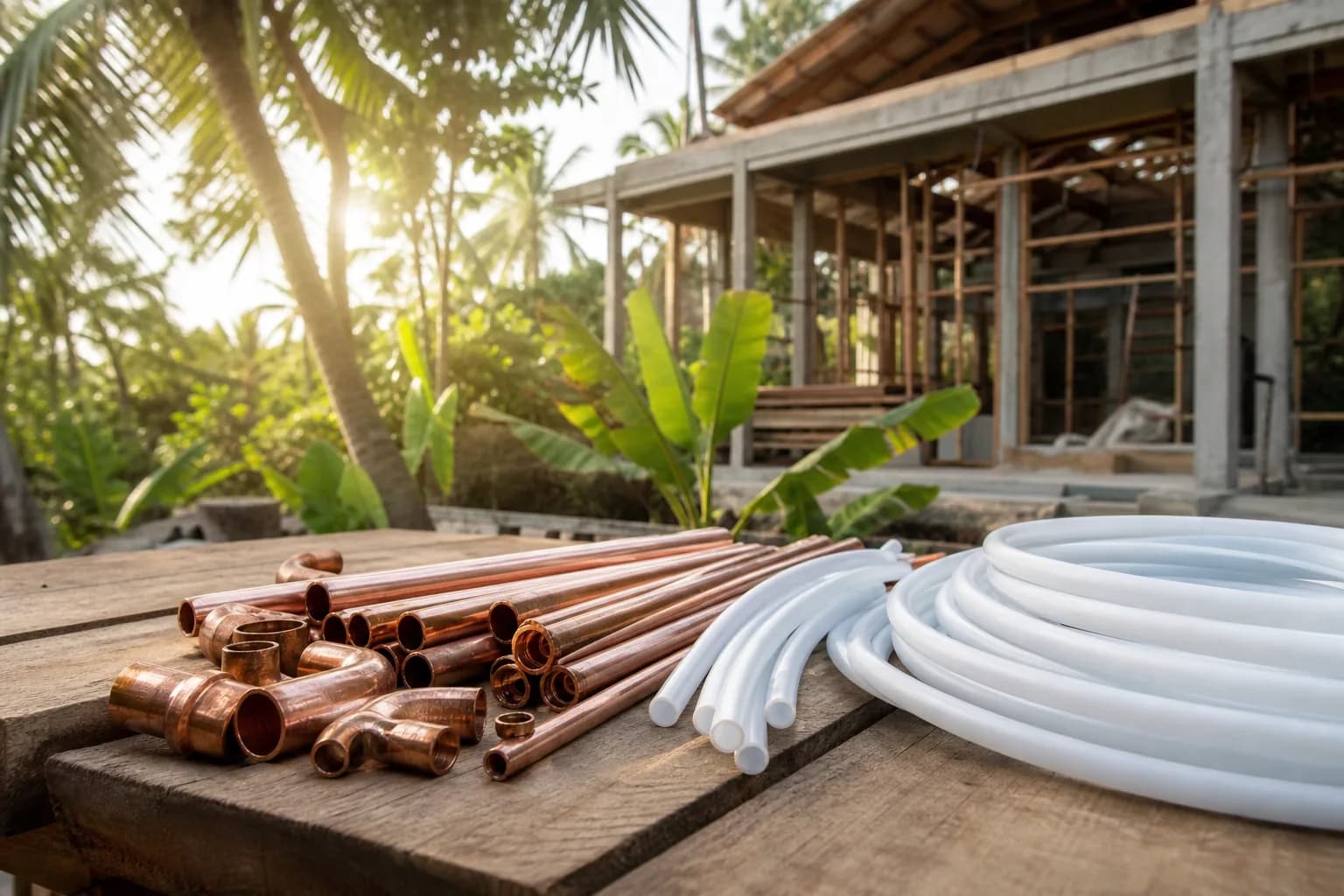
PEX (cross-linked polyethylene) pipes operate on fundamentally different material science principles. The polymer chains are covalently bonded through peroxide, silane, or electron beam methods (PEX-A, PEX-B, PEX-C classifications), creating a three-dimensional molecular structure impervious to ionic attack. Chloride ions cannot oxidize polyethylene because there’s no metallic bonding to disrupt. Laboratory testing per ASTM F2023 demonstrates zero measurable degradation in PEX exposed to 35,000 ppm sodium chloride solutions (full seawater concentration) over 10,000-hour accelerated aging cycles.
The critical engineering distinction: copper requires the protective oxide layer to remain intact, while PEX has no reactive surface layer to compromise. In Bali’s saltwater wells, this translates to copper systems requiring complete replacement every 3-7 years versus PEX systems maintaining structural integrity for 50+ years. The material cost differential becomes irrelevant when factoring replacement cycles, water damage remediation, and villa downtime during emergency repairs.
For villa construction projects in areas like Canggu, Uluwatu, and Sanur—where saltwater intrusion affects 60-80% of shallow wells—PEX specification isn’t optional; it’s engineering due diligence. The polymer’s flexibility also provides secondary benefits: resistance to freeze-thaw cycles (relevant for chilled water lines), reduced noise transmission, and tolerance for minor ground settlement without joint failure.
Hidden Risks & Critical Mistakes in Saltwater Plumbing Systems
The most dangerous assumption contractors make is treating all groundwater as “fresh” without conductivity testing. Bali’s aquifer salinity varies dramatically within 100-meter distances due to geological faulting, tidal influences, and over-extraction creating saltwater upconing. A well testing at 800 ppm chlorides during dry season may spike to 4,500 ppm during wet season as freshwater lenses shift. Specifying copper based on a single water sample creates liability exposure when corrosion appears 18 months post-construction.
Mixed-material systems present catastrophic failure risks. Installing PEX distribution lines with copper manifolds or water heater connections creates galvanic cells where dissimilar metals contact saltwater. The copper components corrode preferentially, and the PEX’s corrosion resistance becomes irrelevant when the brass fittings disintegrate. Proper engineering requires complete system isolation—either full PEX with polymer manifolds or dielectric unions with sacrificial anode protection if copper fixtures are unavoidable.
Contractors frequently underestimate UV degradation of PEX in exposed installations. While PEX resists saltwater corrosion, ultraviolet radiation breaks polymer chains, causing brittleness and cracking within 6-12 months of direct sunlight exposure. Bali’s equatorial UV index (11-13 year-round) accelerates this degradation. Exposed PEX runs to outdoor showers, pool equipment, or rooftop tanks require UV-stabilized jacketing or conduit protection—a specification often omitted in cost-cutting exercises.
The final critical error: assuming PEX eliminates all corrosion concerns. While the pipe itself resists saltwater, metal components (valves, pumps, pressure tanks) still corrode. A complete MEP systems design must specify marine-grade stainless steel (316L minimum) or composite components for all wetted metal surfaces. The plumbing system is only as durable as its weakest component.
Step-by-Step Process: Implementing Corrosion-Resistant Plumbing in Saltwater Conditions
Phase 1: Water Quality Assessment (Pre-Design)
Before material specification, conduct comprehensive water analysis including total dissolved solids (TDS), chloride concentration, pH, and conductivity. Collect samples during both wet and dry seasons if timeline permits, or reference regional aquifer data from BMKG (Indonesian meteorology agency). Water with >250 ppm chlorides mandates corrosion-resistant materials per international plumbing codes. Document results in engineering specifications to establish liability baseline and warranty parameters.
Phase 2: System Design and Material Specification
For confirmed saltwater conditions (>500 ppm chlorides), specify PEX-A or PEX-B tubing with minimum SDR-9 rating (pressure rating 160 psi at 73°F). PEX-A offers superior flexibility for Bali’s seismic conditions (Zone 4 classification), allowing 90-degree bends without fittings. Design manifold systems with 3/4-inch trunk lines feeding 1/2-inch branch circuits—this reduces fitting count by 60% compared to copper tree systems, eliminating potential leak points. Specify EPDM or silicone O-rings in compression fittings; avoid neoprene which degrades in saltwater.
Phase 3: Component Selection and Integration
Select marine-grade components for all metal interfaces: 316 stainless steel ball valves, composite pressure tanks with EPDM bladders, and variable-frequency drive pumps with ceramic seals. Water heaters require special consideration—specify titanium heat exchangers or polymer-lined tanks rather than copper coil units. For villa projects requiring hot water recirculation, use dedicated PEX lines with foam insulation rather than copper returns that corrode from both internal saltwater and external humidity.
Phase 4: Installation Protocol and Quality Control
PEX installation requires different techniques than copper. Use expansion (PEX-A) or crimp (PEX-B) methods with calibrated tools—improper crimping creates stress concentrations that fail under pressure cycling. Protect all exposed runs with UV-resistant conduit or bury minimum 450mm depth. Install dielectric isolation at water heater connections and pressure tank interfaces. Pressure test to 150% of working pressure (120 psi minimum) for 4 hours before concealment—this identifies fitting failures before wall closure.
Phase 5: Corrosion Monitoring and Maintenance Planning
Even with PEX systems, implement annual water quality monitoring to track chloride concentration trends. Install sacrificial anode rods in pressure tanks and water heaters, replacing every 24 months in high-salinity conditions. Document all metal components (pump housings, valve bodies) for inspection scheduling. This proactive approach prevents the emergency failures common in Bali villa construction, where reactive maintenance costs 4-6 times preventive measures.
Realistic Cost Analysis: Investment vs. Lifecycle Economics
Material costs for PEX versus copper in a typical 250m² Bali villa reveal counterintuitive economics. PEX tubing costs Rp 45,000-65,000 per meter for 3/4-inch diameter versus Rp 180,000-220,000 for equivalent Type L copper. Initial material savings reach Rp 15-22 million for complete rough-in plumbing. However, PEX requires specialized manifolds (Rp 8-12 million) and expansion tools (Rp 4-6 million contractor investment), partially offsetting material savings.
The critical calculation involves replacement cycles. Copper systems in saltwater wells require full replacement every 4-6 years at costs of Rp 85-120 million including demolition, pipe replacement, and finishing restoration. PEX systems maintain integrity for 50+ years with only valve and fixture replacement (Rp 8-15 million every 10-12 years). Over a 20-year ownership period, copper total cost of ownership reaches Rp 340-480 million versus Rp 95-140 million for PEX—a 72% lifecycle cost reduction.
Labor costs favor PEX installation: 40% faster installation due to flexibility and reduced fitting count. A complete villa rough-in requires 8-10 days with copper versus 5-6 days with PEX, saving Rp 6-9 million in labor costs. Emergency repair costs amplify the differential—copper pinhole leaks cause water damage averaging Rp 25-45 million per incident (tile replacement, wall remediation, mold treatment), while PEX systems rarely fail catastrophically.
For accurate project budgeting specific to your site conditions and water quality, request detailed MEP cost estimation including material specifications, installation methodology, and lifecycle maintenance projections.
Frequently Asked Questions: Saltwater Corrosion and Plumbing Materials
Can I use copper plumbing if I install a water softener or filtration system?
Water softeners remove calcium and magnesium (hardness minerals) but do not eliminate chloride ions—in fact, salt-based softeners add sodium chloride to the water, increasing corrosion potential. Reverse osmosis systems can remove 95-98% of chlorides, but require point-of-use installation (typically kitchen only) due to high water waste ratios (3-4 gallons rejected per gallon produced). Whole-house RO systems for saltwater wells cost Rp 180-280 million and still leave distribution pipes exposed to source water during filter changes and system failures. The engineering reality: treating saltwater to make it copper-compatible costs more than specifying corrosion-resistant materials initially.
How do I know if my Bali property has saltwater well issues?
Conduct water testing measuring chloride concentration, TDS, and conductivity. Chloride levels >250 ppm indicate corrosion risk; >500 ppm mandate corrosion-resistant materials. Visual indicators include blue-green staining on fixtures, metallic taste, and rapid deterioration of metal components. Properties within 2 kilometers of coastline or below 10-meter elevation have 70-85% probability of saltwater intrusion. Areas with intensive well extraction (dense villa developments) experience accelerated saltwater upconing. Request historical water quality data from neighboring properties or conduct seasonal testing before finalizing material specifications.
What about PEX degradation from chlorine in treated water systems?
PEX demonstrates excellent resistance to chlorine at concentrations used in water treatment (0.5-4.0 ppm). ASTM F2023 testing shows minimal degradation after 50-year equivalent exposure to chlorinated water at 140°F. The concern applies primarily to copper systems where chlorine accelerates pitting corrosion in the presence of chlorides—a synergistic effect. In Bali villa construction, most properties use untreated well water or UV sterilization rather than chlorination, making this a non-issue. If chlorine treatment is specified, PEX remains the superior choice as it resists both chlorine and chloride corrosion simultaneously.
Can I retrofit existing copper plumbing with PEX in a renovation project?
Yes, but requires complete system isolation to prevent galvanic corrosion. The optimal approach: replace all copper from the pressure tank outlet through distribution lines, using brass-to-PEX transition adapters with dielectric isolation at the connection point. Partial retrofits (replacing only corroded sections) create new galvanic cells at copper-PEX interfaces, accelerating remaining copper deterioration. For renovation projects, budget for complete plumbing replacement rather than piecemeal repairs—the labor cost of accessing walls and floors makes partial replacement economically inefficient. Retrofit costs typically reach 60-75% of new installation due to demolition and restoration requirements.
Do building codes in Bali specify plumbing materials for saltwater conditions?
Indonesian building codes (SNI 03-6481-2000 for plumbing systems) reference material standards but don’t mandate specific materials based on water quality. This places responsibility on the design engineer and contractor to specify appropriate materials for site conditions. International codes (IPC, UPC) require corrosion-resistant materials when chloride concentrations exceed 250 ppm. For villa construction targeting international buyers or hotel licensing, adhering to international standards provides liability protection and demonstrates engineering competence. Document water quality testing and material selection rationale in construction specifications—this establishes due diligence if corrosion issues arise during warranty periods.
Expert Engineering Summary: Material Selection as Risk Management
The copper versus PEX decision in Bali
 3104 m²11 month(s)from 99.000 USD
TALA 100
 3127 m²9 month(s)from 177.000 USD
Mukunda
 164 m²7 month(s)from 79.000 USD
Private: Haridas Villas, Tegallalang
 172 m²8 month(s)from 120.000 USD
Keshava
 3180 m²7 month(s)from 142.000 USD
Vasudeva
 3173 m²6 month(s)from 125.000 USD
TALA FOUR

Want to calculate?
 4344 m²16 month(s)from 290.000 USD
Radha
164 m²7 month(s)from 79.000 USDTALA TWO
 3124 m²6 month(s)from 123.000 USD
TALA 8
 1from 198.000 USD
Private: Haridas Villas
 2144 m²11 month(s)from 104.000 USD
Narayana
Start With Real Numbers, Not Guesses
Before buying land or finalizing a design, check the realistic build cost range for your project in Bali.
Our team reviews your inputs and gives a grounded estimate.
Available lands
 889 m²15 min$ 145612Bali, Cepaka
 1430 m²5 min$ 209862Bali, Klungkung
 1000 m²8 min$ 134544Bali, Bukit
 1950 m²7 min$ 150092Bali, Tabanan
 3700 m²15 min$ 738177Bali, Tabanan
 800 m²10 min$ 307882Bali, Tibubeneng
 1375 m²10 min$ 447044Bali, Canggu
 3100 m²20 min$ 272968Bali, Tabanan
 700 m²15 min$ 109052Bali, Buduk
 550 m²15 min$ 164594Bali, Mengwi
 515 m²7 min$ 570813Bali, Canggu
 3800 m²15 min$ 100616Bali, Pererenan
 5028 m²10 min$ 361000Bali, Ubud
 3300 m²15 min$ 449889Bali, Tabanan
 700 m²20 min$ 90517Bali, Cepaka
Essential Bali build & buy guides
- Bali villa construction cost per m² in 2026
- How much will your villa cost? Calculator
- Building a villa in Bali: the complete guide
- Buying land in Bali: step-by-step for foreigners
- Bali villa investment: yields, risks, returns
- Leasehold vs freehold: what foreigners can own
- Construction defect liability & 10-year warranty
- Bali building codes and construction standards
Related guides
Villa Handover in Bali: Snagging Checklist and What to Test Before Final Payment
A disciplined villa handover in Bali: room-by-room snagging tests, numbered defect documentation, the PBG/SLF and warranty documents to insist on, and payment terms that keep leverage until the list is closed.
7 min read
Energy-Efficient Villa in Bali: Solar, Insulation and Passive Cooling That Pay Back
Which energy-efficiency measures actually pay back in Bali's tropical climate — passive design and roof insulation first, efficient equipment second, and self-consumption solar last — with honest 2026 numbers.
7 min read
Choosing a General Contractor in Bali: Red Flags, Questions and Contract Must-Haves
A practical filter for hiring a general contractor in Bali: the red flags that end conversations, the questions professionals answer with documents, and the contract clauses no villa build should start without.
7 min read