TT vs TN-S Grounding Systems in Bali s Volcanic Soil
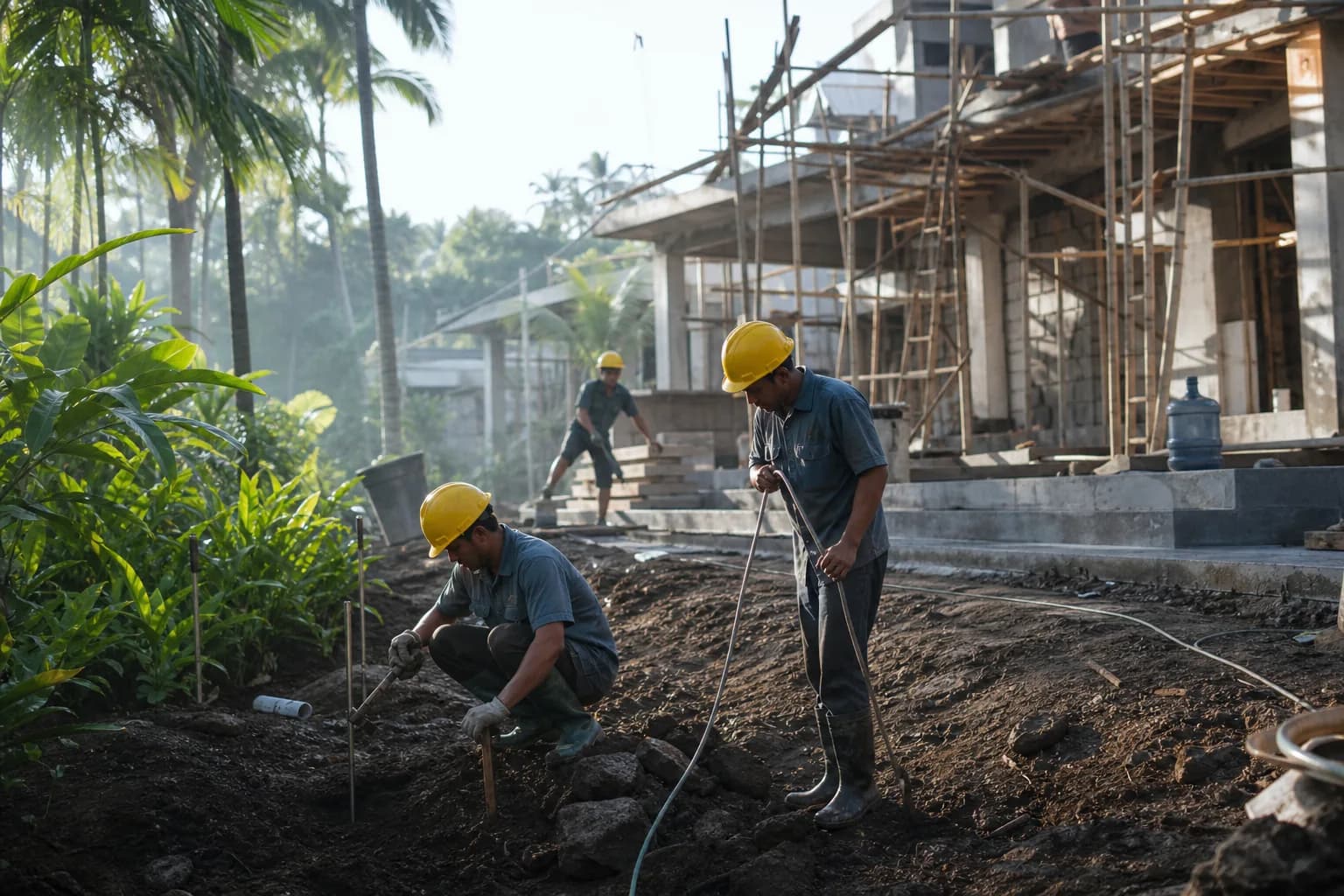
Why Grounding System Selection Can Make or Break Your Bali Villa’s Electrical Safety
When planning villa construction in Bali, most developers focus on architectural aesthetics and structural engineering while overlooking a critical safety component: grounding electrode system design. Bali’s volcanic soil composition—characterized by high resistivity ranging from 200 to 800 ohm-meters in many areas—creates unique challenges for electrical earthing that can compromise both safety and compliance. The choice between TT (Terra-Terra) and TN-S (Terra-Neutral-Separate) grounding systems isn’t merely a technical preference; it’s a fundamental decision that affects fault protection reliability, equipment longevity, and occupant safety throughout your property’s lifespan.
Technical Deep Dive: How Volcanic Soil Composition Affects Grounding Performance
Bali’s geological foundation consists primarily of volcanic ash, pumice, and weathered basalt—materials that exhibit significantly higher electrical resistivity than the clay or loamy soils common in temperate regions. This high resistivity directly impacts the effectiveness of grounding electrodes, which rely on low-resistance pathways to dissipate fault currents and lightning strikes safely into the earth.
TT System Architecture in High-Resistivity Environments
A TT grounding system establishes two independent earth connections: one at the utility transformer (controlled by PLN, Indonesia’s state electricity company) and a completely separate electrode system at your villa installation. The protective earth (PE) conductor connects exclusively to your local earth electrode, creating isolation from the utility’s grounding infrastructure. This independence becomes crucial in Bali where PLN’s transformer grounding quality varies significantly between established tourist areas like Seminyak and developing regions like Tabanan’s rice field zones.
In volcanic soil conditions, achieving the target earth resistance of 100 ohms or lower for TT systems requires strategic electrode design. Standard single-rod installations rarely suffice. Instead, effective TT implementations in Bali typically employ multiple parallel electrodes—often four to eight copper-bonded steel rods driven 3-4 meters deep, spaced at minimum distances of twice their length to prevent overlapping resistance zones. The volcanic ash layers common at 1-2 meter depths actually provide better conductivity than the weathered basalt below, making shallow horizontal grid systems with chemical enhancement compounds particularly effective.
The critical advantage of TT systems in Bali’s context lies in their immunity to utility neutral failures. When PLN’s neutral conductor develops high resistance or breaks—not uncommon during monsoon storms—your villa’s protective earth remains functional because it references only your local electrode. However, TT systems mandate residual current device (RCD) protection rated at 30mA or lower for all circuits, as fault currents through high-resistance soil paths may not trip standard overcurrent breakers.
TN-S System Considerations for Volcanic Terrain
TN-S grounding maintains separate neutral (N) and protective earth (PE) conductors from the utility transformer through to your villa’s distribution board. The PE conductor connects to the transformer’s earth electrode, theoretically providing a low-impedance fault return path. This system offers superior fault protection in ideal conditions—fault currents can reach magnitudes sufficient to trip breakers rapidly without requiring RCD sensitivity.
However, implementing TN-S in Bali presents significant challenges. The system’s effectiveness depends entirely on PLN’s transformer grounding quality and the integrity of the PE conductor throughout the distribution network. In practice, many Bali neighborhoods—particularly those developed before 2015—lack proper TN-S infrastructure. The utility may provide only a TN-C system (combined neutral-earth) or poorly maintained TN-S with compromised PE continuity. Volcanic soil’s high resistivity exacerbates these issues; if the utility’s transformer electrode resistance exceeds 10 ohms, the entire TN-S protective scheme degrades.
For villa construction projects in areas with confirmed TN-S supply, supplementary local earthing remains essential. Bali’s building codes require a local earth electrode system even when connecting to utility PE, creating a hybrid approach that combines TN-S fault protection with local earth reference for lightning protection and equipment grounding. This supplementary electrode must achieve resistance below 10 ohms—a specification that demands extensive electrode arrays in volcanic soil conditions.
Hidden Risks and Common Implementation Mistakes
The most dangerous assumption in Bali villa electrical design is treating grounding as a checkbox compliance item rather than a soil-specific engineering challenge. Standard electrode configurations imported from temperate-climate building codes consistently fail to achieve safe resistance levels in volcanic terrain, yet many contractors proceed with installation without proper testing.
A critical mistake involves inadequate soil resistivity testing before system design. Volcanic soil characteristics vary dramatically even within single land parcels—a 50-meter distance can show 300% resistivity variation depending on ash layer depth and moisture content. Designing electrode systems without four-point Wenner method testing at multiple depths and locations leads to undersized installations that appear compliant during dry-season commissioning but fail during Bali’s wet season when soil chemistry changes.
Another prevalent error concerns electrode material selection. Galvanized steel rods—common in budget construction—corrode rapidly in Bali’s acidic volcanic soils, particularly in coastal areas where salt intrusion accelerates degradation. Within 3-5 years, electrode resistance can double or triple as corrosion reduces effective surface area. Copper-bonded steel or solid copper electrodes, while initially more expensive, maintain stable resistance for 20+ years in volcanic conditions.
Many developers also underestimate the importance of electrode interconnection resistance. Using inadequate conductor sizes (less than 25mm² copper) or poor connection methods (mechanical clamps instead of exothermic welding) creates high-resistance joints that negate the benefits of properly sized electrodes. In volcanic soil’s corrosive environment, these connections deteriorate faster than the electrodes themselves, creating invisible failure points that compromise the entire protective system.
Step-by-Step Process for Volcanic Soil Grounding Design
Phase 1: Pre-Design Soil Analysis
Before architectural planning concludes, conduct comprehensive soil resistivity testing across your land parcel. Engage a qualified electrical testing firm to perform four-point Wenner measurements at minimum three locations, testing at depths of 1m, 2m, 3m, and 4m. Document seasonal variations by testing during both dry season (August-October) and wet season (January-March) if project timeline permits. This data determines whether TT or TN-S implementation is feasible and informs electrode configuration design.
Phase 2: Utility Infrastructure Assessment
Request formal documentation from PLN regarding the available grounding system type at your connection point. Verify whether true TN-S infrastructure exists or if the supply is TN-C or TT. For claimed TN-S systems, insist on measuring the PE conductor’s continuity and the transformer earth electrode resistance. If utility grounding proves unreliable or documentation is unavailable—common in developing Bali areas—default to TT system design for independence from utility infrastructure quality.
Phase 3: Electrode System Engineering
Based on soil resistivity data, calculate required electrode configuration using Dwight’s formula for rod electrodes or Sverak’s equations for grid systems. For typical Bali volcanic soil (400 ohm-meter resistivity), achieving 100-ohm resistance for TT systems generally requires 6-8 copper-bonded rods (16mm diameter, 3m length) arranged in a grid pattern with 6-meter spacing. For TN-S supplementary earthing targeting 10-ohm resistance, expect to install 12-16 rods or a horizontal grid covering 100-150 square meters with chemical enhancement.
Design the electrode layout to integrate with your villa’s foundation system. Coordinate with structural engineers to embed horizontal conductors within foundation concrete, creating a Ufer ground that supplements vertical rod electrodes. This approach leverages the concrete’s moisture retention and large surface area to reduce overall system resistance—particularly effective in volcanic soils where moisture content critically affects conductivity.
Phase 4: Installation and Testing Protocol
During construction execution, install electrodes before foundation backfilling to allow access for testing and modification. Drive vertical rods to specified depths using appropriate equipment—manual driving often fails to achieve full penetration in Bali’s compacted volcanic layers. Install all interconnecting conductors using exothermic welding rather than mechanical connections, ensuring each joint creates a permanent, low-resistance bond.
Upon installation completion, conduct fall-of-potential testing to verify actual resistance values. If measurements exceed design targets, add supplementary electrodes or apply bentonite-based soil enhancement compounds around existing rods. Document all test results with georeferenced photographs for future maintenance reference. Retest the complete system after monsoon season exposure to confirm performance stability under wet conditions.
Realistic Cost and Timeline Expectations
Professional soil resistivity testing for a typical villa plot (500-1000m²) costs between IDR 8-15 million, requiring 1-2 days for field measurements and analysis. This investment prevents costly redesign during construction and ensures code compliance from the outset.
Material costs for grounding systems vary significantly based on configuration. A basic TT system with six copper-bonded electrodes, exothermic welding connections, and 50mm² copper interconnecting conductors typically costs IDR 25-35 million for materials. Professional installation adds IDR 15-20 million, bringing total TT system cost to IDR 40-55 million. TN-S supplementary earthing systems requiring lower resistance targets cost IDR 60-90 million due to increased electrode quantities and more extensive grid configurations.
These figures represent 1.5-3% of total villa construction cost for mid-range projects—a modest investment considering the safety implications and regulatory requirements. Budget an additional IDR 5-8 million for commissioning testing and certification documentation required for PLN connection approval and building permit finalization.
Installation timeline spans 5-7 days for TT systems and 8-12 days for complex TN-S supplementary earthing, assuming favorable weather and soil conditions. Schedule electrode installation during foundation work to avoid delays and enable integration with structural elements. Factor additional time for retesting and potential system augmentation if initial resistance measurements exceed targets.
Frequently Asked Questions: Grounding in Bali’s Volcanic Soil
Can I use the same grounding system design that worked for my previous project in Java or Sumatra?
No—Bali’s volcanic soil composition differs fundamentally from the alluvial or laterite soils common in Java and Sumatra. Resistivity values in Bali typically run 3-5 times higher than coastal Java locations, requiring significantly more extensive electrode systems. Even within Bali, soil characteristics vary dramatically between regions; a design effective in Canggu’s sandy volcanic ash may prove inadequate in Ubud’s clay-rich volcanic soil. Always conduct site-specific resistivity testing rather than replicating previous designs.
How does the wet season affect grounding system performance in volcanic soil?
Bali’s monsoon season (November-March) can reduce soil resistivity by 40-60% compared to dry season conditions, significantly improving electrode performance. However, this seasonal variation creates a design challenge: systems must maintain adequate resistance during dry season when soil conductivity is lowest. Design for worst-case (dry season) conditions and verify through testing during both seasons. Chemical enhancement compounds help stabilize resistance across seasonal variations by maintaining moisture around electrodes year-round.
Is it worth upgrading from TT to TN-S if PLN offers to install proper infrastructure in my area?
This decision depends on your villa’s usage profile and PLN’s infrastructure reliability in your specific location. TN-S offers faster fault clearing and eliminates the need for sensitive RCD protection on all circuits, potentially reducing nuisance tripping. However, in areas where PLN infrastructure maintenance is inconsistent—common outside major tourist zones—TT systems provide greater long-term reliability through independence from utility grounding quality. For high-end villa projects where electrical system reliability is critical, TT systems often prove more dependable despite higher initial RCD costs.
What maintenance does a grounding system require in Bali’s corrosive volcanic environment?
Annual resistance testing is essential to detect electrode degradation before it compromises safety. Schedule testing during dry season (August-October) when resistance values peak, allowing early detection of problems. Every 3-5 years, conduct comprehensive testing including electrode-to-electrode continuity checks to identify corroded connections. Inspect above-ground connections and conductor terminations annually for corrosion, particularly in coastal areas where salt exposure accelerates degradation. Budget IDR 3-5 million annually for professional testing and maintenance—a small investment compared to system replacement costs if degradation goes undetected.
Can I install the grounding system myself to reduce costs, or must I hire specialists?
While basic electrode installation appears straightforward, achieving code-compliant resistance values in volcanic soil requires speci
 2144 m²11 month(s)from 104.000 USD
Narayana
 4344 m²16 month(s)from 290.000 USD
Radha
 3104 m²11 month(s)from 99.000 USD
TALA 100
 3124 m²6 month(s)from 123.000 USD
TALA 8
 3173 m²6 month(s)from 125.000 USD
TALA FOUR
 164 m²7 month(s)from 79.000 USD
TALA TWO
 3127 m²9 month(s)from 177.000 USD
Mukunda
 172 m²8 month(s)from 120.000 USD
Keshava
 1from 198.000 USD
Private: Haridas Villas
 3180 m²7 month(s)from 142.000 USD
Vasudeva
164 m²7 month(s)from 79.000 USDPrivate: Haridas Villas, Tegallalang

Want to calculate?
Start With Real Numbers, Not Guesses
Before buying land or finalizing a design, check the realistic build cost range for your project in Bali.
Our team reviews your inputs and gives a grounded estimate.
Available lands
 6000 m²10 min$ 1330049Bali, Kutuh South Bali
 1300 m²10 min$ 348214Bali, Tabanan
 8313 m²15 min$ 716670Bali, Buduk
 500 m²2 min$ 175862Bali, Cemagi
 2000 m²15 min$ 523000Bali, Canggu
 600 m²10 min$ 206897Bali, Canggu
 7000 m²36 min$ 284483Bali, Gianyar
 1100 m²8 min$ 280419Bali, Ungasan
 700 m²15 min$ 162500Bali, Tabanan
 911 m²15 min$ 248217Bali, Pererenan
 400 m²15 min$ 67192Bali, Tabanan
 700 m²8 min$ 165517Bali, Umalas
 800 m²8 min$ 113300Bali, Ungasan
 2130 m²10 min$ 495776Bali, Pecatu
 1350 m²5 min$ 283467Bali, Pecatu
Essential Bali build & buy guides
- Bali villa construction cost per m² in 2026
- How much will your villa cost? Calculator
- Building a villa in Bali: the complete guide
- Buying land in Bali: step-by-step for foreigners
- Bali villa investment: yields, risks, returns
- Leasehold vs freehold: what foreigners can own
- Construction defect liability & 10-year warranty
- Bali building codes and construction standards
Related guides
Resin-Infused Plaster Finishes: Anti-Salt Systems Bali
Expert technical guide: Resin-Infused Plaster Finishes: Anti-Salt Systems Bali
8 min read
Prefinished Timber Joinery: Silicone Seals Fixings Bali
Professional prefinished timber joinery installation in Bali with silicone seals and fixings for durable weatherproof performance and a premium finish.
10 min read
Polished Concrete Microtopping: Surface Prep Sealants Bali
Discover Bali s polished concrete microtopping: expert surface prep, durable sealants, and a flawless finish for modern floors with minimal maintenance.
9 min read