Septic Tank Sizing Bali Clay Soil: Percolation Rate Guide
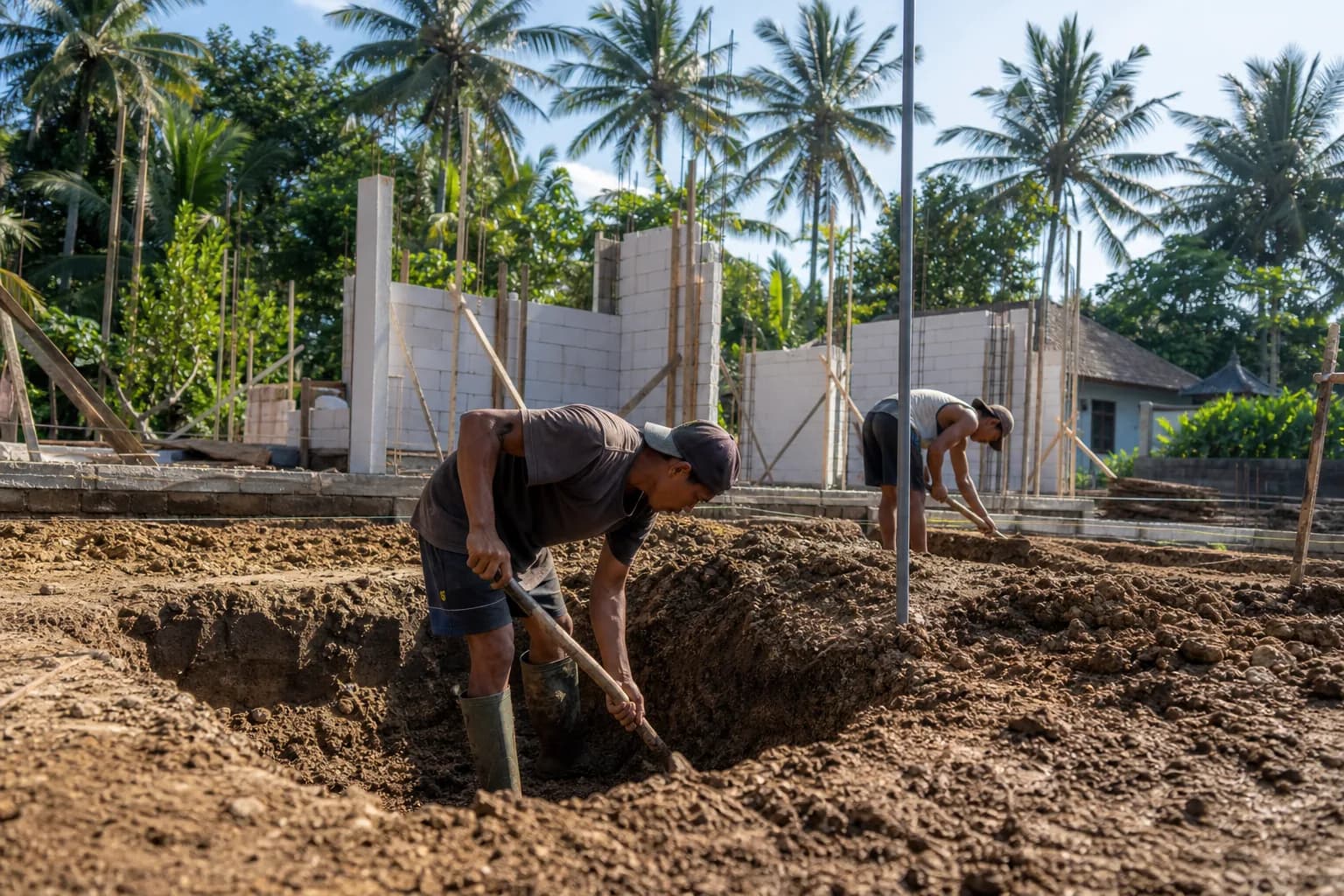
The Critical Challenge of Septic Tank Sizing in Bali’s Clay-Dominant Soil
When planning Bali villa construction on clay-rich soil, one of the most technically complex challenges involves properly sizing septic systems based on actual percolation rates. Unlike sandy or volcanic soils that drain efficiently, Bali’s clay soil—particularly prevalent in areas like Canggu, Seminyak, and parts of Ubud—exhibits percolation rates as slow as 60-120 minutes per inch. This dramatically impacts both septic tank capacity requirements and drain field dimensions. Undersizing leads to system failure, groundwater contamination, and expensive remediation. Oversizing wastes construction budget without performance benefits. The engineering challenge requires site-specific percolation testing, precise hydraulic load calculations, and drain field designs that compensate for clay’s low absorption capacity—a technical reality that many developers discover only after construction begins.
Technical Engineering: How Clay Soil Percolation Rates Determine Septic System Specifications
The relationship between soil percolation rate and septic system sizing follows precise hydraulic engineering principles that are non-negotiable in tropical construction engineering. Clay soil in Bali typically contains 40-60% clay particles, creating a dense matrix with minimal pore space. Standard percolation tests measure the time required for water to drop one inch in a test hole—clay soils often exceed 60 minutes per inch, compared to 5-15 minutes for sandy soils.
This slow percolation rate creates a cascading effect on system design. First, the septic tank itself must provide extended retention time—typically 48-72 hours rather than the 24-hour minimum for faster-draining soils. For a standard 4-bedroom villa generating 1,200 liters daily wastewater, this translates to a minimum tank capacity of 3,600 liters (versus 2,400 liters for sandy soil sites). The tank must allow adequate time for solids settlement and initial biological treatment before effluent enters the drain field.
The drain field calculation becomes more complex. Using the standard formula: Required Area = Daily Flow ÷ (Soil Absorption Rate × Safety Factor), clay soil’s absorption rate of 0.2-0.4 liters per square meter per day demands significantly larger drain fields. That same 1,200-liter daily flow requires 4,000-6,000 square meters of drain field in clay soil, compared to 400-800 square meters in sandy soil—a tenfold increase that often proves impossible on standard residential lots.
This is where advanced engineering solutions become essential. Teville’s approach for clay soil sites involves multi-stage treatment systems: primary septic tank, secondary aerobic treatment unit, and engineered drain fields with imported sand layers. The aerobic treatment unit reduces biological oxygen demand (BOD) by 85-95%, allowing the drain field to function primarily for final polishing rather than heavy biological treatment. This reduces required drain field area by 60-70% while maintaining treatment efficacy.
Soil stratification analysis is equally critical. Bali’s clay layers often sit atop more permeable substrates at 2-4 meters depth. Percolation testing must occur at the actual drain field depth—not surface level. We’ve encountered sites where surface clay showed 90-minute percolation rates, but testing at 2.5 meters revealed volcanic sand with 12-minute rates. This finding completely altered the system design, allowing for deeper drain fields with smaller footprints.
The hydraulic loading rate must account for Bali’s monsoon patterns. During wet season, clay soil becomes saturated, effectively reducing percolation rates by 40-60%. System sizing must accommodate peak wet-season conditions, not dry-season averages. This requires incorporating storage capacity for 3-5 days of flow during heavy rainfall periods when drain field absorption temporarily ceases.
Temperature effects also matter in tropical conditions. Bali’s consistent 26-30°C soil temperature accelerates biological treatment processes by approximately 30% compared to temperate climates, allowing for slightly reduced retention times. However, this benefit is largely offset by clay’s poor oxygen transfer, which limits aerobic bacterial activity essential for effective treatment.
Hidden Risks and Common Mistakes in Clay Soil Septic Design
The most dangerous assumption developers make is applying standard septic sizing charts without site-specific percolation testing. Generic sizing tables assume moderate percolation rates (15-30 minutes per inch) that simply don’t exist in Bali’s clay zones. This leads to chronically overloaded systems that fail within 2-3 years, requiring complete replacement at 3-4 times the original installation cost.
Another critical error involves conducting percolation tests during dry season only. Clay soil exhibits dramatically different characteristics when saturated. A site testing at 45 minutes per inch in August may show 120+ minutes per inch in January. Proper testing requires wet-season verification or artificial saturation of test holes 24 hours before testing to simulate worst-case conditions.
Many contractors underestimate the importance of drain field depth in clay soil. Shallow drain fields (60-90cm depth) in clay create anaerobic conditions, producing hydrogen sulfide odors and incomplete treatment. Proper clay soil drain fields require 120-150cm depth to reach more permeable layers, but this conflicts with Bali’s high water tables in coastal areas. The engineering solution involves mounded drain fields with imported sand media—adding significant cost that contractors often omit from initial quotes.
The failure to account for future expansion represents another expensive oversight. A villa designed for 4 bedrooms but with potential 6-bedroom expansion needs septic sizing for the ultimate capacity, not current use. Retrofitting larger septic systems after construction requires excavation near completed structures, landscape destruction, and potential foundation impacts. When working with clay soil’s already-large drain field requirements, planning for expansion from the start is essential.
Ignoring local groundwater flow patterns creates contamination risks. Clay soil’s slow percolation means effluent moves laterally along clay layers rather than percolating downward. Without proper site analysis, drain fields can direct partially-treated wastewater toward neighboring properties, wells, or surface water bodies—creating legal liability and environmental violations that can halt building permits Bali processes entirely.
Step-by-Step Process for Proper Septic Sizing on Clay Soil Sites
The engineering process begins with comprehensive site investigation, ideally during the land purchase Bali due diligence phase. Step one involves soil boring at multiple locations across the proposed drain field area, extracting samples at 50cm intervals to 3-meter depth. Laboratory analysis determines clay content, particle size distribution, and organic matter percentage—data that informs preliminary system sizing.
Step two requires conducting standardized percolation tests following Indonesian SNI 03-2398-2002 guidelines. Dig test holes to proposed drain field depth (typically 120-150cm), pre-soak for 24 hours to simulate saturated conditions, then measure water level drop over 60-minute intervals. Conduct minimum four tests across the drain field area, as clay soil permeability varies significantly over short distances. Record all measurements during wet season or after artificial saturation.
Step three involves calculating daily wastewater generation based on actual villa specifications. Use 150 liters per bedroom per day as baseline, adding 50 liters per bathroom, 100 liters for kitchen facilities, and 200 liters for pool backwash systems if applicable. A 4-bedroom villa with 5 bathrooms and pool typically generates 1,200-1,400 liters daily. Apply a 1.5x safety factor for clay soil systems, bringing design capacity to 1,800-2,100 liters daily.
Step four determines septic tank sizing using the formula: Tank Volume = Daily Flow × Retention Time. For clay soil sites, use 72-hour retention time: 1,800 liters × 3 days = 5,400 liters minimum. Specify multi-chamber tanks with 60% primary chamber, 30% secondary chamber, and 10% final clarification chamber. This configuration ensures proper solids settlement and prevents particulate carryover to drain fields.
Step five calculates drain field requirements using site-specific percolation data. Convert percolation test results to absorption rate using standard tables, then apply the formula: Drain Field Area = Daily Flow ÷ Absorption Rate. For clay soil with 75-minute percolation rate (0.3 liters/m²/day absorption), a 1,800-liter daily flow requires 6,000 square meters—clearly impractical. This triggers step six: engineered enhancement solutions.
Step six implements advanced treatment to reduce drain field requirements. Install aerobic treatment unit (ATU) between septic tank and drain field, reducing BOD by 90% and allowing 60% reduction in drain field size. The 6,000 m² requirement drops to 2,400 m²—still large but potentially feasible. Alternatively, design mounded drain fields with 60cm imported sand layer over clay, improving effective percolation rate to 20 minutes per inch and reducing area to 1,200 m².
Step seven involves detailed drain field layout considering site topography, setback requirements (minimum 10 meters from structures, 15 meters from wells, 30 meters from water bodies), and future access for maintenance. Clay soil drain fields require 50% larger pipe spacing (2.5-meter centers versus 1.5-meter for sandy soil) to prevent trench saturation. Design includes observation ports every 15 meters for monitoring and maintenance access.
Step eight requires submission to local environmental authorities (BPLHD) for approval, including all percolation test data, system calculations, and construction drawings. This process typically takes 4-6 weeks and may require design modifications based on regulatory feedback. Only after approval should construction commence—a critical sequence that protects against expensive non-compliant installations.
Realistic Cost and Timeline Expectations for Clay Soil Septic Systems
Clay soil septic systems cost significantly more than standard installations due to larger components and engineered enhancements. A properly designed system for a 4-bedroom villa on clay soil typically ranges from IDR 85-150 million (USD 5,500-9,700), compared to IDR 45-65 million for sandy soil sites. This includes comprehensive percolation testing (IDR 8-12 million), oversized multi-chamber septic tank (IDR 25-35 million), aerobic treatment unit (IDR 30-45 million), and engineered drain field with imported sand media (IDR 22-38 million).
The timeline extends considerably as well. Proper percolation testing requires wet-season conditions or artificial saturation, adding 2-3 weeks to site investigation. Regulatory approval for enhanced treatment systems takes 6-8 weeks versus 3-4 weeks for standard systems. Construction of mounded drain fields with imported materials requires 3-4 weeks compared to 1-2 weeks for conventional trenches. Total timeline from initial testing to operational system: 12-16 weeks for clay soil sites versus 6-8 weeks for favorable soil conditions.
Ongoing maintenance costs also increase. Clay soil systems require professional pumping every 12-18 months (versus 24-36 months for sandy soil), costing IDR 2.5-4 million per service. Aerobic treatment units need annual servicing at IDR 3-5 million. Budget IDR 6-9 million annually for proper system maintenance—essential for preventing premature failure and expensive emergency repairs.
These figures reflect actual villa construction cost Bali data from completed projects. Attempting to reduce costs by undersizing components or skipping percolation testing inevitably leads to system failure requiring complete replacement at 2-3 times the original proper installation cost. The engineering investment in correct initial sizing proves far more economical over the villa’s operational lifetime.
Frequently Asked Questions: Septic Tank Sizing for Bali Clay Soil
How do I know if my Bali property has clay soil that requires special septic considerations?
Visual inspection provides initial clues: clay soil appears smooth and sticky when wet, forms hard clumps when dry, and shows poor drainage with standing water after rain. However, definitive determination requires professional soil boring and laboratory analysis. Many Bali areas have mixed soil profiles with clay layers at depth beneath sandy topsoil. Teville conducts comprehensive soil investigation during the feasibility phase of all projects, with boring samples analyzed at certified laboratories. Clay content above 30% triggers enhanced septic design protocols. This testing should occur before land purchase to avoid discovering expensive soil challenges after acquisition.
Can I use a standard-sized septic tank if I install a larger drain field on clay soil?
No—this approach fails to address the fundamental issue. Clay soil’s slow percolation rate requires extended retention time within the septic tank itself for proper solids settlement and initial biological treatment. A standard 2,400-liter tank provides only 24-hour retention for 1,200 liters daily flow, insufficient for clay soil conditions. The effluent quality remains poor, overwhelming even an oversized drain field. Proper clay soil design requires both larger tank capacity (minimum 72-hour retention) and appropriately sized drain field. The components work as an integrated system; undersizing either element causes complete system failure. Our construction process includes hydraulic modeling to ensure all components are properly balanced for site-specific conditions.
What happens if percolation testing shows my clay soil cannot support any size drain field?
Extremely poor percolation rates (120+ minutes per inch) occasionally make conventional drain fields impractical even with engineering enhancements. Alternative solutions include: (1) Mounded sand filter systems that create artificial permeable media above clay layers, (2) Evapotranspiration beds that eliminate effluent through plant uptake and evaporation rather than soil percolation, (3) Aerobic treatment with subsurface drip irrigation distributing highly-treated effluent across landscaped areas, or (4) Package
 3173 m²6 month(s)from 125.000 USD
TALA FOUR
 4344 m²16 month(s)from 290.000 USD
Radha

Want to calculate?
 3104 m²11 month(s)from 99.000 USD
TALA 100
 164 m²7 month(s)from 79.000 USD
TALA TWO
 3124 m²6 month(s)from 123.000 USD
TALA 8
 172 m²8 month(s)from 120.000 USD
Keshava
 3180 m²7 month(s)from 142.000 USD
Vasudeva
 2144 m²11 month(s)from 104.000 USD
Narayana
164 m²7 month(s)from 79.000 USDPrivate: Haridas Villas, Tegallalang
 3127 m²9 month(s)from 177.000 USD
Mukunda
 1from 198.000 USD
Private: Haridas Villas
Start With Real Numbers, Not Guesses
Before buying land or finalizing a design, check the realistic build cost range for your project in Bali.
Our team reviews your inputs and gives a grounded estimate.
Available lands
 2230 m²15 min$ 410573Bali, Padonan
 2000 m²10 min$ 243842Bali, Mengwi
 6000 m²10 min$ 1330049Bali, Kutuh South Bali
 3800 m²15 min$ 100616Bali, Pererenan
 5028 m²10 min$ 361000Bali, Ubud
 1230 m²15 min$ 132543Bali, Tegallalang
 1430 m²5 min$ 209862Bali, Klungkung
 770 m²5 min$ 163578Bali, Kedungu
 1000 m²10 min$ 184729Bali, Kutuh South Bali
 204 m²5 min$ 40899Bali, Kedungu
 1000 m²10 min$ 384852Bali, Canggu
 700 m²8 min$ 165517Bali, Umalas
 10000 m²19 min$ 232759Bali, Buleleng
 889 m²15 min$ 145612Bali, Cepaka
 5815 m²5 min$ 815740Bali, Tabanan
Essential Bali build & buy guides
- Bali villa construction cost per m² in 2026
- How much will your villa cost? Calculator
- Building a villa in Bali: the complete guide
- Buying land in Bali: step-by-step for foreigners
- Bali villa investment: yields, risks, returns
- Leasehold vs freehold: what foreigners can own
- Construction defect liability & 10-year warranty
- Bali building codes and construction standards
Related guides
Sanur and Nusa Dua vs Canggu: Stability Plays vs Hype
Canggu gets the headlines; Sanur and Nusa Dua quietly deliver steadier returns to a different kind of buyer. An honest 2026 comparison of the stability markets against the hype market — prices, demand drivers, oversupply risk, and who should buy where.
7 min read
Ubud and the Wellness Market: Buying or Building for Retreats
Ubud is Bali's wellness capital, and retreat-focused property behaves differently from beach villas: longer stays, group bookings, lower volatility. Here is what the market rewards, what zoning allows, and what it costs to buy or build a retreat property in 2026.
8 min read
Buying and Building on the Bukit: Uluwatu, Bingin and Balangan from a Buyer's Seat
A buyer's-seat 2026 guide to the Bukit peninsula — Uluwatu, Bingin and Balangan land prices, the water problem nobody budgets, cliff setbacks after the 2025 Bingin demolitions, and how to build there properly.
7 min read