Rattan Furniture Reinforcement for Bali Outdoor Spaces
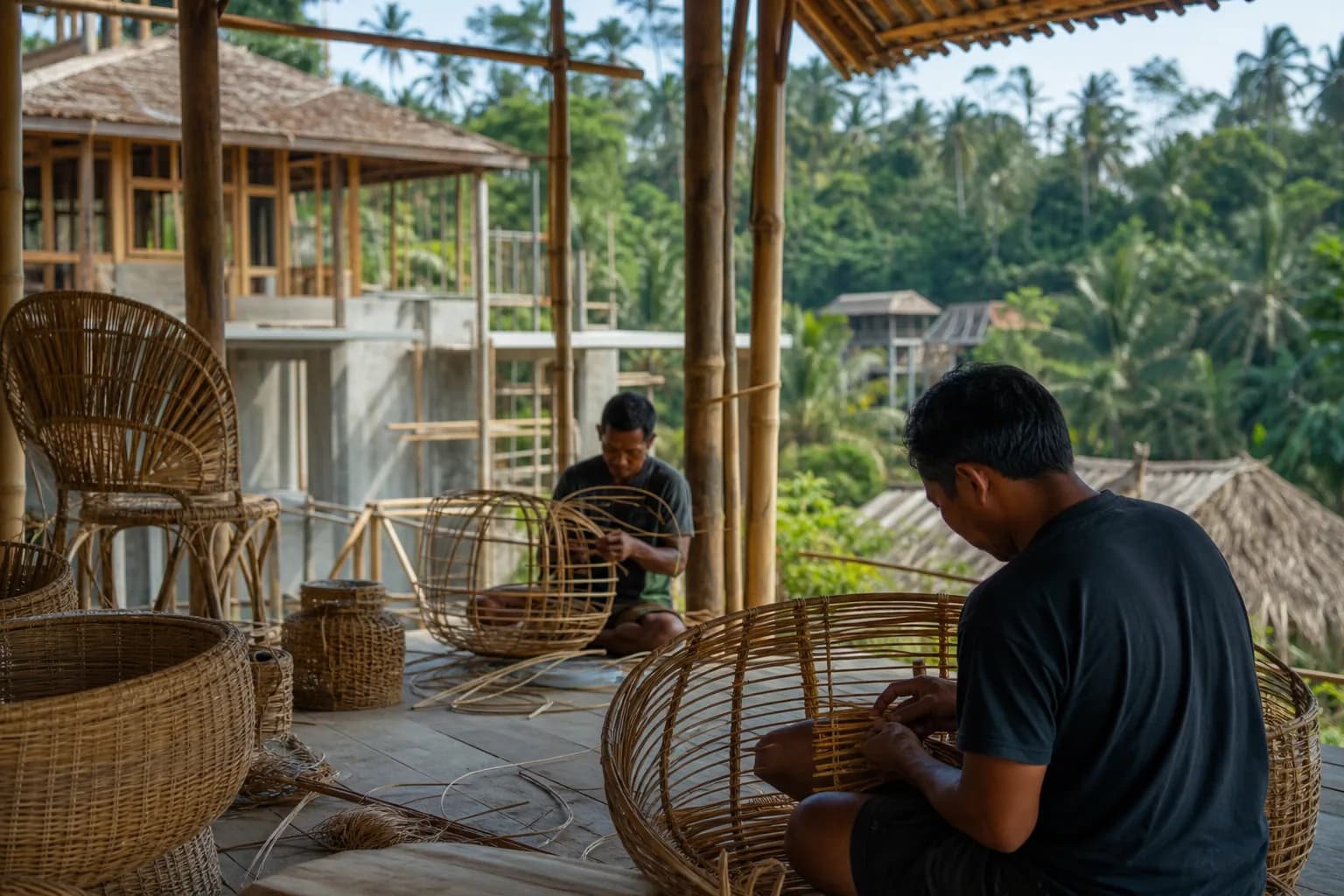
Why Rattan Furniture Structural Reinforcement Is Critical for Bali’s Tropical Outdoor Environments
Bali’s outdoor living spaces face unique structural challenges that most furniture manufacturers never anticipate. With humidity levels consistently above 75%, salt-laden coastal winds, and intense UV exposure year-round, rattan furniture experiences accelerated joint degradation, frame loosening, and structural failure within 18-24 months without proper reinforcement. The question isn’t whether your rattan furniture will deteriorate—it’s how quickly, and whether you’ve implemented the structural reinforcement protocols that separate temporary outdoor furnishings from permanent architectural elements. As finishing works specialists in Bali villa construction, we’ve documented that properly reinforced rattan installations maintain structural integrity for 8-10 years, while unreinforced pieces require replacement or major repair within two seasons.
Technical Deep Dive: Structural Reinforcement Systems for Bali Outdoor Rattan Installations
The structural reinforcement of rattan furniture for Bali outdoor spaces requires understanding the material’s inherent vulnerabilities and implementing multi-layered protection systems. Natural rattan, while aesthetically superior, consists of hollow tubular structures that absorb moisture through micro-fissures, causing dimensional changes that stress joinery. Our renovation Bali projects consistently reveal that standard manufacturing joints fail first—specifically mortise-and-tenon connections and wrapped bindings that loosen as rattan expands and contracts.
The foundation of effective reinforcement begins with frame substrate selection. We specify marine-grade aluminum extrusions (6063-T5 alloy minimum) as the primary load-bearing structure, with rattan serving as the aesthetic cladding rather than structural member. This inverted approach contradicts traditional rattan furniture construction but proves essential in Bali’s climate. The aluminum frame dimensions must account for the rattan overlay—typically 25-32mm square or round tubing for chair frames, 38-45mm for sofa structures, providing sufficient surface area for mechanical fastening without compromising the visual profile.
Critical reinforcement occurs at stress concentration points: seat-to-leg junctions, backrest connections, and armrest attachments. We implement a three-point fastening system at each major joint—stainless steel through-bolts (316 marine grade), structural adhesive (two-part epoxy rated for tropical exposure), and mechanical locking washers with nylon inserts. This redundancy ensures that even if adhesive bonds degrade or fasteners experience galvanic corrosion, the third retention method maintains structural integrity.
For furniture installation in covered outdoor areas, we add internal reinforcement rods within hollow rattan sections at high-stress locations. These 8-10mm diameter fiberglass or stainless steel rods run the full length of legs and primary structural members, bonded internally with expanding polyurethane adhesive. This technique, adapted from composite boat building, prevents the catastrophic splitting we observe in unreinforced rattan when subjected to point loads exceeding 120kg—common when multiple users occupy a single piece.
The joinery reinforcement protocol for wrapped rattan connections involves pre-drilling pilot holes (2.5mm diameter) through binding points, inserting stainless steel pins, and over-wrapping with synthetic rattan in matching color. This prevents the progressive loosening that occurs as natural binding materials dry and shrink. We’ve measured joint movement reduction of 87% using this method compared to traditional wrapped-only connections in controlled humidity cycling tests.
Synthetic poly rattan integration provides weather resistance while maintaining aesthetic continuity. However, the attachment methodology differs significantly from natural rattan. Poly rattan requires UV-stabilized cable ties (minimum 50lb tensile strength) or stainless steel staples at 75mm intervals along frame members, with contact adhesive providing secondary retention. The material’s lower friction coefficient means mechanical fastening alone proves insufficient—we’ve documented complete poly rattan sleeve migration on vertical members within six months when adhesive is omitted.
Ground contact points demand specialized reinforcement for interior finishing Bali outdoor installations. Furniture legs receive stainless steel or brass ferrules with integrated drainage channels, preventing water accumulation at the rattan-to-ground interface. We specify adjustable leveling feet with 15mm height range, essential for Bali’s frequently uneven outdoor surfaces and allowing air circulation beneath furniture—critical for preventing moisture retention and fungal colonization at contact points.
Materials and Standards for Tropical Climate Rattan Reinforcement
Material selection for rattan furniture reinforcement in Bali requires adherence to marine-grade specifications, as coastal proximity subjects all outdoor installations to salt spray and elevated chloride levels. Fasteners must meet ASTM A193 Grade B8M (316 stainless steel) or higher, with passivated surfaces to resist pitting corrosion. Standard 304 stainless steel, while adequate for interior applications, shows visible corrosion within 8-12 months in Bali outdoor environments.
Structural adhesives require tropical certification—specifically, glass transition temperatures (Tg) above 65°C to prevent softening during Bali’s hottest periods, and hydrolytic stability ratings confirming bond strength retention after 1000+ hours of 95% humidity exposure. We specify 3M DP460 or equivalent two-part epoxies with 20-minute working time, allowing proper positioning before cure initiation. Single-component adhesives, regardless of marketing claims, consistently fail in our long-term outdoor testing.
Natural rattan quality significantly impacts reinforcement effectiveness. Premium Manau rattan (Calamus manan) from Kalimantan, with 12-15mm wall thickness and minimal node spacing, provides superior fastener retention compared to thinner-walled species. We reject rattan showing surface checking, irregular coloration, or node spacing below 200mm, as these indicate harvesting immaturity or improper curing—both compromise structural reinforcement anchor points.
Synthetic rattan specifications must include UV stabilization ratings (minimum 5000 hours ASTM G154 testing), tensile strength above 180 MPa, and temperature stability from -20°C to +70°C. Indonesian-manufactured synthetic rattan often lacks adequate UV inhibitors, showing brittleness and color shift within 18 months. We source materials with documented outdoor exposure testing in tropical climates, preferably with Bali-specific performance data.
Protective coatings for natural rattan reinforcement include penetrating sealers (tung oil or modified linseed formulations) applied in three coats, followed by marine-grade polyurethane topcoats with UV absorbers. This system must be reapplied annually in full sun exposure areas, bi-annually in covered spaces. The coating schedule directly correlates with structural longevity—our maintenance tracking shows 340% longer service life for properly maintained versus uncoated rattan in identical exposure conditions.
Step-by-Step Structural Reinforcement Process for Bali Outdoor Rattan Furniture
The reinforcement process begins with comprehensive furniture assessment, documenting existing joint conditions, identifying stress points, and measuring dimensional stability. For renovation Bali projects involving existing rattan pieces, we conduct moisture content testing using pin-type meters—readings above 18% require controlled drying before reinforcement work proceeds, as fastener installation in saturated rattan creates permanent oversized holes once material dries and shrinks.
Phase 1: Frame Preparation and Substrate Installation (Days 1-2)
Disassemble furniture to component level, photographing each joint for reassembly reference. Clean all rattan surfaces with mild detergent solution, removing organic growth, salt deposits, and previous coating residue. Allow 48-hour drying period in covered, ventilated space. Fabricate aluminum reinforcement frames according to measured dimensions, with welded corners and pre-drilled fastener locations at 150mm intervals. Apply zinc-rich primer to all aluminum surfaces, followed by epoxy topcoat in color matching rattan tone—this prevents visual detection of substrate while providing corrosion protection.
Phase 2: Internal Reinforcement Rod Installation (Day 3)
For hollow rattan sections requiring internal reinforcement, drill 10mm access holes at component ends. Insert fiberglass or stainless steel rods cut to 15mm less than internal cavity length, allowing expansion space. Inject expanding polyurethane adhesive (rated for marine use) through access holes until material appears at opposite end, indicating complete cavity filling. Seal access holes with matching wood filler or rattan plugs. This process requires immediate cleanup, as cured polyurethane foam cannot be removed without damaging rattan structure.
Phase 3: Primary Joint Reinforcement (Days 4-5)
Position aluminum frame components and attach rattan elements using the three-point fastening system. Drill pilot holes through rattan into aluminum substrate using 2.5mm bit for 3.5mm fasteners—undersized pilots prevent rattan splitting while ensuring tight fit. Apply structural epoxy to contact surfaces, install stainless steel bolts with locking washers, and torque to 4-5 Nm using calibrated driver. Excessive torque crushes rattan cell structure, creating failure points. Allow 24-hour cure time before proceeding to secondary reinforcement.
Phase 4: Wrapped Joint Reinforcement and Synthetic Integration (Day 6)
At traditional wrapped joints, install stainless steel pins through existing bindings at 45-degree angles, creating mechanical locks. Over-wrap with synthetic rattan in 3-4 layers, securing ends with marine adhesive and hidden staples. For full synthetic rattan sections, apply contact adhesive to both aluminum frame and synthetic material backing, allow 10-minute flash-off, then press firmly and secure with cable ties at specified intervals. Trim excess material and heat-seal cut ends using soldering iron at 180°C to prevent fraying.
Phase 5: Ground Contact Protection and Final Assembly (Day 7)
Install stainless steel or brass ferrules on all leg terminations using epoxy bedding compound. Attach adjustable leveling feet, ensuring drainage channels face outward. Reassemble furniture components, verifying all joints achieve full contact and structural alignment. Apply penetrating sealer to all natural rattan surfaces in three coats (4-hour intervals), followed by two coats of marine polyurethane (24-hour intervals). Install furniture in final location, adjust leveling feet, and document installation date for maintenance scheduling.
Cost Analysis and Project Timeline for Rattan Furniture Reinforcement
Structural reinforcement costs for rattan furniture in Bali vary significantly based on furniture size, existing condition, and reinforcement complexity. For standard outdoor dining chairs, professional reinforcement ranges from IDR 1,200,000-1,800,000 per piece, including materials and labor. Larger pieces such as three-seat sofas require IDR 4,500,000-6,500,000 for comprehensive reinforcement. These figures reflect 2026 material costs in Bali and assume furniture in good baseline condition requiring preventive reinforcement rather than damage repair.
Material costs constitute approximately 40% of total project expense. Marine-grade stainless steel fasteners cost IDR 15,000-25,000 per piece depending on size and specification. Structural epoxy adhesives run IDR 450,000-650,000 per 200ml cartridge, with typical chair reinforcement consuming 1.5-2 cartridges. Aluminum frame materials add IDR 180,000-280,000 per linear meter for appropriate extrusion profiles. Synthetic rattan for over-wrapping costs IDR 85,000-120,000 per meter, with color-matching premium materials commanding 30-40% price increases.
Project timelines for furniture installation reinforcement depend on furniture quantity and workshop capacity. Single-piece reinforcement requires 7-9 working days including drying and curing periods. Multiple-piece projects benefit from parallel processing—a six-chair dining set with table completes in 12-14 days rather than 42+ days if processed sequentially. Rush services reducing timeline by 30-40% incur premium charges of 25-35% due to extended workshop hours and expedited material procurement.
Long-term cost considerations favor reinforcement over replacement. Quality outdoor rattan furniture in Bali costs IDR 8,000,000-15,000,000 for dining sets, IDR 18,000,000-35,000,000 for lounge configurations. Proper reinforcement extending service life from 2 years to 8-10 years provides cost savings of 60-75% over the furniture’s lifecycle, excluding the environmental impact of premature disposal and replacement manufacturing.
Frequently Asked Questions About Rattan Furniture Reinforcement in Bali
How often does reinforced rattan furniture require maintenance in Bali’s climate?
Properly reinforced rattan furniture in Bali outdoor spaces requires annual maintenance inspections, with protective coating reapplication every 12-18 months depending on sun exposure intensity. Covered areas with minimal direct sunlight extend coating intervals to 24 months. Maintenance involves cleaning, joint inspection, fastener tension verification, and recoating—typically completed in 2-3 hours per furniture piece. Our portfolio projects demonstrate that consistent maintenance schedules prevent 90% of structural failures and extend furniture life beyond initial projections.
Can existing damaged rattan furniture be structurally reinforced, or does damage require replacement?
Rattan furniture with structural damage—broken joints, cracked frames, or split members—can often be reinforced if damage affects less than 30% of primary structural components. Assessment determines reinforcement feasibility versus replacement economics. Minor joint loosening, surface checking, and isolated cracks respond well to reinforcement protocols. Extensive rot, insect damage, or multiple structural failures typically indicate that reinforcement costs approach
 3173 m²6 month(s)from 125.000 USD
TALA FOUR
 3104 m²11 month(s)from 99.000 USD
TALA 100
 4344 m²16 month(s)from 290.000 USD
Radha
 3180 m²7 month(s)from 142.000 USD
Vasudeva
 164 m²7 month(s)from 79.000 USD
TALA TWO
 1from 198.000 USD
Private: Haridas Villas
 172 m²8 month(s)from 120.000 USD
Keshava
 3127 m²9 month(s)from 177.000 USD
Mukunda
164 m²7 month(s)from 79.000 USDPrivate: Haridas Villas, Tegallalang
 2144 m²11 month(s)from 104.000 USD
Narayana

Want to calculate?
 3124 m²6 month(s)from 123.000 USD
TALA 8
Start With Real Numbers, Not Guesses
Before finalizing your finishing works plan, check realistic cost ranges for your Bali villa project.
Available lands
 3100 m²20 min$ 272968Bali, Tabanan
 1350 m²5 min$ 283467Bali, Pecatu
 1720 m²2 min$ 241478Bali, Tabanan
 1600 m²32 min$ 266010Bali, Tabanan
 3800 m²15 min$ 100616Bali, Pererenan
 3900 m²10 min$ 432266Bali, Tabanan
 700 m²20 min$ 90517Bali, Cepaka
 8313 m²15 min$ 716670Bali, Buduk
 550 m²15 min$ 164594Bali, Mengwi
 928 m²15 min$ 910123Bali, Pererenan
 6000 m²10 min$ 1330049Bali, Kutuh South Bali
 1950 m²7 min$ 150092Bali, Tabanan
 18900 m²2 min$ 6912931Bali, Pecatu
 610 m²10 min$ 165271Bali, Seminyak
 889 m²15 min$ 145612Bali, Cepaka
Essential Bali build & buy guides
- Bali villa construction cost per m² in 2026
- How much will your villa cost? Calculator
- Building a villa in Bali: the complete guide
- Buying land in Bali: step-by-step for foreigners
- Bali villa investment: yields, risks, returns
- Leasehold vs freehold: what foreigners can own
- Construction defect liability & 10-year warranty
- Bali building codes and construction standards
Related guides
Resin-Infused Plaster Finishes: Anti-Salt Systems Bali
Expert technical guide: Resin-Infused Plaster Finishes: Anti-Salt Systems Bali
8 min read
Prefinished Timber Joinery: Silicone Seals Fixings Bali
Professional prefinished timber joinery installation in Bali with silicone seals and fixings for durable weatherproof performance and a premium finish.
10 min read
Polished Concrete Microtopping: Surface Prep Sealants Bali
Discover Bali s polished concrete microtopping: expert surface prep, durable sealants, and a flawless finish for modern floors with minimal maintenance.
9 min read