Pivot Door Hardware: Weight Load Calculations for Bali Villas
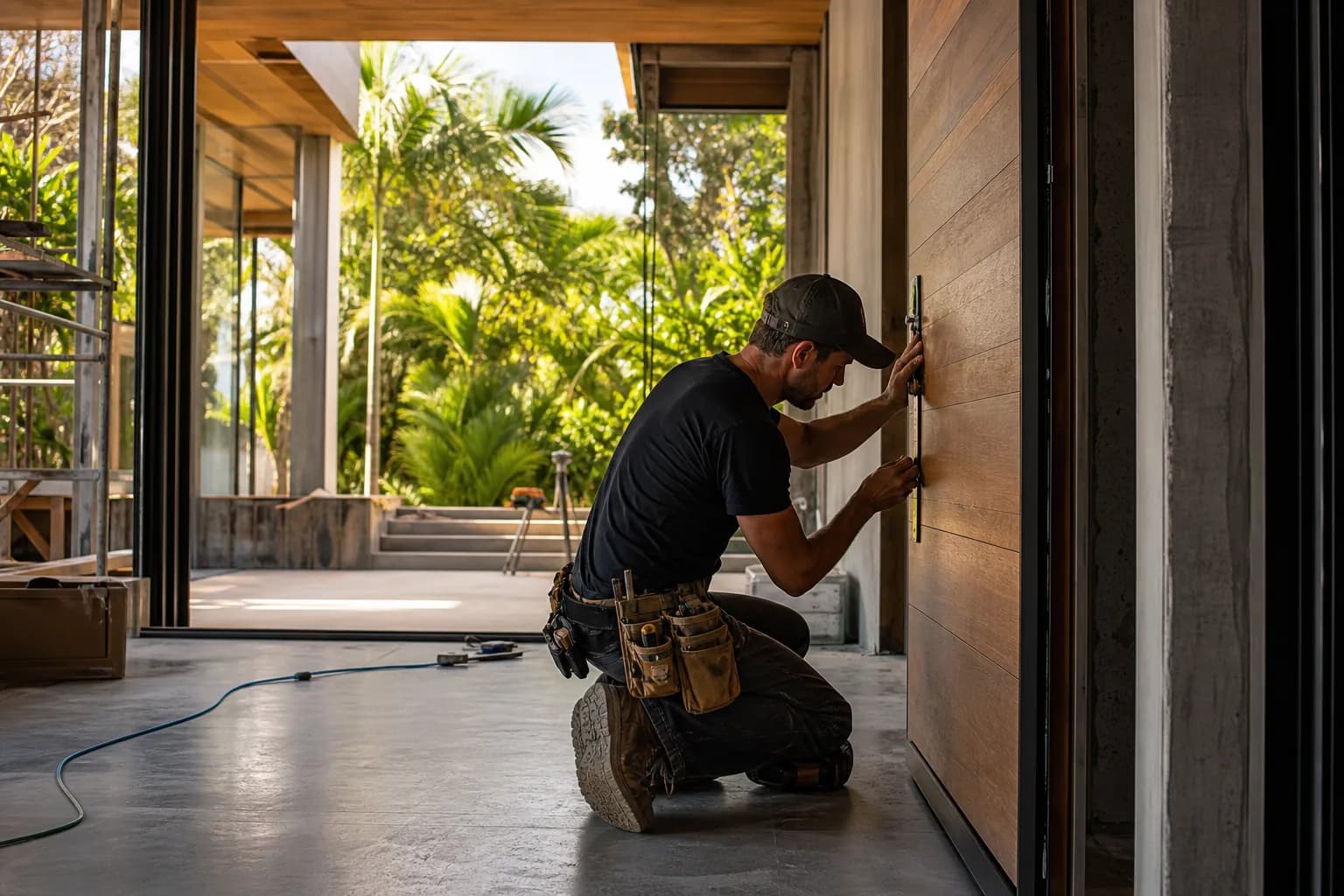
# Pivot Door Hardware Installation: Weight Load Calculations Bali Villas
The Critical Challenge of Pivot Door Weight Distribution in Bali’s Luxury Villas
Pivot doors have become signature architectural elements in Bali villa construction, offering dramatic 3-meter tall entrances and seamless indoor-outdoor transitions. However, the installation of these impressive features presents a critical engineering challenge: accurate weight load calculations. A miscalculated pivot door installation can result in hardware failure within months, floor damage from concentrated stress points, and safety hazards in high-traffic villa entrances. In Bali’s humid tropical climate, where materials expand and contract, and where villa doors often incorporate heavy hardwoods or oversized glass panels, precise weight load calculations become even more crucial for long-term durability and operational smoothness.
Technical Engineering: Understanding Pivot Door Load Mechanics in Tropical Construction
Pivot door hardware operates fundamentally differently from traditional hinged doors. Rather than distributing weight along a vertical edge, pivot systems concentrate the entire door weight onto two or three specific points: the top pivot bearing and the floor-mounted pivot mechanism. This concentration of force requires precise engineering calculations that account for not just static weight, but dynamic loads during operation.
The physics of pivot door installation involves calculating the moment arm—the distance from the pivot point to the door’s center of gravity. In Bali villa construction, where doors frequently measure 1.2 to 1.5 meters wide and 2.8 to 3.2 meters tall, this calculation becomes complex. A solid teak door of these dimensions can weigh 180-250 kilograms, while contemporary glass and steel designs may reach 300-400 kilograms. The pivot offset (typically 100-150mm from the door edge) creates a lever effect that multiplies the actual force on the hardware by a factor of 1.5 to 2.5 times the door’s static weight.
Bali’s tropical environment introduces additional variables. Humidity fluctuations between 70-95% cause timber doors to absorb moisture, increasing weight by 8-15% during rainy season. Temperature variations affect metal hardware expansion rates, while the combination of salt air in coastal villas and high humidity accelerates corrosion in inadequately specified hardware. These factors must be incorporated into load calculations with appropriate safety margins.
The floor substrate condition critically affects pivot door performance. Many Bali villas feature polished concrete, terrazzo, or natural stone flooring. The floor-mounted pivot bearing must distribute concentrated loads (often exceeding 200kg on a 50mm diameter footprint) without causing substrate cracking or settlement. This requires structural assessment of the floor slab thickness, reinforcement density, and compressive strength. In renovation projects where existing floors weren’t designed for pivot door loads, reinforcement plates or structural modifications become necessary.
Professional weight load calculations for Bali villa construction must account for dynamic loading factors: the acceleration forces when opening or closing the door (typically 1.3x static weight), wind loading on exposed entrance doors (critical in elevated or coastal locations), and the cumulative fatigue from thousands of operation cycles. Hardware manufacturers specify maximum load ratings, but these represent ideal conditions—tropical installation requires derating by 20-30% to ensure longevity.
The pivot axis alignment represents another critical technical consideration. Any deviation from perfect vertical alignment creates uneven load distribution, causing premature bearing wear and operational binding. In Bali’s seismic zone, where minor ground movement occurs, the structural mounting of top pivot points must allow for building flex while maintaining pivot alignment. This typically requires flexible mounting systems with adjustment capabilities of ±3mm in multiple axes.
Material Specifications and Hardware Standards for Tropical Pivot Installations
Selecting appropriate pivot hardware for Bali villa installations requires understanding material performance in tropical marine environments. Standard mild steel pivot mechanisms, common in temperate climates, fail rapidly in Bali’s conditions. Professional specifications require stainless steel grade 316 (marine grade) for all pivot components, with particular attention to bearing surfaces that experience constant friction.
Floor-mounted pivot bearings must meet minimum specifications: 316 stainless steel housing, sealed ball bearing assemblies with corrosion-resistant lubricants, and load ratings exceeding calculated door weight by minimum 150%. For doors weighing 150-250kg, this typically requires hardware rated for 400-500kg capacity. The bearing diameter directly affects load distribution on floor substrates—larger diameter bearings (60-80mm) distribute force more effectively than compact 40mm units, reducing substrate stress and cracking risk.
Top pivot mechanisms require different specifications. These components must resist vertical lift forces while allowing smooth rotation. Adjustable top pivots with 10-15mm vertical adjustment range accommodate building settlement and seasonal material movement. The mounting plate thickness (minimum 8mm steel) and fastener specifications (M10 or M12 stainless steel anchors with 80mm embedment depth into concrete or structural timber) determine long-term stability.
Door material selection significantly impacts weight calculations and hardware requirements. Solid teak doors (density 630-720 kg/m³) popular in traditional Bali villa design create substantial loads. A 1.2m x 3m x 60mm solid teak door weighs approximately 160kg before hardware and finishing. Alternative engineered timber cores with teak veneer reduce weight by 40-50% while maintaining aesthetic appeal. Contemporary aluminum-framed glass doors, despite appearing lighter, often weigh 250-350kg due to thick tempered glass requirements (12-19mm) for structural stability.
Substrate reinforcement materials vary by floor type. Concrete floors require steel reinforcement plates (minimum 10mm thickness, 300mm diameter) beneath pivot bearings, anchored with chemical anchors or cast-in-place during construction. Timber floors need structural blocking between joists, extending load distribution across multiple structural members. Natural stone floors present particular challenges, requiring core drilling and epoxy-set mounting systems that prevent stone cracking around pivot points.
Step-by-Step Weight Load Calculation and Installation Process
The professional pivot door installation process for Bali villa projects begins with accurate weight determination. For existing doors, industrial scales provide direct measurement. For doors in design phase, calculate volume (height × width × thickness in meters) multiplied by material density, then add hardware weight (typically 15-25kg for complete pivot systems, handles, and locks).
Step 1: Material Weight Calculation
Measure or calculate door dimensions precisely. For timber doors, identify wood species and moisture content. Solid teak at 12% moisture content: 650 kg/m³. Calculate: 3.0m height × 1.2m width × 0.06m thickness = 0.216 m³ × 650 kg/m³ = 140.4kg base weight. Add glass inserts, hardware, and finishing materials. Apply tropical moisture factor: multiply by 1.12 for 15% moisture absorption potential = 157kg working weight.
Step 2: Pivot Offset and Moment Calculation
Determine pivot axis location (typically 100-120mm from door edge). Calculate center of gravity offset from pivot point. For 1.2m wide door with 100mm pivot offset: CG is at 600mm from edge, creating 500mm moment arm. This offset multiplies effective load on pivot hardware. Dynamic load factor: 157kg × 1.5 (moment multiplier) × 1.3 (acceleration factor) = 306kg effective load. Select hardware rated minimum 450kg (150% safety margin).
Step 3: Substrate Assessment and Preparation
Core drill test holes to verify floor slab thickness and reinforcement. Minimum 150mm concrete slab thickness required for direct pivot mounting. Thinner slabs need reinforcement. For floor-mounted pivot, mark exact location ensuring alignment with top pivot point using laser level. Create recess pocket if flush-mount bearing specified (common in polished concrete floors). Install steel reinforcement plate using epoxy anchoring system, ensuring plate sits level within 0.5mm tolerance.
Step 4: Top Pivot Structural Mounting
Identify structural support above door opening. Pivot must mount to concrete beam, steel lintel, or reinforced timber header—never to ceiling finishes alone. For concrete structures, drill and install M12 stainless steel chemical anchors at 80mm depth. Mount adjustable top pivot mechanism, ensuring vertical alignment with floor pivot using plumb bob or laser. Adjustment range allows for ±5mm positioning correction during final alignment.
Step 5: Door Preparation and Hardware Installation
Machine precise pivot pin pockets in door top and bottom edges. Tolerances critical: ±0.5mm maximum deviation. Install pivot pins using structural adhesive and mechanical fasteners. For timber doors, grain orientation matters—pivot pins should align with vertical grain to prevent splitting. Install door into pivot hardware, checking vertical alignment and swing clearances. Adjust top pivot mechanism to achieve smooth operation without binding.
Step 6: Load Testing and Adjustment
Perform operational testing through 50 complete open-close cycles, monitoring for binding, noise, or uneven movement. Check floor substrate around bottom pivot for cracking or settlement. Adjust door position using top pivot adjustment screws to achieve even reveal gaps and smooth operation. In Bali’s climate, schedule follow-up adjustment after 30 days to account for material settlement and moisture equilibrium.
Step 7: Weatherproofing and Finishing
Apply marine-grade lubricants to all bearing surfaces. Install weather seals appropriate for tropical exposure—silicone or EPDM rubber seals resist UV degradation and maintain flexibility in high temperatures. For coastal villa locations, apply additional corrosion protection to exposed hardware components using marine wax or specialized coatings.
Cost Analysis and Installation Timeline for Bali Villa Pivot Doors
Professional pivot door hardware installation costs in Bali vary significantly based on door size, weight, and substrate conditions. Hardware procurement represents the primary cost component: quality marine-grade pivot systems suitable for 150-250kg doors range from Rp 8,000,000 to Rp 18,000,000 per door, depending on load capacity and finish specifications. Premium European or American manufactured systems with 400kg+ ratings cost Rp 25,000,000 to Rp 45,000,000.
Installation labor for professional Bali villa construction typically costs Rp 3,500,000 to Rp 7,500,000 per door, including substrate preparation, precise hardware installation, and alignment. Complex installations requiring floor reinforcement or structural modifications add Rp 5,000,000 to Rp 12,000,000 depending on scope. Specialized tools required for precision installation (laser levels, core drills, torque wrenches) are typically included in professional installation pricing.
Timeline considerations for pivot door installation span multiple construction phases. Hardware specification and procurement require 3-4 weeks for imported systems, 1-2 weeks for locally available options. Substrate preparation and reinforcement installation: 2-3 days including concrete curing time. Door preparation and hardware installation: 1-2 days per door for experienced installers. Initial adjustment and testing: 1 day. Follow-up adjustment after material stabilization: scheduled 30 days post-installation, requiring 2-4 hours.
For renovation projects, additional costs may include floor repair around pivot points (Rp 2,000,000-4,500,000), structural reinforcement of door headers (Rp 4,000,000-8,000,000), and door modification to accept pivot hardware (Rp 3,000,000-6,000,000). Coastal locations requiring enhanced corrosion protection add 15-20% to hardware and installation costs. Detailed cost estimation for specific projects available through Teville’s consultation process.
Frequently Asked Questions: Pivot Door Weight Calculations and Installation
How do I calculate the exact weight of my villa’s pivot door?
For existing doors, use industrial scales or bathroom scales at multiple points, summing the readings. For doors in design phase, calculate material volume (height × width × thickness in cubic meters) and multiply by material density: teak 650kg/m³, merbau 700kg/m³, glass 2,500kg/m³ for 10mm thickness. Add 20kg for hardware and finishing. Apply 12-15% moisture factor for Bali’s tropical climate. Professional installers use this formula: (Volume × Density × 1.15) + Hardware Weight = Total Working Weight.
What happens if pivot hardware is undersized for door weight?
Undersized hardware leads to accelerated bearing wear, causing operational roughness within 6-12 months. Floor-mounted pivots may settle or crack surrounding substrate. Top pivots experience fastener pullout or mounting plate deformation. In worst cases, catastrophic hardware failure occurs, causing door collapse—a serious safety hazard. Always specify hardware rated minimum 150% of calculated door weight, increased to 200% for high-traffic commercial villa applications or coastal locations with corrosion concerns.
Can existing villa floors support pivot door installation without reinforcement?
This depends entirely on floor construction. Concrete slabs minimum 150mm thick with proper reinforcement typically support pivot doors up to 200kg without modification. Thinner slabs, hollow core floors, or unreinforced concrete require steel reinforcement plates distributing load across larger areas. Timber floors need structural blocking between joists. Natural stone floors over concrete generally acceptable; stone over timber requires case-by-case structural assessment. Professional substrate evaluation prevents costly failures—Teville’s technical team assesses fl
 1from 198.000 USD
Private: Haridas Villas
 4344 m²16 month(s)from 290.000 USD
Radha

Want to calculate?
 3104 m²11 month(s)from 99.000 USD
TALA 100
 3173 m²6 month(s)from 125.000 USD
TALA FOUR
 3124 m²6 month(s)from 123.000 USD
TALA 8
 2144 m²11 month(s)from 104.000 USD
Narayana
 164 m²7 month(s)from 79.000 USD
Private: Haridas Villas, Tegallalang
 3127 m²9 month(s)from 177.000 USD
Mukunda
 3180 m²7 month(s)from 142.000 USD
Vasudeva
 172 m²8 month(s)from 120.000 USD
Keshava
164 m²7 month(s)from 79.000 USDTALA TWO
Start With Real Numbers, Not Guesses
Before finalizing your finishing works plan, check realistic cost ranges for your Bali villa project.
Available lands
 3700 m²15 min$ 738177Bali, Tabanan
 1230 m²15 min$ 132543Bali, Tegallalang
 7500 m²5 min$ 206281Bali, Kedungu
 660 m²10 min$ 175567Bali, Mengwi
 2130 m²10 min$ 495776Bali, Pecatu
 7900 m²25 min$ 413485Bali, Tabanan
 2000 m²15 min$ 523000Bali, Canggu
 1362 m²15 min$ 335468Bali, Tumbak
 1000 m²10 min$ 184729Bali, Kutuh South Bali
 800 m²5 min$ 295567Bali, Seseh
 7000 m²36 min$ 284483Bali, Gianyar
 204 m²5 min$ 40899Bali, Kedungu
 3900 m²10 min$ 432266Bali, Tabanan
 1720 m²2 min$ 241478Bali, Tabanan
 6000 m²10 min$ 1330049Bali, Kutuh South Bali
Essential Bali build & buy guides
- Bali villa construction cost per m² in 2026
- How much will your villa cost? Calculator
- Building a villa in Bali: the complete guide
- Buying land in Bali: step-by-step for foreigners
- Bali villa investment: yields, risks, returns
- Leasehold vs freehold: what foreigners can own
- Construction defect liability & 10-year warranty
- Bali building codes and construction standards
Related guides
Sanur and Nusa Dua vs Canggu: Stability Plays vs Hype
Canggu gets the headlines; Sanur and Nusa Dua quietly deliver steadier returns to a different kind of buyer. An honest 2026 comparison of the stability markets against the hype market — prices, demand drivers, oversupply risk, and who should buy where.
7 min read
Ubud and the Wellness Market: Buying or Building for Retreats
Ubud is Bali's wellness capital, and retreat-focused property behaves differently from beach villas: longer stays, group bookings, lower volatility. Here is what the market rewards, what zoning allows, and what it costs to buy or build a retreat property in 2026.
8 min read
Buying and Building on the Bukit: Uluwatu, Bingin and Balangan from a Buyer's Seat
A buyer's-seat 2026 guide to the Bukit peninsula — Uluwatu, Bingin and Balangan land prices, the water problem nobody budgets, cliff setbacks after the 2025 Bingin demolitions, and how to build there properly.
7 min read