Pererenan Subak Irrigation Rights Water Permits Bali
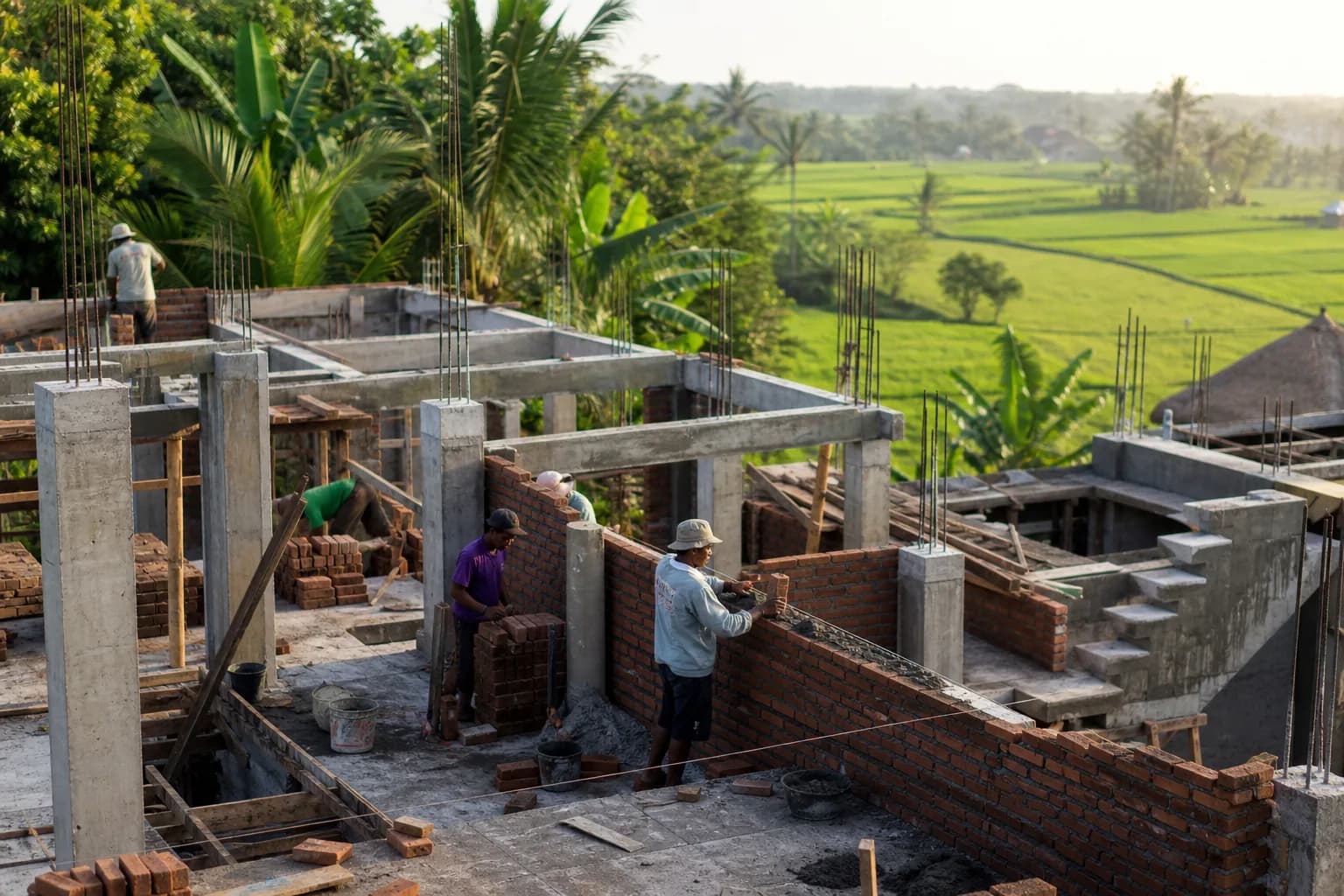
The Critical Water Rights Challenge: Pererenan Subak Irrigation Permits
Pererenan’s rapid development has created an unprecedented engineering challenge: how to legally divert water from traditional Subak irrigation systems for villa construction without violating UNESCO-protected water management protocols. Unlike other Bali regions where municipal water suffices, Pererenan’s agricultural heritage means most land parcels intersect with active Subak channels. Developers face a complex matrix of traditional water rights, government permits, and community obligations that can delay projects 6-18 months or trigger construction halts if mishandled. The technical question isn’t whether you need Subak approval—it’s how to engineer water diversion systems that satisfy both traditional irrigation requirements and modern construction needs while navigating costs that range from IDR 15 million to IDR 85 million depending on channel proximity and seasonal water flow commitments.
Engineering and Legal Framework: Pererenan Subak Water Diversion
Pererenan’s Subak system operates under dual jurisdiction: the traditional Subak organization (recognized under Indonesian Law No. 41/2009 on Sustainable Agricultural Land Protection) and the Badung Regency Water Resources Management Office. This creates a layered approval process fundamentally different from standard construction permits. The Subak Pererenan Kelod and Subak Pererenan Kaja manage approximately 340 hectares of irrigated rice fields, with primary channels (telabah gede) running north-south and secondary channels (telabah pemaron) branching east-west across development zones.
When your land intersects a Subak channel—even a tertiary distribution line—you trigger mandatory water diversion engineering requirements. The technical challenge involves three distinct systems: temporary construction-phase diversion (during foundation work), permanent channel rerouting (if building footprint blocks existing flow), and ongoing water allocation commitments (maintaining downstream irrigation capacity). Each requires separate engineering documentation and community approval.
The legal framework operates through Surat Persetujuan Pengalihan Aliran Air (Water Flow Diversion Approval Letter) issued jointly by the Subak leadership council and village customary authority (Banjar). This isn’t a simple administrative permit—it requires hydraulic engineering calculations proving your diversion maintains equivalent water volume to downstream rice fields, typically verified through dry-season flow testing. The Subak organization will require topographic surveys showing existing channel gradients (typically 1:500 to 1:800 slope in Pererenan’s flat coastal plain), cross-sectional flow capacity measurements, and engineered diversion designs that prevent siltation or flow reduction.
Critical technical specifications include: minimum channel width maintenance (typically 60-80cm for secondary channels), concrete lining requirements for rerouted sections (preventing seepage loss that would reduce downstream flow), and sediment trap installation at diversion points. Pererenan’s high water table (1.5-3 meters depth) complicates this—excavation for foundations often intersects groundwater that feeds Subak channels, requiring dewatering systems that don’t compromise irrigation capacity.
The approval process involves physical site inspections by Subak water masters (pekaseh) who assess seasonal flow patterns. Pererenan receives irrigation water from Sungai Penet via the Telaga Tunjung weir system, with peak flow during wet season (December-March) and critical low-flow periods (August-October) when rice fields require maximum allocation. Your engineering plans must demonstrate adequate flow maintenance during these critical periods, often requiring temporary pumping systems or storage tanks to buffer construction water needs separately from irrigation commitments.
Unlike standard building permits processed through DPMPTSP (One-Stop Investment Service), Subak approvals operate on consensus-based decision timelines. The Subak council meets monthly, but complex diversion proposals requiring hydraulic modeling may need 2-3 review cycles. This creates project timeline risks that standard construction schedules don’t account for—foundation work cannot commence until water diversion infrastructure is operational and approved, yet contractors typically mobilize based on building permit issuance alone.
Hidden Risks: What Developers Miss in Pererenan Water Rights
The most expensive mistake is assuming Subak approval is a one-time administrative fee. Pererenan’s system requires ongoing water allocation contributions—annual payments (typically IDR 2.5-4.5 million per 100m² of land that previously received irrigation) that fund channel maintenance and compensate for lost agricultural productivity. Developers who budget only for initial permits face perpetual obligations that transfer to property owners, creating undisclosed operational costs that affect long-term villa economics.
Second critical risk: seasonal construction restrictions. Subak organizations can prohibit channel modifications during peak irrigation periods (planting and harvest cycles), effectively creating 3-4 month blackout windows where foundation work cannot proceed. Land purchased in May may face construction delays until November, destroying project financing timelines and contractor scheduling. This isn’t documented in standard due diligence—it requires direct consultation with the specific Subak managing your parcel’s water zone.
Third risk involves groundwater extraction conflicts. Many developers plan borewell systems without realizing Pererenan’s shallow aquifer directly feeds Subak channels. Excessive groundwater pumping during construction can reduce surface water flow in irrigation channels 200-300 meters downstream, triggering community disputes and potential construction injunctions. The Subak has customary authority to halt projects that compromise irrigation capacity, a power recognized under traditional law (awig-awig) and enforceable through village dispute resolution mechanisms that supersede standard legal processes.
Engineering consultants unfamiliar with Subak protocols often design drainage systems that discharge construction runoff into irrigation channels, introducing sediment and cement-contaminated water that damages rice fields. This triggers compensation claims and remediation costs (IDR 25-60 million) far exceeding initial permit expenses. Proper engineering requires separate stormwater management systems that bypass Subak channels entirely—a design requirement rarely included in standard villa construction specifications.
Step-by-Step Process: Securing Pererenan Subak Water Diversion Approval
Step 1: Subak Zone Identification and Pekaseh Consultation (Weeks 1-2)
Engage a surveyor to map all water channels crossing your land parcel, identifying whether they’re primary (telabah gede), secondary (telabah pemaron), or tertiary distribution lines. Each classification has different approval requirements and costs. Schedule formal consultation with the Subak pekaseh (water master) for your zone—Pererenan has two main Subak organizations with distinct territories. This meeting establishes your project’s water impact classification: minor (temporary diversion during construction only), moderate (permanent channel rerouting under 50 meters), or major (significant flow modification or channel elimination). Bring topographic surveys and preliminary site plans. The pekaseh will indicate seasonal restrictions and preliminary community concerns that will shape your engineering approach.
Step 2: Hydraulic Engineering and Flow Impact Assessment (Weeks 3-6)
Commission a qualified civil engineer to conduct dry-season flow measurements in channels affecting your site. This requires minimum 3-day monitoring to establish baseline flow rates (typically 8-15 liters/second for secondary channels in Pererenan). Engineer must produce hydraulic calculations proving your diversion design maintains equivalent downstream flow, accounting for channel gradient changes, friction losses in rerouted sections, and seasonal variation. Design must include sediment traps, concrete channel lining specifications (minimum 10cm thickness for permanent diversions), and maintenance access provisions. This engineering package becomes the technical basis for Subak approval—inadequate hydraulic documentation is the primary cause of application rejection.
Step 3: Community Socialization and Banjar Coordination (Weeks 5-8)
Present your diversion plans at a Banjar community meeting (sangkep), explaining construction timeline, water management measures, and compensation offerings. This isn’t optional—Subak approval requires documented community acknowledgment. Expect questions about construction traffic impacts on agricultural access roads, dust control affecting rice crops, and downstream water quality protection. Successful socialization often involves commitments to road maintenance contributions (IDR 5-10 million), agricultural damage insurance, and priority hiring for local labor. Document all commitments in meeting minutes (berita acara) signed by Banjar leadership—these become binding obligations that affect project costs beyond initial permit fees.
Step 4: Formal Application and Subak Council Review (Weeks 9-16)
Submit formal application package to Subak leadership including: hydraulic engineering report, topographic surveys, construction timeline, water management plan, community socialization documentation, and proposed compensation structure. The Subak council reviews applications monthly, but complex diversions may require site committee inspections and multiple review cycles. Be prepared for technical modifications—councils often require additional sediment control measures, modified diversion routes that minimize agricultural impact, or enhanced channel lining specifications. Application fees range IDR 3-8 million depending on diversion complexity, separate from construction-phase water allocation payments and ongoing annual contributions.
Step 5: Physical Infrastructure Implementation and Verification (Weeks 17-22)
Once approved, construct water diversion infrastructure before commencing foundation work. This includes temporary bypass channels, sediment traps, and any permanent channel rerouting. The Subak pekaseh conducts physical inspection to verify construction matches approved engineering plans, measuring channel dimensions, concrete quality, and flow capacity. Only after pekaseh sign-off can you proceed with foundation excavation. Many contractors attempt to parallel-track this work to save time—this risks Subak intervention and construction halts. The verification process includes wet-season flow testing if your project spans rainy months, ensuring diversion systems handle peak flow without flooding or erosion.
Realistic Cost Ranges and Timeline Expectations
Pererenan Subak water diversion costs vary dramatically based on channel classification and construction impact. For minor temporary diversions (construction doesn’t permanently alter channels), expect IDR 15-25 million total including: Subak application fees (IDR 3-5 million), hydraulic engineering documentation (IDR 4-7 million), temporary bypass channel construction (IDR 5-8 million), and community socialization costs (IDR 3-5 million). Timeline: 12-16 weeks from initial consultation to construction approval.
For moderate permanent diversions (rerouting channels 20-50 meters around building footprints), costs increase to IDR 45-65 million including: enhanced engineering with flow modeling (IDR 8-12 million), permanent concrete channel construction (IDR 25-35 million at IDR 850,000-1,200,000 per linear meter including excavation, formwork, and lining), sediment trap systems (IDR 6-9 million), and increased community compensation (IDR 6-9 million). Timeline: 18-24 weeks, with potential seasonal delays adding 8-12 weeks if applications coincide with planting cycles.
For major diversions (eliminating primary channels or significantly altering flow patterns), costs reach IDR 75-95 million and require Water Resources Management Office involvement beyond Subak approval. These projects face highest rejection risk and longest timelines (26-36 weeks), often requiring alternative water source development (deep borewells with separate distribution systems) to compensate for lost irrigation capacity.
Critical hidden cost: ongoing annual water allocation fees of IDR 2.5-4.5 million per 100m² of formerly irrigated land. A typical 500m² villa plot generates IDR 12.5-22.5 million in perpetual annual obligations—a cost rarely disclosed in land purchase negotiations but legally enforceable under Subak customary law and transferable to subsequent property owners.
Frequently Asked Questions: Pererenan Subak Water Rights
Can I avoid Subak approval by using only municipal water and not diverting irrigation channels?
No—if Subak channels cross your land parcel, you require approval regardless of your water source for villa operations. The issue isn’t your water consumption but your construction’s physical impact on irrigation infrastructure. Even if your building footprint doesn’t directly block channels, foundation excavation, site grading, and drainage systems affect water flow patterns. Pererenan’s high water table means excavation for foundations (typically 1.5-2 meters depth) intersects the groundwater that feeds surface irrigation channels. The Subak has legal authority over all water resources within their irrigation zone, including groundwater extraction that affects surface flow. Attempting construction without approval risks community-initiated work stoppages and potential legal action under customary law frameworks that Indonesian courts recognize in water rights disputes.
What happens if I purchase land without checking Subak water obligations?
You inherit all existing water allocation commitments and diversion requirements—these obligations attach to the land, not the individual owner. Many Pererenan land sales don’t disclose Subak status because sellers aren’t legally required to document these customary obligations in standard sale agreements (AJB). During due diligence, specifically request Subak clearance documentation showing: whether land currently receives irrigation water, any existing diversion agreements, outstanding water allocation
 164 m²7 month(s)from 79.000 USD
Private: Haridas Villas, Tegallalang
 3124 m²6 month(s)from 123.000 USD
TALA 8
 4344 m²16 month(s)from 290.000 USD
Radha
 3104 m²11 month(s)from 99.000 USD
TALA 100
 3180 m²7 month(s)from 142.000 USD
Vasudeva

Want to calculate?
 3173 m²6 month(s)from 125.000 USD
TALA FOUR
 172 m²8 month(s)from 120.000 USD
Keshava
164 m²7 month(s)from 79.000 USDTALA TWO
 1from 198.000 USD
Private: Haridas Villas
 2144 m²11 month(s)from 104.000 USD
Narayana
 3127 m²9 month(s)from 177.000 USD
Mukunda
Start With Real Numbers, Not Guesses
Before buying land or finalizing a design, check the realistic build cost range for your project in Bali.
Our team reviews your inputs and gives a grounded estimate.
Available lands
 1000 m²10 min$ 230911Bali, Kerobokan
 800 m²8 min$ 113300Bali, Ungasan
 13000 m²1 min$ 920567Bali, Pekutatan
 700 m²15 min$ 90517Bali, Central Bali
 1410 m²15 min$ 390702Bali, Tabanan
 3700 m²15 min$ 738177Bali, Tabanan
 700 m²20 min$ 90517Bali, Cepaka
 2115 m²5 min$ 1139547Bali, Pererenan
 5028 m²10 min$ 361000Bali, Ubud
 2700 m²30 min$ 314224Bali, Sidemen
 750 m²15 min$ 187038Bali, Kerobokan
 7250 m²56 min$ 235714Bali, Tabanan
 10000 m²19 min$ 232759Bali, Buleleng
 800 m²5 min$ 295567Bali, Seseh
 1000 m²10 min$ 123154Bali, Jimbaran
Essential Bali build & buy guides
- Bali villa construction cost per m² in 2026
- How much will your villa cost? Calculator
- Building a villa in Bali: the complete guide
- Buying land in Bali: step-by-step for foreigners
- Bali villa investment: yields, risks, returns
- Leasehold vs freehold: what foreigners can own
- Construction defect liability & 10-year warranty
- Bali building codes and construction standards
Related guides
Resin-Infused Plaster Finishes: Anti-Salt Systems Bali
Expert technical guide: Resin-Infused Plaster Finishes: Anti-Salt Systems Bali
8 min read
Prefinished Timber Joinery: Silicone Seals Fixings Bali
Professional prefinished timber joinery installation in Bali with silicone seals and fixings for durable weatherproof performance and a premium finish.
10 min read
Polished Concrete Microtopping: Surface Prep Sealants Bali
Discover Bali s polished concrete microtopping: expert surface prep, durable sealants, and a flawless finish for modern floors with minimal maintenance.
9 min read