Limestone Bedrock Drilling Costs Equipment Rental Bali
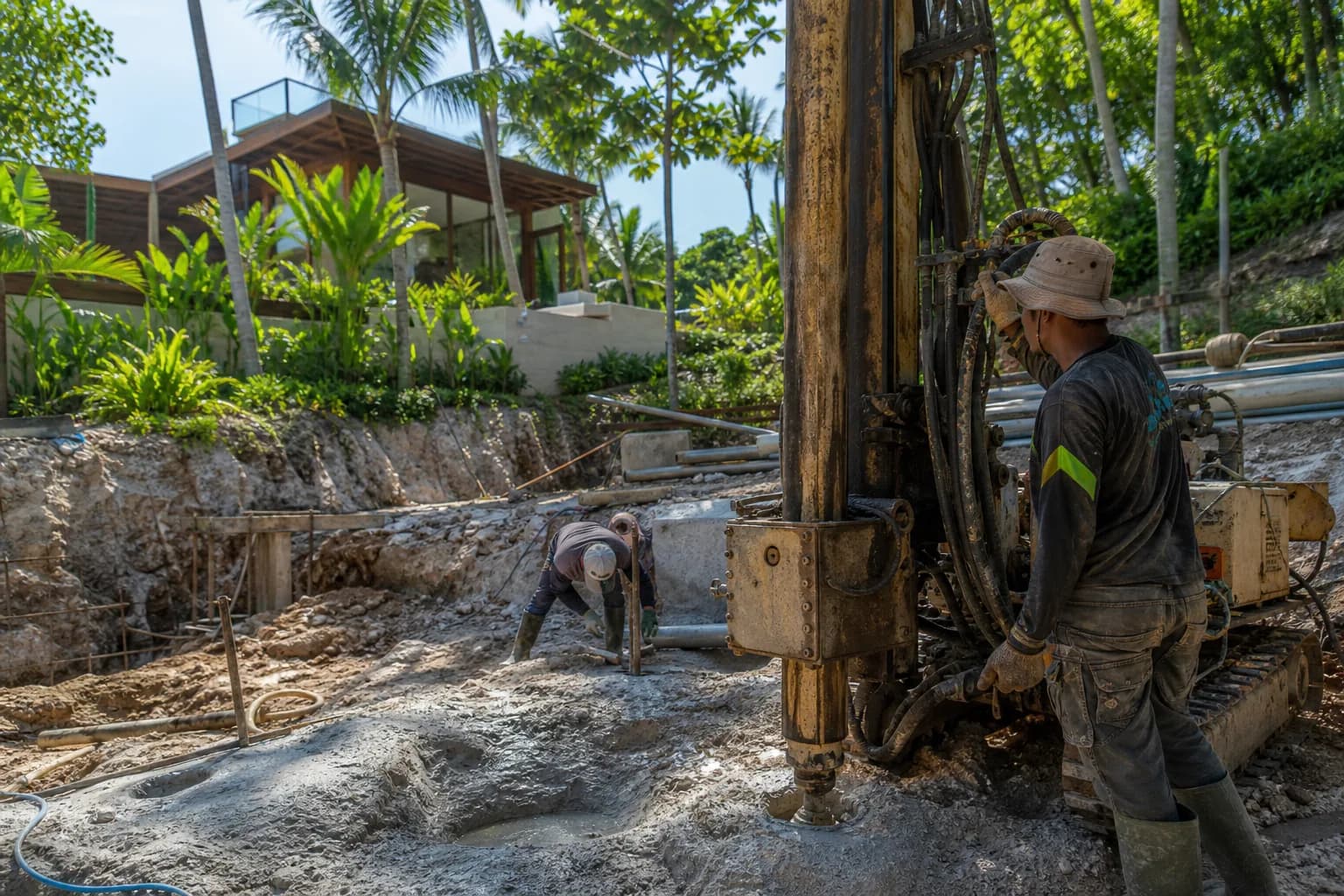
Why Bukit Peninsula Limestone Bedrock Creates Bali’s Most Expensive Foundation Drilling Challenge
The Bukit Peninsula’s geological reality stops construction projects before they start: dense limestone bedrock sitting 0.5 to 8 meters below surface level across Uluwatu, Pecatu, Ungasan, and Jimbaran creates foundation drilling costs that routinely exceed IDR 180-320 million for standard villa projects. Unlike Bali’s volcanic soil regions where augering completes in days, Bukit’s coralline limestone—formed from ancient reef deposits—requires specialized rock drilling equipment, carbide-tipped bits, and experienced operators who understand fracture patterns in sedimentary formations. Property buyers discover this geological constraint during soil testing, when standard excavation equipment fails and project timelines extend by 3-6 weeks while sourcing proper drilling rigs becomes the critical path determining whether construction proceeds or stalls indefinitely.
Bukit Peninsula Limestone Geology and Drilling Engineering Requirements
The Bukit Peninsula’s limestone bedrock represents Bali’s most challenging foundation substrate, formed from uplifted Pleistocene coral reef deposits creating rock densities between 2.2-2.6 g/cm³ with compressive strengths reaching 40-80 MPa. This geological formation extends across the entire southern peninsula from Nusa Dua through Jimbaran, Ungasan, Pecatu, and Uluwatu, creating uniform drilling challenges regardless of specific plot location.
Standard rotary drilling equipment used in Bali’s volcanic soil regions—designed for clay, sand, and soft volcanic tuff—cannot penetrate this limestone effectively. Bukit projects require hydraulic rock drilling rigs with minimum 15-ton operating weight, capable of delivering 8,000-12,000 kg downforce with rotary speeds of 40-80 RPM. The drilling process demands tri-cone roller bits or DTH (Down-The-Hole) hammer systems with carbide inserts specifically engineered for sedimentary rock penetration.
Limestone drilling on Bukit differs fundamentally from volcanic soil augering in penetration rates and bit wear. Where volcanic soil drilling achieves 8-12 meters per hour, limestone bedrock drilling averages 0.8-1.5 meters per hour depending on rock density and fracture patterns. A single foundation pile requiring 6 meters depth into bedrock consumes 4-7 hours of active drilling time, compared to 45 minutes in standard soil conditions.
The coralline limestone structure creates specific engineering challenges: irregular cavities from ancient reef formations, variable density layers, and unpredictable fracture planes that affect drilling stability. Experienced operators adjust drilling parameters continuously—reducing RPM when encountering voids to prevent bit jamming, increasing downforce in dense layers, and monitoring torque readings to detect subsurface cavity formations before equipment damage occurs.
Water requirements for Bukit limestone drilling exceed standard operations significantly. Rock drilling generates extreme friction heat requiring continuous water circulation at 80-120 liters per minute to cool bits, flush rock cuttings, and prevent thermal cracking in the borehole. Projects must secure reliable water supply—typically 15,000-25,000 liters total for complete foundation drilling—before mobilizing equipment, as water interruptions cause bit seizure and borehole collapse requiring complete re-drilling.
Equipment rental for Bukit limestone drilling operates differently than standard construction equipment hire in Bali. Specialized rock drilling rigs remain scarce—only 8-12 units operate across southern Bali—creating 2-4 week lead times during peak construction season (April-October). Rental agreements typically include operator, fuel, bits, and basic maintenance, but exclude water supply, site access preparation, and standby time during permit delays or design changes.
The drilling process requires proper site access: minimum 4-meter-wide pathways capable of supporting 18-22 ton equipment weight, 8-meter vertical clearance for mast extension, and level working platforms within 15 degrees of horizontal. Bukit’s sloped terrain frequently necessitates preliminary earthworks—retaining walls, access ramps, and equipment pads—adding IDR 35-65 million before drilling commences. Projects on steep Uluwatu cliffside plots may require crane-assisted rig positioning, doubling mobilization costs.
Hidden Cost Factors and Common Drilling Mistakes in Bukit Limestone Projects
The most expensive mistake in Bukit Peninsula construction occurs when developers budget for standard soil drilling rates (IDR 450,000-650,000 per meter) and discover actual limestone drilling costs of IDR 1.8-2.8 million per meter after breaking ground. This 300-400% cost variance stems from misunderstanding that “drilling” encompasses fundamentally different processes: soil augering versus rock drilling require different equipment classes, operator expertise, and time allocations.
Soil testing inadequacy creates cascading cost overruns. Standard SPT (Standard Penetration Test) borings to 6-8 meters depth cost IDR 8-12 million but frequently fail to reach actual bedrock depth in areas where limestone sits 10-15 meters below surface under soil overburden. Incomplete geological data leads to foundation redesigns mid-construction when bedrock depth exceeds initial assumptions, requiring additional drilling that wasn’t budgeted or scheduled.
Equipment rental contracts contain hidden cost triggers that inexperienced developers miss. “Standby time” charges of IDR 3.5-5.5 million per day apply when drilling rigs remain on-site but cannot operate due to permit delays, design clarifications, or utility conflicts. A two-week permit processing delay generates IDR 49-77 million in standby charges alone. Contracts also specify “remobilization fees” of IDR 18-28 million if equipment must leave site and return later, penalizing poor project scheduling.
Bit replacement costs escalate rapidly in dense limestone. Tri-cone roller bits rated for 80-120 meters in standard rock conditions may achieve only 40-60 meters in Bukit’s hardest limestone layers before carbide inserts wear beyond effectiveness. Each bit replacement costs IDR 12-18 million, and projects requiring 30-40 foundation piles can consume 6-9 bits total, adding IDR 72-162 million to drilling budgets that assumed minimal bit wear.
The “cheapest quote” trap proves expensive when contractors underestimate Bukit’s geology. Drilling companies quoting IDR 1.2-1.5 million per meter typically operate undersized equipment (10-12 ton rigs) that struggles in dense limestone, achieving 0.3-0.5 meters per hour and frequently breaking down under excessive load. The resulting project delays—3-5 weeks beyond schedule—generate architect supervision fees, extended equipment rental on other trades, and potential penalty clauses that exceed any initial savings from the low bid.
Step-by-Step Process for Bukit Peninsula Limestone Foundation Drilling
Step 1: Comprehensive Geological Investigation (Week 1-2)
Commission proper geological survey with minimum three boreholes to 12-15 meters depth, specifically requesting bedrock depth mapping and limestone density classification. Ensure soil reports include unconfined compressive strength testing of rock cores, not just SPT values. Budget IDR 18-28 million for thorough investigation covering 1,000-1,500 m² plot. This data determines whether foundation design requires drilled piles into bedrock or can utilize shallow footings on competent limestone surface.
Step 2: Foundation Engineering Design (Week 3-4)
Engage structural engineer experienced in Bukit limestone conditions to design foundation system based on actual geological data. Specify pile diameters (typically 300-400mm for villa construction), depths into bedrock (minimum 3 meters embedment), and total pile count. Engineer should provide drilling specifications including required equipment class, bit types, and quality control procedures. Design phase costs IDR 25-45 million but prevents expensive field changes.
Step 3: Equipment Sourcing and Scheduling (Week 5-6)
Contact specialized drilling contractors minimum 4-6 weeks before required start date. Request detailed quotations specifying: equipment model and capacity, operator experience in limestone (minimum 5 years), included consumables (bits, fuel, water), daily rates, mobilization/demobilization costs, and standby time charges. Verify equipment availability with signed reservation agreement and 30% deposit. Expect total drilling costs of IDR 180-320 million for standard 3-4 bedroom villa requiring 28-36 foundation piles.
Step 4: Site Preparation and Access (Week 7-8)
Prepare site for 18-22 ton drilling rig access before equipment mobilization. Construct temporary access roads with 300mm compacted base course, install equipment positioning pads with level tolerance within 2 degrees, and verify 8-meter overhead clearance for mast operation. Secure water supply—either trucked delivery of 20,000+ liters or temporary well with adequate flow rate. Site preparation costs IDR 35-65 million depending on terrain complexity and existing access quality.
Step 5: Drilling Execution and Quality Control (Week 9-12)
Drilling proceeds pile-by-pile with continuous monitoring of penetration rates, torque readings, and rock cuttings characteristics. Experienced operators adjust parameters when encountering density changes or void spaces. Each pile requires verticality verification (maximum 1:100 deviation), depth confirmation to design specifications, and borehole cleaning before concrete placement. Document all drilling with daily logs recording actual depths, rock conditions encountered, and any deviations from design assumptions. Quality control includes periodic core sampling to verify bedrock engagement.
Step 6: Concrete Placement and Reinforcement (Week 13-14)
Immediately following drilling completion, place reinforcement cages and concrete before borehole walls deteriorate. Limestone boreholes remain stable for 24-48 hours in dry conditions but can collapse in fractured zones if left open longer. Use tremie method for concrete placement in deep piles, ensuring continuous pour without segregation. Concrete specifications for limestone foundations require minimum K-300 grade with appropriate workability for tremie placement.
Realistic Cost Ranges and Timeline Expectations for Bukit Drilling Projects
Equipment Rental Rates (2026 Market Rates):
- Hydraulic rock drilling rig (15-18 ton class): IDR 8.5-12 million per day including operator and fuel
- Heavy-duty rig (20-25 ton class) for difficult conditions: IDR 13-17 million per day
- Mobilization/demobilization (round-trip): IDR 18-28 million depending on distance from equipment yard
- Standby time charges: IDR 3.5-5.5 million per day when equipment on-site but not operating
- Tri-cone roller bits (300-400mm diameter): IDR 12-18 million each, expect 6-9 bits for complete villa foundation
Per-Meter Drilling Costs in Bukit Limestone:
- Standard density limestone (40-60 MPa): IDR 1.8-2.2 million per meter drilled
- High density limestone (60-80 MPa): IDR 2.3-2.8 million per meter drilled
- Rates include equipment, operator, fuel, bits, and basic consumables but exclude water supply and site preparation
Complete Villa Foundation Drilling Budget:
- Small villa (2-3 bedrooms, 18-24 piles, 4-5 meters depth): IDR 180-240 million total drilling cost
- Standard villa (3-4 bedrooms, 28-36 piles, 5-6 meters depth): IDR 280-380 million total drilling cost
- Large villa (5+ bedrooms, 45-60 piles, 6-8 meters depth): IDR 450-650 million total drilling cost
Timeline Expectations:
- Geological investigation and reporting: 2-3 weeks from site access to final report
- Equipment reservation to mobilization: 3-6 weeks during peak season, 2-3 weeks off-peak
- Active drilling time: 3-5 weeks for standard villa foundation (weather dependent)
- Total foundation phase from investigation to completed piles: 10-14 weeks
These costs represent 12-18% of total villa construction budgets in Bukit Peninsula, compared to 6-9% for foundation work in Bali’s volcanic soil regions. Developers should allocate contingency of 15-20% above drilling estimates to cover unforeseen geological conditions, equipment delays, or design modifications discovered during execution.
Frequently Asked Questions: Bukit Peninsula Limestone Drilling
Can standard excavation equipment break through Bukit limestone instead of specialized drilling rigs?
Hydraulic excavators with rock breaker attachments can fracture surface limestone to 1-2 meters depth for shallow footings, but cannot achieve the precision, depth, or verticality required for drilled pile foundations extending 5-8 meters into bedrock. Rock breakers also create ground vibration affecting adjacent structures and cause irregular borehole profiles that compromise structural capacity. For villa foundations requiring deep bedrock engagement, proper rotary drilling rigs remain the only viable method. Attempting to substitute excavation equipment typically results in abandoned attempts and subsequent proper drilling, doubling foundation costs and delaying projects 4-6 weeks.
Why do Bukit drilling costs vary so dramatically between contractors quoting IDR 1.2 million versus IDR 2.8 million per meter?
Price variation reflects fundamental differences in equipment capability and contractor experience rather than competitive pricing for equivalent services. Low quotes typically involve undersized rigs (10-12 ton class) operated by contractors inexperienced in Bukit’s dense limestone, resulting in slow penetration rates (0.3-0.5 m/hour), frequent equipment breakdowns, and project delays that generate standby charges exceeding any initial savings. Higher quotes reflect proper 15-20 ton rigs with experienced operators achieving 0.8-1.5 m/hour penetration, completing projects on schedule. The actual delivered cost—including delays, standby time, and remobilization—often converges regardless of initial quote, but proper equipment completes work in half the time with predictable scheduling.
What happens if drilling encounters unexpected cavities or voids in the limestone bedrock?
Cavity encounters occur in 15-25% of Bukit drilling projects
 3180 m²7 month(s)from 142.000 USD
Vasudeva

Want to calculate?
 164 m²7 month(s)from 79.000 USD
TALA TWO
 172 m²8 month(s)from 120.000 USD
Keshava
 1from 198.000 USD
Private: Haridas Villas
 2144 m²11 month(s)from 104.000 USD
Narayana
 3104 m²11 month(s)from 99.000 USD
TALA 100
 3127 m²9 month(s)from 177.000 USD
Mukunda
 3173 m²6 month(s)from 125.000 USD
TALA FOUR
 3124 m²6 month(s)from 123.000 USD
TALA 8
 4344 m²16 month(s)from 290.000 USD
Radha
164 m²7 month(s)from 79.000 USDPrivate: Haridas Villas, Tegallalang
Start With Real Numbers, Not Guesses
Before buying land or finalizing a design, check the realistic build cost range for your project in Bali.
Our team reviews your inputs and gives a grounded estimate.
Available lands
 585 m²8 min$ 165702Bali, Mengwi
 610 m²10 min$ 165271Bali, Seminyak
 500 m²2 min$ 175862Bali, Cemagi
 608 m²15 min$ 310377Bali, Seminyak
 700 m²15 min$ 90517Bali, Central Bali
 800 m²10 min$ 307882Bali, Tibubeneng
 928 m²15 min$ 910123Bali, Pererenan
 6000 m²10 min$ 1330049Bali, Kutuh South Bali
 2500 m²5 min$ 609606Bali, Kedungu
 700 m²15 min$ 162500Bali, Tabanan
 29000 m²6 min$ 3857143Bali, Tabanan
 500 m²10 min$ 107143Bali, Tabanan
 2230 m²15 min$ 410573Bali, Padonan
 3000 m²15 min$ 738916Bali, Cepaka
 5815 m²5 min$ 815740Bali, Tabanan
Essential Bali build & buy guides
- Bali villa construction cost per m² in 2026
- How much will your villa cost? Calculator
- Building a villa in Bali: the complete guide
- Buying land in Bali: step-by-step for foreigners
- Bali villa investment: yields, risks, returns
- Leasehold vs freehold: what foreigners can own
- Construction defect liability & 10-year warranty
- Bali building codes and construction standards
Related guides
Sanur and Nusa Dua vs Canggu: Stability Plays vs Hype
Canggu gets the headlines; Sanur and Nusa Dua quietly deliver steadier returns to a different kind of buyer. An honest 2026 comparison of the stability markets against the hype market — prices, demand drivers, oversupply risk, and who should buy where.
7 min read
Ubud and the Wellness Market: Buying or Building for Retreats
Ubud is Bali's wellness capital, and retreat-focused property behaves differently from beach villas: longer stays, group bookings, lower volatility. Here is what the market rewards, what zoning allows, and what it costs to buy or build a retreat property in 2026.
8 min read
Buying and Building on the Bukit: Uluwatu, Bingin and Balangan from a Buyer's Seat
A buyer's-seat 2026 guide to the Bukit peninsula — Uluwatu, Bingin and Balangan land prices, the water problem nobody budgets, cliff setbacks after the 2025 Bingin demolitions, and how to build there properly.
7 min read