Bathroom Tile Grout Sealing in Bali: Prevent Mold
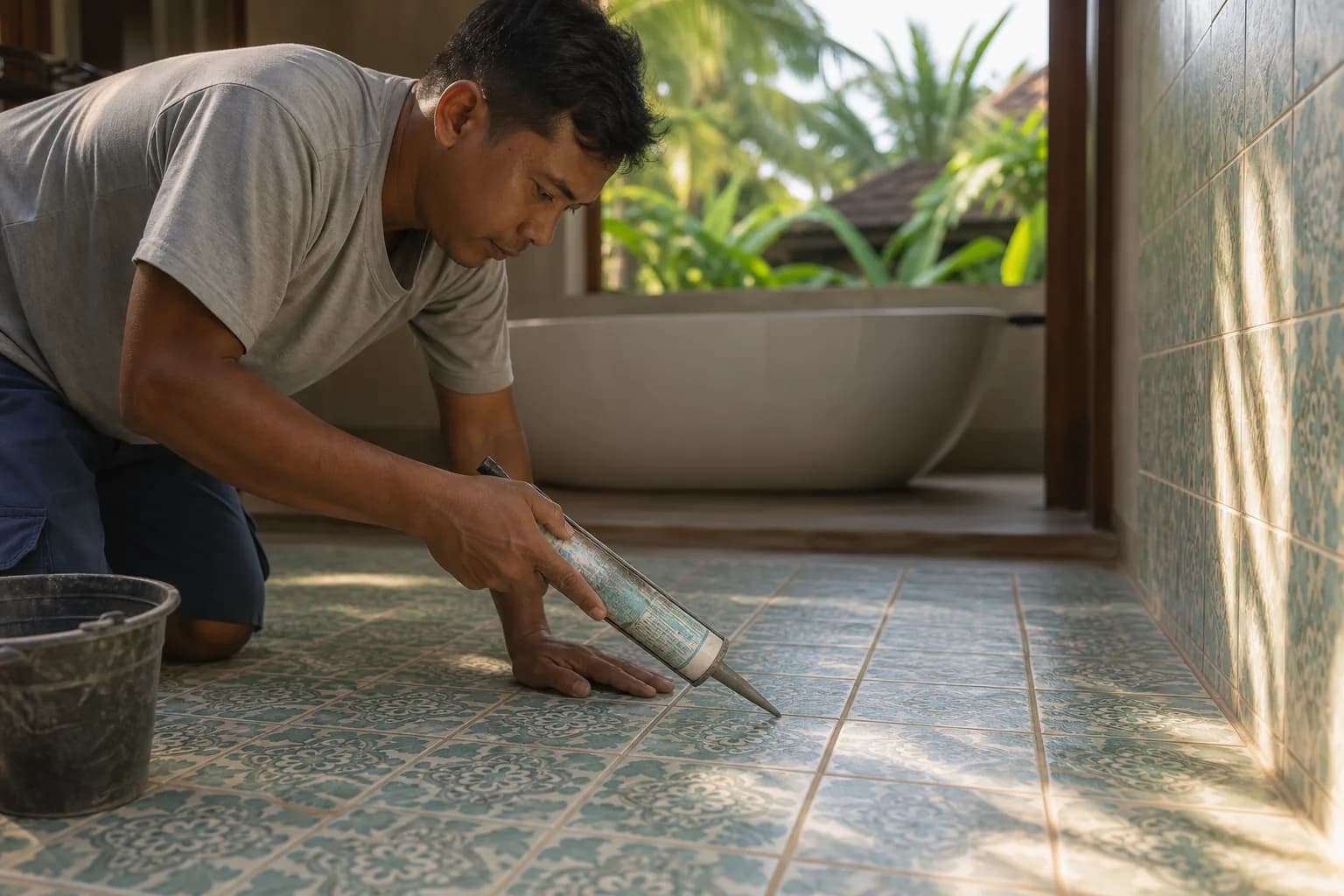
Bathroom Tile Grout Sealing: Mold Prevention in Bali’s Humid Climate
The Specific Problem: Why Bali’s Bathrooms Face Unique Grout Challenges
Bali’s tropical climate presents a distinctive challenge for bathroom finishing works that mainland construction professionals often underestimate. With annual humidity levels consistently exceeding 70-80% and frequent rainfall, bathroom grout becomes a primary vulnerability in villa construction. Unlike temperate climates where grout deterioration happens gradually over years, Bali’s moisture-saturated environment accelerates mold colonization within weeks of improper sealing or installation. Property owners frequently discover black mold streaking through grout lines within their first monsoon season, transforming what appeared to be pristine finishing work into a maintenance nightmare. This isn’t merely an aesthetic concern—unsealed or improperly sealed grout compromises the structural integrity of tile installations, allows moisture penetration into substrate layers, and creates conditions for mildew that can spread to adjacent wall structures. For villa developers and homeowners investing in Bali real estate, understanding proper grout sealing methodology isn’t optional; it’s fundamental to ensuring bathroom finishing durability in this specific tropical environment.
Technical Deep Dive: How Grout Sealing Functions in Tropical Conditions
Grout sealing operates through a deceptively simple principle that becomes complex when applied to Bali’s climate: creating a protective barrier that prevents moisture penetration while allowing vapor transmission. Unsealed grout is inherently porous—composed of cement, sand, and water, it naturally absorbs moisture like a sponge. In Bali’s humidity, this porosity becomes catastrophic. Water molecules migrate through grout lines continuously, creating an environment where mold spores (which exist everywhere in tropical air) find ideal conditions: moisture, darkness, and organic material to consume. The sealing process fills microscopic pores in the grout matrix with either penetrating sealers (which chemically bond with grout) or membrane-forming sealers (which create a surface barrier). However, this is where tropical climate considerations diverge sharply from standard construction practice.
In Bali’s environment, the sealing application timing is critical. Grout must cure completely—typically 72 hours minimum in temperate climates—before sealing application. However, Bali’s humidity interferes with this curing process. High moisture content in the air slows cement hydration, potentially extending curing time to 5-7 days. Applying sealer to incompletely cured grout traps residual moisture within the grout matrix, creating conditions where mold actually thrives beneath the sealed surface. This is why many villa owners report mold appearing after sealing—a counterintuitive outcome that reflects improper application timing rather than sealer failure.
The chemistry of sealer performance also shifts in tropical conditions. Penetrating sealers work by forming siloxane or silane bonds within grout pores. These chemical reactions proceed more slowly in high humidity and elevated temperatures (Bali averages 28-32°C year-round). Membrane-forming sealers, conversely, can trap moisture if applied too early or if humidity prevents proper film formation. Additionally, Bali’s salt-laden air (particularly in coastal villas) accelerates sealer degradation. Chloride ions from sea spray chemically attack sealer polymers, reducing protective lifespan from the typical 3-5 years to potentially 18-24 months in exposed locations. This technical reality means grout sealing in Bali isn’t a one-time finishing task—it’s a recurring maintenance component requiring reapplication every 2-3 years as part of comprehensive villa maintenance protocols.
The relationship between grout sealing and mold prevention must also be understood within realistic parameters. Sealing reduces mold growth by approximately 60-70% according to industry research, but does not eliminate it entirely. In Bali’s climate, sealed grout still experiences moisture penetration through tile edges, substrate layers, and microscopic sealer imperfections. Mold prevention therefore requires sealing as one component within a multi-layered strategy: proper substrate waterproofing, adequate ventilation systems, regular cleaning protocols, and humidity management. Teville’s finishing approach recognizes this complexity, implementing grout sealing as part of integrated bathroom systems rather than as an isolated finishing step.
Materials & Standards: Selecting Appropriate Sealers for Bali’s Climate
Sealer selection fundamentally determines long-term performance in Bali’s tropical environment. Two primary categories exist: penetrating sealers and membrane-forming sealers, each with distinct advantages and limitations in high-humidity conditions.
Penetrating Sealers (Siloxane/Silane-Based) chemically bond with grout minerals, creating hydrophobic properties without surface film formation. These sealers allow vapor transmission—critical in Bali where trapped moisture accelerates mold growth. Penetrating sealers typically last 3-5 years in temperate climates but 18-36 months in Bali due to salt-air degradation and UV exposure. Premium brands like Aqua Mix Sealer’s Choice Gold or TileLab Grout Sealer perform adequately in tropical conditions, though they require reapplication more frequently than manufacturers’ standard recommendations suggest. The advantage: they won’t trap moisture or create surface slickness. The disadvantage: they provide less visible protection and require more frequent maintenance cycles.
Membrane-Forming Sealers (Acrylic/Polyurethane-Based) create protective surface films that visibly darken grout and provide immediate water repellency. These sealers offer superior initial protection but present risks in Bali’s climate. If applied to incompletely cured grout or during high-humidity conditions, they trap moisture beneath the membrane, creating ideal mold conditions. Polyurethane-based sealers (like Aqua Mix Polyurethane Grout Sealer) perform better than acrylic in tropical environments due to superior moisture resistance, but still require precise application conditions. Membrane sealers typically last 2-3 years in Bali before degradation becomes visible.
Hybrid Sealers combining penetrating and membrane technologies represent emerging solutions for tropical climates. These products attempt to balance vapor transmission with surface protection. Performance data from Bali applications remains limited, but preliminary results suggest 3-4 year durability cycles.
Industry standards for grout sealing in tropical regions remain underdeveloped—most specifications derive from temperate climate research. However, the Tile Council of North America (TCNA) provides baseline guidance applicable to Bali: grout must cure 72 hours minimum before sealing (extended to 5-7 days in high humidity), sealer application requires dry conditions (humidity below 85%, which is challenging in Bali), and reapplication intervals should be shortened by 30-40% compared to standard recommendations. Teville specifies penetrating sealers for most Bali applications due to superior long-term performance in high-humidity environments, with membrane sealers reserved for specific aesthetic requirements where clients accept increased maintenance responsibility.
Step-by-Step Grout Sealing Process: Bali-Specific Methodology
Phase 1: Pre-Sealing Preparation (Days 1-7 Post-Grouting)
Proper preparation determines 80% of sealing success. After tile installation and grout application, grout must cure completely before any sealing work begins. In Bali’s climate, this requires 5-7 days minimum, not the standard 72 hours. During this curing period, maintain bathroom ventilation continuously—open windows, operate exhaust fans, and if available, use dehumidification equipment. This accelerates moisture evaporation from grout and substrate, reducing the moisture content that would otherwise interfere with sealer bonding.
On day 5-6 post-grouting, inspect grout lines for complete curing. Properly cured grout should be uniformly colored (no lighter patches indicating moisture), firm to light pressure, and free of surface dust. If grout appears wet or discolored, extend curing an additional 2-3 days. This patience-intensive step is where many Bali construction projects fail—rushing to sealing before complete curing guarantees moisture-trapping and subsequent mold growth.
Once curing is confirmed, clean grout lines thoroughly. Use a grout brush or old toothbrush with clean water to remove surface dust, debris, and any residual grout haze. For stubborn haze, dilute white vinegar (1:1 with water) can be applied, but rinse thoroughly afterward. Allow grout to dry completely—typically 24 hours in Bali’s climate with continuous ventilation. This drying phase is non-negotiable; sealing damp grout traps moisture and negates the entire process.
Phase 2: Environmental Conditions Assessment (Day 7-8)
Before sealing application, verify environmental conditions meet specifications. Ideal conditions for grout sealing in Bali: humidity below 85% (challenging but achievable during dry season or early morning hours), temperature between 15-30°C (Bali typically exceeds this, but early morning application helps), and no rainfall forecast for 48 hours post-application. Check weather patterns—avoid sealing during monsoon season or immediately before predicted heavy rain. If humidity exceeds 85%, delay sealing. This is the critical decision point where many projects compromise quality by proceeding under suboptimal conditions.
Prepare the bathroom by closing windows and doors after initial ventilation, creating a controlled environment. Ensure adequate lighting—sealer application requires visibility to detect missed areas. Have all materials staged: sealer, application tools, protective equipment, and cleanup supplies.
Phase 3: Sealer Application (Day 8)
For penetrating sealers (recommended for Bali), application methodology differs from membrane sealers. Apply penetrating sealer using a small brush, applicator bottle with precision tip, or foam applicator, working along grout lines systematically. The goal is saturating grout pores without excessive surface pooling. Apply sealer in thin, consistent lines along each grout joint, allowing it to absorb into the grout. Work in 2-3 meter sections, completing one area before moving to the next.
Penetrating sealers typically require 2-3 coats for optimal protection in tropical climates. Apply the first coat, allow 30-60 minutes absorption time (follow specific product instructions), then apply the second coat. A third coat, applied 24 hours later, provides enhanced protection justified by Bali’s aggressive moisture environment. Between coats, maintain ventilation but avoid direct air circulation that could dry sealer too rapidly.
For membrane-forming sealers, application requires different technique. These sealers should be applied with a small brush or applicator, working quickly to maintain wet edges and prevent lap marks. Apply in thin, even coats, allowing 4-6 hours drying between coats. Membrane sealers typically require only 1-2 coats but demand more precise application technique.
Critical detail: avoid sealer contact with tile surfaces. Sealer on tile creates slippery conditions and aesthetic issues. Use painter’s tape along tile edges if necessary, or apply sealer with precision to grout lines only. Immediately wipe any sealer that contacts tile with a damp cloth.
Phase 4: Curing and Post-Application Care (Days 8-10)
After final sealer application, allow complete curing before bathroom use. Penetrating sealers typically cure in 24-48 hours; membrane sealers require 48-72 hours. During this period, maintain ventilation but avoid moisture exposure. Don’t shower, clean, or introduce water to the bathroom. This curing phase is where tropical humidity creates challenges—high ambient moisture slows sealer curing. If possible, use dehumidification equipment or maintain continuous air circulation to accelerate curing.
After curing is complete, test sealer effectiveness by applying water droplets to grout lines. Properly sealed grout should bead water rather than absorb it. If water absorbs into grout, sealing was incomplete—additional coats may be necessary.
Phase 5: Maintenance Protocol Establishment (Ongoing)
Grout sealing in Bali is not a permanent solution but rather the foundation of ongoing maintenance. Establish a cleaning schedule: weekly bathroom cleaning with pH-neutral cleaners (avoid acidic or alkaline products that degrade sealer), monthly inspection for mold appearance, and quarterly deep cleaning with dilute vinegar solution if mold begins appearing. Reapply sealer every 2-3 years, or sooner if water no longer beads on grout surfaces. This maintenance cycle, while requiring discipline, ensures bathroom finishing durability throughout the villa’s lifespan.
Costs & Timeline: Budget Planning for Bali Bathroom Finishing
Grout sealing costs in Bali vary based on bathroom size, grout line length, and sealer type selected. For a standard 8-10 square meter bathroom with typical tile layout, material costs range from IDR 800,000-2,000,000 (USD $50-130) depending on sealer quality and quantity required. Premium penetrating sealers cost more than basic options but provide superior tropical performance.
Labor costs for professional application typically range from IDR 2,000,000-4,000,000 (USD $130-260) for a standard bathroom, reflecting the time-intensive nature of proper application and the expertise required to manage Bali’s climate-specific challenges. DIY application can reduce costs but introduces significant risk of improper technique, inadequate curing time management, and moisture-trapping errors that compromise long-term performance.
Timeline for complete grout sealing process: 10-12 days from grouting completion to bathroom readiness. This includes 5-7 days curing, 1-2 days preparation and environmental assessment, 1 day sealing application, and 2-3 days final curing. Rushing this timeline—a common pressure in construction projects—directly correlates with mold problems appearing within 2-3 months post-completion.
For villa renovation projects involving multiple bathrooms, economies of scale apply. A 4-bathroom villa renovation might cost IDR 12,000,000-18,000,00
 1from 198.000 USD
Private: Haridas Villas

Want to calculate?
 3180 m²7 month(s)from 142.000 USD
Vasudeva
 164 m²7 month(s)from 79.000 USD
Private: Haridas Villas, Tegallalang
164 m²7 month(s)from 79.000 USDTALA TWO
 3124 m²6 month(s)from 123.000 USD
TALA 8
 3173 m²6 month(s)from 125.000 USD
TALA FOUR
 172 m²8 month(s)from 120.000 USD
Keshava
 4344 m²16 month(s)from 290.000 USD
Radha
 3104 m²11 month(s)from 99.000 USD
TALA 100
 2144 m²11 month(s)from 104.000 USD
Narayana
 3127 m²9 month(s)from 177.000 USD
Mukunda
Start With Real Numbers, Not Guesses
Before finalizing your finishing works plan, check realistic cost ranges for your Bali villa project.
Available lands
 3254 m²5 min$ 631800Bali, All
 6000 m²10 min$ 1330049Bali, Kutuh South Bali
 1300 m²10 min$ 348214Bali, Tabanan
 2800 m²15 min$ 310345Bali, Tabanan
 500 m²10 min$ 107143Bali, Tabanan
 600 m²10 min$ 206897Bali, Canggu
 250 m²15 min$ 40025Bali, Munggu
 3000 m²15 min$ 1246921Bali, Tabanan
 2000 m²5 min$ 1440887Bali, Pecatu
 800 m²5 min$ 295567Bali, Seseh
 700 m²15 min$ 90517Bali, Central Bali
 3800 m²15 min$ 100616Bali, Pererenan
 1230 m²15 min$ 132543Bali, Tegallalang
 2700 m²30 min$ 314224Bali, Sidemen
 2000 m²10 min$ 243842Bali, Mengwi
Essential Bali build & buy guides
- Bali villa construction cost per m² in 2026
- How much will your villa cost? Calculator
- Building a villa in Bali: the complete guide
- Buying land in Bali: step-by-step for foreigners
- Bali villa investment: yields, risks, returns
- Leasehold vs freehold: what foreigners can own
- Construction defect liability & 10-year warranty
- Bali building codes and construction standards
Related guides
Sanur and Nusa Dua vs Canggu: Stability Plays vs Hype
Canggu gets the headlines; Sanur and Nusa Dua quietly deliver steadier returns to a different kind of buyer. An honest 2026 comparison of the stability markets against the hype market — prices, demand drivers, oversupply risk, and who should buy where.
7 min read
Ubud and the Wellness Market: Buying or Building for Retreats
Ubud is Bali's wellness capital, and retreat-focused property behaves differently from beach villas: longer stays, group bookings, lower volatility. Here is what the market rewards, what zoning allows, and what it costs to buy or build a retreat property in 2026.
8 min read
Buying and Building on the Bukit: Uluwatu, Bingin and Balangan from a Buyer's Seat
A buyer's-seat 2026 guide to the Bukit peninsula — Uluwatu, Bingin and Balangan land prices, the water problem nobody budgets, cliff setbacks after the 2025 Bingin demolitions, and how to build there properly.
7 min read