Volcanic Ash Concrete Mix Standards for Karangasem Bali
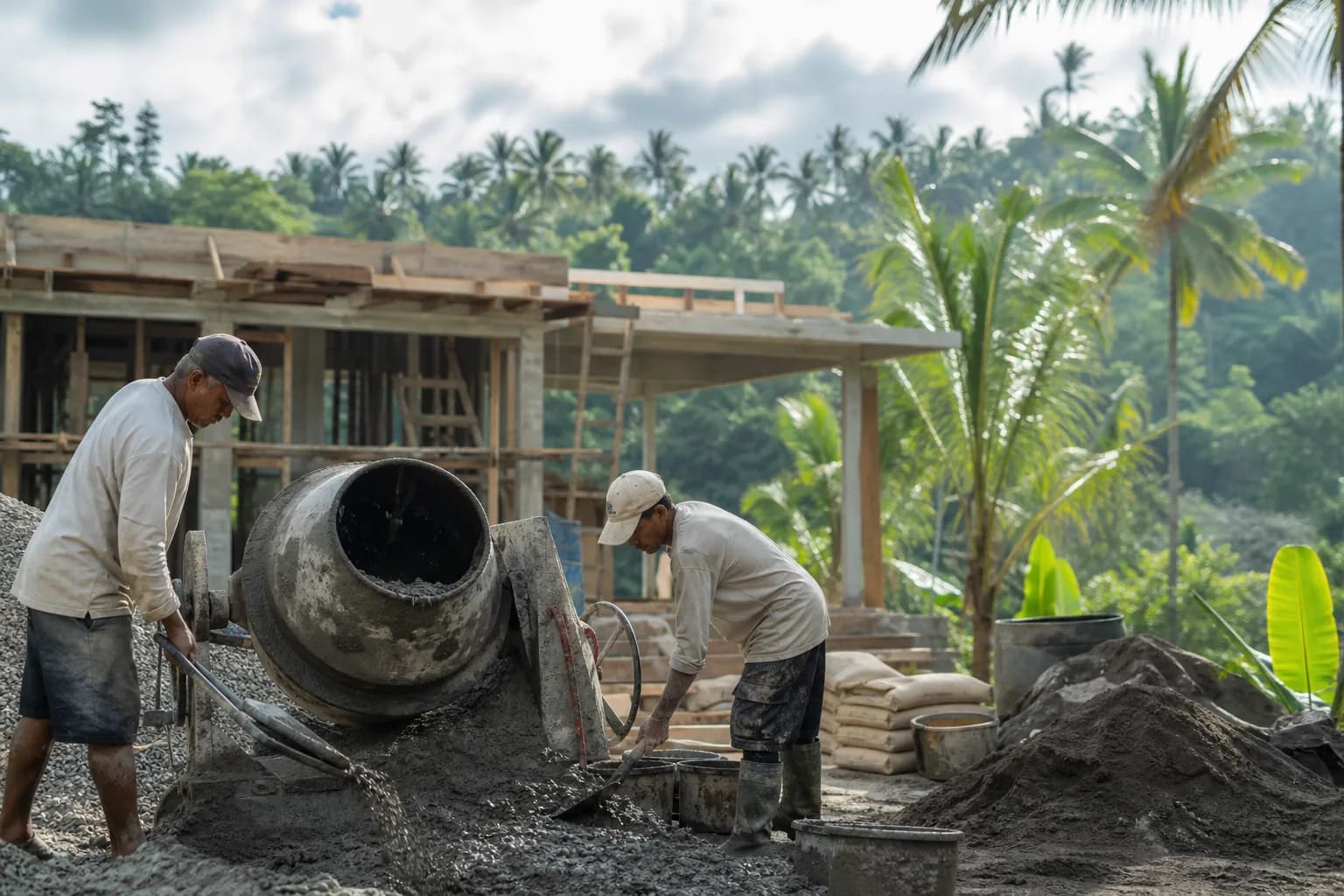
The Critical Gap in Volcanic Ash Concrete Standards for Karangasem Construction Projects
Karangasem regency sits in the shadow of Mount Agung, Bali’s most active volcano, where construction materials are literally shaped by volcanic geology. Yet despite abundant local volcanic ash deposits and their proven pozzolanic properties, no region-specific concrete mix standards exist for Karangasem construction in 2026. This regulatory vacuum creates significant engineering risks for villa construction projects, particularly when builders attempt to substitute volcanic ash for conventional cement without proper testing protocols, structural calculations, or quality control measures. The absence of localized standards means projects must navigate between international specifications like ASTM C618-22 and Indonesian SNI concrete standards while accounting for Karangasem’s unique ash mineralogy, moisture conditions, and seismic requirements—a technical challenge that separates engineered construction from speculative building practices.
Engineering Specifications for Volcanic Ash Pozzolan in Karangasem Concrete Systems
Volcanic ash from Mount Agung and surrounding deposits contains reactive silica and alumina compounds that function as supplementary cementitious materials when properly processed and proportioned. ASTM C618-22 classifies natural pozzolans into Class N materials, requiring minimum 70% combined SiO2 + Al2O3 + Fe2O3 content and specific fineness retention standards. However, Karangasem volcanic ash exhibits variable chemical composition depending on eruption age, weathering exposure, and collection depth—factors that directly impact pozzolanic reactivity and concrete performance.
The fundamental engineering challenge involves balancing cement replacement ratios against compressive strength requirements for tropical villa construction. Research published in construction materials journals demonstrates that volcanic ash replacement rates between 10-30% of Portland cement mass can maintain or improve long-term concrete durability while reducing embodied carbon. Yet these ratios assume controlled particle size distribution (typically 45-micron fineness), consistent chemical analysis, and proper curing protocols—conditions rarely verified in local Karangasem material supply chains.
For structural concrete applications in Bali villa construction, the critical performance threshold remains 25 MPa compressive strength at 28 days for load-bearing elements. When incorporating Karangasem volcanic ash, mix designs must account for delayed pozzolanic reaction kinetics. Unlike Portland cement’s rapid hydration, volcanic ash requires 56-90 days to achieve full strength contribution through secondary reactions with calcium hydroxide. This extended curing timeline conflicts with typical construction schedules where formwork removal and load application occur at 14-21 days.
The mineralogical composition of Karangasem ash—predominantly andesitic to basaltic glass with crystalline phases—requires X-ray diffraction analysis to verify amorphous content exceeding 60%. Without this glassy phase dominance, the material functions as inert filler rather than reactive pozzolan, compromising both strength development and durability enhancement. Indonesian SNI 2847:2019 concrete standards reference pozzolanic admixtures but provide no specific guidance for volcanic ash sourcing, processing, or quality verification in regional contexts.
Chloride penetration resistance becomes particularly relevant for Karangasem coastal construction zones. Volcanic ash concrete demonstrates superior resistance to chloride ion ingress compared to pure Portland cement systems—a critical advantage for tropical construction engineering within 5 kilometers of ocean exposure. However, this benefit only materializes when ash replacement exceeds 20% and water-cement ratios remain below 0.45, requiring precise batching controls often absent in small-scale concrete production facilities.
Sulfate attack resistance presents another engineering consideration for Karangasem groundwater conditions. Volcanic ash pozzolans reduce concrete permeability and bind sulfate ions through aluminate phase reactions, but effectiveness depends on ash fineness and replacement percentage. Projects near rice paddies or areas with organic-rich soils face elevated sulfate exposure, necessitating specialized mix designs that balance volcanic ash content against sulfate-resistant cement specifications per SNI 15-7064-2014.
The thermal properties of volcanic ash concrete offer advantages for Bali’s tropical climate, with reduced heat of hydration minimizing thermal cracking risks in mass concrete applications like foundation systems and retaining walls. Karangasem ash typically reduces peak hydration temperatures by 8-15°C compared to pure Portland cement mixes, but this benefit requires minimum 25% replacement ratios and controlled placement temperatures below 32°C—challenging during midday construction operations.
Hidden Risks in Unverified Volcanic Ash Concrete Applications
The most dangerous assumption in Karangasem construction involves treating all volcanic ash as equivalent pozzolanic material. Ash collected from different geological strata, weathering conditions, or processing methods exhibits dramatically different reactivity levels. Material sourced from recent eruption deposits may contain excessive unburned carbon or soluble salts that compromise concrete setting and long-term durability. Conversely, heavily weathered ash loses reactive glass content through natural pozzolanic reactions with groundwater, reducing effectiveness as cement replacement.
Many local suppliers provide volcanic ash without chemical analysis certificates, particle size distribution data, or loss-on-ignition testing—fundamental quality control parameters required by international pozzolan standards. This documentation gap creates liability exposure for construction projects, as structural failures related to substandard concrete cannot be traced to specific material batches or suppliers. For projects requiring building permits Bali compliance and structural engineering certifications, undocumented volcanic ash sources represent unacceptable technical risk.
The interaction between volcanic ash concrete and reinforcing steel requires careful consideration in Karangasem’s high-humidity environment. While pozzolanic reactions generally improve concrete alkalinity and passive steel protection, improperly processed ash containing chloride contamination or reduced pH levels can accelerate corrosion. Without material testing protocols verifying chloride content below 0.1% by cement mass and pH levels above 12.5, reinforced concrete elements face premature deterioration—a critical concern for villa construction cost Bali lifecycle economics.
Workability challenges emerge when volcanic ash replacement exceeds 20% without corresponding adjustments to water content, plasticizers, or mixing duration. Karangasem ash particles exhibit angular morphology and high surface area, increasing water demand and reducing concrete slump. Contractors unfamiliar with pozzolanic mix designs often compensate by adding excess water, inadvertently increasing porosity and reducing final compressive strength below structural requirements. This field modification practice undermines engineered mix designs and creates hidden structural deficiencies.
Implementation Protocol for Volcanic Ash Concrete in Karangasem Projects
Establishing project-specific volcanic ash concrete standards begins with geological material characterization. Engage accredited Indonesian laboratories (SNI ISO/IEC 17025 certified) to perform comprehensive testing on proposed ash sources, including X-ray fluorescence for chemical composition, laser diffraction for particle size analysis, and strength activity index testing per ASTM C311. This baseline characterization typically requires 2-3 weeks and costs 15-25 million IDR for complete pozzolan qualification testing.
Develop trial mix designs targeting specific structural applications—foundation concrete (K-300 grade), structural columns and beams (K-350 grade), and non-structural elements (K-225 grade). Each mix design should include minimum three volcanic ash replacement ratios (15%, 20%, 25%) with corresponding adjustments to water-cement ratios, superplasticizer dosages, and aggregate proportions. Cast standard test cylinders (150mm x 300mm) for compressive strength testing at 7, 28, 56, and 90 days to verify strength development curves and establish appropriate formwork removal schedules.
Implement field quality control protocols including daily slump testing, air content verification, and cylinder casting for every 50 cubic meters of concrete placement. For Karangasem projects using volcanic ash concrete, extend standard curing periods from 7 days to minimum 14 days with continuous moisture maintenance. This extended curing requirement directly impacts construction scheduling and formwork inventory requirements—factors that must be integrated into project planning and cost estimation processes.
Establish material traceability systems linking each concrete batch to specific volcanic ash source locations, processing dates, and quality control test results. This documentation becomes critical for structural certification submissions to Karangasem building authorities and provides liability protection if material performance issues emerge during construction or occupancy phases. Digital batch tracking systems integrated with project management platforms enable real-time quality verification and regulatory compliance demonstration.
Coordinate with structural engineers to modify reinforcement detailing and cover depth specifications for volcanic ash concrete applications. While pozzolanic concrete generally provides superior steel protection, conservative engineering practice maintains minimum 40mm cover for exterior exposure conditions and 50mm for ground-contact elements in Karangasem’s aggressive tropical environment. These adjustments affect formwork complexity and reinforcement fabrication costs but ensure long-term structural durability.
Develop supplier qualification criteria requiring volcanic ash providers to demonstrate consistent material quality across multiple delivery batches. Establish acceptance testing protocols where each material delivery undergoes rapid field verification (fineness testing, visual inspection for contaminants) before incorporation into concrete mixes. Reject materials showing visible organic matter, excessive moisture content above 3%, or color variations indicating geological source changes.
For projects pursuing green building certifications or carbon reduction targets, document embodied carbon savings achieved through volcanic ash cement replacement. Typical Portland cement production generates 0.82-0.92 kg CO2 per kg cement, while processed volcanic ash contributes negligible embodied carbon. At 25% replacement ratios in a 300 cubic meter villa project, carbon savings exceed 15 metric tons CO2-equivalent—a quantifiable sustainability benefit relevant to villa project positioning and environmental impact assessments.
Cost and Timeline Implications for Volcanic Ash Concrete Systems
Material cost analysis for Karangasem volcanic ash concrete reveals complex economics. Raw volcanic ash costs 150,000-300,000 IDR per cubic meter depending on processing level and transportation distance, compared to Portland cement at 1,400,000-1,600,000 IDR per ton. At 25% cement replacement in K-300 concrete (typical foundation grade), material cost savings range from 180,000-240,000 IDR per cubic meter of concrete—approximately 12-15% reduction in concrete material costs.
However, these direct material savings must be offset against additional testing requirements, extended curing periods, and specialized quality control protocols. Initial material characterization and mix design development adds 25-40 million IDR to project preconstruction costs. Ongoing batch testing and quality verification increases construction phase testing budgets by 8-12 million IDR for typical 250-350 square meter villa projects. The net economic benefit emerges primarily in larger projects exceeding 500 cubic meters of concrete placement where material savings outweigh testing overhead.
Timeline extensions for volcanic ash concrete implementation include 3-4 weeks for material qualification and mix design development during preconstruction phases, plus 7-10 additional days for extended curing requirements during foundation and structural frame construction. For typical Bali villa construction projects with 8-10 month schedules, volcanic ash concrete systems add approximately 4-6 weeks to overall project duration—a factor that must be communicated clearly during client expectation setting and construction scheduling.
Labor cost implications remain minimal as concrete placement techniques for volcanic ash mixes mirror conventional practices once proper mix designs are established. However, contractor training requirements add 2-3 days for site supervision teams to understand modified curing protocols, quality control procedures, and documentation requirements. This training investment becomes particularly valuable for construction companies managing multiple Karangasem projects where volcanic ash concrete knowledge transfers across project portfolios.
Frequently Asked Questions: Volcanic Ash Concrete in Karangasem Construction
Can volcanic ash from Mount Agung eruptions be used directly in concrete without processing?
No. Raw volcanic ash requires processing including drying, grinding to specified fineness (typically 45-micron retention), and removal of contaminants like unburned carbon, soluble salts, and organic matter. Direct use of unprocessed eruption ash introduces variable particle sizes, excessive moisture content, and chemical inconsistencies that compromise concrete strength and durability. Proper processing also enables quality control testing to verify pozzolanic reactivity and compliance with ASTM C618 Class N specifications before incorporation into structural concrete mixes.
How does volcanic ash concrete perform during Bali’s seismic events compared to conventional concrete?
Volcanic ash concrete exhibits comparable or superior seismic performance to conventional Portland cement concrete when properly designed and cured. The pozzolanic reactions create denser microstructure with reduced permeability,

Want to calculate?
 3173 m²6 month(s)from 125.000 USD
TALA FOUR
 2144 m²11 month(s)from 104.000 USD
Narayana
 164 m²7 month(s)from 79.000 USD
TALA TWO
 3104 m²11 month(s)from 99.000 USD
TALA 100
 3180 m²7 month(s)from 142.000 USD
Vasudeva
164 m²7 month(s)from 79.000 USDPrivate: Haridas Villas, Tegallalang
 1from 198.000 USD
Private: Haridas Villas
 172 m²8 month(s)from 120.000 USD
Keshava
 3124 m²6 month(s)from 123.000 USD
TALA 8
 3127 m²9 month(s)from 177.000 USD
Mukunda
 4344 m²16 month(s)from 290.000 USD
Radha
Start With Real Numbers, Not Guesses
Before buying land or finalizing a design, check the realistic build cost range for your project in Bali.
Our team reviews your inputs and gives a grounded estimate.
Available lands
 1000 m²10 min$ 280788Bali, Pecatu
 4270 m²10 min$ 394397Bali, Ubud
 500 m²2 min$ 175862Bali, Cemagi
 1362 m²15 min$ 335468Bali, Tumbak
 3000 m²15 min$ 1246921Bali, Tabanan
 1430 m²5 min$ 209862Bali, Klungkung
 660 m²10 min$ 175567Bali, Mengwi
 3900 m²10 min$ 432266Bali, Tabanan
 700 m²20 min$ 90517Bali, Cepaka
 600 m²10 min$ 206897Bali, Canggu
 615 m²15 min$ 113608Bali, Tabanan
 5815 m²5 min$ 815740Bali, Tabanan
 420 m²15 min$ 41897Bali, Tabanan
 700 m²8 min$ 165517Bali, Umalas
 680 m²15 min$ 110751Bali, Pererenan
Essential Bali build & buy guides
- Bali villa construction cost per m² in 2026
- How much will your villa cost? Calculator
- Building a villa in Bali: the complete guide
- Buying land in Bali: step-by-step for foreigners
- Bali villa investment: yields, risks, returns
- Leasehold vs freehold: what foreigners can own
- Construction defect liability & 10-year warranty
- Bali building codes and construction standards
Related guides
Integrated Furniture Fixings Hidden Brackets MEP Clearance Bali
Explore integrated furniture fixings with hidden brackets and MEP clearance in Bali. Learn installation tips, load guidance, and clean, accessible finishes.
8 min read
Epoxy Primer Moisture Barrier for Bali Interior Renovations
Explore epoxy primer and moisture barrier solutions for Bali interior renovations, delivering durable adhesion, moisture protection, and long-lasting finishes.
8 min read
Engineered Stone Countertop Fixing Support Standards Bali
Explore Bali s engineered stone countertop fixing and support standards. Installation tips, durability guidance, and compliance for lasting quality surfaces.
10 min read