Variable Speed Pool Pump Sizing: kWh Savings for Bali Villas
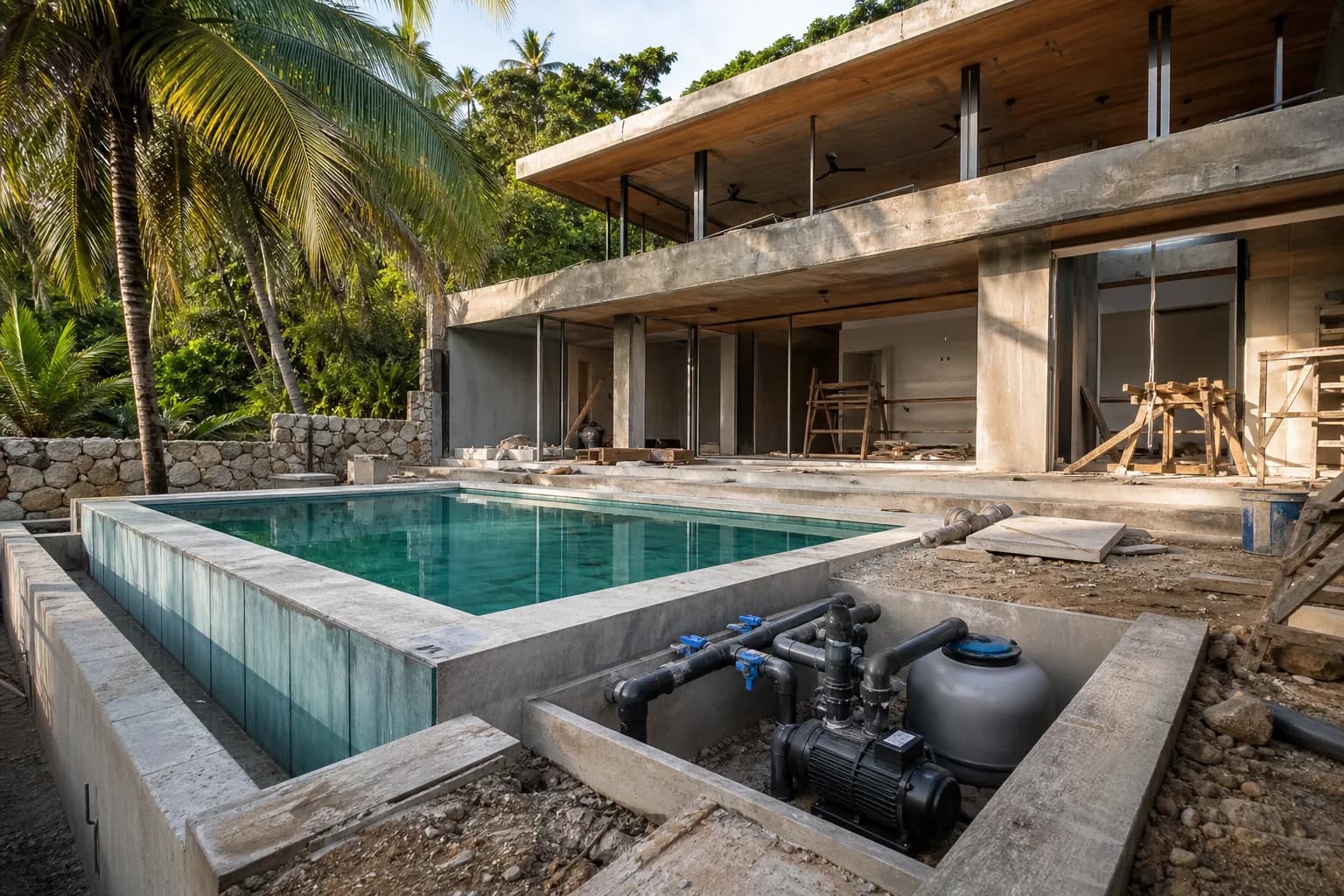
Variable Speed Pool Pump Sizing: kWh Savings for Bali Villa Operations
Villa operators across Bali face a persistent challenge: pool maintenance costs that consume 20-30% of monthly utility budgets. A typical single-speed pool pump running 8 hours daily at 1,500 watts costs approximately IDR 3.6 million annually at Bali’s commercial electricity rates. The technical question isn’t whether to upgrade—it’s how to properly size variable speed pumps for tropical pool conditions where higher ambient temperatures, increased evaporation, and year-round operation create unique load requirements. Incorrect sizing leads to inadequate filtration or wasted energy, both costly mistakes in Bali villa construction and renovation projects.
Technical Deep Dive: Variable Speed Technology in Tropical Pool Systems
Variable speed pool pumps utilize permanent magnet motors with integrated frequency drives, allowing precise RPM control from 600 to 3,450 rotations per minute. This technology fundamentally changes energy consumption because pump power requirements follow the affinity laws: reducing speed by 50% decreases energy use by approximately 87.5%. For Bali villa operations, this translates to running pumps at lower speeds for extended periods, achieving superior filtration while consuming significantly less electricity.
The tropical climate introduces specific technical considerations that affect pump sizing. Bali’s consistent 26-32°C temperatures accelerate algae growth and chemical degradation, requiring more frequent water turnover. However, higher water temperatures also reduce viscosity, allowing pumps to move water more efficiently at lower speeds. Our MEP systems installations account for these factors when calculating required flow rates.
Proper sizing begins with calculating pool volume and determining turnover rate. Bali villa pools typically range from 30-80 cubic meters. Industry standards recommend complete water turnover every 6-8 hours for residential pools, but tropical conditions often necessitate 4-6 hour cycles during peak season. A 50 cubic meter pool requiring 6-hour turnover needs 8.33 cubic meters per hour flow rate, or approximately 138 liters per minute.
Variable speed pumps achieve optimal efficiency at 1,200-1,800 RPM for standard filtration cycles. At these speeds, a properly sized pump consumes 200-400 watts compared to 1,200-1,800 watts for equivalent single-speed units. The energy savings compound over Bali’s year-round swimming season—there’s no winter shutdown period to reduce annual consumption.
Critical to tropical installations is understanding total dynamic head (TDH)—the resistance the pump must overcome including elevation changes, pipe friction, filter resistance, and fitting losses. Bali villa construction often incorporates elevated equipment rooms or rooftop installations for aesthetic reasons, increasing TDH by 0.1 bar per meter of elevation. A pump room 3 meters above pool water level adds 0.3 bar to system resistance, requiring careful calculation to maintain adequate flow at reduced speeds.
Filter compatibility significantly impacts pump performance. Sand filters common in Bali installations create 0.3-0.7 bar resistance when clean, increasing to 1.0 bar when requiring backwash. Cartridge filters offer lower resistance (0.2-0.5 bar) but need more frequent cleaning in dusty tropical environments. Variable speed pumps excel with cartridge systems because lower operating pressures allow extended low-speed operation.
Electrical infrastructure in Bali villa operations requires specific attention. Variable speed pumps draw 220-240V single-phase power with lower starting amperage than single-speed units—typically 8-12 amps versus 15-20 amps. This reduced electrical demand often eliminates the need for dedicated circuit upgrades during renovation projects, providing additional cost savings beyond operational efficiency.
Installation Process: Step-by-Step Variable Speed Pump Integration
Professional installation begins with comprehensive system assessment. Our finishing works teams measure existing plumbing diameter (typically 50mm or 63mm PVC in Bali villa construction), document elevation changes, and calculate total pipe length including equivalent length for fittings. Each 90-degree elbow adds approximately 1 meter equivalent length; gate valves add 0.3 meters. This data determines actual TDH requirements.
Equipment room preparation involves creating stable mounting surfaces. Concrete pads should be 100mm thick, reinforced with 8mm rebar grid at 200mm spacing, and elevated 50-100mm above floor level for drainage. In coastal Bali locations, we apply epoxy coating to concrete surfaces to prevent salt-air corrosion affecting pump mounting hardware. The pad must be perfectly level—even 2-degree slopes create vibration issues at higher RPM settings.
Plumbing modifications typically require transitioning from rigid PVC to flexible connections immediately before and after the pump. We install 300mm flexible PVC couplings or reinforced rubber unions to absorb vibration and prevent stress cracks in rigid piping. This detail is critical in Bali’s seismic conditions where ground movement can fracture rigid connections.
Electrical installation requires dedicated circuits with appropriate breakers—typically 16-20 amp for residential variable speed pumps. We run 2.5mm² cable in UV-resistant conduit, ensuring all outdoor connections use IP65-rated junction boxes. Ground fault protection is mandatory in wet environments; we install 30mA RCD protection at the distribution board. Control panels should be mounted in shaded, ventilated locations—direct tropical sun exposure degrades electronic components within 2-3 years.
Priming procedures differ from single-speed installations. Variable speed pumps require complete air evacuation before starting. We fill the pump housing through the lid opening, ensuring water reaches the impeller chamber. Initial startup occurs at low speed (1,200 RPM) for 2-3 minutes, allowing gradual air purging through the system. Attempting high-speed startup with air pockets can damage seals and impellers.
Programming optimal schedules maximizes energy savings. Our standard Bali villa configuration runs pumps at 1,400 RPM for 6 hours during off-peak electricity periods (typically 22:00-04:00), then 2 hours at 2,400 RPM during morning for skimming and chemical distribution. This schedule provides 1.5 complete turnovers daily while consuming approximately 2.4 kWh compared to 12 kWh for equivalent single-speed operation.
System balancing involves adjusting valve positions to achieve target flow rates at programmed speeds. We use ultrasonic flow meters to verify actual flow, adjusting return valve positions to match calculated requirements. Over-restriction wastes energy; under-restriction reduces filtration effectiveness. Proper balancing typically requires 2-3 adjustment cycles over the first week of operation.
Materials & Specifications: Equipment Selection for Tropical Durability
Variable speed pump selection for Bali villa operations prioritizes corrosion resistance and thermal management. We specify pumps with reinforced thermoplastic housings rather than cast iron—Bali’s humidity and salt air corrode ferrous metals rapidly. Quality units feature glass-filled polypropylene or composite resin construction rated for continuous tropical exposure.
Motor specifications should include IP55 or higher ingress protection, with sealed bearing assemblies and corrosion-resistant shaft materials. Stainless steel (316 grade minimum) or ceramic shafts withstand Bali’s coastal environment. Avoid pumps with aluminum components in salt-air zones—corrosion appears within 6-12 months.
Seal materials require careful selection. EPDM rubber seals tolerate chlorine and high temperatures better than standard nitrile. Carbon-ceramic mechanical seals outlast standard rubber seals by 3-5 years in continuous tropical operation. The incremental cost (approximately IDR 800,000) is recovered through reduced maintenance.
Control interfaces should feature weatherproof construction with UV-stabilized plastics. LCD displays must be readable in bright tropical sunlight—backlit units with high contrast ratios perform best. We avoid touch-screen controls in outdoor installations; physical buttons withstand humidity and temperature cycling more reliably.
Plumbing components require UV-stabilized PVC rated for continuous 40°C water temperature. Standard gray PVC degrades in direct sunlight; we specify dark gray or black UV-resistant formulations. All threaded connections use Teflon tape plus thread sealant—temperature cycling in tropical climates loosens tape-only connections within months.
Cost Breakdown: Investment Analysis for Bali Villa Projects
Variable speed pump equipment costs range from IDR 12-28 million depending on capacity and features. A quality 1.5 HP unit suitable for 40-60 cubic meter pools costs approximately IDR 18 million. Comparable single-speed pumps cost IDR 4-7 million, creating an initial premium of IDR 11-14 million that requires justification through operational savings.
Installation labor for new construction adds IDR 3-5 million including electrical work, plumbing modifications, and commissioning. Renovation projects involving equipment replacement cost IDR 5-8 million due to additional work removing existing equipment and adapting plumbing. Our cost estimation service provides detailed breakdowns for specific villa configurations.
Annual energy savings in typical Bali villa operations average IDR 2.8-3.6 million based on 8-hour daily operation and commercial electricity rates of IDR 1,650 per kWh. A 50 cubic meter pool operating a 1.5 HP single-speed pump consumes approximately 4,380 kWh annually (IDR 7.2 million). The equivalent variable speed installation consumes 1,460 kWh (IDR 2.4 million), saving IDR 4.8 million yearly—recovering the equipment premium within 3 years.
Maintenance costs decrease with variable speed technology. Lower operating speeds reduce wear on bearings, seals, and impellers. Expected service intervals extend from 18-24 months for single-speed pumps to 36-48 months for variable speed units. Seal replacement costs approximately IDR 1.2 million; bearing service costs IDR 1.8 million. Extended intervals save IDR 800,000-1.2 million over 5-year ownership periods.
Common Mistakes: Technical Pitfalls in Tropical Pool Pump Installations
Undersizing pumps for tropical conditions represents the most frequent error. Installers often apply temperate-climate calculations without accounting for Bali’s accelerated algae growth and chemical consumption. Pools requiring 6-hour turnover in moderate climates need 4-5 hour cycles in tropical environments. This oversight leads to chronic water quality issues that operators mistakenly attribute to chemical imbalances rather than inadequate circulation.
Improper electrical installation creates performance and safety issues. Running undersized cables causes voltage drop at the pump, reducing motor efficiency and triggering thermal protection shutoffs. We’ve encountered installations using 1.5mm² cable for 12-amp pumps—the 8% voltage drop at 25-meter run length reduces motor power by 15% and increases operating temperature significantly. Always specify 2.5mm² minimum for pump circuits.
Neglecting vibration isolation damages plumbing systems. Variable speed pumps generate different vibration frequencies at various RPM settings. Without flexible connections, these vibrations transmit through rigid PVC, creating stress cracks at joints and fittings. We’ve repaired systems where omitted flexible couplings caused six pipe failures within the first year, costing IDR 4-6 million in emergency repairs.
Incorrect programming wastes the efficiency advantage. Many operators run variable speed pumps at maximum speed continuously, negating energy savings. Others program excessively low speeds that fail to achieve adequate turnover. Optimal programming requires calculating minimum flow rates for complete filtration, then scheduling extended low-speed operation supplemented by brief high-speed periods for skimming and chemical distribution.
Inadequate weather protection shortens equipment life. Mounting control panels in direct sun exposure or rain-exposed locations causes premature electronic failure. Bali’s intense UV radiation degrades plastic housings and LCD displays within 2-3 years without proper shading. Equipment rooms should provide overhead protection and cross-ventilation while preventing direct rain entry—louvered walls work effectively in our villa projects.
Frequently Asked Questions: Variable Speed Pool Pumps in Bali Villas
What size variable speed pump does a typical Bali villa pool require?
Most Bali villa pools of 40-60 cubic meters require 1.5 HP variable speed pumps capable of delivering 150-200 liters per minute at operating speeds. Larger resort pools (80-120 cubic meters) need 2.0-2.5 HP units. Sizing depends on total dynamic head—pools with elevated equipment rooms or extensive plumbing runs require higher capacity. Our MEP systems team calculates exact requirements based on specific site conditions including pipe length, elevation changes, and filter type during the design phase.
How long does variable speed pump installation take in renovation projects?
Complete installation typically requires 2-3 days for renovation projects. Day one involves removing existing equipment, modifying plumbing for flexible connections, and preparing electrical circuits. Day two covers pump installation, electrical connections, and initial testing. Day three focuses on programming, system balancing, and operator training. New construction installations integrate more quickly—1-2 days—because plumbing and electrical infrastructure is designed specifically for the equipment. Weather delays can extend timelines during Bali’s rainy season.
Can variable speed pumps handle saltwater pool systems common in Bali?
Yes, but material specifications become critical. Saltwater systems require pumps with enhanced corrosion resistance—316-grade stainless steel or titanium components rather than standard materials. Seal materials must tolerate both chlorine and salt; EPDM or Viton seals perform best. We specify saltwater-rated units that cost approximately 20% more than standard models but provide reliable 7-10 year service life. Standard pumps in saltwater applications fail within 2-3 years due to accelerated corrosion of shafts, seals, and fasteners.
What ma
Want to calculate?
 164 m²7 month(s)from 79.000 USD
TALA TWO
 4344 m²16 month(s)from 290.000 USD
Radha
 3124 m²6 month(s)from 123.000 USD
TALA 8
 3173 m²6 month(s)from 125.000 USD
TALA FOUR
 3127 m²9 month(s)from 177.000 USD
Mukunda
 172 m²8 month(s)from 120.000 USD
Keshava
164 m²7 month(s)from 79.000 USDPrivate: Haridas Villas, Tegallalang
 3104 m²11 month(s)from 99.000 USD
TALA 100
 2144 m²11 month(s)from 104.000 USD
Narayana
 3180 m²7 month(s)from 142.000 USD
Vasudeva
 1from 198.000 USD
Private: Haridas Villas
Start With Real Numbers, Not Guesses
Before buying land or finalizing a design, check the realistic build cost range for your project in Bali.
Our team reviews your inputs and gives a grounded estimate.
Available lands
 3100 m²20 min$ 272968Bali, Tabanan
 700 m²15 min$ 162500Bali, Tabanan
 2500 m²5 min$ 609606Bali, Kedungu
 422 m²15 min$ 93547Bali, Kerobokan
 3700 m²15 min$ 738177Bali, Tabanan
 200 m²11 min$ 89286Bali, Tabanan
 260 m²5 min$ 51872Bali, Kedungu
 2800 m²15 min$ 310345Bali, Tabanan
 2200 m²15 min$ 508005Bali, Canggu
 500 m²10 min$ 107143Bali, Tabanan
 204 m²5 min$ 40899Bali, Kedungu
 600 m²10 min$ 206897Bali, Canggu
 3300 m²15 min$ 449889Bali, Tabanan
 325 m²15 min$ 44472Bali, Ungasan
 2115 m²5 min$ 1139547Bali, Pererenan
Essential Bali build & buy guides
- Bali villa construction cost per m² in 2026
- How much will your villa cost? Calculator
- Building a villa in Bali: the complete guide
- Buying land in Bali: step-by-step for foreigners
- Bali villa investment: yields, risks, returns
- Leasehold vs freehold: what foreigners can own
- Construction defect liability & 10-year warranty
- Bali building codes and construction standards
Related guides
Integrated Furniture Fixings Hidden Brackets MEP Clearance Bali
Explore integrated furniture fixings with hidden brackets and MEP clearance in Bali. Learn installation tips, load guidance, and clean, accessible finishes.
8 min read
Epoxy Primer Moisture Barrier for Bali Interior Renovations
Explore epoxy primer and moisture barrier solutions for Bali interior renovations, delivering durable adhesion, moisture protection, and long-lasting finishes.
8 min read
Engineered Stone Countertop Fixing Support Standards Bali
Explore Bali s engineered stone countertop fixing and support standards. Installation tips, durability guidance, and compliance for lasting quality surfaces.
10 min read