Salt Chlorinator vs Chemical Dosing: Bali Pool Cost Analysis
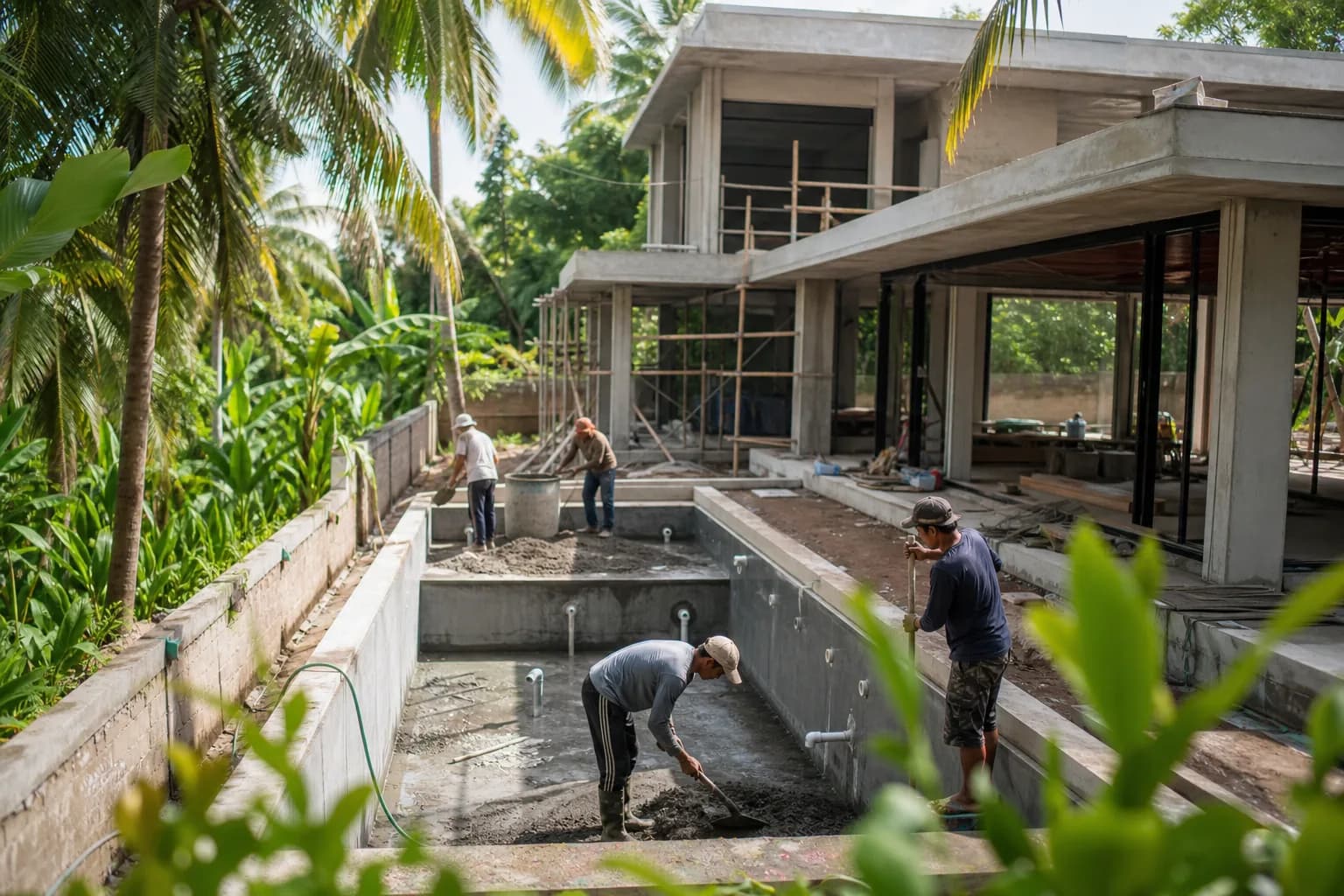
The Real Cost Dilemma: Choosing Between Salt Chlorination and Chemical Dosing for Your Bali Pool
When completing the MEP systems phase of villa construction in Bali, pool owners face a critical decision that impacts both upfront investment and long-term operational costs: salt chlorinator systems versus traditional chemical dosing. With initial equipment costs ranging from IDR 15-45 million for salt chlorinators compared to IDR 5-12 million for basic chemical dosing setups, the choice seems straightforward—until you factor in Bali’s tropical climate, water quality variations, maintenance labor costs, and the actual chemical consumption over 5-10 years. Many villa developers make this decision based solely on construction budget constraints, only to discover that the cheaper initial option costs significantly more over the property’s lifetime, particularly when factoring in staff time, chemical storage requirements, and equipment replacement cycles in Bali’s corrosive coastal environment.
Technical Deep Dive: Understanding Both Systems in Bali’s Tropical Context
Salt chlorination systems use electrolysis to convert dissolved salt (sodium chloride) into chlorine gas, which sanitizes the pool water before reverting back to salt. The core component is a titanium cell with ruthenium or iridium coating that conducts electrical current through salt-enriched water (typically 3,000-4,000 ppm, about one-tenth the salinity of seawater). This process generates hypochlorous acid—the same sanitizing agent produced by traditional chlorine—but does so continuously and automatically.
In Bali’s tropical climate, salt chlorinator systems offer distinct advantages. The consistent 26-32°C ambient temperatures accelerate chlorine consumption in traditionally-dosed pools, requiring more frequent chemical additions. Salt systems compensate automatically by increasing production during high-demand periods. However, Bali’s high humidity (75-95%) and salt air in coastal areas accelerate corrosion of electronic components and metal fixtures, reducing the typical 5-7 year cell lifespan to 3-5 years without proper material selection.
Traditional chemical dosing involves manually or automatically adding liquid chlorine (sodium hypochlorite), granular chlorine (calcium hypochlorite), or stabilized chlorine tablets (trichlor or dichlor) to maintain sanitizer levels. This requires regular testing, chemical storage facilities, and either dedicated staff time or automated dosing pumps (IDR 8-15 million for quality peristaltic systems). The chemical storage area must meet safety standards: ventilated space, acid-resistant flooring, separate storage for incompatible chemicals (never store chlorine and acid together), and protection from direct sunlight and moisture.
Bali’s water quality significantly impacts system performance. Municipal water in Denpasar, Sanur, and Seminyak typically has 150-300 ppm total dissolved solids (TDS), while well water in Canggu, Uluwatu, and Ubud can exceed 800 ppm with high iron content. Salt chlorinators add approximately 3,500 ppm to TDS, which may exceed ideal pool water parameters (1,500 ppm maximum) when starting with high-TDS source water. Traditional chemical dosing doesn’t add TDS from salt but does increase it through calcium hypochlorite use (adds calcium hardness) or stabilizer accumulation from trichlor tablets.
The electrical requirements differ substantially. Salt chlorinators require dedicated 220V circuits with 200-500 watt continuous draw (depending on pool size), adding IDR 150,000-300,000 monthly to electricity costs. They must be installed with proper grounding and GFCI protection—critical in Bali’s wet environment. Chemical dosing pumps use minimal electricity (15-30 watts) but require chemical replenishment logistics, which in remote Bali locations can mean significant delivery fees or staff time traveling to suppliers in Denpasar.
For villa projects in Bali, the system choice impacts multiple finishing trades. Salt systems require all metal pool fixtures (ladders, handrails, light fixtures) to be marine-grade 316 stainless steel rather than standard 304 grade, adding 30-40% to fixture costs. Natural stone coping and decking must be sealed with salt-resistant products. Landscaping near salt pools requires salt-tolerant species, as splash-out and backwash water contains 3,000+ ppm salt that damages sensitive tropical plants.
Installation Process: Implementing Each System in Bali Villa Construction
Salt Chlorinator Installation Sequence:
The salt chlorinator installation occurs during the MEP rough-in phase, after pool shell completion but before finishing works. First, install the dedicated 220V electrical circuit from the distribution panel to the equipment area, using 2.5mm² NYM cable in waterproof conduit. Position the circuit breaker with 30mA GFCI protection—non-negotiable in Bali’s humid environment where ground faults are common.
Mount the salt cell in the return line after the filter and heater (if present) but before any water features or return jets. The cell must be installed vertically or at a slight angle to prevent air pocket formation, which reduces efficiency and damages the titanium plates. Use schedule 40 PVC unions on both sides of the cell for easy removal during cleaning (required every 3-6 months in Bali’s hard water conditions). The control unit mounts on a nearby wall, protected from direct rain but with adequate ventilation—never inside sealed equipment boxes where heat buildup exceeds operating specifications.
Install a flow switch in the plumbing line before the cell. This safety device prevents the cell from operating when water flow is insufficient, which would cause overheating and premature failure. In Bali installations, we’ve seen 40% of premature cell failures traced to missing or malfunctioning flow switches. Connect the bonding wire from the cell to the pool’s equipotential bonding system, linking all metal components to prevent galvanic corrosion and electrical hazards.
After plumbing and electrical connections, pressure test the system at 2 bar for 24 hours before filling the pool. Once filled with fresh water, add pool-grade salt (sodium chloride with 99%+ purity, no iodine or anti-caking agents) to achieve 3,000-4,000 ppm. For a 50m³ pool, this requires approximately 150-200kg of salt (IDR 300,000-500,000). Dissolve salt by running the circulation pump; never add salt directly over metal fixtures or allow undissolved salt to settle on pool surfaces, as concentrated salt causes etching and corrosion.
Traditional Chemical Dosing Installation:
Chemical dosing systems require less complex installation but more careful planning for chemical storage and handling. Designate a dedicated chemical storage area meeting these specifications: minimum 2m² floor space, acid-resistant tile or epoxy-coated concrete flooring, louvered ventilation providing 6+ air changes per hour, lockable door (required by Indonesian safety regulations), and location away from electrical panels and living spaces.
For manual dosing, install a dedicated chemical mixing station with a hose connection and drainage to waste (never drain concentrated chemicals directly to landscaping). For automated systems, mount peristaltic dosing pumps on a wall-mounted panel with the chemical reservoirs below. Install the injection points in the return line after the filter, using check valves to prevent backflow. Each chemical (chlorine and pH adjuster) requires a separate pump and injection point, spaced at least 30cm apart to prevent chemical reactions in the plumbing.
Connect dosing pumps to the pool controller or timer system so they only operate when the circulation pump runs. Install an ORP (oxidation-reduction potential) probe and pH probe in a flow cell on the return line to provide feedback for automated dosing. These probes require monthly calibration and replacement every 12-18 months in Bali’s conditions (IDR 1,500,000-2,500,000 per probe). Without automated monitoring, manual testing with liquid reagent kits (more accurate than test strips in tropical heat) is required 2-3 times weekly.
Materials & Specifications: What Works in Bali’s Environment
Salt Chlorinator Components:
Specify salt cells with titanium plates coated with ruthenium-iridium rather than cheaper ruthenium-only coatings. The iridium addition extends cell life by 30-50% in Bali’s hard water. Quality brands include Hayward AquaRite, Pentair IntelliChlor, and Zodiac LM Series, with cells rated for 40-80m³ pools costing IDR 15-25 million. Oversizing the cell by 20-30% reduces the operating percentage required, extending cell lifespan significantly.
Use only pool-grade salt meeting AS 4315 or equivalent standards. Agricultural or industrial salt contains impurities (iron, copper, manganese) that stain pool surfaces and damage equipment. Expect to pay IDR 2,500-3,500 per kilogram for quality pool salt in Bali, with 150-200kg required for initial fill and 20-40kg annually for replacement after backwashing and splash-out.
All metal components in contact with salt water must be marine-grade 316 stainless steel or bronze. This includes pump housings, filter tanks, light fixtures, ladders, and handrails. Standard 304 stainless steel shows pitting corrosion within 12-18 months in salt pool environments. The cost premium is 30-40% but prevents replacement expenses and safety hazards from corroded fixtures.
Chemical Dosing Materials:
For manual dosing, liquid sodium hypochlorite (12.5% chlorine) is most practical in Bali, available in 20-liter containers for IDR 200,000-300,000. Store in opaque containers away from heat and sunlight; chlorine concentration decreases 50% within 90 days in tropical conditions. Granular calcium hypochlorite (65-70% chlorine) has longer shelf life but adds calcium hardness, problematic in Bali’s already-hard water.
Automated dosing systems require commercial-grade peristaltic pumps with chemical-resistant tubing (Viton or EPDM, not PVC which degrades). Quality systems from Prominent, Grundfos, or Emec cost IDR 8-15 million per pump. Chemical reservoirs should be opaque HDPE with 20-40 liter capacity, positioned to allow gravity feed to pumps while maintaining prime.
Cost Breakdown: Real Numbers for Bali Pool Systems
Salt Chlorinator System (50m³ pool):
- Salt chlorinator unit with cell (40-80m³ capacity): IDR 18,000,000-28,000,000
- Marine-grade 316 stainless steel fixtures (premium over standard): IDR 8,000,000-12,000,000
- Electrical installation (dedicated circuit, GFCI): IDR 2,500,000-4,000,000
- Initial salt (150-200kg): IDR 500,000-700,000
- Installation labor: IDR 3,000,000-5,000,000
- Total Initial Investment: IDR 32,000,000-49,700,000
Annual Operating Costs (Salt System):
- Electricity (300W × 8hrs × 365 days × IDR 1,500/kWh): IDR 1,314,000
- Salt replacement (30kg annually): IDR 90,000-120,000
- Cell cleaning chemicals: IDR 200,000
- Cell replacement reserve (every 4 years): IDR 5,000,000/year
- Total Annual Cost: IDR 6,604,000-6,634,000 (IDR 550,000/month)
Traditional Chemical System (50m³ pool):
- Basic filtration equipment (standard fixtures): IDR 5,000,000-8,000,000
- Chemical storage facility construction: IDR 4,000,000-6,000,000
- Optional: Automated dosing system: IDR 16,000,000-30,000,000
- Installation labor: IDR 2,000,000-3,000,000
- Total Initial Investment: IDR 11,000,000-17,000,000 (manual) or IDR 27,000,000-47,000,000 (automated)
Annual Operating Costs (Chemical System):
- Liquid chlorine (12.5%, ~200L annually): IDR 2,400,000-3,600,000
- pH adjusters (acid/soda ash): IDR 600,000-900,000
- Algaecide and clarifiers: IDR 800,000-1,200,000
- Test kits and supplies: IDR 400,000-600,000
- Labor (2hrs weekly at IDR 50,000/hr): IDR 5,200,000
- Total Annual Cost: IDR 9,400,000-11,500,000 (IDR 783,000-958,000/month)
The cost analysis reveals that salt chlorinators have higher initial investment but lower operating costs, breaking even within 3-4 years for most villa projects in Bali.
Common Mistakes: What Goes Wrong and Prevention Strategies
Mistake #1: Using Standard Stainless Steel with Salt Systems
The most expensive error in Bali salt pool installations is specifying 304 stainless steel fixtures instead of marine-grade 316. Within 18 months, pool ladders, handrails, and light bezels show pitting corrosion, requiring complete replacement. Prevention: Specify 316 stainless steel or bronze for all metal components in the specification documents, and verify materials on delivery before installation. The 35% cost premium is far less than replacement expenses.
Mistake #2: Inadequate Chemical Storage Ventilation
Chemical storage rooms without proper ventilation accumulate chlorine gas, corroding nearby metal structures and creating health hazards. We’ve documented cases where poorly ventilated storage areas corroded electrical panels 5 meters away within 6 months. Prevention: Install louvered vents providing cross-ventilation with intake near floor level (chlorine gas is heavier than air) and exhaust near the ceiling. Mechanical exhaust fans (IDR 800,000-1,500,000) are recommended for enclosed spaces.
Mistake #3: Incorrect Salt Cell Positioning
Installing salt cells horizontally or in the suction line rather than the return line causes air pocket formation and inadequate flow, reducing efficiency by 40-60% and causing premature failure. Prevention: Always install cells vertically or at maximum 45° angle in the return line after the filter. Use clear unions to visually verify no air pockets during operation.
Mistake #4: Mixing Incompatible Chemicals
Storing chlorine and acid in the same enclosed space or adding them simultaneously to pool water causes dangerous chemical reactions releasing toxic chlorine gas. This remains the leading cause of pool chemical accidents in Bali. Prevention: Store oxidizers (chlorine) and acids in separate ventilated compartments. When adding chemicals manually, wait 30 minutes between different chemical additions with circulation pump running.
Mistake #5: Neglecting Water Balance in Salt Pools 172 m²8 month(s)from 120.000 USD
Keshava
 3104 m²11 month(s)from 99.000 USD
TALA 100
 3173 m²6 month(s)from 125.000 USD
TALA FOUR

Want to calculate?
 164 m²7 month(s)from 79.000 USD
Private: Haridas Villas, Tegallalang
 4344 m²16 month(s)from 290.000 USD
Radha
164 m²7 month(s)from 79.000 USDTALA TWO
 1from 198.000 USD
Private: Haridas Villas
 2144 m²11 month(s)from 104.000 USD
Narayana
 3180 m²7 month(s)from 142.000 USD
Vasudeva
 3124 m²6 month(s)from 123.000 USD
TALA 8
 3127 m²9 month(s)from 177.000 USD
Mukunda
Start With Real Numbers, Not Guesses
Before buying land or finalizing a design, check the realistic build cost range for your project in Bali.
Our team reviews your inputs and gives a grounded estimate.
Available lands
 800 m²10 min$ 307882Bali, Tibubeneng
 1000 m²10 min$ 184729Bali, Kutuh South Bali
 300 m²55 min$ 32475Bali, Tegelalang
 8313 m²15 min$ 716670Bali, Buduk
 1230 m²15 min$ 132543Bali, Tegallalang
 2000 m²15 min$ 523000Bali, Canggu
 889 m²15 min$ 145612Bali, Cepaka
 800 m²5 min$ 295567Bali, Seseh
 5028 m²10 min$ 361000Bali, Ubud
 700 m²8 min$ 165517Bali, Umalas
 660 m²10 min$ 175567Bali, Mengwi
 10000 m²19 min$ 232759Bali, Buleleng
 3000 m²15 min$ 1246921Bali, Tabanan
 1700 m²10 min$ 632257Bali, Kuta
 550 m²5 min$ 217629Bali, Tabanan
Essential Bali build & buy guides
- Bali villa construction cost per m² in 2026
- How much will your villa cost? Calculator
- Building a villa in Bali: the complete guide
- Buying land in Bali: step-by-step for foreigners
- Bali villa investment: yields, risks, returns
- Leasehold vs freehold: what foreigners can own
- Construction defect liability & 10-year warranty
- Bali building codes and construction standards
Related guides
Integrated Furniture Fixings Hidden Brackets MEP Clearance Bali
Explore integrated furniture fixings with hidden brackets and MEP clearance in Bali. Learn installation tips, load guidance, and clean, accessible finishes.
8 min read
Epoxy Primer Moisture Barrier for Bali Interior Renovations
Explore epoxy primer and moisture barrier solutions for Bali interior renovations, delivering durable adhesion, moisture protection, and long-lasting finishes.
8 min read
Engineered Stone Countertop Fixing Support Standards Bali
Explore Bali s engineered stone countertop fixing and support standards. Installation tips, durability guidance, and compliance for lasting quality surfaces.
10 min read