Pecatu Limestone Quarry Permits Blast Safety Costs Bali
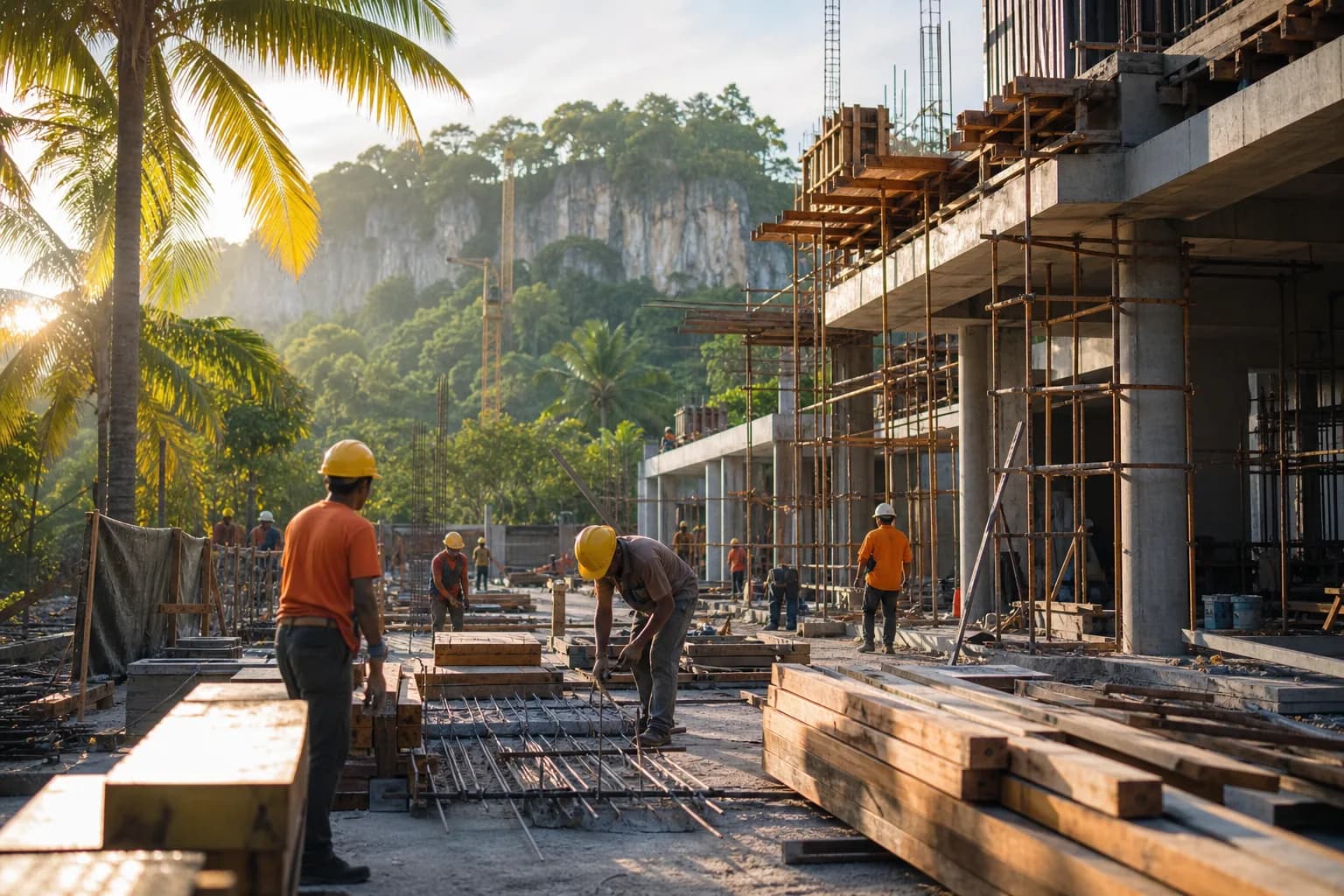
The Hidden Infrastructure Risk: Why Pecatu Limestone Quarry Operations Affect Your Construction Timeline and Budget
When evaluating land for villa construction in Pecatu, most buyers focus on ocean views, land certificates, and zoning compliance. Few investigate the operational status of nearby limestone quarries—a critical oversight that can derail construction schedules, inflate foundation costs, and expose projects to regulatory complications. Pecatu’s limestone extraction operations require complex permitting under Indonesian mining law, with blast radius safety protocols that directly impact construction activity within 500-1,000 meters of active quarry sites. Understanding quarry permit cycles, blasting schedules, and associated safety compliance costs is essential for accurate project budgeting and risk assessment in this rapidly developing region of southern Bali.
Technical Framework: Indonesian Mining Permits and Blast Safety Regulations in Pecatu
Limestone quarry operations in Pecatu fall under Indonesia’s Mining Law (Law No. 3/2020 on Mineral and Coal Mining), which replaced the 2009 framework and introduced stricter environmental and safety requirements. Quarry operators must secure an IUP (Izin Usaha Pertambangan) or Mining Business Permit from the Badung Regency government, with specific technical annexes addressing blasting operations, environmental impact mitigation, and community safety zones.
The permit structure involves three critical components that affect nearby construction projects. First, the Environmental Impact Assessment (AMDAL) defines blast radius safety zones—typically 300 meters for controlled blasting operations, extending to 800-1,000 meters for larger extraction sites depending on explosive load calculations and geological conditions. Second, the Technical Mining Plan (Rencana Kerja dan Anggaran Biaya/RKAB) submitted annually details blasting schedules, which must be coordinated with local authorities and communicated to surrounding property owners. Third, the Community Development and Empowerment Program (Program Pengembangan dan Pemberdayaan Masyarakat) requires quarry operators to fund infrastructure improvements and safety measures in affected areas.
For construction projects within designated safety zones, several regulatory requirements apply. Building permits may require additional structural engineering certifications demonstrating foundation designs can withstand ground vibration from blasting operations, typically measured in peak particle velocity (PPV) not exceeding 5 mm/s for residential structures under Indonesian National Standard SNI 7571:2010. Projects within 500 meters often face mandatory vibration monitoring during both quarry blasting and construction excavation phases, adding 15-25 million IDR to initial site preparation costs.
The blast radius safety framework also affects construction scheduling. Active quarries typically conduct blasting operations 2-4 times weekly during dry season months (April-October), with mandatory evacuation protocols requiring all personnel to clear the safety zone 30 minutes before detonation. Construction teams working within 800 meters must coordinate daily schedules with quarry operators, potentially losing 3-6 productive hours per blast day. This coordination requirement, while essential for worker safety, can extend construction timelines by 8-15% for projects in proximity zones.
Pecatu’s geological composition—primarily coral limestone with varying density and fracture patterns—creates additional complexity. Quarry operators must adjust explosive loads based on limestone hardness, which ranges from 20-45 MPa compressive strength in the Pecatu formation. Higher explosive loads increase blast radius requirements and ground vibration transmission, directly impacting safety zone calculations. Construction projects must account for these variable conditions when designing foundations, often requiring deeper pile systems or reinforced raft foundations that add 180-320 million IDR to structural costs for a standard 300-square-meter villa.
The permit renewal cycle introduces another risk factor. IUP permits require annual RKAB renewals and five-year comprehensive reviews, during which operations may be suspended pending environmental compliance audits. Construction projects initiated during permit renewal periods face uncertainty regarding blasting schedules and safety zone modifications. Teville’s pre-construction due diligence process includes verification of quarry permit status for all land parcels within 1,200 meters of known extraction sites, ensuring clients understand operational timelines before committing to purchase.
Hidden Risks: What Property Buyers and Developers Overlook
The most significant oversight involves assuming quarry operations are static. Pecatu’s limestone deposits support multiple extraction sites with staggered permit cycles, meaning a currently inactive quarry may resume operations during your construction phase. Land sellers rarely disclose proximity to dormant quarry sites, and standard due diligence processes don’t typically include mining permit database searches at the regency level.
Foundation engineering costs escalate dramatically within blast zones. Standard shallow foundation systems suitable for stable Pecatu limestone become inadequate when accounting for repetitive vibration exposure. Engineers must specify either deep pile foundations extending 8-12 meters or reinforced raft systems with enhanced steel reinforcement—modifications that increase foundation costs by 40-65% compared to standard specifications. Many contractors provide initial quotes based on standard foundation assumptions, leading to significant budget overruns when blast zone requirements are discovered during engineering phase.
Insurance and liability complications emerge for projects within documented safety zones. Standard construction all-risk insurance policies may exclude or limit coverage for vibration-related structural damage when quarry operations are known factors. Securing adequate coverage requires specialized endorsements that add 2.5-4.5% to total insurance premiums. Additionally, if structural issues arise post-completion that can be attributed to quarry vibration, warranty claims become complex legal disputes involving multiple parties—the builder, quarry operator, and local government authorities.
The community safety cost burden often shifts unexpectedly. While quarry operators fund primary safety infrastructure, secondary measures for individual construction projects—vibration monitoring equipment, reinforced access roads, dust suppression systems—fall to property developers. These costs, ranging from 45-85 million IDR for a single villa project, are rarely itemized in preliminary budgets and surface only when permit applications trigger safety compliance reviews.
Step-by-Step Process: Navigating Quarry Permit Verification and Safety Compliance
Begin with comprehensive site analysis extending 1,500 meters from your target land parcel. Request a mining permit registry search from the Badung Regency Mining and Energy Office (Dinas Energi dan Sumber Daya Mineral), identifying all active, suspended, and dormant IUP permits in the area. This search, which costs approximately 500,000-1,200,000 IDR through authorized facilitators, provides permit holder details, operational status, and approved extraction zones. Teville conducts this verification as standard practice for all villa construction projects in southern Bali limestone regions.
Obtain copies of relevant AMDAL documents and current RKAB submissions for any active quarries within 1,000 meters. These documents, which are public records under Indonesian environmental law, detail planned blasting schedules, explosive load calculations, and defined safety zones. Review the blast design specifications with a qualified geotechnical engineer to determine actual ground vibration predictions for your specific site location, accounting for limestone density variations and transmission pathways. This engineering review typically costs 8-15 million IDR but provides essential data for foundation design specifications.
Commission a baseline vibration survey if your site falls within 800 meters of active operations. This survey, conducted over 2-4 weeks during normal quarry operations, establishes existing ground vibration levels and identifies any structural vulnerabilities in the surrounding area. The survey data becomes critical for two purposes: first, it informs your foundation engineering requirements; second, it provides legal documentation of pre-construction conditions, protecting against future liability claims. Expect to invest 18-28 million IDR for professional vibration monitoring and analysis.
Coordinate with quarry operators to establish a formal communication protocol before construction begins. Request written confirmation of planned blasting schedules for your construction period, typically provided in quarterly updates. Negotiate access to the quarry’s blast notification system—many operators now use SMS or app-based alerts sent 24 hours and 2 hours before detonation. This coordination, while not legally required for all projects, significantly reduces construction delays and improves worker safety compliance. Document all communications for permit application support.
Modify your building permit application to address blast zone requirements explicitly. Include the geotechnical engineer’s vibration analysis, enhanced foundation specifications, and construction phase vibration monitoring plan. Badung Regency building authorities increasingly require these elements for permits within known quarry proximity zones, and proactive submission prevents permit delays. Work with your construction partner—Teville’s engineering-driven approach integrates these requirements from initial design phase—to ensure structural specifications meet both standard building codes and quarry-specific safety standards.
Implement continuous monitoring during construction. Install seismograph equipment at your site boundary to record ground vibration during both quarry blasting and your own excavation work. This dual-purpose monitoring, costing approximately 6-12 million IDR monthly for equipment rental and data analysis, provides real-time verification that vibration levels remain within safe limits and creates documentation for regulatory compliance and future warranty protection. Maintain detailed logs correlating any structural observations with recorded vibration events.
Realistic Cost Analysis: Budgeting for Quarry Proximity Compliance
Pre-construction due diligence costs for quarry proximity assessment range from 15-35 million IDR, including mining permit searches, AMDAL document review, geotechnical analysis, and baseline vibration surveys. These costs scale with site complexity and the number of nearby quarry operations requiring evaluation.
Foundation engineering modifications add 180-320 million IDR for a standard 300-square-meter villa within 500 meters of active blasting operations. This includes upgraded pile systems or reinforced raft foundations, additional steel reinforcement (typically 15-25% increase in rebar quantities), and specialized concrete mixes with enhanced vibration resistance. Projects between 500-800 meters may require moderate upgrades costing 85-150 million IDR, while sites beyond 800 meters typically need no quarry-specific foundation modifications.
Construction phase monitoring and coordination costs accumulate to 35-65 million IDR over a typical 8-12 month villa construction timeline. This includes vibration monitoring equipment rental, monthly data analysis reports, communication system integration with quarry operators, and schedule coordination overhead that reduces labor productivity by 5-12% during active blasting periods.
Insurance premium increases for blast zone projects add 2.5-4.5% to total construction all-risk coverage, translating to approximately 15-35 million IDR for a 1.5-2 billion IDR construction project. Specialized endorsements covering vibration-related damage and business interruption due to quarry operations account for most of this premium increase.
Timeline extensions due to blasting coordination typically add 4-8 weeks to standard construction schedules, with associated carrying costs including extended site security, equipment rental, and contractor overhead fees totaling 25-45 million IDR for most villa projects. These delays are most significant during dry season months when quarry operations intensify and blasting frequency increases.
Frequently Asked Questions: Pecatu Quarry Permits and Construction Safety
How do I determine if my land is within a limestone quarry blast radius safety zone?
Request a mining permit registry search from the Badung Regency Mining and Energy Office, which identifies all IUP permits within a specified radius of your coordinates. Active permits include AMDAL documents that define safety zones, typically 300-1,000 meters depending on blast design. Commission a geotechnical engineer to review these documents and calculate actual vibration transmission to your specific site, accounting for limestone density and topography. This process takes 2-3 weeks and costs 10-20 million IDR but provides definitive safety zone classification essential for accurate construction budgeting.
Can quarry operators change blasting schedules after I’ve started construction?
Yes, within the parameters of their approved RKAB annual plan. Quarry operators must submit blasting schedules to local authorities but can adjust timing and frequency based on operational needs, weather conditions, and market demand. However, they must provide advance notification—typically 24-48 hours—to registered stakeholders within safety zones. Establish formal communication protocols with quarry operators before construction begins, requesting inclusion in their notification system. Document all schedule changes and coordinate with your construction team to minimize productivity impacts during blast periods.
What happens if a dormant quarry resumes operations during my construction project?
Dormant quarries with valid IUP permits can resume operations after submitting updated RKAB plans and passing environmental compliance audits, typically requiring 3-6 months for regulatory approval. If resumption occurs during your construction phase, you may need to retrofit additional safety measures including enhanced vibration monitoring and modified construction sequencing. Th
 3180 m²7 month(s)from 142.000 USD
Vasudeva
 164 m²7 month(s)from 79.000 USD
TALA TWO
 172 m²8 month(s)from 120.000 USD
Keshava
164 m²7 month(s)from 79.000 USDPrivate: Haridas Villas, Tegallalang

Want to calculate?
 1from 198.000 USD
Private: Haridas Villas
 3124 m²6 month(s)from 123.000 USD
TALA 8
 3173 m²6 month(s)from 125.000 USD
TALA FOUR
 3104 m²11 month(s)from 99.000 USD
TALA 100
 2144 m²11 month(s)from 104.000 USD
Narayana
 4344 m²16 month(s)from 290.000 USD
Radha
 3127 m²9 month(s)from 177.000 USD
Mukunda
Start With Real Numbers, Not Guesses
Before buying land or finalizing a design, check the realistic build cost range for your project in Bali.
Our team reviews your inputs and gives a grounded estimate.
Available lands
 1300 m²10 min$ 348214Bali, Tabanan
 1700 m²10 min$ 392549Bali, Nusadua
 515 m²7 min$ 570813Bali, Canggu
 2200 m²3 min$ 183842Bali, Berawa
 3300 m²15 min$ 449889Bali, Tabanan
 3100 m²15 min$ 257697Bali, Tegallalang
 200 m²11 min$ 89286Bali, Tabanan
 2000 m²15 min$ 523000Bali, Canggu
 2400 m²7 min$ 496552Bali, Canggu
 400 m²15 min$ 67192Bali, Tabanan
 700 m²15 min$ 109052Bali, Buduk
 1000 m²10 min$ 303571Bali, Tabanan
 1100 m²8 min$ 280419Bali, Ungasan
 1700 m²10 min$ 632257Bali, Kuta
 2000 m²15 min$ 261700Bali, Babakan
Essential Bali build & buy guides
- Bali villa construction cost per m² in 2026
- How much will your villa cost? Calculator
- Building a villa in Bali: the complete guide
- Buying land in Bali: step-by-step for foreigners
- Bali villa investment: yields, risks, returns
- Leasehold vs freehold: what foreigners can own
- Construction defect liability & 10-year warranty
- Bali building codes and construction standards
Related guides
Integrated Furniture Fixings Hidden Brackets MEP Clearance Bali
Explore integrated furniture fixings with hidden brackets and MEP clearance in Bali. Learn installation tips, load guidance, and clean, accessible finishes.
8 min read
Epoxy Primer Moisture Barrier for Bali Interior Renovations
Explore epoxy primer and moisture barrier solutions for Bali interior renovations, delivering durable adhesion, moisture protection, and long-lasting finishes.
8 min read
Engineered Stone Countertop Fixing Support Standards Bali
Explore Bali s engineered stone countertop fixing and support standards. Installation tips, durability guidance, and compliance for lasting quality surfaces.
10 min read