Electrical Systems for Villas in Bali | Expert Installation
# Electrical Systems for Villas in Bali: A Technical Guide to Safe, Compliant Power Infrastructure
Understanding Power Supply and PLN Connection Requirements
When planning electrical systems villas Bali, the foundation begins with understanding Indonesia’s national power grid operated by PLN (Perusahaan Listrik Negara). The capacity requirements for villa developments differ significantly from residential homes, particularly for properties intended as rental investments or luxury residences.
Standard villa connections typically require between 5,500 VA to 11,000 VA capacity, though larger properties with multiple bedrooms, pools, and extensive air conditioning systems may need 16,500 VA or higher. The application process through PLN involves submitting detailed electrical load calculations, site plans, and proof of land ownership or building permits. Processing times can extend from four to twelve weeks depending on location and grid availability in your area.
In regions like Canggu, Seminyak, and Ubud, grid capacity has improved substantially, but remote areas may face limitations requiring alternative solutions or grid upgrades at the developer’s expense. The connection fee structure scales with requested capacity, ranging from approximately IDR 15 million for basic connections to IDR 50 million or more for high-capacity commercial installations.
Voltage stability remains a consideration across Bali. While PLN supplies 220V single-phase or 380V three-phase power, fluctuations between 200V and 240V occur regularly, particularly during peak demand periods or in areas with aging infrastructure. This variability necessitates protective equipment and careful component selection to ensure longevity of electrical systems and connected appliances.
Electrical Design: Load Calculation and Circuit Planning
Proper electrical design for electrical systems villas Bali requires comprehensive load calculation that accounts for simultaneous usage patterns, climate-specific demands, and future expansion possibilities. The design phase determines the entire system’s capacity, safety, and functionality for decades to come.
Load calculation begins with cataloging every electrical consumer in the villa: air conditioning units (typically 1,000-2,500W each), water heaters (2,000-4,000W), pool pumps (750-1,500W), kitchen appliances, lighting systems, and entertainment equipment. A three-bedroom villa with pool typically requires 15-20 kVA total capacity when accounting for diversity factors—the statistical likelihood that not all loads operate simultaneously.
Circuit planning follows a hierarchical structure. Main distribution boards receive power from the PLN meter, then distribute to sub-distribution boards serving specific zones: bedrooms, kitchen, outdoor areas, pool equipment, and air conditioning systems. This zoning approach provides several advantages: easier troubleshooting, selective power management, and the ability to isolate problems without affecting the entire property.
Modern villa designs incorporate dedicated circuits for high-draw appliances. Each air conditioning unit receives its own circuit breaker, as do water heaters, pool pumps, and kitchen equipment. This prevents nuisance tripping and ensures adequate wire sizing for each load. Lighting and general power outlets typically share circuits, with a maximum of eight to ten outlets per 16A breaker to maintain safety margins.
The circuit breaker panel itself requires careful specification. Quality panels from manufacturers like Schneider Electric, ABB, or Siemens offer superior reliability compared to generic alternatives. Each circuit should feature appropriate overcurrent protection, with breaker ratings matched to wire gauge: 10A for 1.5mm² wire, 16A for 2.5mm², and 20-25A for 4mm² conductors. Ground fault protection (RCBO or RCCB devices) on wet area circuits provides essential safety against electrocution risks.
Safety Standards: Grounding, Surge Protection, and Humidity Considerations
Safety represents the non-negotiable foundation of electrical systems villas Bali. The tropical climate, high humidity levels, and exposure to salt air in coastal areas create unique challenges that demand rigorous attention to protective measures and material selection.
Grounding systems in Bali require particular attention due to soil conditions. The Indonesian National Standard (SNI) mandates earth resistance below 5 ohms for residential installations, though achieving this in volcanic or sandy soils often requires extensive grounding arrays. A proper grounding system includes copper earth rods (typically 1.5-3 meters long) driven into the ground at multiple points around the property, interconnected with bare copper conductors.
In areas with poor soil conductivity, chemical grounding enhancement or extended grounding grids become necessary. The grounding system connects to the main distribution board’s earth bar, with separate grounding conductors running to every outlet, fixture, and metal enclosure throughout the villa. This creates multiple paths for fault currents, ensuring rapid circuit breaker operation in the event of insulation failure or equipment faults.
Surge protection devices (SPDs) provide the second layer of defense against voltage transients caused by lightning strikes, grid switching, or nearby industrial equipment. Bali experiences frequent electrical storms, particularly during the wet season from November through March. A comprehensive surge protection strategy includes Type 1 SPDs at the main panel (capable of handling direct lightning strikes), Type 2 SPDs at sub-distribution boards, and Type 3 point-of-use protectors for sensitive electronics.
Humidity management distinguishes successful electrical installations from problematic ones in Bali’s climate. Relative humidity regularly exceeds 80%, creating conditions for corrosion, tracking across insulation surfaces, and premature component failure. All electrical enclosures should feature IP54 or higher ingress protection ratings, with sealed cable entries and drainage provisions to prevent water accumulation.
Outdoor installations require IP65-rated weatherproof enclosures constructed from stainless steel or UV-resistant polycarbonate. Standard mild steel enclosures corrode rapidly in coastal environments, often failing within two to three years. Cable glands, junction boxes, and conduit systems must similarly resist moisture ingress and corrosion. PVC conduit systems offer advantages over metal conduit in humid environments, though proper support spacing and expansion joints remain essential.
Installation Process: Permits, Inspections, and Timeline
The installation process for electrical systems villas Bali follows a structured sequence that integrates with overall construction timelines while satisfying regulatory requirements. Understanding this process helps developers and owners plan realistic schedules and budget appropriately for professional execution.
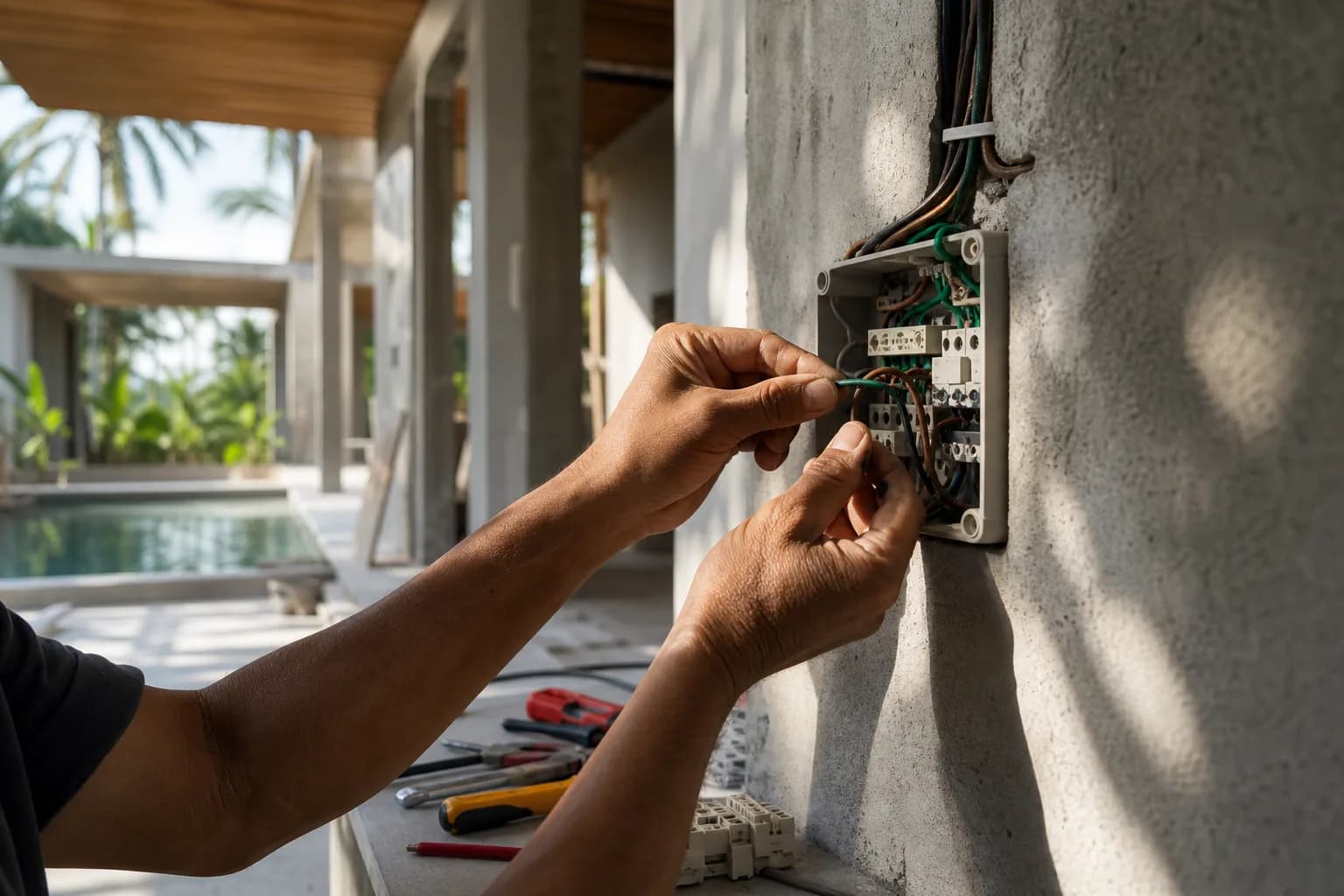
Electrical work typically begins during the structural phase, with conduit installation coordinated with concrete pours and masonry work. This “first fix” stage involves embedding conduits in floors and walls, installing back boxes for outlets and switches, and routing main distribution cables. Coordination with other trades—plumbing, HVAC, and structural work—prevents conflicts and costly modifications later.
The permit process in Bali requires submission of electrical drawings stamped by a licensed electrical engineer to the local building authority (Dinas PUPR). These drawings must demonstrate compliance with SNI standards, show single-line diagrams of the distribution system, and include load calculations justifying the requested PLN capacity. Permit approval typically requires two to four weeks, though this varies by regency and the completeness of submitted documentation.
Installation proceeds in phases. After first-fix conduit work, the construction team completes wall finishes, allowing the “second fix” electrical phase to begin. This involves pulling cables through conduits, terminating connections at distribution boards, installing outlets and switches, and mounting light fixtures. Quality installations use color-coded wiring (brown for live, blue for neutral, yellow-green for ground) and maintain proper polarity throughout the system.
Testing and commissioning represent critical steps often rushed or omitted in lower-quality projects. Comprehensive testing includes insulation resistance measurements (minimum 1 megohm between conductors and earth), earth loop impedance testing to verify grounding effectiveness, RCD trip time verification, and polarity checks at every outlet. These tests identify installation defects before energization, preventing safety hazards and equipment damage.
Final inspection by building authorities occurs after testing completion. Inspectors verify compliance with approved drawings, check for proper circuit protection, examine grounding systems, and review test documentation. Passing inspection allows PLN connection and meter installation, typically scheduled two to four weeks after inspection approval. The entire electrical installation process, from first fix to energization, spans eight to twelve weeks for a typical three-bedroom villa.
Component Quality: Panels, Wiring, Switches, and Outlets
Component selection directly impacts the reliability, safety, and longevity of electrical systems villas Bali. The initial cost differential between quality components and budget alternatives pales compared to the expense and disruption of premature failures or safety incidents.
Distribution panels form the system’s nerve center. Quality panels feature robust bus bars with high current ratings, secure breaker mounting systems, and adequate space for future expansion. Schneider Electric’s Domae or Easy9 series, ABB’s System Pro M, and Siemens’ Sentron panels represent reliable choices widely available in Indonesia with local technical support. These panels accommodate modern protection devices including RCBOs (combined overcurrent and residual current protection) that provide superior safety compared to basic circuit breakers.
Wiring quality varies dramatically in the Indonesian market. Specify cables from established manufacturers like Supreme, Kabel Metal, or Eterna that comply with SNI standards. Copper conductor purity matters—99.9% pure copper provides optimal conductivity and flexibility. Insulation should be rated for 90°C operation (XLPE or similar) rather than basic PVC, offering better performance in Bali’s heat. Cable sizing should include derating factors for ambient temperature, conduit fill, and grouping effects, typically resulting in one size larger than basic calculations suggest.
Switches and outlets represent the most frequently interacted components, making quality and aesthetics equally important. Schneider Electric’s Vivace or Anya series, Panasonic’s Wide series, and Legrand’s Arteor range offer durability, modern aesthetics, and reliable performance. Key features include captive terminal screws that prevent loosening over time, phosphor bronze contacts that resist corrosion, and robust mounting frames that prevent movement in the wall box.
Grounded outlets (Type F Schuko or Type G British standard) should be specified throughout, even though many Indonesian appliances use ungrounded plugs. This future-proofs the installation and provides safety for imported equipment. USB charging outlets integrated into wall plates offer convenience in bedrooms and living areas, though quality varies significantly—specify units with proper voltage regulation and overcurrent protection rather than generic Chinese imports.
Outdoor components require special attention. Pool area outlets must feature weatherproof covers and GFCI protection with 30mA trip current. Garden lighting systems benefit from stainless steel fixtures with silicone-sealed cable entries. Coastal properties within 500 meters of the ocean should use marine-grade components with enhanced corrosion resistance, accepting the 30-50% cost premium as insurance against premature failure.
Backup Power: Generators, Solar Systems, and Battery Storage
Backup power systems have transitioned from luxury to necessity for electrical systems villas Bali, particularly for rental properties where guest experience depends on uninterrupted electricity. The choice between generators, solar systems, and battery storage depends on usage patterns, budget, and environmental priorities.
Diesel generators remain the most common backup solution, offering reliable power during outages that can last from minutes to several hours. Sizing requires careful calculation—a 15 kVA generator typically suffices for a three-bedroom villa when non-essential loads like water heaters are temporarily disconnected. Quality generators from Perkins, Cummins, or Denyo provide 10,000-15,000 hours of service life with proper maintenance, though noise levels require consideration in residential areas.
Automatic transfer switches (ATS) detect power failures and start the generator within 10-15 seconds, minimizing disruption. The ATS also manages the transition back to grid power when PLN service restores, preventing backfeeding that could endanger utility workers. Generator installations require proper ventilation, vibration isolation, and exhaust systems that direct fumes away from occupied areas. Fuel storage typically provides 8-12 hours of runtime, with 200-500 liter tanks common for villa applications.
Solar photovoltaic systems offer clean, silent backup power while reducing ongoing electricity costs. A typical villa installation ranges from 5 kWp to 10 kWp capacity, generating 20-40 kWh daily depending on panel orientation and shading. Grid-tied systems with battery backup provide the optimal configuration—solar power reduces daytime grid consumption, batteries provide evening power and backup during outages, and the grid serves as backup when solar and battery capacity are exhausted.
Battery technology has advanced significantly, with lithium iron phosphate (LiFePO4) systems offering 6,000-10,000 cycle lifespans compared to 1,500-3,000 cycles for lead-acid batteries. A 10 kWh battery bank provides 4-6 hours of essential load operation (lighting, refrigeration, internet, minimal air conditioning), sufficient for most outages. Brands like Pylontech, BYD, and Growatt offer reliable systems with local support in Bali.
Hybrid inverter systems manage the interaction between solar panels, batteries, grid power, and loads. Quality inverters from manufacturers like SMA, Fronius, or Victron Energy provide sophisticated energy management, prioritizing solar power, then battery storage, then grid power based on availability and cost. These systems can be monitored remotely via smartphone apps, providing real-time visibility into energy production, consumption, and system status.
The economics of solar systems in Bali are compelling. With PLN electricity costs around IDR 1,500 per kWh for higher consumption tiers and solar system costs declining to approximately IDR 15-20 million per installed kWp, payback periods of 5-7 years are typical. For rental villas, solar systems also provide marketing advantages, appealing to environmentally conscious guests and demonstrating operational sophistication.
Smart Home Integration and Automation Possibilities
Modern electrical systems villas Bali increasingly incorporate smart home technology that enhances convenience, security, and energy efficiency. The integration of automation systems during construction proves far more cost-effective than retrofitting, making early planning essential.
Smart home systems range from simple wireless solutions to comprehensive wired automation platforms. For rental villas, reliability and ease of use take precedence over complexity. Systems based on WiFi protocols like Tuya, Google Home, or Apple HomeKit offer straightforward setup and guest-friendly interfaces. More sophisticated properties might implement KNX or Loxone systems that provide industrial-grade reliability and extensive customization possibilities.
Lighting control represents the most common automation application. Smart switches or dimmers replace conventional switches, enabling remote control, scheduling, and scene creation. Guests can activate “Welcome” scenes that illuminate pathways and common areas, “Dinner” scenes that set appropriate ambiance, or “Away” modes that simulate occupancy for security. Motion sensors in hallways and bathrooms provide convenience while reducing energy waste.
Climate control automation significantly impacts guest comfort and operating costs. Smart thermostats learn occupancy patterns and adjust air conditioning accordingly, potentially reducing cooling costs by 20-30%. Integration with door/window sensors automatically reduces cooling when openings are detected, preventing energy waste. Remote monitoring allows property managers to verify systems are functioning correctly and adjust settings based on guest feedback.
Security integration combines access control, surveillance, and alarm systems into unified platforms. Smart locks eliminate physical key management, allowing unique codes for each guest reservation that automatically expire at checkout. IP cameras with cloud recording provide security monitoring accessible from anywhere, with motion detection alerts for unusual activity. Water leak sensors in bathrooms and kitchens provide early warning of plumbing failures that could cause extensive damage.
Energy monitoring systems provide visibility into consumption patterns, identifying inefficient equipment or unusual usage that might indicate problems. Smart plugs on pool pumps, water heaters, and other high-draw equipment enable remote control and scheduling, optimizing operation for off-peak hours when applicable. This data-driven approach to energy management reduces costs while maintaining guest comfort.
The electrical infrastructure for smart home systems requires planning during design. Ensure adequate neutral wires at all switch locations (many smart switches require neutral connections). Provide robust WiFi coverage through multiple access points with wired backhaul connections. Install conduits for future cabling needs, even if not immediately utilized. Specify a dedicated network rack with proper cooling and backup power for networking equipment, automation controllers, and surveillance systems.
Common Electrical Issues in Bali and Prevention Strategies
Understanding typical problems affecting electrical systems villas Bali enables proactive prevention through proper design and installation practices. Many issues stem from the challenging tropical environment, inconsistent construction standards, and the use of substandard materials.
Corrosion represents the most pervasive issue, particularly in coastal areas. Salt-laden air attacks metal components, causing connection failures, enclosure deterioration, and conductor degradation. Prevention requires marine-grade materials within 500 meters of the ocean, regular inspection and maintenance schedules, and protective coatings on exposed metal surfaces. Stainless steel hardware, tinned copper conductors, and sealed enclosures provide long-term reliability worth the initial investment.
Loose connections cause numerous problems,
 3180 m²7 month(s)from 142.000 USD
Vasudeva

Want to calculate?
 3104 m²11 month(s)from 99.000 USD
TALA 100
 3173 m²6 month(s)from 125.000 USD
TALA FOUR
 1from 198.000 USD
Private: Haridas Villas
 172 m²8 month(s)from 120.000 USD
Keshava
 2144 m²11 month(s)from 104.000 USD
Narayana
 3124 m²6 month(s)from 123.000 USD
TALA 8
 164 m²7 month(s)from 79.000 USD
Private: Haridas Villas, Tegallalang
 4344 m²16 month(s)from 290.000 USD
Radha
 3127 m²9 month(s)from 177.000 USD
Mukunda
164 m²7 month(s)from 79.000 USDTALA TWO
Start With Real Numbers, Not Guesses
Check realistic build cost range for your Bali project.
Available lands
 3900 m²10 min$ 432266Bali, Tabanan
 220 m²2 min$ 66565Bali, Cemagi
 1100 m²8 min$ 280419Bali, Ungasan
 3700 m²15 min$ 738177Bali, Tabanan
 1410 m²15 min$ 390702Bali, Tabanan
 700 m²8 min$ 165517Bali, Umalas
 1350 m²5 min$ 283467Bali, Pecatu
 1700 m²10 min$ 632257Bali, Kuta
 2400 m²7 min$ 496552Bali, Canggu
 18900 m²2 min$ 6912931Bali, Pecatu
 1600 m²32 min$ 266010Bali, Tabanan
 422 m²15 min$ 93547Bali, Kerobokan
 2000 m²15 min$ 261700Bali, Babakan
 1000 m²10 min$ 184729Bali, Kutuh South Bali
 2000 m²15 min$ 523000Bali, Canggu
Essential Bali build & buy guides
- Bali villa construction cost per m² in 2026
- How much will your villa cost? Calculator
- Building a villa in Bali: the complete guide
- Buying land in Bali: step-by-step for foreigners
- Bali villa investment: yields, risks, returns
- Leasehold vs freehold: what foreigners can own
- Construction defect liability & 10-year warranty
- Bali building codes and construction standards
Related guides
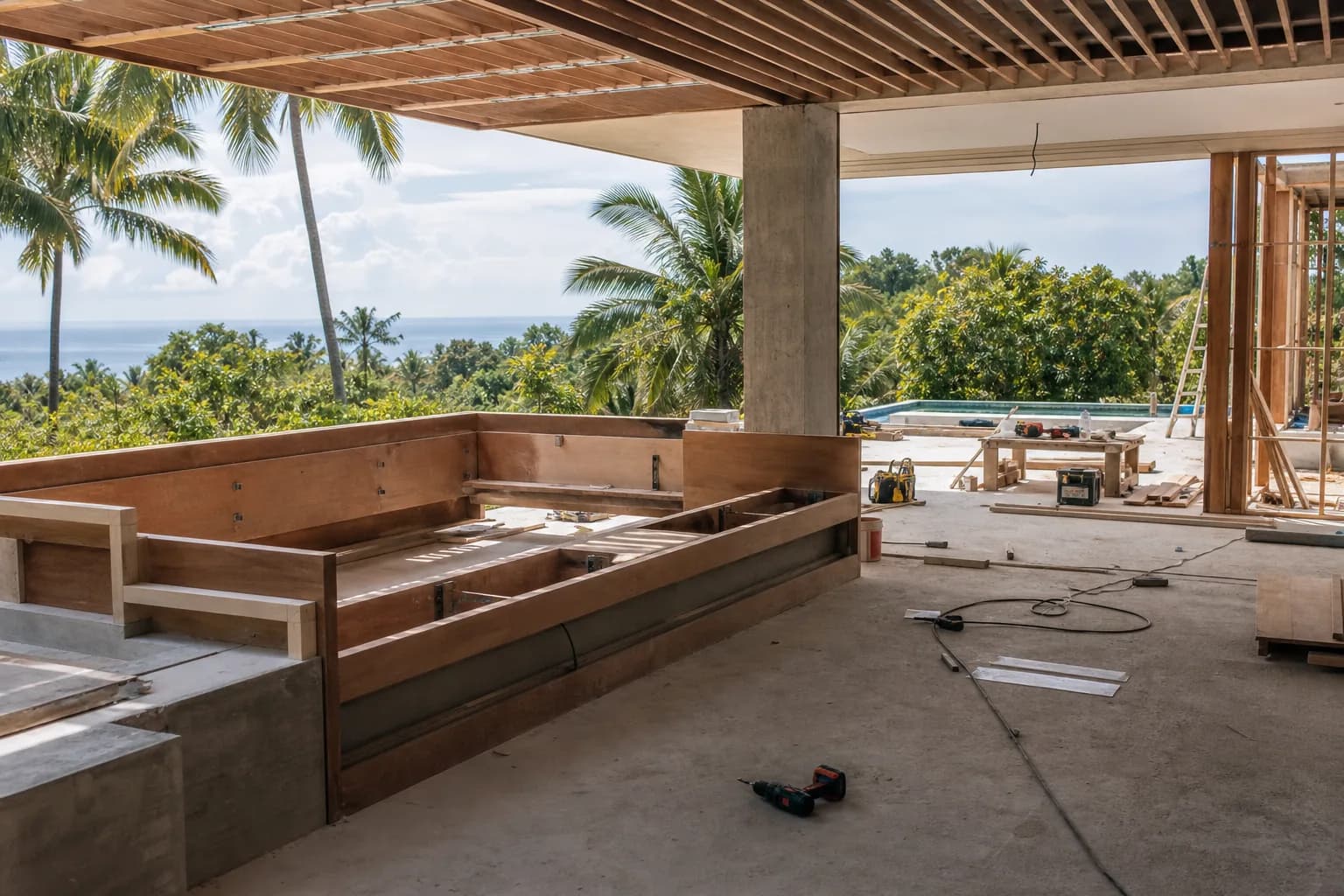
Integrated Furniture Fixings Hidden Brackets MEP Clearance Bali
Explore integrated furniture fixings with hidden brackets and MEP clearance in Bali. Learn installation tips, load guidance, and clean, accessible finishes.
8 min read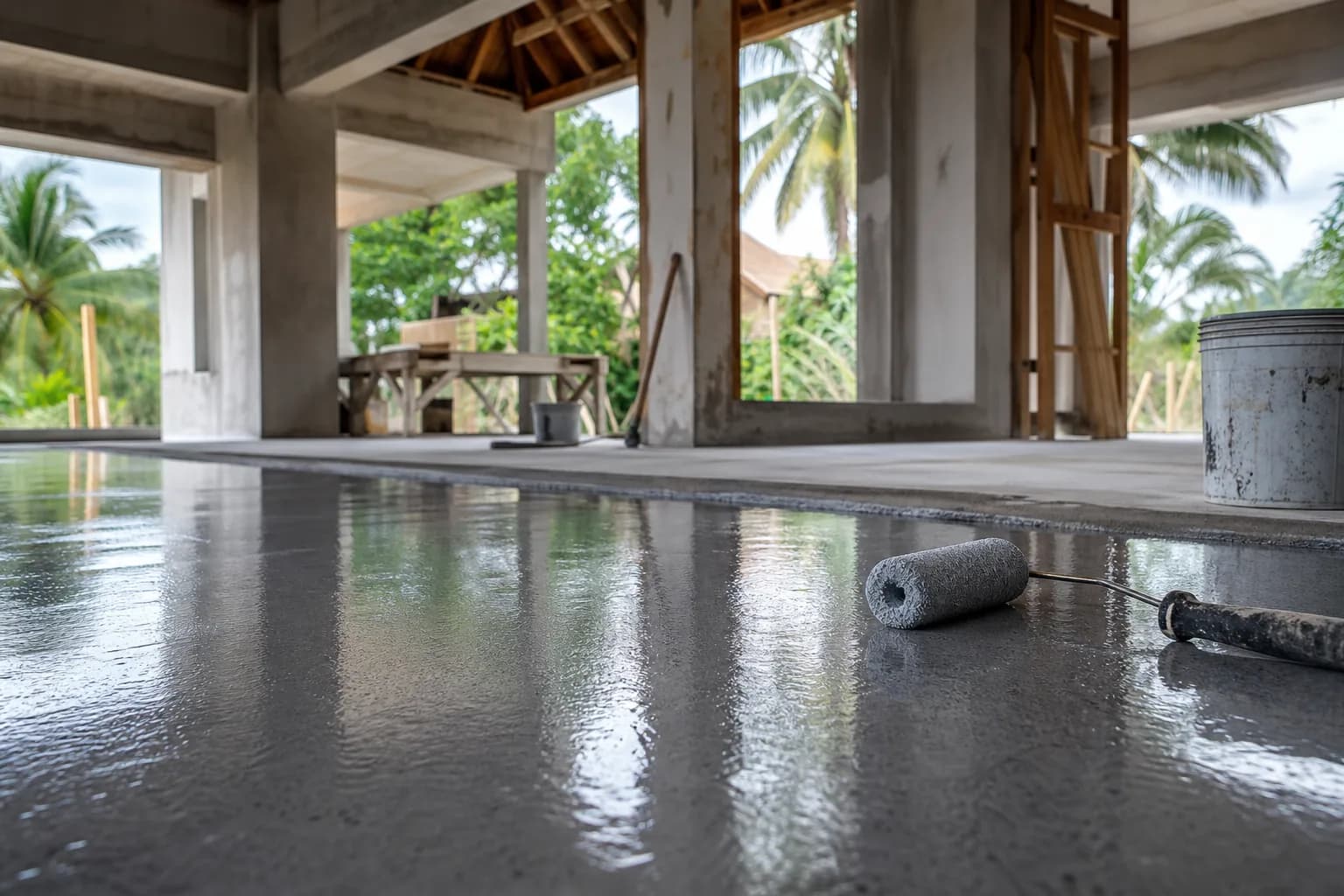
Epoxy Primer Moisture Barrier for Bali Interior Renovations
Explore epoxy primer and moisture barrier solutions for Bali interior renovations, delivering durable adhesion, moisture protection, and long-lasting finishes.
8 min read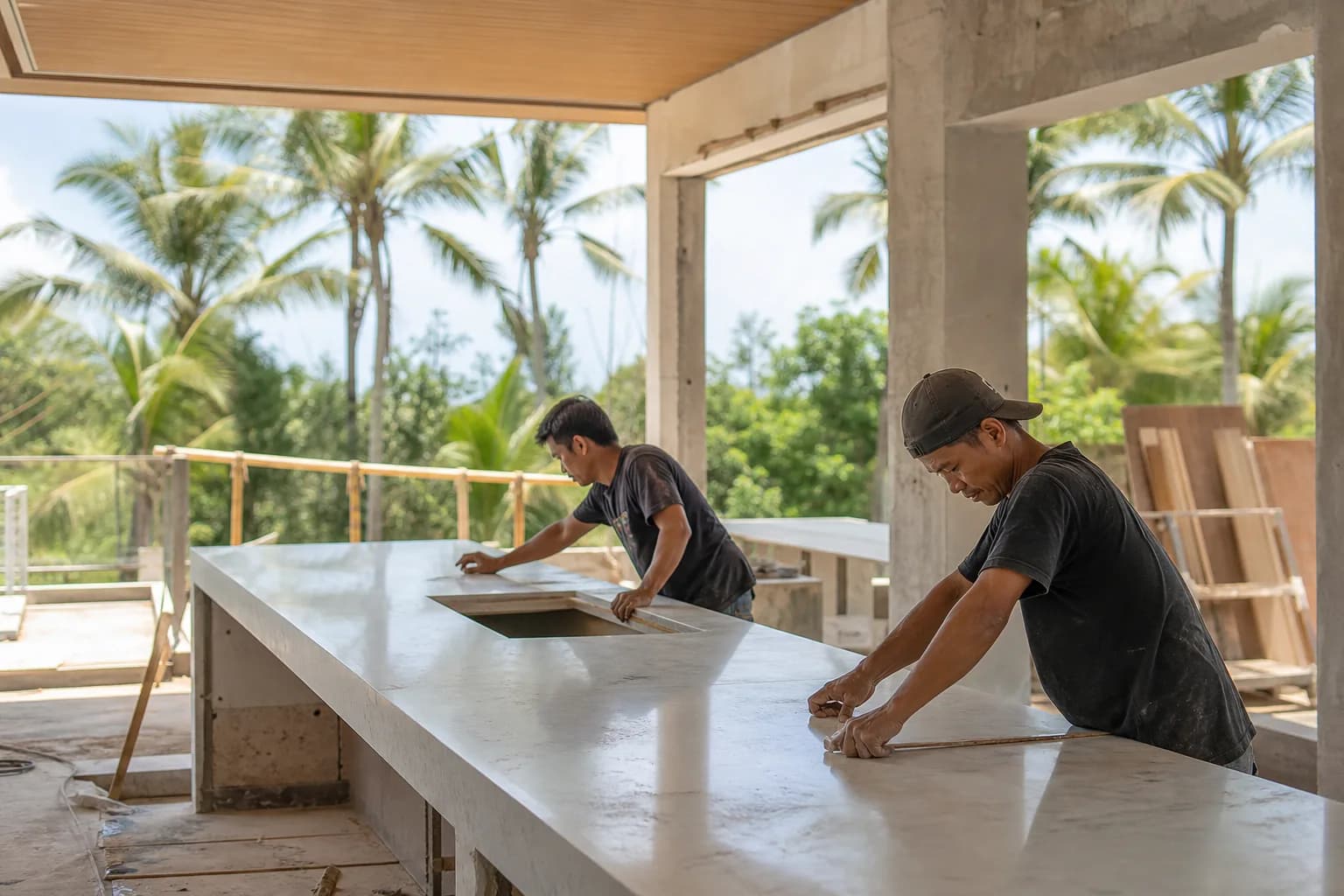
Engineered Stone Countertop Fixing Support Standards Bali
Explore Bali s engineered stone countertop fixing and support standards. Installation tips, durability guidance, and compliance for lasting quality surfaces.
10 min read