Cartridge vs Sand Filter Maintenance Costs: Bali Villa Pools
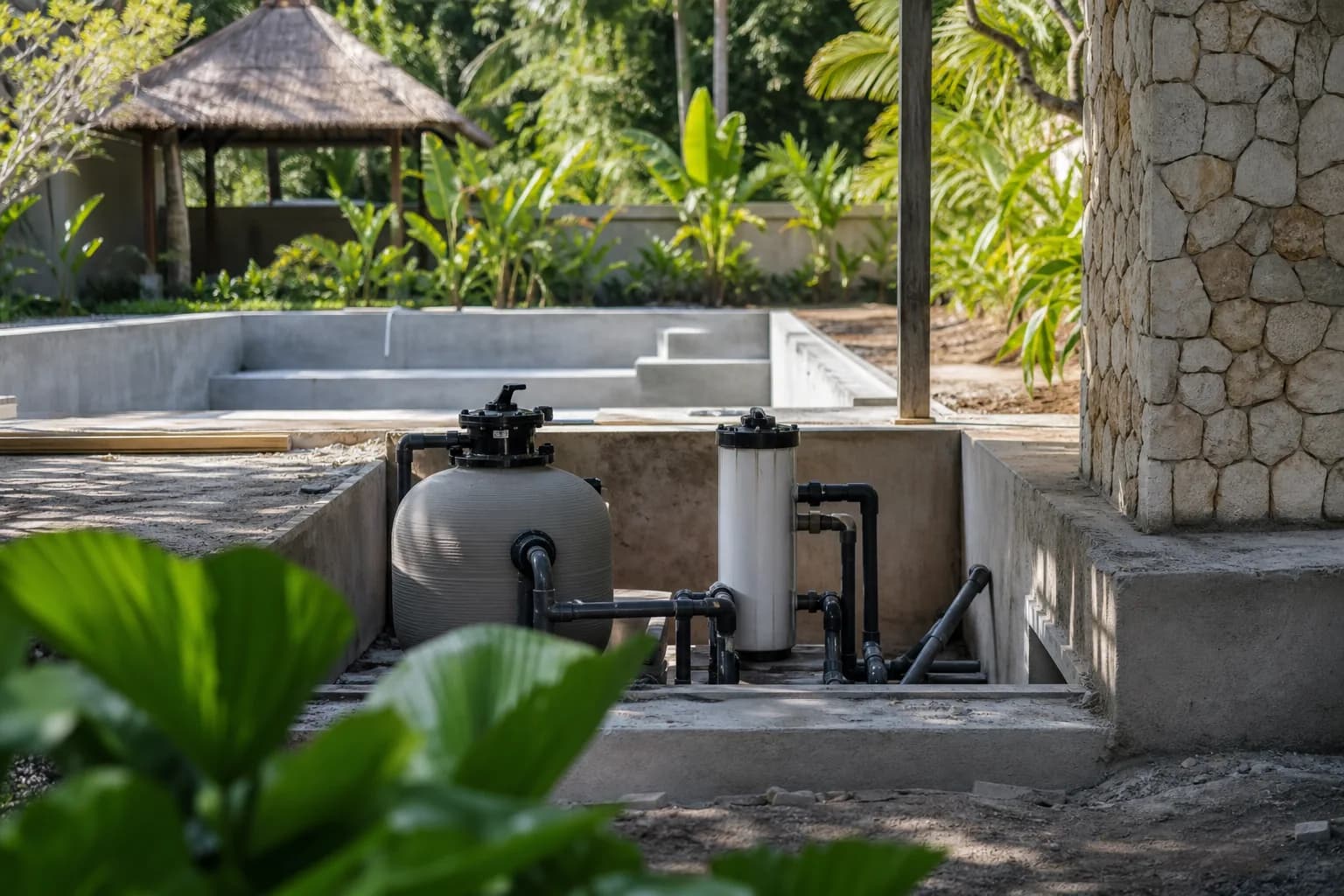
The Hidden Cost Trap in Bali Villa Pool Filter Selection
When completing MEP systems for luxury villas in Bali, developers often focus on initial equipment costs while overlooking the long-term maintenance burden that can drain operational budgets for years. The choice between cartridge and sand filtration systems represents one of the most significant recurring cost decisions in villa pool construction. In Bali’s tropical climate with high humidity, frequent rainfall, and organic debris loads, filter maintenance costs can vary by 300% over a five-year period depending on system selection. Understanding the true total cost of ownership—including water consumption, labor frequency, replacement parts, and chemical efficiency—is essential for villa construction projects targeting sustainable operational economics.
Technical Analysis: Filter Systems in Tropical Pool Environments
The fundamental difference between cartridge and sand filtration systems lies in their filtration mechanism and maintenance requirements, both of which are amplified in Bali’s unique environmental conditions. Cartridge filters use pleated polyester fabric or paper elements that trap particles as small as 10-15 microns, while sand filters rely on specially graded silica sand that captures particles down to 20-40 microns through depth filtration.
Cartridge Filter Operational Characteristics
Cartridge systems operate at lower pressure (typically 8-15 PSI) and require no backwashing, making them inherently more water-efficient. In Bali villa construction, this translates to significant savings given water costs and environmental considerations. The pleated design provides 25-50% more filtration surface area compared to equivalent-sized sand filters, resulting in longer run times between cleanings. However, Bali’s tropical environment introduces specific challenges: high organic loads from frangipani flowers, leaves, and airborne spores can clog cartridge pleats faster than in temperate climates. The constant humidity also promotes algae growth on cartridge surfaces if cleaning intervals are extended beyond recommended periods.
For villa renovation Bali projects, cartridge systems offer installation advantages in space-constrained equipment rooms. They require no drainage infrastructure for backwashing and can be positioned in tighter configurations. The typical cartridge filter for a 50-cubic-meter villa pool measures 600-800mm in diameter and 900-1200mm in height, with flow rates of 15-25 cubic meters per hour. Quality cartridge housings should be constructed from UV-resistant fiberglass or reinforced thermoplastic to withstand Bali’s intense solar exposure in outdoor installations.
Sand Filter System Dynamics
Sand filters operate through a bed of specially graded silica sand (typically 0.45-0.55mm grain size) that traps particles through mechanical straining and biological action. The sand bed depth of 600-750mm creates multiple filtration layers, with the top layer capturing larger debris and deeper layers removing finer particles. In Bali villa construction, sand filters demonstrate superior resilience to variable debris loads—a critical advantage during monsoon seasons when organic matter influx increases dramatically.
The backwashing process, while water-intensive, provides complete system cleaning that cartridge rinsing cannot match. Backwashing reverses water flow at high velocity (40-50 cubic meters per hour), expanding the sand bed by 20-30% and flushing trapped debris to waste. This process consumes 300-500 liters per backwash cycle, occurring every 4-6 weeks in typical Bali villa applications. The backwash discharge requires proper drainage infrastructure—a consideration often overlooked in finishing works Bali planning but essential for environmental compliance and site management.
Tropical Climate Impact on Filter Performance
Bali’s climate introduces specific maintenance cost factors absent in temperate regions. Average temperatures of 26-30°C accelerate biological activity in pool water, increasing filter workload. Humidity levels consistently above 75% promote algae and bacterial growth on filter media. The wet season (November-March) introduces elevated organic loads from vegetation, while the dry season concentrates mineral content through evaporation, affecting filter efficiency differently for each system type.
Cartridge filters in Bali require more frequent inspection—every 4-6 weeks versus 8-12 weeks in temperate climates—due to accelerated organic accumulation. Sand filters benefit from the tropical environment’s biological activity, as beneficial bacteria colonize the sand bed and enhance filtration through biofilm formation, though this same process can lead to channeling if backwashing is insufficient.
Installation Process for Villa Pool Filtration Systems
Site Preparation and Equipment Room Configuration
Proper installation begins during the MEP systems Bali planning phase, ideally when the pool shell is under construction. The equipment room location must provide adequate ventilation (minimum 10 air changes per hour), protection from direct rainfall, and accessibility for maintenance. For cartridge systems, allocate minimum 1.2 square meters of floor space plus 800mm clearance above the filter for cartridge removal. Sand filters require 1.5-2 square meters plus drainage infrastructure for backwash discharge.
Foundation preparation differs significantly between systems. Cartridge filters, being lighter (40-60kg when dry), can be mounted on reinforced concrete pads 100mm thick with minimal structural requirements. Sand filters, weighing 150-300kg when filled, require 150mm reinforced concrete foundations with proper load distribution. In elevated equipment rooms common in Bali villa designs, structural engineers must verify floor loading capacity—a critical step often missed in renovation projects.
Plumbing Integration and Hydraulic Design
The plumbing configuration directly impacts long-term maintenance costs through energy efficiency and system longevity. For cartridge systems, install 50-63mm PVC pressure pipe (PN16 minimum) with gradual bends (minimum 300mm radius) to minimize head loss. Position the filter after the pump with unions on both inlet and outlet for easy removal—a detail that reduces maintenance labor costs by 40% over the system’s lifetime.
Sand filter installations require multi-port valve integration, typically mounted on top of the filter vessel. The valve must be positioned for easy access with 600mm clearance for handle operation. Install a sight glass on the backwash discharge line to monitor cleaning effectiveness—this simple addition prevents incomplete backwashing that degrades filtration performance and increases chemical costs. For Bali installations, use stainless steel (316 grade) hardware for all valve components exposed to humid air; standard brass fittings corrode within 18-24 months in coastal villa locations.
Electrical and Control System Setup
Both filter types integrate with the pool pump system, but maintenance cost optimization requires proper control configuration. Install pressure gauges (0-3 bar range) on filter inlet and outlet lines with isolation valves for accurate differential pressure monitoring. This enables predictive maintenance scheduling rather than reactive cleaning, reducing labor costs by 25-30%.
For automated systems increasingly common in luxury Bali villa projects, integrate the filter pressure differential into the building management system. Set cartridge cleaning alerts at 0.5 bar differential increase; configure sand filter backwash cycles at 0.7 bar differential or weekly intervals, whichever comes first. This automation reduces the need for daily manual monitoring, a significant labor cost in villa operations.
Commissioning and Initial Operation
Proper commissioning establishes baseline performance metrics essential for maintenance cost tracking. For sand filters, perform initial backwashing for 5-7 minutes to remove sand fines and stabilize the bed. Record the clean pressure reading (typically 0.8-1.2 bar) as the baseline for future backwash scheduling. For cartridge systems, operate for 24 hours, then remove and inspect cartridges for proper seating and initial debris accumulation patterns.
Document all baseline readings, including flow rates, pressure differentials, and water chemistry parameters. This data becomes invaluable for maintenance cost analysis and system optimization over the villa’s operational lifetime.
Materials and Specifications for Bali Installations
Cartridge Filter Components
Specify cartridge elements with reinforced polyester cores and end caps—critical for Bali’s humidity. Standard paper cartridges degrade within 12-18 months; quality polyester elements last 24-36 months. For a typical 50-cubic-meter villa pool, use 4-cartridge configurations (each 185mm diameter × 500mm length) rather than single large cartridges. This allows staged replacement, reducing per-service costs and maintaining consistent filtration during partial cartridge changes.
Filter housings must be UV-stabilized fiberglass or high-density polyethylene with minimum 6mm wall thickness. Avoid acrylic housings common in budget systems—they crack within 18 months under Bali’s UV exposure. Specify stainless steel (316 grade) band clamps and hardware; aluminum corrodes rapidly in coastal environments.
Sand Filter Specifications
Use only premium-grade silica sand specifically manufactured for pool filtration, with 0.45-0.55mm grain size and silica content above 96%. Avoid river sand or construction sand—irregular grain shapes and mineral impurities reduce filtration efficiency by 40% and require replacement within 18 months versus 4-5 years for proper media.
Filter vessels should be side-mounted fiberglass construction with minimum 8mm wall thickness for installations up to 800mm diameter. For larger systems, specify top-mounted configurations with reinforced bases. Multi-port valves must be commercial-grade with Viton seals rather than standard rubber—Viton withstands chlorine exposure and maintains seal integrity 3-4 times longer, reducing leak-related maintenance costs.
Supporting Infrastructure Materials
All plumbing should use Schedule 80 PVC pressure pipe for underground runs and Schedule 40 for above-ground installations in protected equipment rooms. In finishing works Bali projects, specify UV-resistant PVC for any exposed piping—standard grey PVC degrades within 24 months under direct sunlight. Use solvent-welded joints rather than threaded connections for all permanent installations; threaded joints account for 70% of leak-related service calls in Bali villa pools.
Install isolation valves (ball valves, not gate valves) on all major components to enable maintenance without system drainage. This single specification reduces maintenance labor costs by 2-3 hours per service event.
Comprehensive Cost Breakdown for Five-Year Ownership
Initial Equipment and Installation Costs
For a standard 50-cubic-meter villa pool in Bali, cartridge filter systems cost IDR 12-18 million for quality equipment (filter housing, 4 cartridges, mounting hardware). Professional installation adds IDR 3-4.5 million including plumbing integration and commissioning. Sand filter systems cost IDR 8-12 million for equivalent capacity (filter vessel, multi-port valve, 150kg silica sand), with installation costs of IDR 4-6 million due to additional drainage infrastructure requirements.
Annual Maintenance Cost Comparison
Cartridge systems require cleaning every 6-8 weeks in Bali conditions (8-9 times annually). Professional cleaning services cost IDR 350,000-500,000 per visit, totaling IDR 2.8-4.5 million annually. Cartridge replacement every 24-30 months costs IDR 4-6 million per set. Over five years, total maintenance costs reach IDR 22-30 million including two cartridge replacements.
Sand filters require backwashing every 4-6 weeks (8-10 times annually), consuming 400 liters per cycle (3,200-4,000 liters annually). At Bali water rates of IDR 8,000-12,000 per cubic meter, water costs add IDR 25,600-48,000 annually. Professional backwashing service costs IDR 250,000-350,000 per visit (IDR 2-3.5 million annually). Sand replacement at year 4 costs IDR 2.5-3.5 million. Five-year total: IDR 13-20 million including sand replacement.
Hidden Operational Costs
Cartridge systems’ superior filtration (10-15 microns) reduces chemical consumption by 15-20% compared to sand filters, saving IDR 800,000-1.2 million annually on chlorine and pH adjusters. However, cartridge systems require more frequent pressure monitoring and cleaning, adding 2-3 hours monthly of staff time. Sand filters’ backwashing requires drainage infrastructure maintenance and periodic valve servicing (IDR 500,000-800,000 every 18-24 months).
For detailed cost estimation specific to your villa construction project, professional assessment of site conditions and operational requirements provides accurate long-term budgeting.
Common Installation and Maintenance Mistakes
Undersizing Filter Capacity
The most costly error in MEP systems Bali installations is selecting filter capacity based solely on pool volume rather than turnover rate and debris load. Bali’s tropical environment requires 20-30% oversizing compared to temperate climate recommendations. An undersized filter operates at elevated pressure continuously, reducing equipment life by 40% and increasing cleaning frequency by 50%. For villa pools, specify filters rated for 1.5 times the calculated flow rate to accommodate peak debris loads during monsoon seasons.
Inadequate Drainage Infrastructure for Sand Filters
Many villa renovation Bali projects retrofit sand filters without proper backwash drainage, leading to site flooding, erosion, and environmental violations. Backwash discharge requires dedicated drainage to appropriate disposal points—never to landscaping areas or directly to storm drains. Install a 75-100mm drainage line with minimum 2% slope to a proper discharge point. The absence of this infrastructure adds IDR 1.5-2.5 million in remedial work and potential regulatory fines.
Improper Cartridge Cleaning Techniques
Villa maintenance staff often use high-pressure washers on cartridge elements, which damages pleated fabric and reduces filtration efficie
 2144 m²11 month(s)from 104.000 USD
Narayana
 164 m²7 month(s)from 79.000 USD
Private: Haridas Villas, Tegallalang
 3104 m²11 month(s)from 99.000 USD
TALA 100

Want to calculate?
164 m²7 month(s)from 79.000 USDTALA TWO
 3124 m²6 month(s)from 123.000 USD
TALA 8
 3180 m²7 month(s)from 142.000 USD
Vasudeva
 4344 m²16 month(s)from 290.000 USD
Radha
 172 m²8 month(s)from 120.000 USD
Keshava
 3127 m²9 month(s)from 177.000 USD
Mukunda
 3173 m²6 month(s)from 125.000 USD
TALA FOUR
 1from 198.000 USD
Private: Haridas Villas
Start With Real Numbers, Not Guesses
Before buying land or finalizing a design, check the realistic build cost range for your project in Bali.
Our team reviews your inputs and gives a grounded estimate.
Available lands
 2000 m²5 min$ 738916Bali, Ungasan
 600 m²10 min$ 206897Bali, Canggu
 6000 m²10 min$ 1330049Bali, Kutuh South Bali
 1000 m²5 min$ 350431Bali, Drupadi
 2000 m²5 min$ 1440887Bali, Pecatu
 911 m²15 min$ 248217Bali, Pererenan
 2200 m²15 min$ 508005Bali, Canggu
 2115 m²5 min$ 1139547Bali, Pererenan
 1158 m²12 min$ 291996Bali, Mengwi
 3100 m²15 min$ 257697Bali, Tegallalang
 6000 m²30 min$ 55419Bali, Tabanan
 700 m²15 min$ 90517Bali, Central Bali
 1200 m²2 min$ 155172Bali, Klungkung
 5815 m²5 min$ 815740Bali, Tabanan
 420 m²15 min$ 41897Bali, Tabanan
Essential Bali build & buy guides
- Bali villa construction cost per m² in 2026
- How much will your villa cost? Calculator
- Building a villa in Bali: the complete guide
- Buying land in Bali: step-by-step for foreigners
- Bali villa investment: yields, risks, returns
- Leasehold vs freehold: what foreigners can own
- Construction defect liability & 10-year warranty
- Bali building codes and construction standards
Related guides
Integrated Furniture Fixings Hidden Brackets MEP Clearance Bali
Explore integrated furniture fixings with hidden brackets and MEP clearance in Bali. Learn installation tips, load guidance, and clean, accessible finishes.
8 min read
Epoxy Primer Moisture Barrier for Bali Interior Renovations
Explore epoxy primer and moisture barrier solutions for Bali interior renovations, delivering durable adhesion, moisture protection, and long-lasting finishes.
8 min read
Engineered Stone Countertop Fixing Support Standards Bali
Explore Bali s engineered stone countertop fixing and support standards. Installation tips, durability guidance, and compliance for lasting quality surfaces.
10 min read